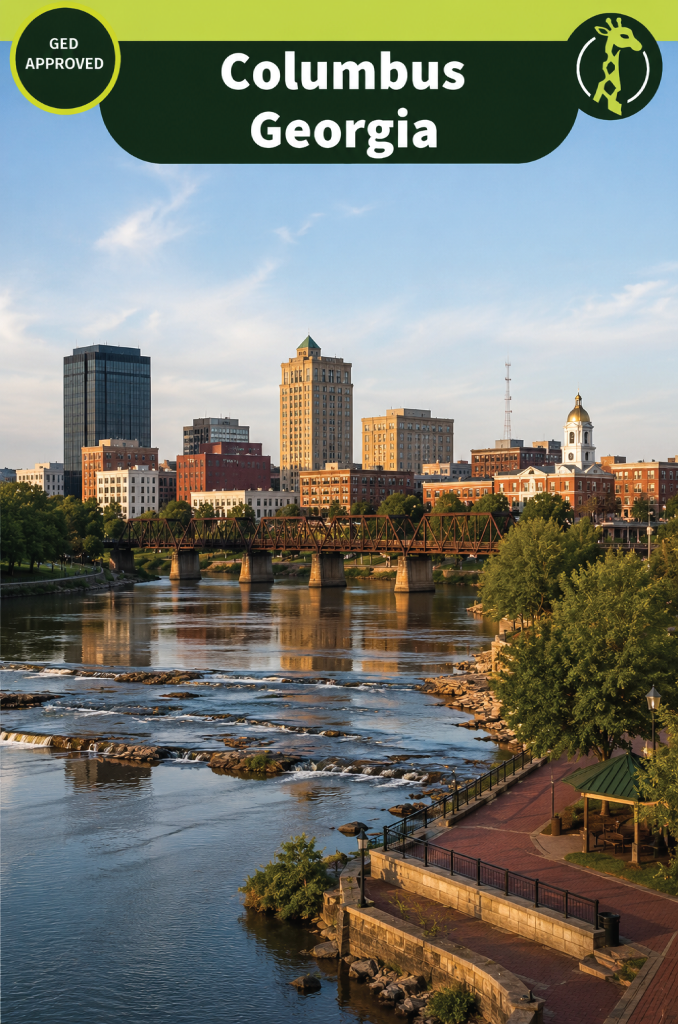
Pass the Columbus GED on your schedule, from Midtown to Cusseta.
Columbus Technical College on Manchester Expressway is the GED test site for Muscogee County, and its adult education department serves six counties around it. Georgia's HOPE grant covers up to $210 in exam fees, more than the $184 battery costs. We get you ready for the test itself.
Free diagnostic · one-time payment, never a subscription
The fast facts for taking the GED in Georgia — verify on official sources before your test date.
Georgia GED Diploma
HiSET also accepted
Available in Spanish
Facts verified May 31, 2026
Official GED test sites listed by GED Testing Service for the Columbus metro. Verify hours and seat availability on ged.com before you go.
Center listings refreshed quarterly. The official source is GED Testing Service.
Local context for prep — testing capacity, college access, statewide pricing, and the always-available online option.
Columbus Technical College on Manchester Expressway is the public GED test site for Muscogee County. Its adult education department covers a six-county service area from the same campus.
Georgia charges $46 per subject, in person or online proctored — $184 for all four. The HOPE grant covers up to $210, issued as a voucher before you test, so a qualifying Georgian can clear the whole fee.
Standard registration is 18. A 16- or 17-year-old can test after enrolling in a free state-approved adult education class for at least 40 hours, meeting the readiness score, and getting Office of Adult Education approval.
Georgia allows online proctored testing from home at the same $46 per subject. You need a passing score on the official GED Ready practice test, a webcam, and a private room.
Same prep, same lessons, wherever you are. What changes is how the program meets the realities of studying in Columbus.
Lessons run 6 to 9 minutes, which fits a break, a lunch hour, or the half hour after the kids go down. Military families here move on short notice — your plan travels with you, nothing expires, and there is no fixed class night to be in town for.
Columbus graduates move into Columbus Technical College certificates, transfer tracks toward Columbus State University, and the employers hiring across the valley — Aflac and Global Payments downtown, Piedmont Columbus Regional, and the civilian workforce at Fort Benning. Columbus Tech and Goodwill's BRIDGE program both run free classes if you want a room to sit in.
Four credentialed teachers — one per subject — answer your questions seven days a week. Median reply is under four hours. Most students study 45 minutes a day. No ticket queue, no chatbot.
Fee subsidies and free-testing programs. Confirm eligibility and current funding on the official source before you rely on one.
Up to $210 toward exam fees, lifetime limit
Georgia Lottery-funded grant covering GED exam fees for residents who meet HOPE and TCSG test-readiness standards; subject to annual appropriation.
The GED is run by GED Testing Service — a joint venture of Pearson and the American Council on Education — not a government agency. Fee and prep assistance is administered state by state, so it varies and you should confirm what your state offers — though much of the underlying adult-education funding is federal (WIOA Title II). Eligibility and funding change; always check the official source before relying on one.
Same program, same lessons, different metro. Pick another city or head back to the Georgia hub for the statewide overview.
Specific to taking the GED in Columbus. For broader course questions, see the help center or email support@twigera.com.
Columbus Technical College at 928 Manchester Expressway, Room 606, is the public GED test site for Muscogee County. Several other Columbus addresses run GED classes rather than the exam itself, and a few listings you may find online are county jail or prison programs that are not open to the public. Book your appointment through ged.com rather than the campus, and check seat availability there first — hours shift by term.
Georgia charges $46 per subject, or $184 for all four — the same price whether you test at Columbus Tech or online from home. The HOPE High School Equivalency Examination Grant covers up to $210 in exam fees for Georgians who meet HOPE requirements and the state's test-readiness standard, which can clear the full battery. It is a voucher, not a refund: you apply through your adult education program, complete the required subject-area pre-testing, and receive a voucher before you sit — the state pays the Technical College System of Georgia directly, so you never front the fee. The $210 is a lifetime limit. A discounted retake at a test center is $20 per subject.
Yes. Georgia allows online proctored testing at any Columbus address, at the same $46 per subject as the test center. You need a passing score on the official GED Ready practice test first, plus a webcam, a stable connection, and a private room where nobody will interrupt you. That practice-test requirement applies only to online testing — walk into Columbus Tech and it does not apply. One trade-off: discounted retakes are not offered on the online exam.
Yes. Georgia lets you take the test in English, Spanish, or a combination across the four subjects — math in Spanish and language arts in English is allowed if that is how you think. Twigera's prep is in English, and we suggest testing each subject in whichever language you read fastest. The Georgia GED Diploma issued is identical regardless of which language you tested in.
Yes. Columbus Technical College and Columbus State University both treat the Georgia GED Diploma as equivalent to a high school diploma for admission, as does every other public institution in the state. Columbus Tech is the usual first stop — medical assisting, industrial systems, welding, and early childhood certificates all open up once you hold the credential, and credits can transfer toward a Columbus State degree later.
Yes. Columbus Tech's adult education department, on the first floor of the campus library building, runs free classes across a six-county service area. Goodwill Industries of the Southern Rivers runs its BRIDGE program on Cross Country Drive, and Christian Women's Job Corps and Asbury Methodist Church offer preparation too. The classes are free; the exam still costs $184 unless the HOPE grant covers it. A classroom gives you structure, and our adaptive practice targets the subjects actually losing you points.
Most Columbus students who study consistently for 45 to 60 minutes a day are test-ready in 8 to 14 weeks. Your day-one diagnostic shows which of the four subjects actually need the hours, and the plan adapts from there. There is no minimum preparation time in Georgia — you sit each subject when you are ready, in any order, and your passing scores are held until the set is complete.
Eight to fourteen weeks of steady study and one morning at Columbus Tech on Manchester Expressway — that is the whole path for most students here, and the HOPE grant may cover the fee. Start with the free diagnostic and we will show you which subjects need the work.