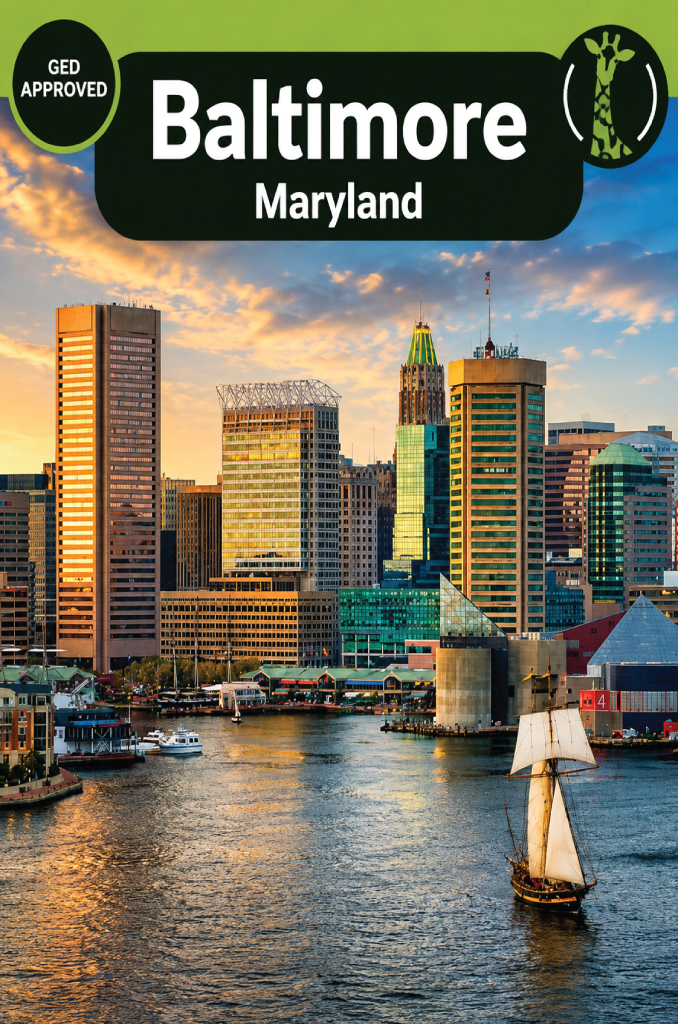
Pass the Baltimore GED on your schedule, from Cherry Hill to Hampden.
Maryland takes $21.75 off every first attempt, which drops the whole four-subject test to $57 — the cheapest GED in the country. You apply the state voucher code at checkout. Baltimore has three test centers, and we get you ready for all four subjects before you spend a dollar.
Free diagnostic · one-time payment, never a subscription
The fast facts for taking the GED in Maryland — verify on official sources before your test date.
Maryland High School Diploma
Available in Spanish
Facts verified May 31, 2026
Official GED test sites listed by GED Testing Service for the Baltimore metro. Verify hours and seat availability on ged.com before you go.
Center listings refreshed quarterly. The official source is GED Testing Service.
Local context for prep — testing capacity, college access, statewide pricing, and the always-available online option.
Maryland subsidises first attempts by $21.75 a subject, cutting the fee from $36 to $14.25 and the full four-subject battery from $144 to $57. Apply voucher code MDGED2175 at checkout.
The Power Plant center on South Frederick Street downtown, plus the Community College of Baltimore County's Dundalk and Essex campuses. All three give all four subtests.
Fail a subject and the first retake at a test center is $10. A second retake goes back to the full $36, then the cycle repeats. The state subsidy covers first attempts only, not retests.
You must be 18 to test without paperwork. A 16- or 17-year-old can test with proof of legal withdrawal from school or a Maryland home instruction verification form, approved before registering.
Maryland allows online proctored testing at the same subsidised $14.25 per subject. You need a green score on GED Ready taken within the 60 days before you test.
Same prep, same lessons, wherever you are. What changes is how the program meets the realities of studying in Baltimore.
Lessons run 6 to 9 minutes, which fits a break, a Light RailLink ride, or the half hour after the kids go down. Hospital and port shifts here rotate — nothing in your plan expires, and there is no fixed class night to cross the Beltway for.
Baltimore graduates move into Baltimore City Community College and CCBC certificates, transfer tracks toward Morgan State, Coppin State and UMBC, and the roles that gate on a diploma across the city — support and patient-transport work at Johns Hopkins, the University of Maryland Medical System and MedStar, plus logistics at the Port of Baltimore. A dozen neighbourhood centers run free classes.
Four credentialed teachers — one per subject — built the lessons and practice you work through. Most students study 45 minutes a day.
Fee subsidies and free-testing programs. Confirm eligibility and current funding on the official source before you rely on one.
$21.75 off per subject, first attempt
Reduces the per-subject fee to $14.25 at a test center or online; retests are not subsidized.
The GED is run by GED Testing Service — a joint venture of Pearson and the American Council on Education — not a government agency. Fee and prep assistance is administered state by state, so it varies and you should confirm what your state offers — though much of the underlying adult-education funding is federal (WIOA Title II). Eligibility and funding change; always check the official source before relying on one.
Same program, same lessons, different metro. Pick another city or head back to the Maryland hub for the statewide overview.
Specific to taking the GED in Baltimore. For broader course questions, see the help center or email support@twigera.com.
Three centers administer all four GED subtests: the Power Plant center at 3 South Frederick Street downtown, and the Community College of Baltimore County's Dundalk campus on Sollers Point Road and Essex campus on Rossville Boulevard. A dozen other Baltimore addresses run GED classes rather than the exam, and several listings are state correctional facilities not open to the public. Book through ged.com and confirm availability before you travel.
Less than almost anywhere in the country. Maryland subsidises first attempts by $21.75 per subject, so instead of $36 you pay $14.25 — $57 for all four rather than $144. You apply the state voucher code MDGED2175 at checkout on ged.com; the discount is not automatic, so do not skip that step. Fail a subject and the first retake is $10, though the subsidy covers first attempts only, so a second retake returns to $36.
Yes. Maryland requires proof of residency, and specifically asks for a current Maryland MVA-issued driver's license, learner's permit or state ID at the testing center. An out-of-state license will not get you seated, so if you have recently moved to Baltimore, get the MVA paperwork done before you book. Expired IDs are not accepted, and the name must match your ged.com account.
Yes, at the same subsidised $14.25 per subject as a test center. Maryland asks for a green, likely-to-pass score on the official GED Ready practice test taken within the 60 days before you sit the real thing — an older green score will not do. You also need a webcam, a stable connection, and a private room. One catch: discounted retakes are not offered on the online exam, so a borderline subject is cheaper to sit in person.
Yes. Maryland lets you test in English or Spanish and lets you combine the two languages across the four subjects, so math in Spanish and language arts in English is allowed if that is how you think. Twigera's prep is in English, and we suggest sitting each subject in whichever language you read fastest. The Maryland High School Diploma issued is identical regardless of language.
Yes. Baltimore City Community College, the Community College of Baltimore County, Morgan State University, Coppin State University, Towson University and UMBC all treat the Maryland High School Diploma as equivalent to a traditional high school diploma for admission. BCCC and CCBC are the usual first stops — nursing assistant, HVAC, early childhood and IT certificates all open up once you hold the credential, and those credits transfer onward.
Yes, about a dozen. The South Baltimore Learning Center on East Ostend Street, the Baltimore Adult Learning Center on East Biddle Street, the Center for Urban Families on North Monroe Street, Living Classrooms' POWER House on South Caroline Street, the Franciscan Center, Julie Community Center and Baltimore Healthy Start all run free preparation. None administer the exam. Classes are free, and with the state subsidy the test itself is only $57.
Most Baltimore students who study consistently for 45 to 60 minutes a day are test-ready in 8 to 14 weeks. Your day-one diagnostic shows which of the four subjects actually need the hours, and the plan adapts from there. Maryland sets no minimum preparation time — you sit each subject when you are ready, in any order, and your passing scores are held until all four are done.
Eight to fourteen weeks of steady study, a voucher code that brings all four subjects to $57, and a morning at the Power Plant center or CCBC. Start with the free diagnostic and we will show you which subjects actually need the work.