GED Accommodations 2026: ADHD, Dyslexia & Disability Help
Honest 2026 walkthrough of GED accommodations — who qualifies, what supports are approved, how the 30-day ARS review works, and where to get a free or low-cost evaluation if you do not have current documentation.
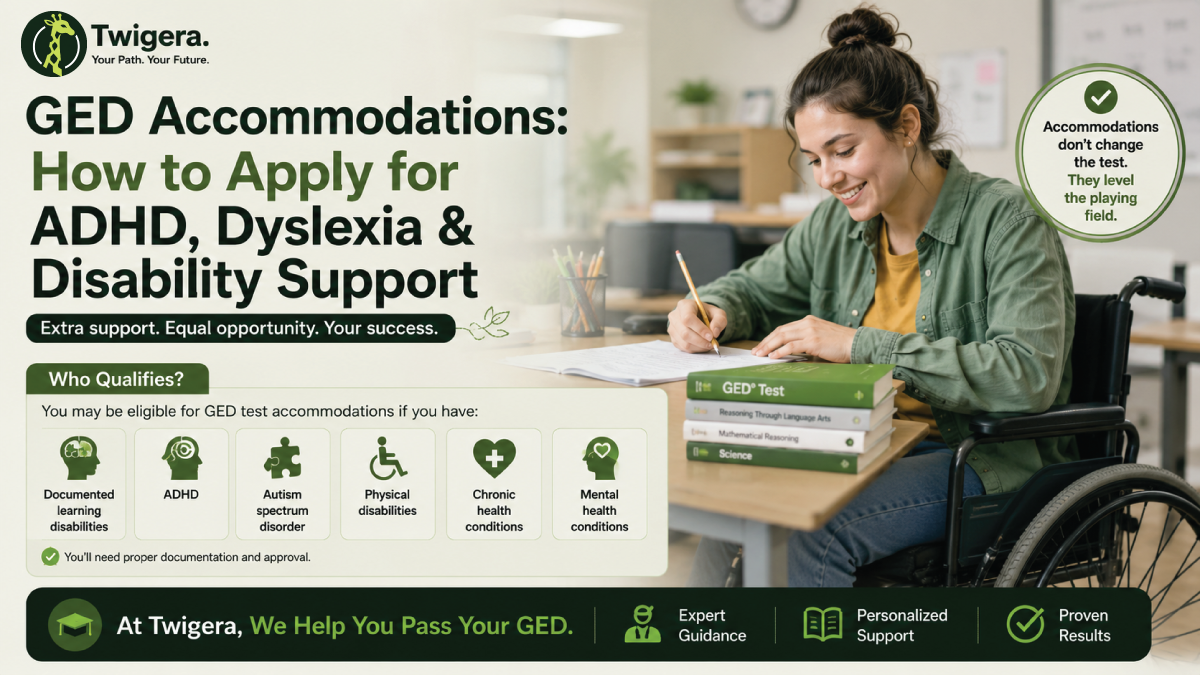
Yes, you can get accommodations for the GED. The test is governed by the ADA, so GED Testing Service is required to provide reasonable accommodations — extra time, separate rooms, scribes, screen readers, sign language interpreters, and more — for documented disabilities. Apply through the Accommodations Request System (ARS) on ged.com about 30 days before scheduling. It is free beyond the standard test fee.
Last reviewed
Are you trying to find out whether GED accommodations apply to ADHD, dyslexia, autism, a learning disability, or a chronic health condition? You deserve clear answers before you register, submit forms, or walk into a test without the support you need.
The GED test is administered in over 100 countries, with more than 3,200 official testing centers in the US and worldwide, according to GED Testing Service. That means getting the right support before test day matters. In a decade teaching adult learners, the ARS application was the most under-used support I saw — students who started it 30 days early walked into the test with the environment they needed, not the standard one. This guide explains how GED accommodations work, who qualifies, what supports are approved, and what to do before scheduling your test.
Quick Answer: Are GED Accommodations Available?
Yes. GED accommodations are available for test-takers with documented disabilities. The GED is protected under the Americans with Disabilities Act (ADA) and the ADA Amendments Act (ADAA), and GED Testing Service reviews each request case by case. You apply through the Accommodations Request System (ARS) on ged.com. Requests typically take about 30 days after submission.
Question
Answer
Are accommodations available?
Yes — for eligible test-takers with documented disabilities.
Who qualifies?
People with documented learning disabilities, ADHD, autism, physical disabilities, chronic health conditions, or mental health conditions.
What support is available?
Extra time, separate testing room, extra breaks, readers, scribes, sign language interpreters, screen readers, and other approved supports.
Do accommodations cost extra?
No. There is no extra fee beyond the standard GED test cost.
How long does the review take?
About 30 days in most cases.
Where do you apply?
Through ARS, the Accommodations Request System on ged.com.
Who Qualifies for GED Accommodations?
You qualify for GED accommodations when you have a documented disability or health condition that affects how you take a standardized test. The goal is fair access — not an easier version of the exam. Learning and attention differences are common: the CDC reports that 7.1 million US children ages 3 to 17 — about 1 in 9 have received an ADHD diagnosis. That is part of why clear access to GED testing accommodations matters for adult test-takers too. For the basics of what the GED actually is and how it is scored, see our what is a GED guide.
Learning disabilities
Learning disabilities affect reading, writing, math, listening, or processing. Common examples include dyslexia, dyscalculia, dysgraphia, and auditory processing disorder. Dyslexia affects reading, dyscalculia affects math, and dysgraphia affects writing. For this type of GED disability request, you usually need a current psychoeducational evaluation that explains the diagnosis, testing limits, and recommended support.
ADHD and ADD
ADHD or ADD affects attention, focus, pacing, and impulse control during testing. Common accommodations include extra time, a separate testing room, and scheduled breaks. Documentation should come from a psychiatrist, psychologist, or qualified medical doctor and should explain how ADHD affects your testing and which GED accommodations you need.
Autism spectrum disorder
GED accommodations for autism support learners whose sensory needs, focus, timing, communication, or testing environment affects performance. Common supports include a separate room, sensory-related accommodations, breaks, or extra time. You usually need a clinical autism diagnosis, and the documentation should explain how autism affects test-taking and why the requested support is needed.
Physical disabilities
Physical disabilities affect movement, vision, hearing, sitting, typing, or reading test materials. This includes mobility disabilities, low vision, blindness, deafness, or being hard of hearing. Accommodations may include adaptive equipment, large print, Braille, screen tools, sign language support, or an adjusted testing setup. Documentation should come from a qualified provider familiar with your condition.
Chronic health conditions
Chronic health conditions such as diabetes, epilepsy, cancer treatment, or other medical needs qualify when they affect test-taking. Some learners need time for medication, insulin, rest, food, monitoring, or recovery from symptoms. Common supports include medication breaks, insulin breaks, extended breaks, or other approved health-related testing adjustments.
Mental health conditions
Severe anxiety, post-traumatic stress disorder, and severe depression qualify when properly documented and functionally limiting. The key is not the diagnosis alone, but how the condition affects your ability to take the GED fairly. Common accommodations include a separate room, extra breaks, or other supports tied to the documented need. A licensed mental health professional should explain the diagnosis, limits, and recommended accommodation.
What Accommodations Are Available?
GED Testing Service offers different supports based on your documented need. The support you receive depends on how your disability or health condition affects testing, so your paperwork should clearly connect your diagnosis to the accommodation requested.
Accommodation
What it means
Common for
Extended time (50% or 100%)
More time to complete each subject test
ADHD, learning disabilities, processing disorders
Separate or private room
Test in a quieter room with a proctor
Autism, anxiety, ADHD, sensory sensitivities
Extended breaks
Longer breaks between sections
Chronic health conditions, ADHD, fatigue
Scheduled medication breaks
Time to pause for medication, insulin, or health needs
Diabetes, epilepsy, anxiety medication
Reader or scribe
Trained person reads content or records answers
Visual impairments, severe dysgraphia
Sign language interpreter
Interpreter assists with approved communication needs
Deaf or hard-of-hearing test-takers
Screen magnification
Larger on-screen text for easier reading
Low vision
Screen reader software
Software reads approved test content aloud
Blindness, severe dyslexia
Large print or Braille
Materials provided in accessible formats
Vision impairments
Adaptive keyboard / service animal
Specialized input equipment or approved service animal
Motor impairments / various
Save for later
Pin this guide so you can find it again.
We refresh these every season. Save it to a Pinterest board and you’ll get the latest version next time you come back.
About 150,000 GED graduates earn the credential in the US each year, according to GED Testing Service. That number is a reminder to start your GED accommodations request early so paperwork does not delay your test plan.
1. Create or log into your ged.com account
Start by creating a ged.com account or logging into your existing account. This is where the official accommodation process begins.
2. Submit your request through ARS
Use the Accommodations Request System (ARS) before choosing a test date. Approvals are not instant, so apply before scheduling.
3. Gather your documentation
Your documents should explain your condition and why testing support is needed. For GED accommodations for ADHD, this typically includes a diagnosis from a psychiatrist, psychologist, or qualified medical doctor. For GED accommodations for learning disabilities, you usually need a current psychoeducational evaluation that explains the specific disability — dyslexia, dyscalculia, or dysgraphia.
Requirement
What GED Testing Service needs to see
Recent evaluation
Often within the past five years
Qualified provider
Psychologist, psychiatrist, MD, neurologist, or condition-specific professional
Specific diagnosis
Current terms such as DSM-5 or ICD-11
Functional limits
How the condition affects testing
Recommended support
The exact accommodations requested and why they are needed
An IEP or 504 Plan from school helps support your request, but for adults it is usually not enough on its own.
4. Upload your documents through ARS
Submit your forms and professional documentation through the ARS portal. Check every file for clarity before sending.
5. Wait for review
GED Testing Service says accommodation requests typically take about 30 days to review. Complex requests or missing documents take longer.
6. Read the decision carefully
You might receive an approval, partial approval, or denial. A partial approval means some supports were approved while others were not.
7. Schedule your test after approval
If approved, schedule at a participating Pearson VUE center. Some accommodations are not available through online-proctored GED testing. For details on locations, see our where can I take the GED guide.
8. Appeal if denied
If denied, you have the right to appeal or submit stronger documentation. Most issues come from missing, outdated, or unclear paperwork.
Free and Low-Cost Evaluation Resources
Private evaluations often cost $500 to $2,000, which stops many learners from applying. If you need documentation for GED accommodations and do not have current records, start with these lower-cost paths.
State vocational rehabilitation — every state has a voc rehab agency that may fund evaluations for adults pursuing education tied to work. Search your state website for "vocational rehabilitation disability evaluation."
University training clinics — psychology graduate programs often run clinics with supervised evaluations from $0 to $200. Search "psychology clinic" or "psychoeducational assessment clinic" near you.
Public mental health centers — sliding-scale fees based on income. Some help with learning, attention, or mental health evaluations.
Community college disability services — if you are in adult education or community college, ask disability services to point you toward local evaluation options.
Health insurance — some plans cover part of an evaluation when it is tied to diagnosis or treatment. Call your insurer first.
Schools for younger candidates — if you are 17 to 21 and recently attended school, ask your former district about transition-related evaluations.
Specific Disability Walkthroughs
GED accommodations for ADHD
GED ADHD accommodations often include 50% extra time, a separate room, or scheduled breaks. Documentation may include a psychiatrist or psychologist evaluation, treatment records, or a qualified medical provider report. GED Testing Service does not publish approval rates by condition, but clear documentation usually gives your request a stronger foundation.
GED accommodations for dyslexia
For dyslexia, you usually need a psychoeducational evaluation showing a specific reading disorder. Common supports include extra time, screen reader access, or a reader / scribe option. A strong evaluation should explain reading fluency, decoding, and phonological processing.
GED accommodations for dyscalculia
Your documentation should show a math-specific learning disability. Common supports include extra time on Mathematical Reasoning and approved scratch paper. Make sure the evaluation includes math-related cognitive testing.
GED accommodations for autism
GED special accommodations for autism may include a separate room, breaks, or sensory-related support. Your documentation should include a clinical ASD diagnosis and explain any sensory, focus, or communication needs.
Common Reasons Applications Are Denied
A denied request does not always mean you are ineligible. Most denials happen because the paperwork does not clearly prove the need for support. Common reasons include:
Outdated documentation — often more than five years old
Missing explanation of how the disability affects testing
Vague recommendations such as "extra help needed"
No specific diagnosis listed
Submitting only an IEP or 504 Plan without an adult evaluation
Documentation from someone not qualified to diagnose the condition
Requested support not matching the documented disability
If your request is denied, read the reason carefully. You have the right to appeal, submit updated records, or ask for reconsideration with stronger documentation. If you have already taken the GED and need to retake a section, see our can you retake the GED guide for the retake rules.
Online-Proctored vs Test Center Accommodations
Online-proctored GED testing supports some accommodations — extra time and approved breaks usually work. But not every support fits a remote testing setup. Scribes, sign language interpreters, certain adaptive equipment, large print, and Braille typically require an in-person Pearson VUE test center. Before you book, check with GED Testing Service to confirm the format fits your approved accommodation, so you do not have to reschedule. For more on the online testing option, see our how to get your GED online guide.
Does Earning a GED Affect Disability Benefits?
Earning a GED does not, by itself, affect SSDI or SSI benefits. The part that may affect benefits is work income after you earn the credential. The Social Security Administration Ticket to Work program supports disability beneficiaries ages 18 to 64 who want to work, and WIPA projects offer free benefits counseling on how work affects benefits. This is a benefits-counseling question, not a GED Testing Service question — speak with a free WIPA counselor before making work or income decisions tied to your credential.
The Bottom Line
GED accommodations are your legal right under the ADA when a documented disability affects test-taking. Apply through ARS on ged.com before scheduling your test, since the review process usually takes about 30 days. Approved accommodations cost $0 extra beyond the standard GED test fee. If you do not have current documentation, look into state vocational rehabilitation, university clinics, public mental health centers, or community college disability services. Do not feel embarrassed about asking for support — this process exists to help you test fairly.
Frequently asked
Questions people ask.
Can I get accommodations for the GED if I have ADHD?
ShowHide
Yes. ADHD is one of the most common conditions for which the GED grants accommodations. You will need documentation from a psychiatrist, psychologist, or qualified medical doctor that includes a current diagnosis using DSM-5 or ICD-11 terms, a description of functional limitations during testing, and specific accommodation recommendations. Common ADHD accommodations: 50% extra time, separate testing room, scheduled breaks. Apply through the Accommodations Request System (ARS) on ged.com before scheduling your test.
How do I get a GED if I have a learning disability?
ShowHide
Apply for accommodations through the Accommodations Request System on ged.com before scheduling your test. You will need a current professional psychoeducational evaluation — typically within the past five years. Free or low-cost evaluations are available through state vocational rehabilitation agencies, university psychology training clinics, and public mental health centers if you do not have current documentation. A childhood IEP or 504 Plan alone is usually not enough for adult test-takers.
Are GED accommodations free?
ShowHide
Yes. There is no additional fee for accommodations beyond the standard GED test cost (about $144 for all four subjects in most US states for 2026). The only cost some applicants face is for the supporting documentation if they need a new professional evaluation — and there are free or low-cost evaluation options, including state voc rehab, university clinics, and public mental health centers.
How long does GED accommodation approval take?
ShowHide
Typically 30 days from submitting your complete request, according to GED Testing Service. Complex requests or those needing additional documentation can take longer. Start the accommodation process before you schedule your test — do not try to work backwards from a fixed test date, because if review runs long you may have to reschedule. Submit through ARS as soon as your documentation is ready.
What documentation do I need for GED accommodations?
ShowHide
A recent professional evaluation — usually within the past five years — from a qualified provider: psychologist, psychiatrist, MD, or neurologist depending on the condition. It must include a specific diagnosis using DSM-5 or ICD-11 terms, a clear description of functional limitations during testing, and specific accommodation recommendations tied to those limitations. Childhood IEPs alone are usually not sufficient for adult test-takers; you typically need an adult evaluation.
What accommodations can I get for the GED?
ShowHide
Available accommodations include extended time (typically 50% additional, sometimes 100%), separate or private testing room, extended breaks, scheduled medication breaks, scribes, readers, sign language interpreters, screen magnification, screen reader software, large print, Braille materials, adaptive keyboards, service animal accommodation, and closed captioning. The specific accommodations approved depend on how your documented disability affects testing.
Can I take the GED online with accommodations?
ShowHide
Some accommodations are supported on the online-proctored GED — extra time and approved breaks usually work. Others — in-person scribes, sign language interpreters, certain adaptive equipment, large print, Braille — require taking the test at an in-person Pearson VUE test center. Before you book, confirm with GED Testing Service that your approved accommodation fits the format you want; scheduling the wrong format can force a reschedule.
What if my GED accommodations application is denied?
ShowHide
You have the right to appeal. Most denials come from documentation issues — outdated records, vague recommendations, missing functional limitation descriptions, or paperwork from a provider not qualified to diagnose the specific condition — rather than ineligibility. Read the denial reason carefully, gather updated or more detailed documentation, and resubmit. LDA America (Learning Disabilities Association of America) and IncludeNYC offer guidance on appeals.
Will getting a GED affect my Social Security disability benefits?
ShowHide
Earning a GED itself does not affect SSDI or SSI benefits. It is work and earned income after the credential that may affect benefits, depending on amount and your specific situation. The Social Security Administration Ticket to Work program lets SSI and SSDI beneficiaries try working without immediate benefit loss. Consult a free Work Incentives Planning and Assistance (WIPA) counselor before making work or income decisions tied to your credential.
Amara is the editor at Twigera. She came to publishing the long way — a decade teaching the GED in community colleges and adult-learning centers, where she watched students pass not on talent or time, but on the strength of a study plan they actually trusted. Now she shapes the guides students read here for the parent studying after a closing shift, the second-career welder, the grandmother finishing what she started forty years ago. Expect honest timelines, math made survivable, and study plans built around real life — not around a textbook's idea of one.
Enjoyed this?
Take the next step — start today.
Our online GED course includes every subject, a free 30-minute diagnostic, and a 7-day refund on every plan.