GED Language Arts Study Guide 2026: Grammar, Reading & Essay
The six grammar patterns worth knowing, a reading method that works under time pressure, argument analysis, Extended Response planning, and a one-page review sheet you can keep beside your practice questions.
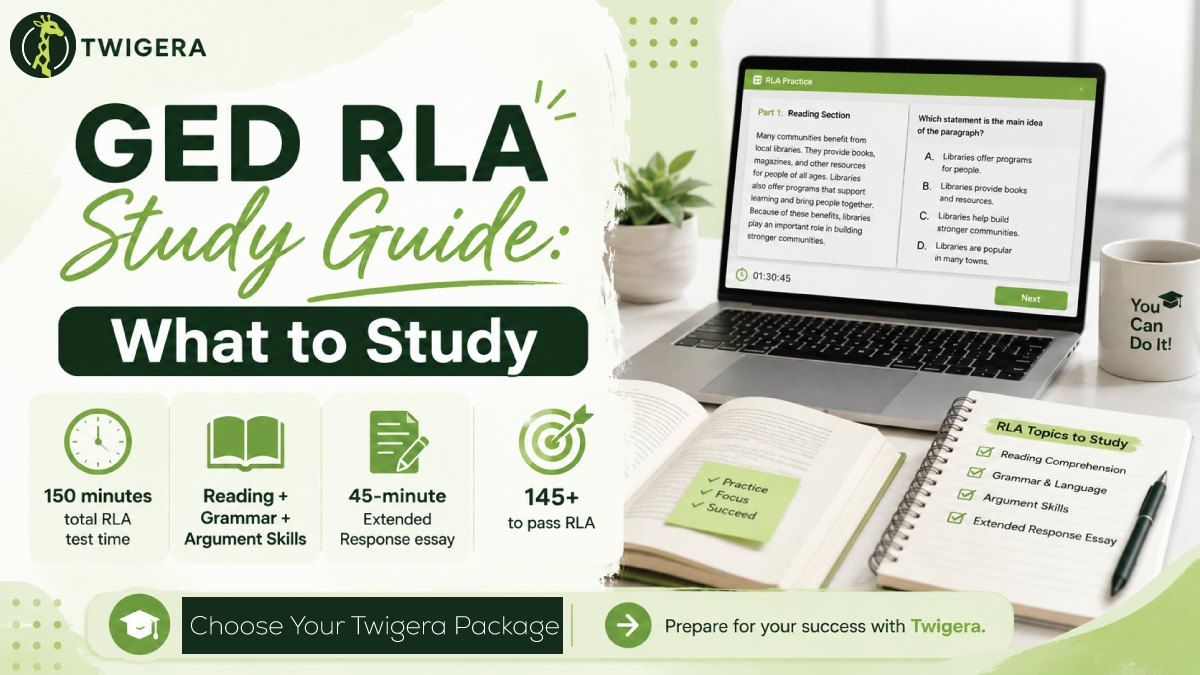
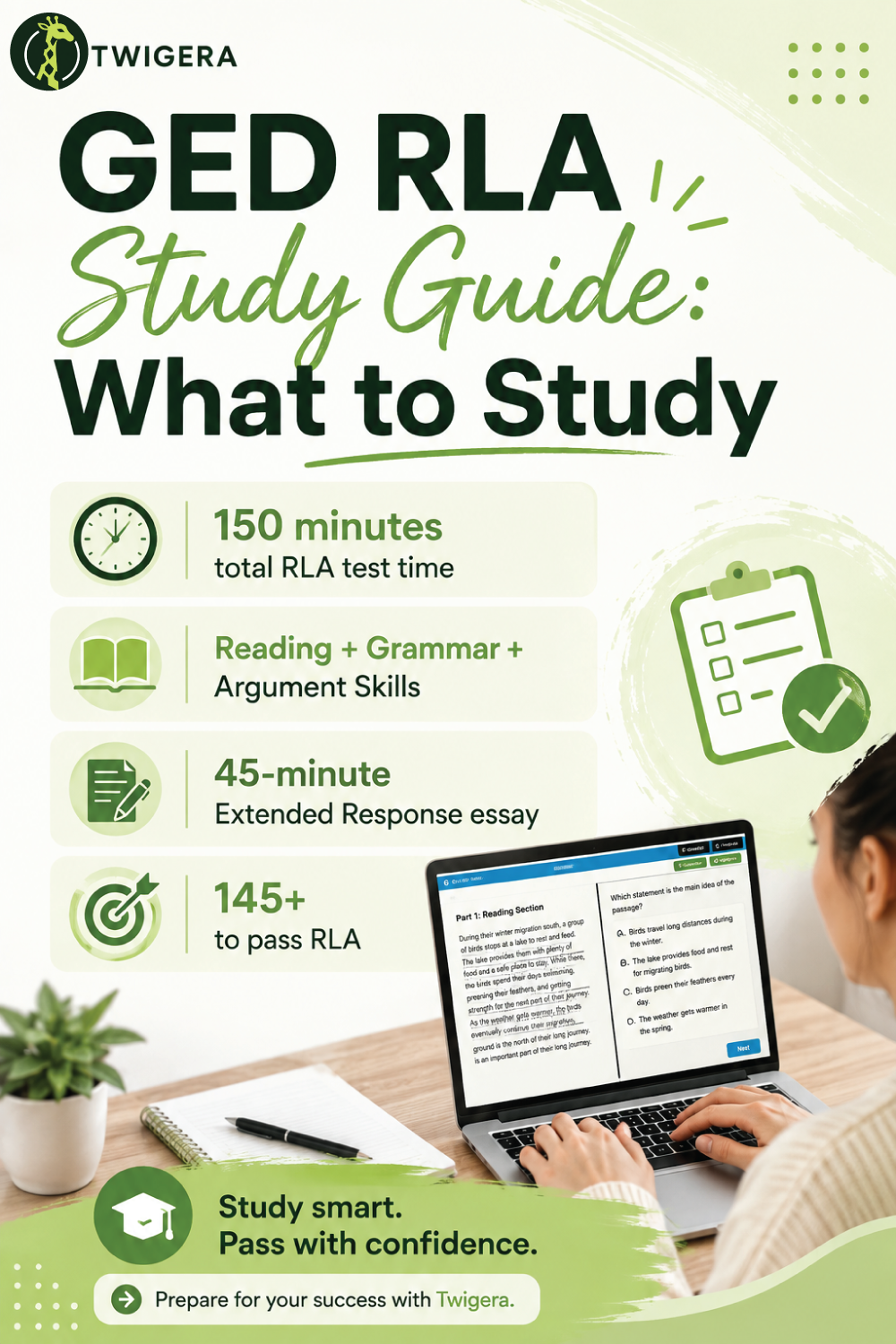
A GED language arts study guide should tell you what to review and what to do after you miss a question. Focus on four areas: reading for meaning, argument analysis, grammar and language, and the Extended Response. The RLA test runs 150 minutes across three sections, and you need 145 to pass. Review the six repeating grammar patterns, then practice rather than memorize.
Last reviewed
RLA is one of the most underestimated GED subjects. You may already read and write every day, but the test asks you to apply those skills under strict time limits and across question types you have probably never seen. A useful GED language arts study guide should show you what to study, how to approach the questions, and what to do after you miss one — not just restate the rules of English.
The GED RLA test takes 150 minutes across three sections, with a 10-minute break between parts 2 and 3 and 45 minutes allocated to the Extended Response, according to the official GED test subjects page. To reach the 145 passing score, focus on four areas: reading comprehension, grammar and language, argument analysis, and evidence-based writing. This guide gives you the core notes for each, plus a review sheet you can keep beside your practice questions.
What Does the GED RLA Test Cover?
The GED organizes RLA around three major areas: Reading for Meaning, Identifying and Creating Arguments, and Grammar and Language. The test uses literary and informational passages and asks you to understand ideas, draw conclusions, analyze relationships, evaluate arguments, and edit written language. It also includes one Extended Response. In practice it helps to treat your preparation as four connected skills rather than three sections, because the essay draws on all of them at once.
Area
What to study
Reading
Main idea, details, inference, purpose, tone, organization
Argument analysis, evidence, organization, language
One thing worth internalizing early: RLA is not a memorization test. You need to understand what you read, draw conclusions, write clearly, and apply grammar in context. That changes how you should study — reading a rule list five times does far less for your score than working through questions and diagnosing why a wrong answer attracted you.
GED Grammar Study Guide: Six Patterns to Master
Grammar questions get easier when you recognize the error type instead of rereading the sentence over and over. Six patterns cover most of what the test asks. Use this as a GED grammar study guide recap — each pattern below is the one-line version plus the trap that catches people.
Subject-verb agreement. "The list of assignments is on the desk," not "are." The subject is list, not assignments — words sitting between the subject and verb are there to distract you.
Commas. "After finishing the practice test, Maria reviewed her answers." Do not add a comma just because you would pause. Watch for comma splices: "The passage was difficult, I read it again" needs a "so."
Pronouns. "When James spoke to Daniel, he seemed worried" — who was worried? If two people could match the pronoun, the sentence needs the name.
Modifiers. "Walking through the library, the loud music distracted Maya" says the music was walking. Check who is actually performing the action in the opening phrase.
Sentence vs. fragment. "Because the students needed more time" is not a sentence. Words like because, although, while, and when signal a clause that still needs a main idea attached.
Parallel structure. "The course helps students read, write, and analyze" — not "read, writing, and analyze." When you see a list, compare the grammatical form of each item.
If you want each pattern worked through at length, with the question formats they show up in and the timing strategy that surrounds them, our guide on how to pass the GED Language Arts takes them apart one at a time. This page keeps them short on purpose so the recap stays usable as a review sheet.
Quick Grammar Check
When reviewing any sentence on the test, run these six questions in order. They convert the patterns above into something you actively do rather than something you reread.
What is the subject?
What is the main verb?
Are the clauses complete?
Do the pronouns clearly refer to something?
Does each modifier describe the right word?
Do items in a list follow the same structure?
Save for later
Pin this guide so you can find it again.
We refresh these every season. Save it to a Pinterest board and you’ll get the latest version next time you come back.
Reading questions test what you can determine from a passage, not how much you already know about its topic. That distinction matters more than it sounds: the most common way to lose reading points is answering from general knowledge instead of from the text in front of you.
Find the Main Idea
The main idea is the central point of the passage. Ask what the passage is mainly saying about its topic. Do not choose an answer just because it appears in the passage — a specific fact can be perfectly true and still be too narrow to be the main idea.
Public libraries have expanded their services beyond lending books. Many now provide internet access, career workshops, digital resources, and community programs. These services allow libraries to support residents who need information, technology, or educational opportunities.
Main idea: libraries now provide a wider range of services that support their communities. "Libraries provide internet access" is a supporting detail — true, but not the point of the passage.
Find Supporting Details
Supporting details explain, develop, or provide evidence for the main idea. When a question asks which detail supports an idea, do not pick the option that merely mentions the same subject. Ask how the detail supports the point. The strongest answer connects directly to the claim.
Make an Inference
An inference is a conclusion supported by information in the passage: evidence plus reasoning. Take this one — "Marcus checked the train schedule three times before leaving home. He also packed an umbrella after looking through the window at the dark clouds." You can infer that Marcus expects conditions that could affect his trip. You cannot conclude that he always checks the weather, or that he dislikes rain. The passage does not support either. Inference questions are where confident readers lose points, because a reasonable-sounding conclusion is not the same as a supported one.
Purpose, Tone, and Organization
Ask why the author wrote the passage — to inform, explain, describe, compare, argue, or persuade. Then notice how the ideas are arranged: cause and effect, comparison, problem and solution, sequence, description, or claim and evidence. Transitions give the structure away. "However" usually signals contrast, "therefore" a conclusion, "for example" supporting information, and "as a result" cause and effect.
Read the Question Before the Passage
Train yourself to look at the question before reading the passage closely. This gives your reading a purpose. If the question asks for the main idea, you track the overall point. If it asks for evidence, you watch for details supporting a claim. If it asks for vocabulary in context, you look for the surrounding words that define it. This is not about rushing — it is about knowing what you are looking for before you start looking.
How to Analyze Arguments on the GED
Argument questions ask you to examine how a writer supports a position. Start with three things every time: the claim (what does the author want you to believe), the evidence (what facts, examples, or information do they use), and the reasoning (how does that evidence actually support the claim). Most wrong answers fail on the third one.
A school administrator argues that the school should open its library for two additional hours each evening. She points to attendance records showing that students frequently use the library during the final hour before closing and notes that many students cannot arrive earlier because of work or transportation schedules.
Claim: extend library hours. Evidence: students use the library near closing time, and some cannot arrive earlier. Reasoning: additional evening hours would reach students who currently have limited access. When comparing two arguments, do not choose the one you personally agree with — compare the evidence.
Is the evidence relevant?
Does it actually support the claim?
Is enough evidence provided?
Does the author address an opposing position?
Does the reasoning connect the evidence to the conclusion?
Prepare for the Extended Response
The Extended Response is not a personal-opinion essay. You read two passages, analyze the arguments, decide which position has stronger support, and build your response around evidence from the texts. GED materials specifically instruct students to analyze the arguments, use evidence from the passages, explain how that evidence supports the argument, and avoid summarizing or offering an unsupported opinion. Our full walkthrough of the GED Extended Response essay breaks the scoring traits down with sample essays.
Use your 45 minutes in stages rather than writing straight through. Read and analyze: identify each author's main claim and the evidence behind it. Choose the stronger argument: the better-supported one, not the one you prefer. Plan: jot your position, two or three pieces of evidence, and why each matters. Write: state your position, explain your reasoning, and connect every piece of evidence back to your argument. Review: check that you answered the prompt, used evidence, explained it, organized your ideas, and caught obvious grammar errors.
GED RLA Notes: A Quick Review Sheet
These GED RLA notes are deliberately short. Read them before a practice session, not instead of one.
Reading
Main idea: what is the author's central point?
Details: which information develops that point?
Inference: what conclusion does the evidence support?
A useful study plan tells you what to do after you miss a question. That is the part most plans leave out — they schedule topics by calendar rather than by weakness, which means you spend equal time on the skills you already have and the ones costing you the test. The five steps below invert that. Start with a free GED diagnostic test so the plan is built on evidence rather than on a guess about where you stand. When you are closer to test day and want a practice score that actually predicts your result, the official GED Ready practice test is the one built to do that.
The loop below is the part of a GED language arts study guide that actually moves a score. Steps 2 and 4 are the ones people skip, and they are the ones that matter: reviewing the concept behind a miss rather than the answer, then working out why the wrong option attracted you in the first place. A learner who does only steps 1, 3, and 5 will grind through hundreds of questions and plateau, because they are practicing the same misconception repeatedly. Expect the loop to feel slow for the first week and noticeably faster by the third, as the number of distinct skills you are still getting wrong shrinks.
Get the GED Language Arts Study Notes
If you want something shorter to keep beside you while studying, condense this page into quick-reference pages covering the grammar patterns, reading skills, argument analysis, and Extended Response planning. The point of notes is retrieval, not coverage — a page you can scan in four minutes before a practice set beats twenty pages you never reopen. That is the difference between a reference and a textbook, and it is why a good GED language arts study guide is short enough to reread weekly.
Then put them to work. Notes and practice do different jobs: notes tell you what the rule is, practice tells you whether you can apply it under a clock. When you are ready to test yourself, our GED RLA practice test gives you 20 questions with explanations, and the GED passing score guide explains what each score tier actually unlocks, including the official GED score scale where 175 to 200 may qualify you for up to 10 college credit hours.
Frequently asked
Questions people ask.
How do I use a GED language arts study guide effectively?
ShowHide
Start with a diagnostic or practice test, identify your weakest skill, review the relevant notes, then solve questions targeting that skill specifically. A study guide works as a reference you return to after missing questions — not as something you read cover to cover. Include reading, grammar, argument analysis, and Extended Response practice.
What does a GED grammar study guide need to cover?
ShowHide
Six patterns cover most of what the RLA test asks: subject-verb agreement, commas, pronouns, modifiers, sentence versus fragment, and parallel structure. The test applies grammar in context rather than testing terminology, so recognizing the error type matters more than naming the rule.
How do I prepare for the RLA essay?
ShowHide
Practice analyzing two arguments, deciding which position has stronger evidence, planning your response, using evidence from the passages, explaining your reasoning, and editing. The Extended Response is not a personal-opinion essay — it asks which argument is better supported, not which one you agree with.
Is there a free GED language arts study guide?
ShowHide
Yes. GED Testing Service publishes free RLA study materials, and this page works as a free GED language arts study guide covering grammar patterns, reading skills, argument analysis, and Extended Response planning. Use any study guide alongside practice questions rather than instead of them.
How long should I study for GED RLA?
ShowHide
There is no single study period that works for everyone. Your timeline depends on your current reading and writing skills, your practice results, and how many hours a week you can give it. Let your missed questions decide what gets attention rather than studying every topic equally.
What score do I need to pass GED RLA?
ShowHide
You need 145 or higher on RLA to meet the GED passing standard. The score scale runs from 100 to 200, with 165 to 174 marking College Ready and 175 to 200 marking College Ready + Credit, which may qualify you for up to 10 college credit hours.
How long is the GED RLA test and how is the time split?
ShowHide
The RLA test takes 150 minutes across three sections, including about 3 minutes of instructions and final review. There is a 10-minute break between parts 2 and 3, and 45 minutes is allocated to the written Extended Response. Time from one section does not carry over into another.
Should I memorize grammar rules for the GED?
ShowHide
No. The RLA test applies language skills in context rather than testing whether you can name a rule. You do not need to identify a "dangling modifier" by name — you need to notice that the opening phrase describes the wrong word. Recognizing the pattern is what earns the point.
Amara is the editor at Twigera. She came to publishing the long way — a decade teaching the GED in community colleges and adult-learning centers, where she watched students pass not on talent or time, but on the strength of a study plan they actually trusted. Now she shapes the guides students read here for the parent studying after a closing shift, the second-career welder, the grandmother finishing what she started forty years ago. Expect honest timelines, math made survivable, and study plans built around real life — not around a textbook's idea of one.
Enjoyed this?
Take the next step — start today.
Our online GED course includes every subject, a free 30-minute diagnostic, and a 7-day refund on every plan.