A clear-eyed 2026 walkthrough of the GED Extended Response — the 45-minute RLA essay, the three-trait 6-point rubric, three graded sample essays, and the single mistake that fails most candidates.
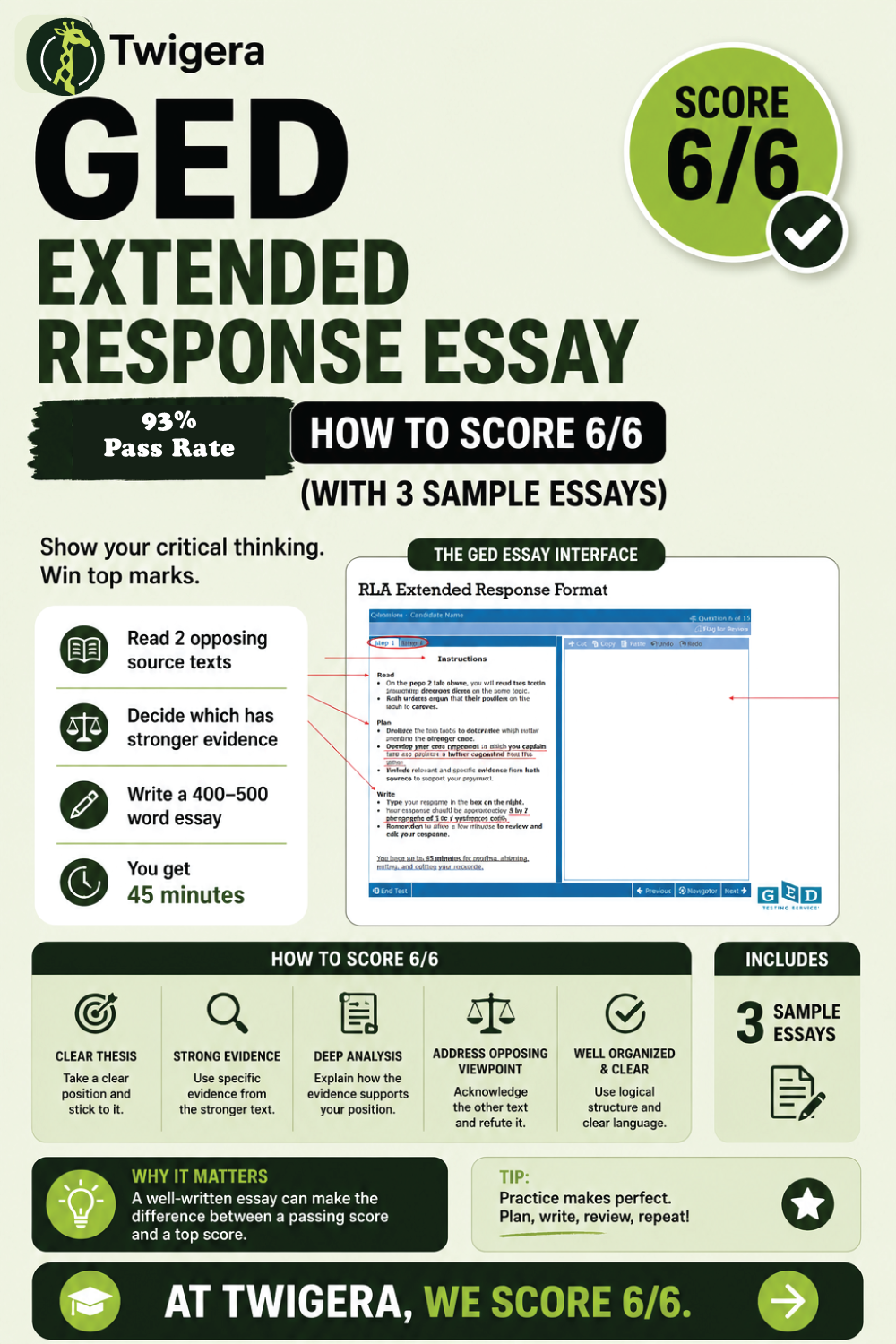
The GED Extended Response is one 45-minute essay in the Reasoning Through Language Arts test. You read two opposing source texts and write a 400-500 word analysis of which uses stronger evidence. Scored on three traits — Analysis, Development, Conventions — for 6 points total. The biggest mistake: giving personal opinion instead of analyzing the source texts. Use a five-paragraph structure and cite both sources.
Last reviewed
There is no better feeling than walking into the GED essay section with a clear plan instead of fear. Many students lose confidence in Language Arts because the essay feels personal, but the GED asks for something more specific: evidence-based writing. Your goal is not to sound perfect — your goal is to prove your answer with evidence. After a decade scoring practice essays, the failing ones almost always share one trait: they argue what the writer believes about the topic, not which author actually proved their point.
The Reasoning Through Language Arts test includes reading and writing, and you need a score of 145 points on each GED subject test to pass. For the full passing-score breakdown across all four subjects, see our GED passing score guide. This guide walks through the rubric, three graded sample essays, the 45-minute time plan, and the single mistake that sinks most failing responses.
What Is the GED Essay?
The GED essay is the Extended Response in the Reasoning Through Language Arts test. You get 45 minutes within the 150-minute RLA section to read two source texts with opposing arguments and decide which author uses stronger evidence. Your job is to write an analysis, not a personal opinion on the topic.
A strong response usually runs 400 to 500 words, though some students pass with about 300 words. Essays over 600 words rarely help if the evidence analysis is weak. Scoring uses three traits — analysis of arguments and evidence, development and organization, and command of standard English. Each trait earns 0 to 2 points, for a 6-point maximum. The essay is often estimated at about 20% of the RLA score.
If you want to know how to write an essay for GED success, start with timed GED essay practice. For the full RLA scoring breakdown and what counts toward your passing score, see our how many questions are on the GED guide.
The Official GED Essay Scoring Rubric
Before you begin GED essay practice, you need to know what scorers are looking for. The Extended Response is graded across three traits, and each measures a different part of your writing.
Trait
0 points
1 point
2 points
Analysis of Arguments & Evidence
No analysis or mostly personal opinion
Some analysis, evidence mentioned but not explained
Clear analysis of both texts with specific cited evidence
Development of Ideas & Structure
Random ideas, no clear structure
Some structure with weak transitions or thin points
Clear intro, body, conclusion, logical flow
Clarity & Standard English
Errors throughout obscure meaning
Errors appear but main ideas still understandable
Mostly correct grammar and varied sentence structure
Total possible score: 6 points. There is no separate "passing score" for the essay alone — the Extended Response contributes to your overall RLA score. Most passing essays do not sound perfect. They make a clear claim, use evidence from the source texts, explain why one argument is stronger, and stay organized from start to finish.
Save for later
Pin this guide so you can find it again.
We refresh these every season. Save it to a Pinterest board and you’ll get the latest version next time you come back.
The best way to understand the GED Extended Response is to compare essays side by side. All three samples below answer the same practice prompt, but each one earns a different score based on evidence, structure, and grammar control.
Practice prompt: plastic bag ban
Source Text A argues that stores should stop giving out single-use plastic bags — bags create litter, harm wildlife, clog drains, and increase cleanup costs for cities. Reusable bags are a better long-term option.
Source Text B argues that plastic bag bans create problems for shoppers and small businesses — reusable bags cost money, paper bags also affect the environment, and many people reuse plastic bags at home for trash or storage.
Essay task: Which source presents the stronger argument? Use evidence from both texts to support your answer.
Sample essay 1 — 2/6, failing
Plastic bags should be banned because they are bad for the earth. People use too many bags and then throw them away. When I go shopping, I see people taking many bags even when they only bought a few things. This is wasteful and people should learn better habits. Plastic bags also make towns look dirty. Sometimes they get stuck in trees or blow across roads. I think stores should give everyone paper bags instead. Some people say plastic bags are useful, but I do not agree. People should bring their own bags if they want to shop. This reminds me of recycling at school. Some students throw bottles in the wrong bin, and then everything gets messy. In conclusion, plastic bags should be banned. They hurt animals, make places dirty, and show that people are not careful with trash.
Why this scores 2/6: the essay has a clear opinion but does not complete the GED task. The writer says plastic bags should be banned without comparing Source Text A and Source Text B, and does not cite evidence from either source. It mostly uses personal experience and general statements, which weakens the response.
Analysis of Arguments and Evidence: 0/2 — personal opinion replaces source analysis
Development and Structure: 1/2 — there is a beginning, middle, and end, but ideas are thin
Clarity and Conventions: 1/2 — understandable but repetitive sentence patterns
Sample essay 2 — 4/6, passing
Source Text A gives the stronger argument about plastic bag bans. Both sources make points, but Source Text A gives clearer evidence about the problems caused by plastic bags. Source Text B focuses more on inconvenience, which is worth thinking about, but its support is weaker. Source Text A explains that plastic bags create litter and often end up in places where they hurt animals. The author also says plastic bags clog drains and cost cities money to clean up — this evidence shows that plastic bags affect the whole community, not only shoppers. Source Text B says plastic bag bans cause problems for customers and businesses, and mentions reusable bags cost money and paper bags also affect the environment. These points are fair, but the source does not explain how serious those problems are or show they are worse than litter, wildlife harm, and cleanup costs. Another reason Source Text A is stronger is that it looks at long-term effects. Plastic bags might be useful for a short time, but they become waste after people leave the store. Source Text B says some people reuse plastic bags at home, but that does not prove most bags are reused. Overall, Source Text A has the better argument.
Why this scores 4/6: the essay answers the prompt and clearly chooses Source Text A as stronger. It compares both sources and uses evidence from each. It passes because it analyzes evidence instead of giving only personal opinion. It loses points because some explanations are still basic and the writing needs stronger development and smoother sentence control.
Analysis of Arguments and Evidence: 2/2 — chooses stronger source, uses evidence from both, explains why
Development and Structure: 1/2 — organized but some points need deeper explanation
Clarity and Conventions: 1/2 — clear, but sentence structure is simple in places
Sample essay 3 — 6/6, perfect
Source Text A presents the stronger argument for banning single-use plastic bags because it supports its claim with broader and more specific consequences. Source Text B raises fair concerns about cost and convenience, but its evidence is narrower. First, Source Text A uses strong evidence by explaining the environmental harm caused by plastic bags — the writer says plastic bags often become litter and may harm animals that mistake them for food or become trapped in them. This evidence is effective because it explains what happens after the bag leaves the store. The argument does not depend on emotion alone — it connects plastic bag use to a clear public problem. Second, Source Text A strengthens its argument by discussing cleanup costs. The writer explains that plastic bags clog drains and require cities to spend money on cleanup. Even people who rarely use plastic bags still pay for cleanup through public resources, which makes the argument broader than a personal preference about shopping. Source Text B makes a reasonable point when it says bans may inconvenience shoppers and small businesses, and it mentions reusable bags cost money and paper bags have environmental effects. Those concerns deserve attention, but Source Text B does not explain how large those costs are or whether they outweigh the problems Source Text A describes. Without stronger support, the argument feels less complete. Source Text B's weakest point is its claim that many people reuse plastic bags at home — reusing is helpful, but the source does not prove that most bags are reused or that reuse prevents litter. For these reasons, Source Text A gives the stronger argument.
Why this scores 6/6: the essay does everything the GED Extended Response asks for. It chooses the stronger source, uses evidence from both texts, and explains why the evidence in one source is stronger. The essay has a clear introduction, focused body paragraphs, a counterargument section, and a complete conclusion. The grammar and sentence flow are controlled throughout.
Analysis of Arguments and Evidence: 2/2 — analyzes both sources, compares evidence strength, explains logic
Development and Structure: 2/2 — strong introduction, clear body, logical flow, focused conclusion
Clarity and Conventions: 2/2 — polished, readable, mostly free from grammar or punctuation errors
The 45-Minute Time Strategy
This time plan keeps your GED essay writing focused from the first minute to the last.
The 5-Paragraph Template That Always Works
A clear GED essay template keeps your response organized when the clock runs. Since the Extended Response is scored on three traits worth up to 6 points, structure matters as much as evidence.
Paragraph 1 — introduction (60–80 words): acknowledge that the two source texts present different views, state which argument has stronger evidence, and preview two or three reasons.
Paragraph 2 — first reason: topic sentence, cite a specific detail from the stronger source, explain why that evidence is strong. Focus on logic, facts, or credibility.
Paragraph 3 — second reason: same pattern. Use another source detail and explain how it supports your position. Do not only repeat what the author said — explain why the evidence works.
Paragraph 4 (optional but useful) — counterargument: acknowledge the other source's best point, then explain why its evidence is weaker.
Paragraph 5 — conclusion (50–70 words): restate which argument is stronger, connect your main points, and end clearly.
Use this structure until it feels natural. You get 45 minutes, so a familiar plan helps you spend more time analyzing evidence and less time wondering what to write next.
The #1 Mistake Most Failing Essays Make
The biggest mistake is writing a personal opinion essay instead of analyzing the two source texts.
Wrong: "I think plastic bags should be banned because they harm the environment."
Right: "Author A's argument is supported by stronger evidence than Author B's. Author A cites specific consequences for wildlife and city cleanup costs, while Author B relies on vague claims about consumer convenience."
The GED essay is not asking what you personally believe about plastic bags, school uniforms, or athlete salaries. It asks which author proves their point better. Evidence analysis affects the highest-value part of the rubric, so stay focused on the sources, compare both arguments, and explain why one side is stronger.
Common Extended Response Prompt Topics
GED Extended Response prompts usually focus on everyday civic or social issues where two reasonable authors disagree. You do not need expert knowledge — the two source texts give you the evidence needed to write your response. Common topics include plastic bag bans, environmental rules, daylight saving time, school uniforms, workplace dress codes, minimum wage, standardized testing, and professional athlete salaries.
The pattern matters more than the topic itself. You will read two opposing arguments, decide which has stronger evidence, and explain your choice clearly. Practice with current GED-style prompts — older "GED essay topics 2014" materials may use outdated formats or scoring notes from test sections that no longer apply.
Do You Have to Write an Essay on the GED?
Yes. The GED includes one essay — the Extended Response — in the RLA test. It is not optional. The essay counts toward your RLA score, often estimated at about 20%. You do not need a perfect essay to pass, but skipping it makes passing much harder. For the full GED format breakdown including which subjects allow which tools, see our can you use a calculator on the GED guide.
Was There a Social Studies Essay?
Yes, but it is no longer part of the GED. The Social Studies Extended Response was removed in 2017. Today, only the RLA test includes an essay. If you find "GED social studies essay examples" in old study materials, treat them as outdated and focus on current RLA essay practice.
How to Practice
Start with the free GED Testing Service Extended Response Classroom Practice PDF and the Argumentative Writing Workbook on ged.com. These official materials show the kind of reading, thinking, and writing the test expects. Next, write 5 to 10 practice essays before test day, using a 45-minute timer each time so you learn how to read, outline, write, and proofread under real test pressure.
After each essay, compare your work with the official rubric. Ask a tutor, adult education teacher, or writing coach to review your response. You can also use AI tools for feedback, but always check the advice against the official scoring traits. For curated practice materials beyond ged.com, see our best GED study guides roundup. For the underlying RLA score targets, see our GED passing score breakdown.
The Bottom Line
The GED Extended Response is one 45-minute essay in the RLA test. It is scored across three traits for up to 6 points and is often estimated at about 20% of your RLA score. To score well: cite both source texts, analyze evidence, and avoid writing only personal opinions. Use a five-paragraph structure and complete 5 to 10 timed practice essays before test day. Depending on your state, you may also have the option of HiSET instead of GED — see our GED vs HiSET guide for the comparison, or our what is a GED guide for the full format breakdown.
Frequently asked
Questions people ask.
Does the GED have an essay?
ShowHide
Yes. The GED includes one essay — the Extended Response — in the Reasoning Through Language Arts (RLA) test. You get 45 minutes to read two source texts with opposing arguments, decide which has stronger evidence, and write a 400-500 word analysis. The Social Studies Extended Response was discontinued in 2017, so today only RLA includes an essay.
How many points is the GED essay worth?
ShowHide
The Extended Response is scored on three traits — Analysis of Arguments and Use of Evidence, Development of Ideas and Organizational Structure, and Clarity and Command of Standard English — each worth 0 to 2 points, for a maximum of 6 points. The essay contributes approximately 20% of your overall RLA score. Most candidates who pass RLA score between 3 and 4 on the essay.
How long should my GED essay be?
ShowHide
400 to 500 words is the sweet spot. Some candidates pass with about 300 words if the evidence analysis is strong. Essays over 600 words rarely improve scores and risk running out of time before proofreading. Quality of evidence analysis matters far more than length, so spend time on cited evidence rather than padding word count.
What is the GED essay topic?
ShowHide
You will get two source texts presenting opposing arguments on a civic or social topic — common examples include plastic bag bans, daylight saving time, school uniforms, professional athlete salaries, and minimum wage. Your job is to determine which argument is supported by stronger evidence — not to give your personal opinion on the topic itself.
How do I write a passing GED essay?
ShowHide
Read both source texts carefully (about 5 minutes), decide which has stronger evidence and outline (3 minutes), write an introduction stating your position (5 minutes), write two to three body paragraphs that each cite specific evidence from the source texts and analyze it (about 20 minutes), write a conclusion (5 minutes), then proofread (5 minutes). Total: 45 minutes. Stay focused on analyzing the sources, not on personal opinion.
What's the most common GED essay mistake?
ShowHide
Giving your personal opinion on the topic instead of analyzing which of the two provided source texts has stronger evidence. The Extended Response is an analysis task, not an opinion piece. Always cite specific evidence from the source texts and explain why one argument is better supported than the other — that is the highest-value part of the rubric.
Are GED essay examples available?
ShowHide
Yes. GED Testing Service publishes a free "Perfect Scoring Extended Response" sample PDF on ged.com along with an Argumentative Writing Workbook of practice prompts. The r/GED community on Reddit also has user-submitted examples that learners share for feedback. This guide includes three graded sample essays on the same prompt — failing (2/6), passing (4/6), and perfect (6/6) — so you can compare side by side.
Can I use a calculator on the GED essay?
ShowHide
No — the calculator is only available on the Mathematical Reasoning test, not RLA. For the essay, you have the GED word-processing interface with basic editing tools — spell-check, copy and paste. No external resources are allowed during the essay portion of the RLA test.
Amara is the editor at Twigera. She came to publishing the long way — a decade teaching the GED in community colleges and adult-learning centers, where she watched students pass not on talent or time, but on the strength of a study plan they actually trusted. Now she shapes the guides students read here for the parent studying after a closing shift, the second-career welder, the grandmother finishing what she started forty years ago. Expect honest timelines, math made survivable, and study plans built around real life — not around a textbook's idea of one.
Enjoyed this?
Take the next step — start today.
Our online GED course includes every subject, a free 30-minute diagnostic, and a 7-day refund on every plan.