You need 145 to pass GED Science. Here is what the 100–200 scale actually measures, why no one can tell you how many questions to get right, and what 165 and 175 unlock if you are heading to college.
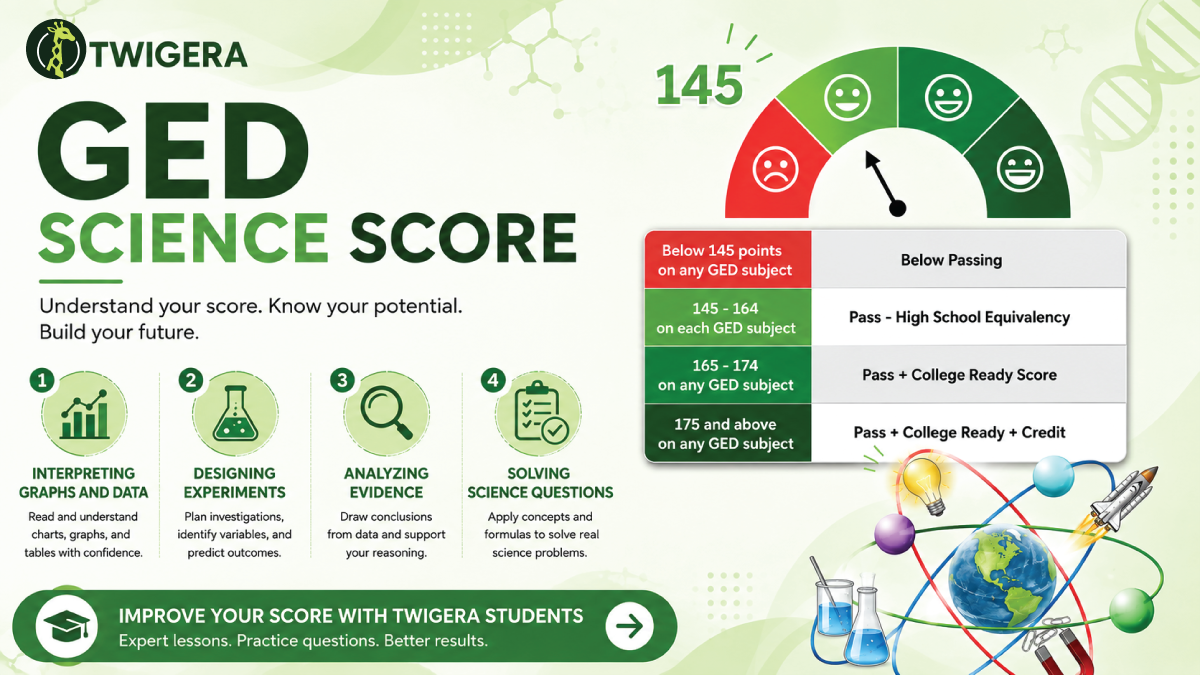
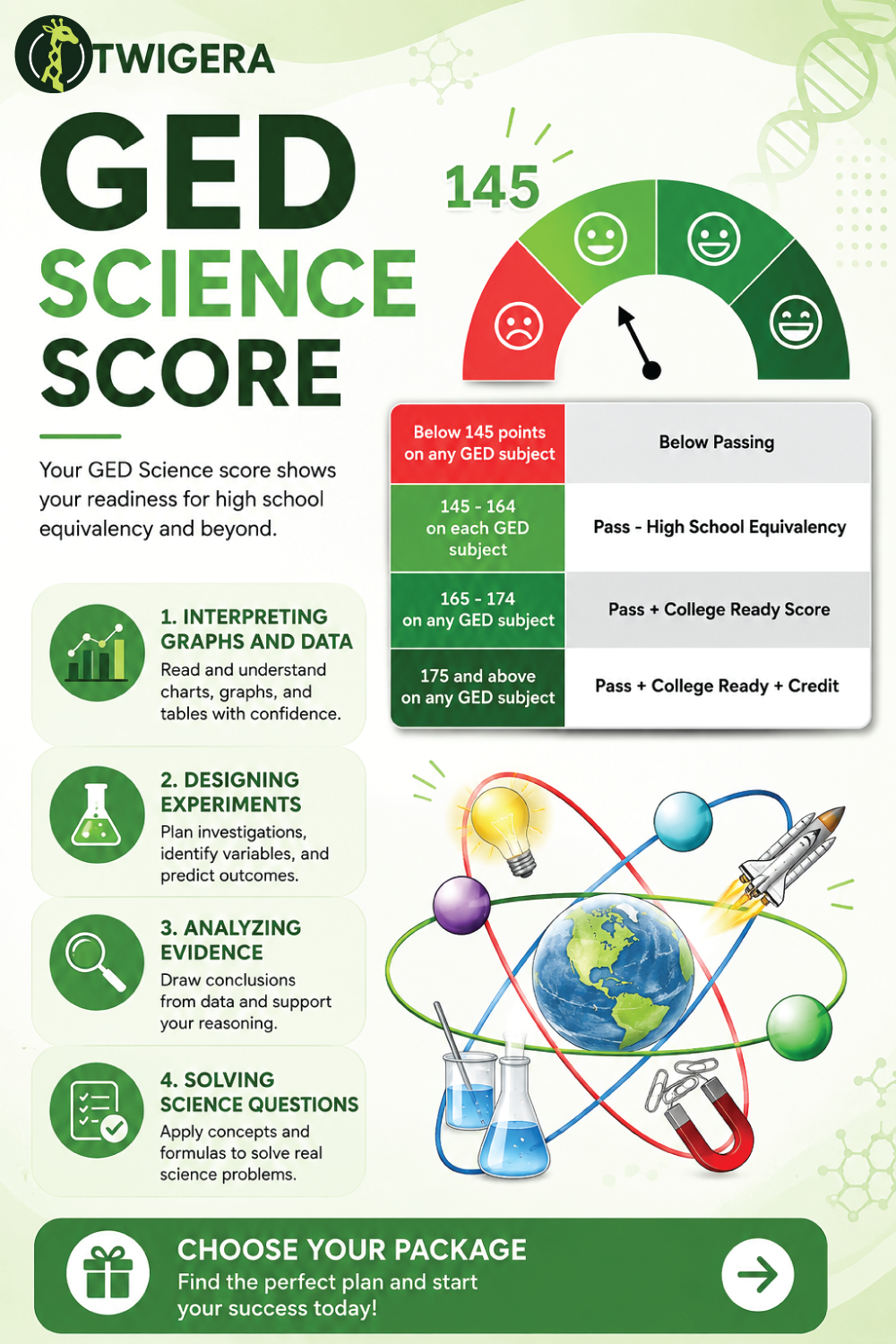
You need 145 to pass GED Science, and 145 on each of the other three subjects to earn the credential. The scale runs 100 to 200, but 145 is not 72.5% of the questions — it is a scaled score that adjusts for test-form difficulty. Scores of 165 to 174 earn College Ready and 175 to 200 earn College Ready + Credit.
Last reviewed
If you are worried about your GED science score, the number to remember is 145. That passes the Science test. Reach 145 on all four subjects and you earn the credential.
The scale runs from 100 to 200, which is where most of the confusion starts. A 145 out of 200 looks like 72.5% — it is not. The 100 to 200 range is a reporting scale, not a percentage of questions answered correctly.
The GED Science Score Scale
Every GED subject uses the same four performance levels. Here is what each Science band means.
Score
Performance level
What it means
100–144
Below Passing
You have not yet reached the passing standard for this subject
145–164
GED Passing / High School Equivalency
You passed Science
165–174
GED College Ready
You demonstrated college-readiness skills
175–200
GED College Ready + Credit
You may qualify for college credit, depending on the institution
A 145 or higher passes Science. To earn the GED credential you need at least 145 on all four subject tests, and the requirement is subject-specific — you cannot offset a Science score of 140 with a strong Math result.
So do not let the 200-point ceiling make the test look harder than it is. Your first target is 145, and for most people it should be the only target.
Why 145 Is Not 72.5%
The GED reports scaled scores. Your raw performance is converted onto the 100 to 200 range in a way that accounts for how difficult your particular test form was.
Two things break the percentage assumption. Items can carry different point values, so not every question contributes equally. And test forms vary slightly in difficulty, so the conversion shifts to keep a 145 meaning the same level of skill whichever form you sat.
That second point is the fairness mechanism. Without scaling, someone who happened to receive a slightly harder set of items would need more raw marks to reach the same reported score than someone who got an easier set. Scaling removes that luck. The trade-off is that no fixed raw-score threshold can be published, which is exactly the number everyone wants.
That is the whole reason a fixed rule like "get 60% correct and you pass" is misleading. It assumes a conversion table that does not exist.
How Many Questions Do You Need to Get Right?
There is no reliable number, and any page that gives you one is guessing rather than citing.
GED Testing Service publishes performance levels and the score scale, but not a raw-correct-to-scaled conversion. Without that, "you need X questions" is arithmetic performed on an assumption.
The useful move is to stop reverse-engineering a cutoff and work on the skills instead. That is not a consolation prize — it is genuinely the approach that raises scores, because it tells you what to do on Monday morning and a target number does not.
There is a practical version of this too. Answer every question. The GED carries no penalty for a wrong answer, so a considered guess on an item you cannot finish is always better than a blank. Leaving items unanswered is one of the few ways to lose marks you had already earned the skills for.
Save for later
Pin this guide so you can find it again.
We refresh these every season. Save it to a Pinterest board and you’ll get the latest version next time you come back.
The official GED Science Study Guide lists three topics for the Science test, and they are skills rather than subjects.
Study Guide topic
Corresponding reporting category
Weight
Reading for Meaning in Science
Analyzing scientific and technical arguments, evidence and text-based information
30%
Designing and Interpreting Science Experiments
Applying scientific processes and procedural concepts
40%
Using Numbers and Graphics in Science
Reasoning quantitatively and interpreting data in scientific contexts
30%
Read the weights column and a study priority appears. Experiment design and scientific process carry the largest single share at 40%. That is variables, controls, sources of error, and judging whether a conclusion follows — not biology, chemistry or Earth science content.
One caution about that mapping. The Study Guide names the three topics and the Assessment Guide assigns the weights, so treat the pairing as a correspondence between two official documents rather than a single published table.
The same guide confirms the format: 90 minutes, no breaks, calculator allowed. It also states the science formulas will be provided and that the test is not a memorisation exercise.
What to Practice Before Test Day
If you are working toward 145, put your hours into the four skills that recur across Science questions regardless of topic.
Skill
What to practice
Read scientific information
Identify the main point, compare information, and draw conclusions from short passages
Interpret experiments
Identify variables, controls, hypotheses, procedures and conclusions
Read graphs and tables
Spot trends, compare values, and use data to support a conclusion
Use numbers in context
Calculations involving measurements, rates, percentages, ratios and supplied formulas
This beats memorising isolated science facts, and the weighting table above explains why. A student who knows every body system but cannot say which variable was controlled will lose more marks than one who reasons well from a passage about a topic they have never studied.
You do not need a score above 145 to earn your GED. But the higher bands are worth knowing about if college is in your plans.
165 to 174: GED College Ready
GED Testing Service says this range demonstrates the skills needed to start college-level courses, and it may let you skip certain placement tests or remedial requirements. Whether a particular college honours it is that college decision, but the saving can be real — remedial courses often cost tuition without earning credit.
175 to 200: GED College Ready + Credit
This range demonstrates skills that could qualify you for college credit. The word "could" is carrying weight here. The institution decides whether and how any credit applies, so do not assume a 175 converts into credit everywhere.
Check with the college or programme you plan to attend before you build a plan around it. GED Testing Service publishes the full score scale and performance levels for all four subjects.
Is 145 Still the Passing Score?
Yes. Current official GED scoring information lists 145 as the passing score for each subject, with 165 to 174 as College Ready and 175 to 200 as College Ready + Credit.
If you have seen different numbers online, they are almost certainly from older materials. The GED test was overhauled in 2014 and the performance levels were revised afterwards, so study guides published before that describe a scale that no longer exists.
One more time, because it is the detail people most often get wrong: the requirement is per subject. You need at least 145 on Science, Mathematical Reasoning, Reasoning Through Language Arts and Social Studies individually. There is no averaging across the four.
What If You Scored Below 145?
A score under 145 does not mean relearning every science topic, and treating it that way wastes the most useful thing you now have — a score report.
Start there. Your report identifies which areas need work, turning a vague "study more science" into a short list. If graphs are the weak point, practice reading charts and tables. If experiments are, spend the time on variables, controls and conclusions. If calculations slow you down, drill the numerical reasoning and formula application.
Take a practice set before you rebook rather than after. GED Testing Service offers a free Science preview with the same question types you will meet, including the technology-enhanced formats. If you are not sure where your gaps are at all, a free GED diagnostic test is a faster way to find them than working through a textbook front to back.
Retaking the Science Test
You retake only the subject you did not pass. A Science score below 145 does not put your other three results at risk, and passing subjects stay passed.
Retake rules and discounted retake pricing are set at state level rather than nationally, so the number of attempts allowed in a year and what each costs depend on where you test. Check your state page before you assume anything about timing or fees.
Most people who retake do better, and the reason is mundane rather than inspiring — the second attempt is the first time they have studied against a real diagnosis instead of a guess. That is also why rebooking immediately, before working the score report, tends to repeat the result.
Aim for 145 First
The scale stretching to 200 makes the test look more demanding than it is. Your immediate goal does not need to be 200, or 175, or even 165.
Plenty of people talk themselves out of booking because they are measuring against the top of a scale nobody asked them to reach.
Start with 145. Once you understand how Science questions work — reading scientific information, interpreting experiments, analyzing data and applying supplied formulas — you can decide whether pushing for a College Ready score is worth the extra weeks. For most people it is not, and passing is the thing that changes what they can do next.
Use practice results to find weak areas rather than guessing how many questions you need right. Then put your study time where it makes the most difference, which the 30/40/30 weighting above tells you is usually experiment design.
Frequently asked
Questions people ask.
What is the passing score for GED Science?
ShowHide
A 145. You need at least 145 on Science and on each of the other three subjects to earn the GED credential. The requirement is subject-specific, so a strong Math or RLA result cannot compensate for a Science score below 145.
What is the highest GED Science score?
ShowHide
The scale tops out at 200. Scores from 175 to 200 fall into the College Ready + Credit range, which may qualify you for college credit depending on the institution. Very few test-takers need to aim that high — 145 earns the credential on its own.
How many questions do I need to get right to pass GED Science?
ShowHide
There is no published number, and any page offering one is guessing. GED reports scaled scores on a 100 to 200 system, items can carry different point values, and the scaling adjusts for differences in test-form difficulty. A rule like "get 60% correct" is misleading because it assumes a fixed conversion that does not exist.
Is 145 the same as 72.5%?
ShowHide
No, and this is the most common misreading of the scale. 145 out of 200 looks like 72.5%, but the 100 to 200 range is a reporting scale rather than a percentage. Your raw performance is converted to that scale in a way that accounts for how difficult your particular set of items was.
What does a GED College Ready score mean?
ShowHide
A Science score of 165 to 174 falls in the College Ready band. GED Testing Service says it demonstrates the skills needed to begin college-level coursework, and it may let you skip certain placement or remedial requirements. Whether a specific college honours that is the college decision.
Can a high GED Science score earn college credit?
ShowHide
A score of 175 to 200 may qualify you for credit, but the institution decides whether and how it applies. Do not assume a 175 automatically converts into credit everywhere — check with the college or programme you plan to attend before counting on it.
Did the GED Science passing score change?
ShowHide
No. Current official GED scoring information still lists 145 as the passing score for every subject, with 165 to 174 as College Ready and 175 to 200 as College Ready + Credit. If you have seen different numbers online, they are likely from older study materials predating the current performance levels.
What should I do if I scored below 145 on GED Science?
ShowHide
Start with your score report rather than relearning everything. It identifies which areas need work. If graphs are the problem, practice reading charts and tables. If experiments are, work on variables and conclusions. If calculations slow you down, drill the numerical reasoning. Targeted study beats starting over.
Amara is the editor at Twigera. She came to publishing the long way — a decade teaching the GED in community colleges and adult-learning centers, where she watched students pass not on talent or time, but on the strength of a study plan they actually trusted. Now she shapes the guides students read here for the parent studying after a closing shift, the second-career welder, the grandmother finishing what she started forty years ago. Expect honest timelines, math made survivable, and study plans built around real life — not around a textbook's idea of one.
Enjoyed this?
Take the next step — start today.
Our online GED course includes every subject, a free 30-minute diagnostic, and a 7-day refund on every plan.