GED Science Study Guide 2026: Notes, Topics & Study Plan
What to study for GED Science and in what order — the three content areas at their real weightings, the reasoning skills the test actually scores, and a five-step plan that starts from a diagnostic rather than from page one.
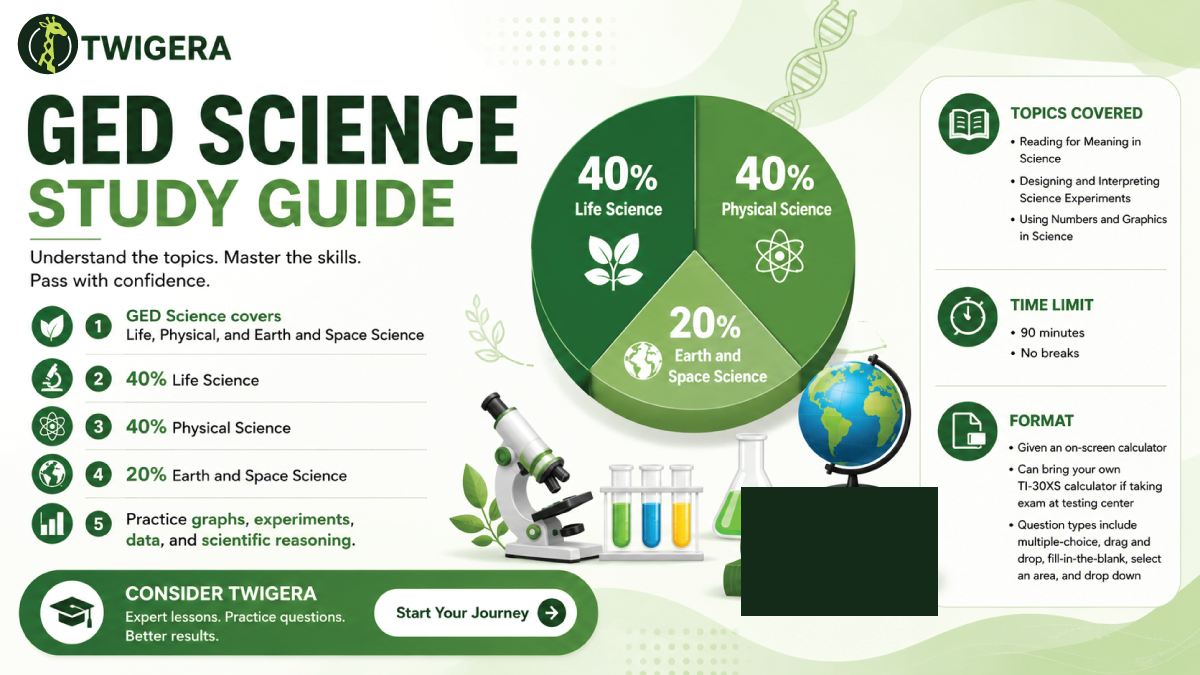
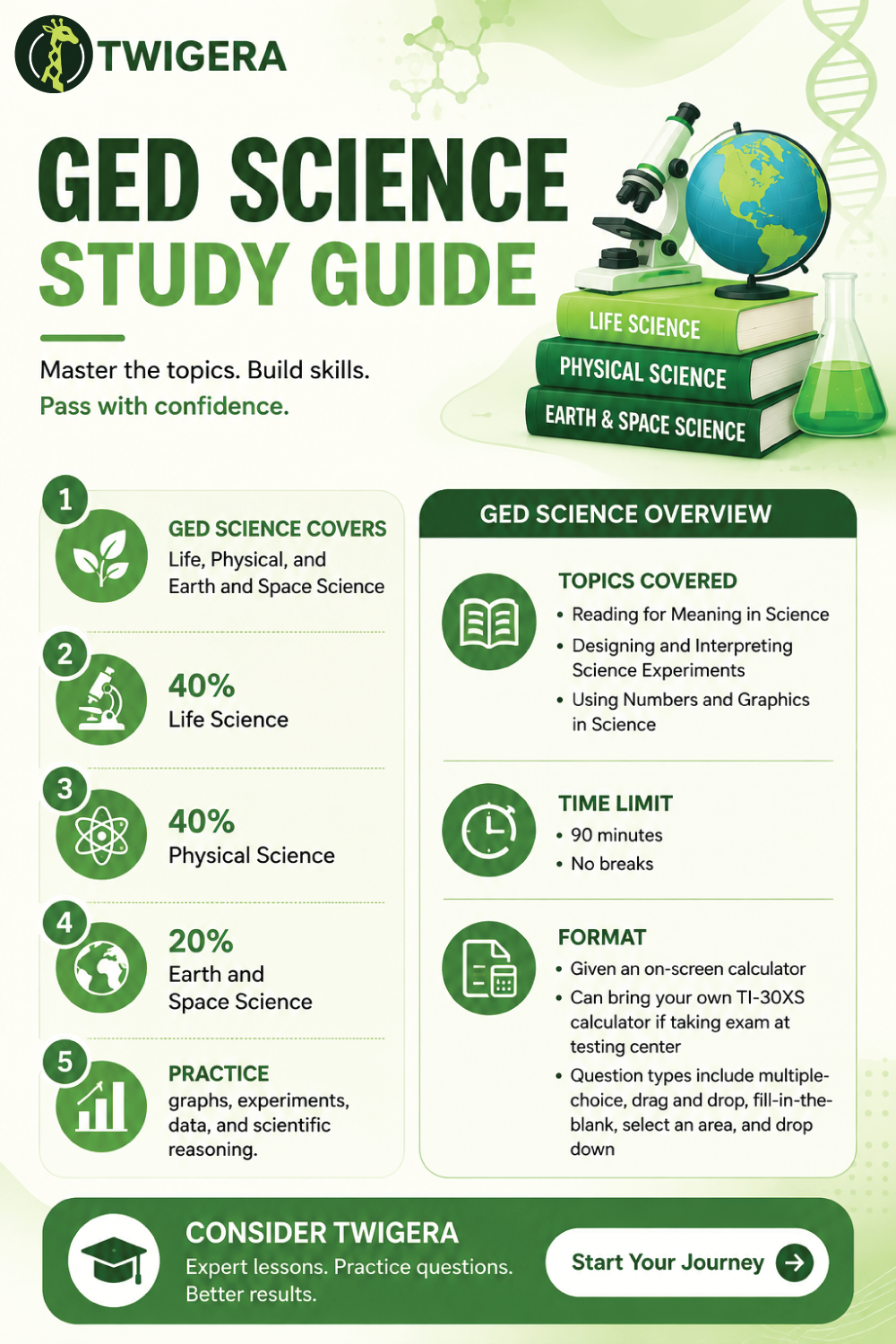
Study GED Science by content area and reasoning skill, not by memorising facts. The test is about 40% life science, 40% physical science, and 20% Earth and space science, runs 90 minutes with no break, and needs 145 to pass. Around 60% of items sit at Depth of Knowledge level 2 or 3, so most questions ask you to reason from a stimulus rather than recall a definition.
Last reviewed
Studying for GED Science and unsure which topics deserve your time? Start with the shape of the test, not the first chapter of a textbook. This GED science study guide covers what you need to understand, the reasoning skills that actually carry the marks, and the order to work in.
Science covers three content areas. The official Assessment Guide for Educators assigns about 40% to life science, 40% to physical science, and 20% to Earth and space science.
The test runs 90 minutes with no scheduled break and needs 145 to pass. Item types are multiple choice plus fill in the blank, drag and drop, select an area and drop down. An on-screen calculator is available for items involving calculation, and you may bring your own TI-30XS to a test center.
That distribution is the single most useful planning fact on this page. Most people split their study time evenly across three areas, which quietly over-invests in the smallest one.
What Does the GED Science Test Cover?
Every Science item pairs a science practice with a content topic. The test measures scientific reading, data interpretation, experimental reasoning and problem solving rather than recall. About 60% of items sit at Depth of Knowledge level 2 or 3. Roughly half come in scenarios where two or three questions share one stimulus.
Content area
Share
Main topics
Life science
40%
Human health, cells, heredity, evolution, ecosystems, energy flow
Physical science
40%
Matter, chemical reactions, energy, motion, forces, density
Earth and space science
20%
Earth systems and interactions, resources, weather and climate, the cosmos
Now read that alongside the reporting categories, which are what your score is built from. Analyzing arguments and evidence is 30%. Applying scientific processes is 40%. Reasoning quantitatively and interpreting data is 30%. Content decides what a question is about; the reporting categories decide what it tests. To see the format before you study it, work through the free GED science practice test first.
Life Science: 40% of the Test
Life science covers human health and living systems, the organization of life, heredity, evolution, energy relationships and ecosystems.
Cells and the organization of life
Know how cells are organized and how their structures support different functions. Mitochondria are involved in cellular energy production; cell membranes regulate what enters and leaves the cell.
A GED-style example: researchers expose two groups of cells to a chemical. Group A has functioning mitochondria, Group B has damaged mitochondria, and ATP production is substantially lower in Group B. Which conclusion is best supported?
A. Mitochondria prevent chemicals from entering cells.
B. Mitochondria contribute to cellular energy production.
C. ATP damages mitochondria.
D. Chemicals cannot enter cells without mitochondria.
Answer: B. The evidence links damaged mitochondria to reduced ATP. Options A and D describe membrane function, and C reverses cause and effect. Notice you did not need to know what ATP stands for — the data alone decides it.
Human body systems
Learn the relationships between systems rather than each system in isolation. During exercise, muscles need more energy. Oxygen demand rises, so breathing and heart rates increase. The respiratory system brings oxygen in and the circulatory system moves it to tissues. A question might hand you heart-rate data from before, during and after exercise and ask which explanation fits.
Genetics and heredity
Understand alleles, dominant and recessive traits, chromosomes and basic inheritance. For a cross of Aa × Aa the possible genotypes are AA, Aa, Aa and aa, so the probability of aa is 25%.
Now the part that gets tested harder. Suppose researchers observe 19 recessive offspring out of 96: 19 ÷ 96 × 100 = 19.8%. That does not disprove the model. Observed results are not required to match theoretical probability, and random variation explains a gap of that size easily.
Ecology and energy flow
Know producers, consumers, decomposers, food chains, food webs and energy transfer. Take the chain grass → grasshopper → frog → snake → hawk. A sharp fall in the grass population hits grasshoppers first, then everything that depends on them. Questions often show a food web and ask you to predict the knock-on effect of one population changing.
Evolution
Focus on natural selection, variation, adaptation and environmental pressure. If some insects already carry greater pesticide resistance, repeated exposure leaves more resistant insects alive to reproduce, and resistance becomes more common over generations.
The distinction the GED tests here is precise: the pesticide did not create resistance because the insects needed it. Existing variation affected who survived. Wrong answers on evolution questions almost always describe an organism developing a trait on demand.
Save for later
Pin this guide so you can find it again.
We refresh these every season. Save it to a Pinterest board and you’ll get the latest version next time you come back.
Physical science covers chemical properties and reactions, energy, work, motion and forces. It carries the same weight as life science and is where most people under-prepare.
Matter and chemical reactions
Know atoms, elements, compounds, properties of matter and reactions. Take 2H₂ + O₂ → 2H₂O. The equation shows hydrogen and oxygen atoms rearranged into water; no atoms are destroyed. Four hydrogen atoms and two oxygen atoms appear on each side.
When a question asks which statement about an equation is supported, count the atoms on both sides rather than judging by how the equation looks. Conservation of mass is what these items are really checking.
Density
Density = mass ÷ volume. A metal sample with a mass of 270 g and a volume of 100 cm³ has a density of 270 ÷ 100 = 2.7 g/cm³.
The harder version gives you densities for several materials and asks which would sink in water. That needs the calculation and then an interpretation: water is about 1 g/cm³, so anything denser sinks. The number alone is not the answer.
Energy
Know kinetic energy, potential energy, thermal energy and energy transformations. At the top of a roller-coaster hill gravitational potential energy is high; as the car descends, potential energy falls while kinetic energy rises. A question may mark positions along a track and ask where each is greatest.
Motion and forces
Know speed, velocity, acceleration, gravity, force and work. A vehicle traveling 180 metres in 12 seconds has a speed of 180 ÷ 12 = 15 m/s.
The GED makes this harder by splitting the journey. Say a vehicle covers 50 m in the first 5 seconds, 75 m in the next 5, and 100 m in the next 5. Each interval is the same length, but the distance grows. The speed is increasing. You did not need the acceleration formula to see that, only the comparison.
Earth and Space Science: 20% of the Test
Earth and space science covers how Earth systems interact with living things, Earth’s components, and the structure of the cosmos. It carries half the weight of the other two areas, so it deserves less of your study time. Not none, though — it is where the clearest data-interpretation questions tend to live.
Earth’s systems
Know the atmosphere, hydrosphere, geosphere and biosphere, and how they interact. Rainfall raises soil moisture. Soil moisture affects vegetation. Vegetation influences erosion and water movement. A question might show a diagram of rainfall, runoff, groundwater, evaporation and transpiration. It then asks you to name a process, or to predict what changes if one part shifts.
Weather and climate
Weather is short-term atmospheric conditions; climate is the long-term pattern. A seven-day temperature table is weather. A graph of average temperatures across several decades is climate. One unusually hot day establishes nothing about a climate trend, and questions are built to see whether you know the difference.
Natural resources
Know renewable and non-renewable resources and how use affects Earth systems. Solar energy is renewable because sunlight keeps arriving. Fossil fuels are non-renewable because they form over geological timescales. Questions often give consumption data and ask which conclusion the trend supports.
Space science
Know basic relationships involving the Sun, planets, stars, gravity and the organization of the cosmos. Items here usually supply orbital distance, planetary motion or gravitational data and ask you to reason from it. The reading skill matters more than the astronomy.
The Science Reasoning Skills You Need
GED Science is not a collection of biology, chemistry and Earth science questions. It asks you to understand scientific concepts, measurements, experimental setups, graphs and data sets. You do not need to memorise formulas, because the information required is supplied in the stimulus.
Reading a scientific presentation
When you meet a passage, find five things: the research question, the variables, the evidence, the results and the conclusion. Not every sentence carries equal weight, and treating them as if they do is why passages feel slow.
Interpreting data
Read the title, labels, units, scale and legend before you interpret anything. Take this table:
Temperature
Dissolved oxygen
10°C
11.3 mg/L
20°C
9.0 mg/L
30°C
7.4 mg/L
Dissolved oxygen falls as temperature rises, so a claim that it increases with temperature is not supported. The skill is stating what the data shows and, just as often, what it does not.
Evaluating an experiment
Identify the independent variable, the dependent variable, the control group, the controlled variables, the hypothesis, the results and the possible sources of error.
Consider an experiment comparing three fertiliser concentrations where each group also gets a different amount of water. Growth differences cannot be attributed to fertiliser, because two things changed at once. The improved design holds water volume constant and varies only fertiliser concentration.
What to Put in Your GED Science Notes
Good GED science notes should help you answer questions, not just define terms. For every concept, write one line of explanation and one line showing how it could appear as a test question. A note reading "density = mass ÷ volume; a question gives four samples and asks which floats" is worth ten notes that only define density.
Area
What to note
Life science
Cells and cell functions, human body systems, genetics and heredity, evolution, ecosystems, energy flow
Physical science
Atoms and elements, chemical reactions, matter, energy transformations, motion, forces, density
Earth and space science
Earth’s systems, weather and climate, natural resources, Earth processes, solar system, cosmos
That last row is the one people leave out, and it is the row the reporting categories weight most heavily.
How to Use Your GED Science Study Notes
Do not read every topic from the beginning. Start with a diagnostic and let the results choose your order.
Step 5 is the one that compounds. A list of question numbers you got wrong tells you nothing next week; a list of reasons tells you exactly what to drill. GED Ready, the official practice test, also returns a likelihood-of-passing indicator and a study plan built from your weak areas. That makes a useful checkpoint between cycles.
A Practical GED Science Study Checklist
Work through this while you prepare, and weight your hours by the 40/40/20 split rather than spreading them evenly.
Life science
Physical science
Earth and space science
Reasoning
Cells
Matter
Earth’s systems
Scientific reading
Human body systems
Atoms and reactions
Weather and climate
Graphs and tables
Genetics
Energy
Natural resources
Experimental design
Evolution
Motion
Earth processes
Variables and controls
Ecosystems
Forces
Solar system
Evidence and conclusions
Energy flow
Density
Cosmos
Probability and statistics
Life science and physical science each carry about twice the weight of Earth and space science. Two-thirds of your content time belongs in the first two columns. The fourth column is not optional. It applies to every question on the test, whichever column it came from.
Do You Need to Memorise Science Facts?
Memorisation alone is not enough. Over-relying on it is the most common way people prepare hard and still miss the score. GED Testing Service says preparation should cover scientific concepts, measurements, experimental setup, graphs and data interpretation. It also states that the information needed for formulas is provided rather than memorised.
Here is the gap that catches people. A learner can know that density equals mass divided by volume and still miss the question. The scenario never labels its numbers "mass" and "volume". It describes a sample and leaves the identifying to you. Knowing a formula and knowing when it applies are separate skills, and only the second one is tested.
Work in this order: understand the concept, identify the evidence, apply the information, then check whether the conclusion actually follows. Facts still matter — you cannot reason about a food web you have never seen. But learn each one attached to a use, not on its own.
How Long Should You Study for GED Science?
It depends on what your practice results show, and any guide offering you a fixed number of weeks is guessing. Someone who understands the concepts but struggles with graphs needs a completely different plan from someone who has never met chemical reactions or genetics.
Let the results decide what comes next. A set study period is a poor target if it does not address the skills causing your mistakes. You can finish six diligent weeks and sit down no better at the thing that was costing you points.
The broader sequencing question, across all four subjects, is covered in how to study for the GED. One honest rule of thumb: keep going until you can explain your wrong answers without looking anything up. The chart-reading approach specific to this subject is in how to pass the GED science test.
What Score Do You Need to Pass GED Science?
You need 145. Scores from 145 to 164 sit in the passing range. From 165 to 174 earns College Ready. From 175 to 200 earns College Ready + Credit, which can convert into free college credit at some institutions. GED Testing Service publishes the full score scale and performance levels.
Each subject is passed on its own. A strong Social Studies result does not lift a Science score of 140.
During practice, the target should not be collecting correct answers. It should be understanding which ones you missed and why. A 70% score built on guesses is worth less than a 60% you can fully explain, because only the second one tells you what to do next.
Cover all three content areas — life science, physical science, and Earth and space science — while practicing the reasoning skills that carry the marks: scientific reading, data interpretation, experimental design, evidence evaluation, probability and statistics. Start with a diagnostic rather than page one, then study the areas your results flag instead of working through every topic in order.
What topics are on the GED Science test?
ShowHide
Life science at about 40% covers cells, body systems, genetics, evolution, ecosystems and energy flow. Physical science at about 40% covers matter, atoms, chemical reactions, energy, motion, forces and density. Earth and space science at about 20% covers Earth systems, weather and climate, natural resources and the cosmos.
Do I need to memorise science formulas for the GED?
ShowHide
No. GED Testing Service states that the information needed to answer a question is supplied in the stimulus, so you are not required to memorise formulas. Knowing that density equals mass divided by volume is still not enough on its own — you also have to recognize which numbers in a scenario are the mass and the volume.
How long is the GED Science test?
ShowHide
Ninety minutes with no scheduled break, including about two minutes of instructions and final review. You get an on-screen calculator for items that involve calculation, and you may bring your own TI-30XS to a test center. A calculator reference sheet is available throughout.
What score do you need to pass GED Science?
ShowHide
A 145. Scores from 145 to 164 sit in the passing range, 165 to 174 earn College Ready, and 175 to 200 earn College Ready + Credit, which can convert into free college credit. Each subject is passed independently, so a strong score elsewhere does not offset a Science score below 145.
How long should I study for GED Science?
ShowHide
It depends entirely on what your practice results show. Someone who understands the concepts but struggles with graphs needs a very different plan from someone who has not met chemical reactions or genetics. A fixed number of weeks is a poor target if it does not address the specific skills causing your mistakes.
Is there a free GED Science study guide?
ShowHide
GED Testing Service publishes a free Science study guide on its official platform, and GED Ready is the official practice test, which returns a likelihood-of-passing indicator and a study plan based on your weak areas. This page condenses the same content areas into notes you can review quickly rather than read once.
What should my GED Science notes contain?
ShowHide
For each concept, one line of explanation and one example of how it could appear as a test question. Notes that only hold definitions will not help, because the test rarely asks for a definition. A note reading "density = mass ÷ volume; a question gives four samples and asks which floats" is worth ten that only define the term.
Amara is the editor at Twigera. She came to publishing the long way — a decade teaching the GED in community colleges and adult-learning centers, where she watched students pass not on talent or time, but on the strength of a study plan they actually trusted. Now she shapes the guides students read here for the parent studying after a closing shift, the second-career welder, the grandmother finishing what she started forty years ago. Expect honest timelines, math made survivable, and study plans built around real life — not around a textbook's idea of one.
Enjoyed this?
Take the next step — start today.
Our online GED course includes every subject, a free 30-minute diagnostic, and a 7-day refund on every plan.