GED Social Studies Cheat Sheet 2026: All Four Areas
One page for the whole section. Civics is 50% of the test, history 20%, economics and geography 15% each — plus the three reasoning skills every question is really built on, and what belongs on a printable sheet.
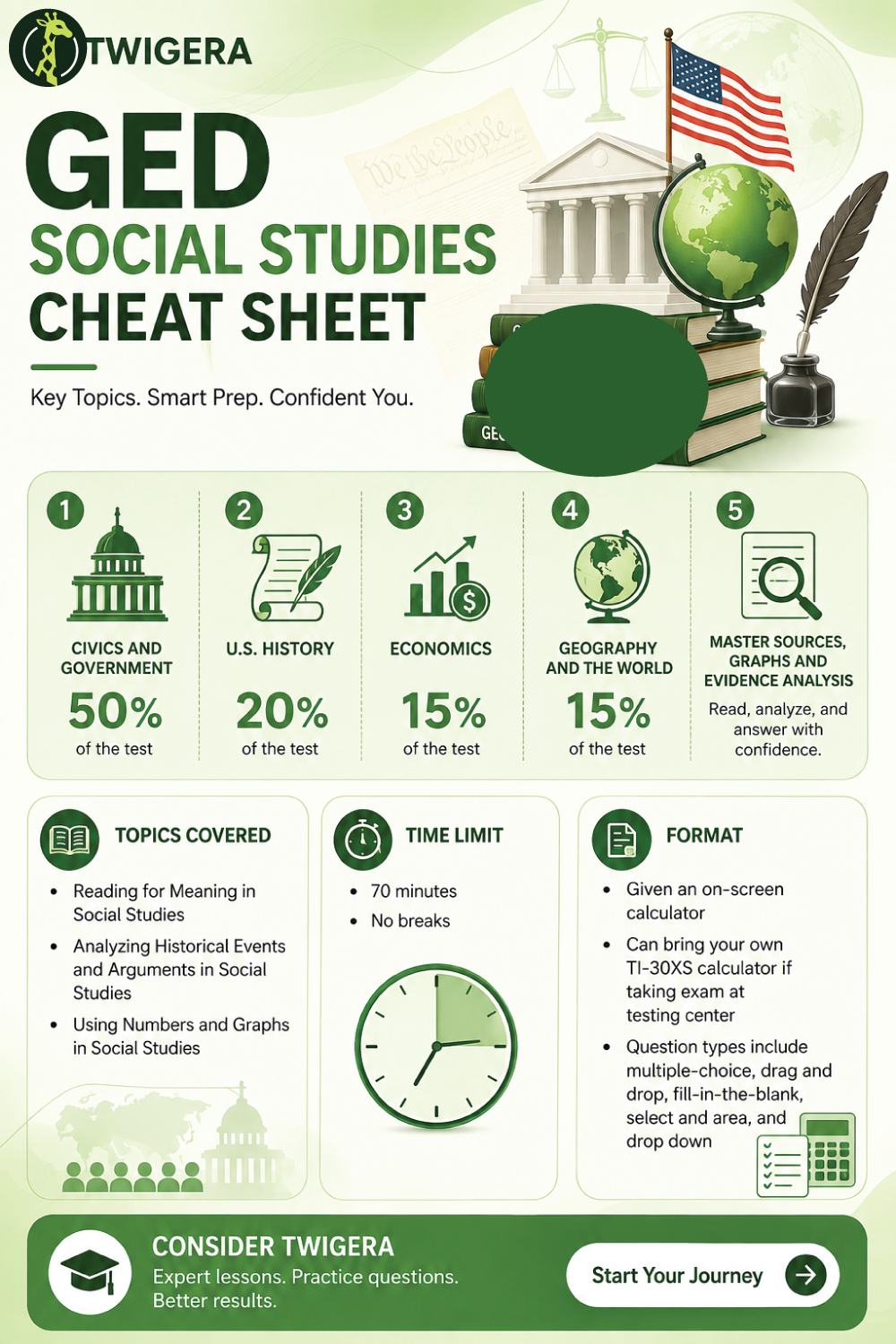
A GED social studies cheat sheet should be built around the official weighting: civics and government 50%, U.S. history 20%, economics 15%, geography and the world 15%. The test runs 70 minutes with no break. Because questions supply their own evidence, the sheet should carry reasoning habits and key relationships rather than dates.
Last reviewed
A GED social studies cheat sheet is only useful if it helps you decide under time pressure. The test is not a memory contest. You are handed passages, historical sources, charts, graphs and maps, then asked what the evidence means.
The practical details first. According to the official GED Study Guide for Social Studies, the test runs 70 minutes with no scheduled break, a calculator is allowed with a reference sheet provided, and questions come as multiple choice plus drag and drop, fill in the blank, hot spot and drop down. The biggest mistake is treating the section as a list of dates. Connect four content areas to three reasoning skills instead: reading for meaning, analyzing historical events and arguments, and using numbers and graphs.
Your GED social studies study map
Use the official content weighting to decide where review time goes. These four shares come from the GED Assessment Guide for Educators, and they are lopsided enough to change your plan.
Content area
Weight
What to focus on
Civics and Government
50%
Government structure, rights, elections, the Constitution
U.S. History
20%
Founding, major conflicts, reform, civil rights
Economics
15%
Markets, incentives, indicators, policy
Geography and the World
15%
Maps, migration, resources, global relationships
Half the test is one content area. If your revision time is split evenly across four areas, it is misallocated. Start with civics, and treat the other three as support.
A rough guide for a two-week run: five sessions on civics, two on history, and one each on economics and geography, with every session ending in questions rather than notes. That mirrors the weighting closely enough, and it stops geography — the area people find most interesting and least profitable — from quietly eating the schedule.
Build your civics core first
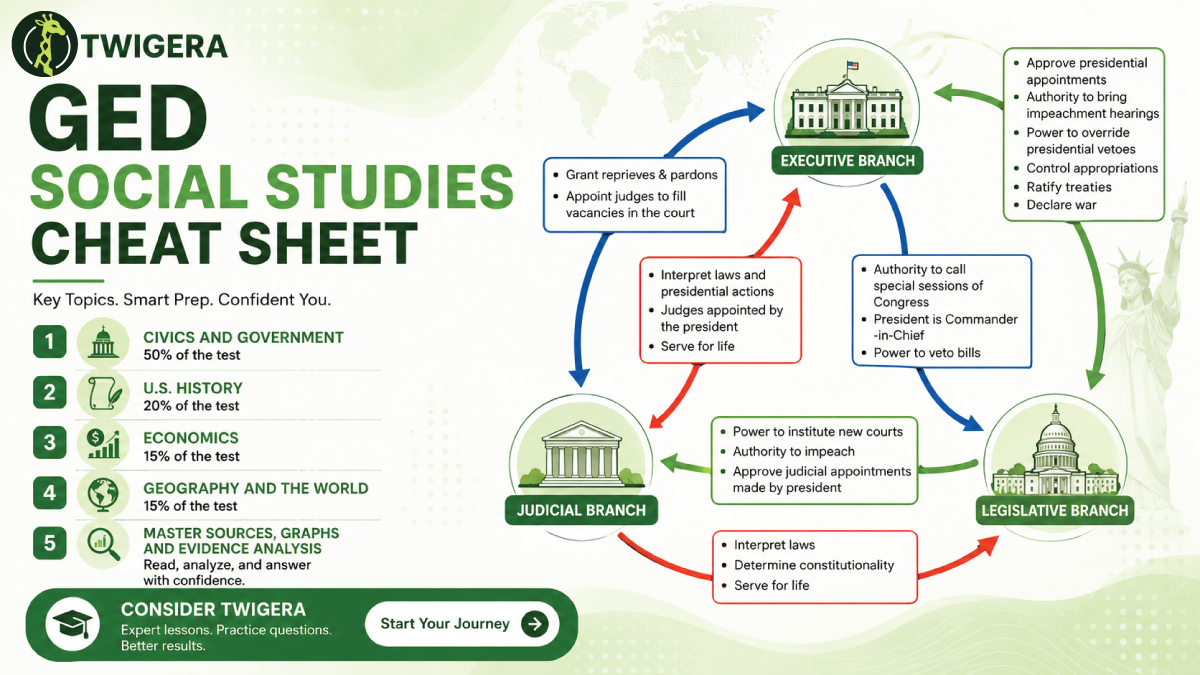
Start with how government works rather than a long list of political vocabulary. Three branches, and what each one does:
Branch
Role
Legislative
Makes federal laws
Executive
Enforces federal laws
Judicial
Interprets laws and settles disputes
Example. A federal court rules that a law passed by Congress conflicts with the Constitution. Which power is being exercised?
Answer: judicial review. The question describes the action and expects you to name the power. It never uses the term, which is exactly the point. For the full treatment of this content area, see our guide to GED social studies civics.
Add the bill-to-law path while you are here, because it generates its own questions. A bill is introduced, considered in committee, passed by both the House and the Senate, then sent to the president. A veto can be overridden by a two-thirds vote in both chambers. Questions often drop you midway and ask what happens next.
Save for later
Pin this guide so you can find it again.
We refresh these every season. Save it to a Pinterest board and you’ll get the latest version next time you come back.
Constitutional questions describe a scenario and expect you to match it to a principle. Learn the principles as situations rather than as definitions, and the matching becomes automatic.
Separation of powers: each branch holds distinct authority.
Checks and balances: each branch can limit the others.
Federalism: authority is divided between national and state government.
Popular sovereignty: government authority comes from the people.
Rule of law: law applies to everyone, including those who govern.
Individual rights: protections that limit what government may do to a person.
Three founding documents carry most of the source material. The Declaration of Independence argues for independence and natural rights. The Constitution creates the structure and powers of government. The Bill of Rights protects individual liberties. For any unfamiliar excerpt ask who wrote it, why it was written, and what problem or principle it addresses.
Turn U.S. history into cause and effect
History is 20% of the test, and it is examined as relationships rather than dates. Five chains carry most of what you will meet:
American Revolution → independence → Articles of Confederation → Constitution
Slavery and sectional conflict → Civil War → emancipation → Reconstruction
Segregation and discrimination → civil rights activism → federal protections
Industrialization → urban growth → labor movements and reform
World Wars → changes in U.S. foreign policy and society
Example. A source describes laws separating people by race, followed by court challenges and organized protests against those laws. Which broader development does the evidence illustrate?
Answer: the struggle to dismantle racial segregation and expand civil rights. You get there by connecting the evidence to its context, not by recognising a date. Our guide to GED social studies history works through all eight periods and the source method.
Make economics practical
Economics is 15% of the test and rewards understanding relationships over definitions. These seven terms cover most of what appears:
Term
What it means
Supply
Quantity producers are willing to sell
Demand
Quantity consumers are willing to buy
Inflation
General rise in prices
Unemployment
People seeking work who cannot find it
GDP
Value of final goods and services produced in an economy
Scarcity
Limited resources against unlimited wants
Opportunity cost
What you give up when you choose one option over another
Data example. A graph shows a product's price rising from $20 to $30 while the quantity consumers buy falls from 1,000 units to 700. What relationship does the data suggest?
Answer: as price increased, quantity demanded decreased. Do not upgrade that to proof of causation. The graph shows two things moving together. Look at what it actually measures and what else might be involved before claiming one caused the other.
Read geography instead of memorizing places
Geography questions hand you a map and ask you to explain a pattern. Suppose a map shows major cities clustered along a navigable river. Which factor most likely contributed to that pattern?
Answer: access to transportation, water, trade and economic activity. No place names required. The pattern carries the answer.
Review these seven ideas rather than an atlas: migration, population distribution, natural resources, borders, trade routes, human-environment interaction, and the difference between physical and political geography. Before answering any map question, check the title, legend, scale and labels first — a map read without its legend is a guess.
Push-and-pull framing covers most migration questions. Push factors drive people out — conflict, drought, lack of work. Pull factors draw them in — jobs, safety, land, family already settled. A passage describing people leaving a region is usually testing whether you can name which of the two is doing the work.
Master the three skills behind the questions
The official framework identifies social studies practices such as drawing conclusions, analyzing events and ideas, evaluating evidence, comparing sources, and interpreting data. In practice they collapse into three habits.
Reading for meaning
Read the question first, then find the central idea and the evidence supporting it. If a passage argues that a new law will reduce unemployment, ask what evidence the author actually provides. Do not choose an answer because it sounds reasonable.
Analyzing arguments
Separate claim, evidence and reasoning. Take the statement that a city should cut public transport funding because ridership fell last year. The claim is that funding should be cut. The evidence is the fall in ridership. The reasoning assumes the fall justifies the cut — and that is the weak link. Service quality, fares, population change or route closures could each explain the drop.
Using numbers and graphs
Never read a graph from the bars alone. Work through seven things in order:
Title
Horizontal axis
Vertical axis
Units
Scale
Legend
Trend
Scale is the one that catches people. A vertical axis starting at 90 instead of zero makes a small difference look dramatic. The bars did not change; the axis did.
What to put on your printable cheat sheet
A GED social studies cheat sheet works best as one page in five blocks. If it does not fit on a page you will not review it, and a sheet you do not review is just a craft project.
Write it in your own words. The act of compressing a topic to one line is where the learning happens, which is why copying someone else's sheet verbatim helps far less than making your own. Leave margins wide enough to add the diagnoses from your practice questions.
Civics: three branches, checks and balances, Constitution, Bill of Rights, federalism, elections, individual rights.
History: Revolution, Constitution, Civil War, Reconstruction, industrialization, world wars, Great Depression, civil rights.
Economics: supply and demand, scarcity, opportunity cost, inflation, unemployment, GDP, taxes and policy.
Question skills: central idea, evidence, comparing sources, unsupported claims, cause and effect, graphs, point of view.
Use the cheat sheet correctly
Do not spend an hour rereading the same page. Study one block for 10 to 15 minutes, then answer several questions without looking at your notes. Mark every mistake and name the exact reason you missed it.
“Chose the wrong amendment” is not a diagnosis. “Confused freedom of speech with protection against unreasonable searches” is. The second tells you what to review next; the first tells you nothing. That difference is most of what separates a productive revision session from a comfortable one.
The official guide is explicit that this section is not primarily about memorising dates or facts. You are expected to use the information supplied in the question to draw conclusions and interpret evidence — which means practice questions beat re-reading, every time. Our guide on how to study for the GED covers how to space that work.
Five questions to ask before you submit
What is the question actually asking?
Where is the evidence?
Does my answer match the evidence?
Am I assuming something the source never says?
Is there another answer that is more directly supported?
Question four catches the most marks. The GED writes distractors that are true, or that feel true, but rest on an assumption the passage never makes. Running these five in order takes about fifteen seconds and is the cheapest accuracy gain available to you on test day. Our walkthrough of GED test day covers what the session itself looks like.
Question five is the tie-breaker. When two options both look defensible, the test is almost always rewarding the one tied more tightly to the text in front of you. Being more specific beats being more impressive, and the broader-sounding answer is usually the trap.
Make your final review count
In the last week, stop adding material. Work the weighting: civics first because it is half the test, then history, then economics and geography together. Answer questions in each area, diagnose every miss by name, and revisit only what the diagnoses point to.
If you want to read one primary source before you sit the exam, make it the founding documents published by the National Archives. Skimming the Constitution and the Bill of Rights once will do more for the 50% of the test that is civics than another pass over a summary sheet, because the exam quotes from documents like these rather than from study guides.
Then stop. The night before is for sleep, not for a fifth pass over the same page. A GED social studies cheat sheet is a tool for the weeks before the exam, not a comfort blanket for the last night. For the wider section strategy, including timing and how the four areas interact, see how to pass the GED Social Studies test, and check the GED passing score you are aiming at before you decide you are ready.
Frequently asked
Questions people ask.
What should a GED social studies cheat sheet include?
ShowHide
Five blocks on one page: civics (three branches, checks and balances, Constitution, Bill of Rights, federalism, elections, rights), history (Revolution through civil rights), economics (supply and demand, scarcity, opportunity cost, inflation, unemployment, GDP, policy), geography (migration, resources, population, maps, borders, trade), and the question skills.
Is there a printable GED social studies notes PDF?
ShowHide
Yes. Twigera publishes a free printable GED Social Studies cheat sheet covering all four content areas and the question skills in the same five blocks described here, laid out for a single page. It is one of the free downloadable study PDFs and needs no payment.
What should I study first for GED social studies?
ShowHide
Civics and government, because the official assessment guide puts it at approximately 50 percent of the test — more than history, economics and geography combined. Then U.S. history at 20 percent, then economics and geography at 15 percent each.
Do I need to memorize historical dates for the GED?
ShowHide
No. The official GED Study Guide states the social studies test is not a memorization test and that you do not need country capitals or the timeframes of particular wars. Questions supply passages, charts and maps, and ask what the evidence shows.
How long is the GED Social Studies test?
ShowHide
70 minutes with no scheduled break, per the official study guide. A calculator is allowed and a calculator reference sheet is provided. Item types include multiple choice, drag and drop, fill in the blank, hot spot and drop down.
What GED economics terms should be on my review sheet?
ShowHide
Supply, demand, inflation, unemployment, GDP, scarcity and opportunity cost cover most of what appears. Learn them as relationships rather than definitions — questions usually describe a situation and ask which term or effect the data supports.
How do I answer GED geography questions without memorizing maps?
ShowHide
Read the pattern, not the place names. Check the map's title, legend, scale and labels first, then ask what the pattern implies about transport, water, resources or trade. Push and pull factors explain most migration questions.
How should I use a GED social studies review sheet?
ShowHide
Study one block for 10 to 15 minutes, then answer questions without looking at it. Diagnose every miss by name — 'confused free speech with unreasonable searches' rather than 'picked the wrong amendment' — and review only what those diagnoses point to.
Amara is the editor at Twigera. She came to publishing the long way — a decade teaching the GED in community colleges and adult-learning centers, where she watched students pass not on talent or time, but on the strength of a study plan they actually trusted. Now she shapes the guides students read here for the parent studying after a closing shift, the second-career welder, the grandmother finishing what she started forty years ago. Expect honest timelines, math made survivable, and study plans built around real life — not around a textbook's idea of one.
Enjoyed this?
Take the next step — start today.
Our online GED course includes every subject, a free 30-minute diagnostic, and a 7-day refund on every plan.