

How to Study for the GED: Your 4–12 Week Study Plan
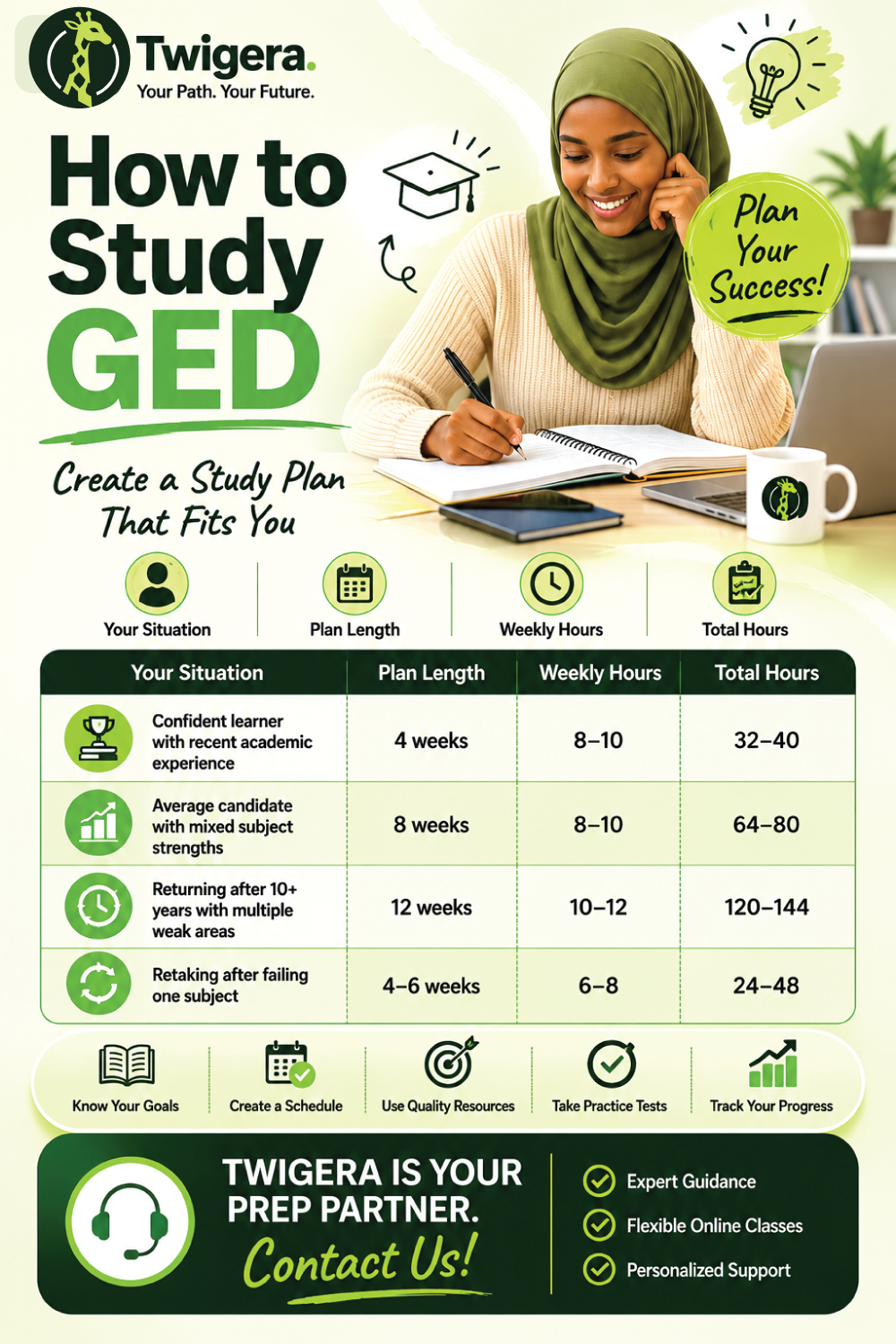
Most candidates pass the GED in four to twelve weeks at eight to twelve hours a week. Here are concrete 4-, 8-, and 12-week study plans, subject tactics, free resources, and the readiness check that predicts a pass.


Most candidates pass the GED in 4 to 12 weeks studying 8 to 12 hours a week. Start with a diagnostic to find weak subjects, rotate all four subjects weekly to avoid burnout, and use free tools like Khan Academy and GED.com PDFs. Take the official GED Ready practice test near the end, and once you hit green, schedule the exam within two weeks.
Pin this guide so you can find it again.
We refresh these every season. Save it to a Pinterest board and you’ll get the latest version next time you come back.
Save to PinterestQuestions people ask.
- How long does it take to study for the GED?
Most candidates need 4 to 12 weeks, though the full range is 1 to 6 months. Strong recent learners may pass in as little as 4 weeks, while those returning to academics after several years often need 12 weeks or more. Most study plans work best with 8 to 12 hours of preparation per week.
- How many hours should I study for the GED?
For most people, 8 to 12 hours per week is the ideal balance. Studying fewer than 5 hours weekly often slows progress, while pushing beyond 20 hours can lead to burnout. Depending on your starting level, total study time usually falls between 32 and 144 hours.
- How do I study for the GED at home?
Start with a diagnostic test through GED.com or a prep platform like Twigera. Use free resources such as Khan Academy, USAHello, and official GED subject PDFs. Study consistently each week while rotating subjects to avoid burnout, and take the GED Ready practice test before booking the real exam.
- How do I study for the GED for free?
You can prepare for free using Khan Academy for math and science, USAHello Classroom for GED lessons, official GED Testing Service PDFs, and free YouTube channels like Test Prep Champions and Light & Salt Learning. Free resources are enough for many students when paired with consistent practice and a structured schedule.
- What is the best way to study for GED math?
GED math is often the most-failed subject, so focus heavily on algebra, geometry, and data analysis. Learn the GED formula sheet early and practice with the TI-30XS MultiView calculator used on the exam. Khan Academy provides strong free support for GED-level math.
- Can I study for the GED in 30 days?
Yes, but usually only for students with recent academic experience and enough weekly study time. Most candidates need closer to 8 weeks for reliable preparation. If you have been away from school for several years, a longer timeline is usually more effective.
- Do I need to take GED Ready before the real test?
It is highly recommended. GED Ready is the official practice test and the best predictor of real exam performance. Students who receive a green "Likely to Pass" score are very likely to pass the actual GED exam.
- Is it better to study one subject at a time or rotate?
Rotating subjects is usually more effective than focusing on one subject for weeks at a time. Alternating subjects improves retention, reduces burnout, and keeps study sessions balanced. Many successful students use weekly focus rotations while still reviewing all four subjects consistently.
Amara is the editor at Twigera. She came to publishing the long way — a decade teaching the GED in community colleges and adult-learning centers, where she watched students pass not on talent or time, but on the strength of a study plan they actually trusted. Now she shapes the guides students read here for the parent studying after a closing shift, the second-career welder, the grandmother finishing what she started forty years ago. Expect honest timelines, math made survivable, and study plans built around real life — not around a textbook's idea of one.
Take the next step — start today.
Our online GED course includes every subject, a free 30-minute diagnostic, and a 7-day refund on every plan.