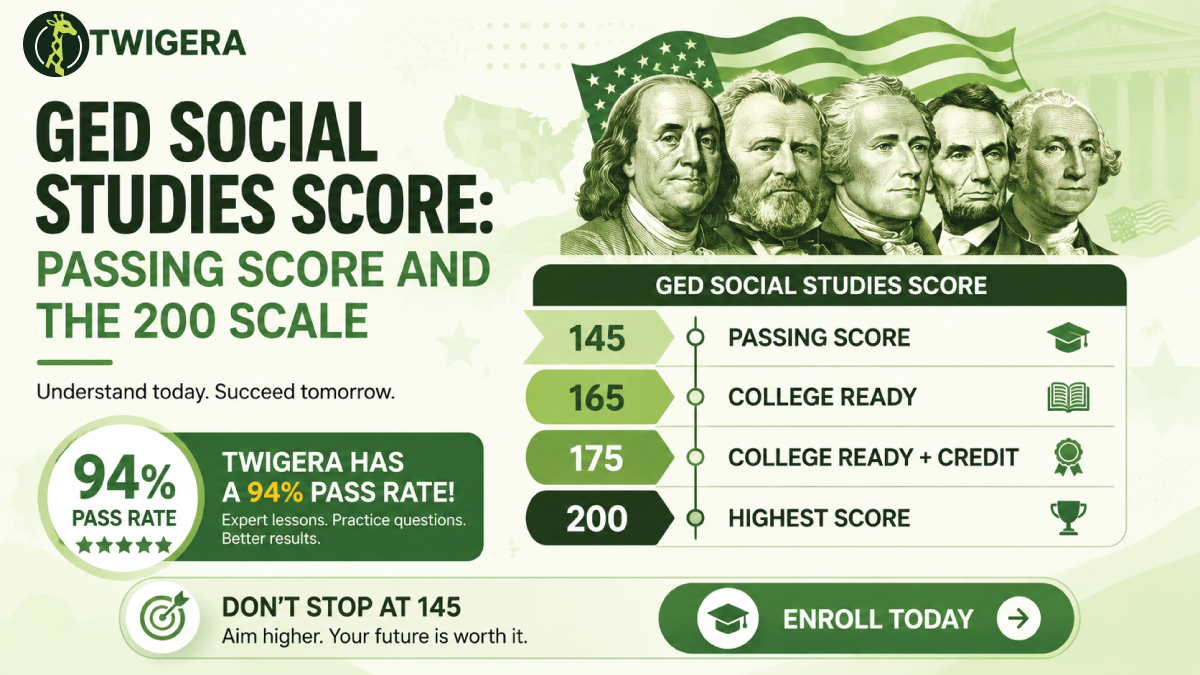
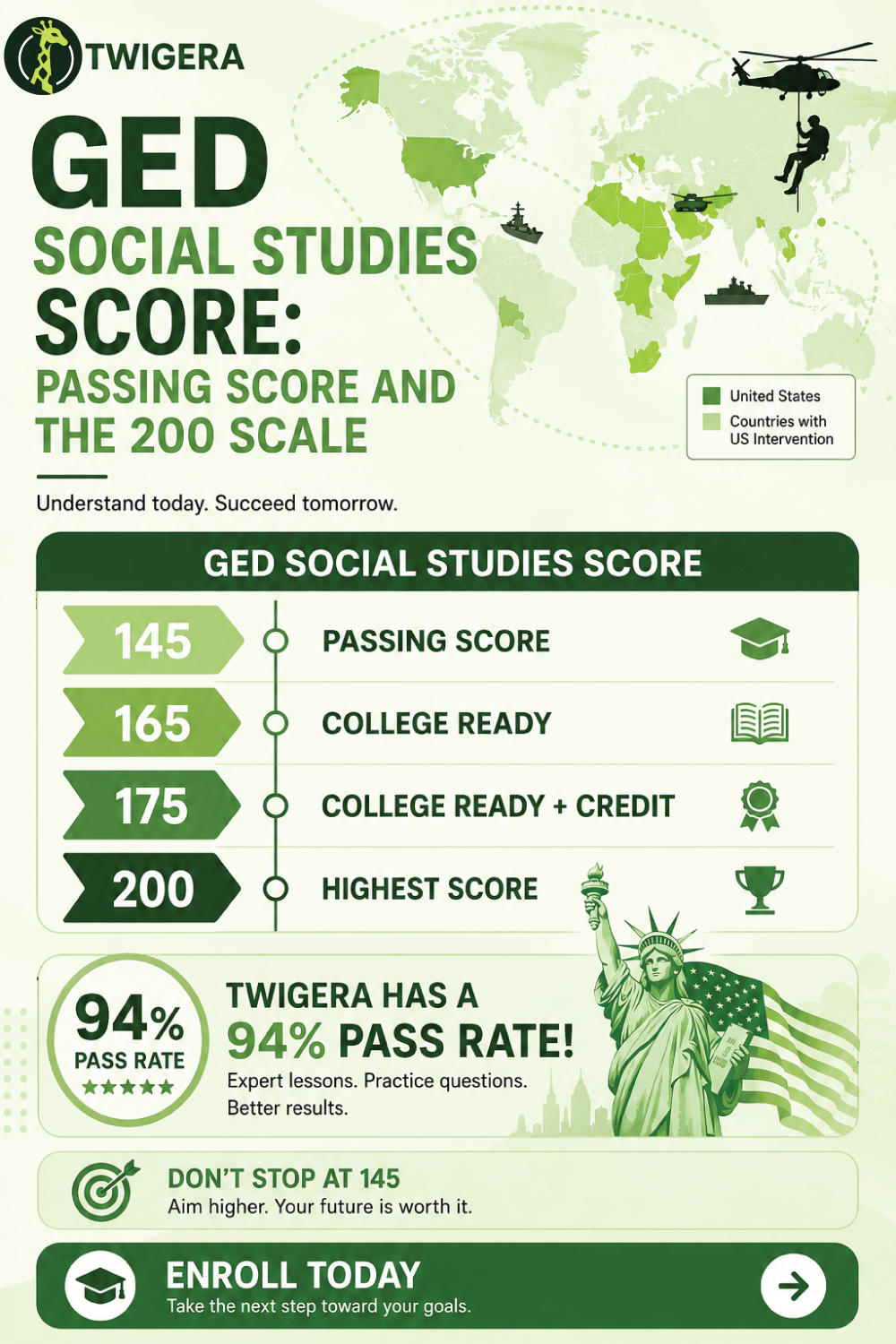
Your score places your performance in one of four bands. Read it as a band, not as a mark out of 200.
Score | Performance level | What it means |
|---|
100–144 | Below Passing | You have not yet reached the passing standard |
145–164 | Pass / High School Equivalency | You have met the GED passing standard |
165–174 | GED College Ready | Skills associated with readiness for college-level work |
175–200 | GED College Ready + Credit | You may be eligible for college credit |
The 145 threshold applies to each subject separately. You cannot offset a 138 in Social Studies with a 170 in another subject — every module has to clear 145 on its own. If you want the full picture across all four subjects, see our guide to the GED passing score.
One more detail that trips people up: the band names are national, but what a College Ready score entitles you to is not. Placement-test exemptions and credit awards are decided by individual colleges and, in some cases, state systems. The score is the same everywhere; what it buys you is not.
A common mistake is to divide: 145 out of 200 is 72.5%, so surely you need 72.5% of the questions right. That is not how the test reports results.
The GED reports a scaled score. Scaling accounts for the fact that different forms of the test vary slightly in difficulty, so the same scaled score represents the same level of skill whichever form you sat. A raw percentage would not do that.
The practical consequence is that no percentage target is meaningful. “I need 72.5% correct” is a sentence that cannot be acted on, because the conversion from questions-correct to scaled score is not published and is not fixed. Aim at the skills, not at a percentage.
The same reasoning explains why 100 is the bottom of the scale rather than zero. The scale is a reporting device, not a tally of your answers, so its endpoints carry no arithmetic meaning either. A 100 does not mean you got nothing right.
It means you passed Social Studies. That is the whole of it. Some worked examples:
The gap between 144 and 145 is the only one that decides whether you passed. Every gap above 145 is about performance level, not about pass or fail — which is why a 149 and a 164 are the same outcome for the credential, and different signals for what comes next.
This matters when you are deciding whether to retake a subject you already passed. Nothing about the credential improves by moving from 149 to 158; both are a pass. Retaking is worth it when you need a specific band — College Ready for a placement exemption, for instance — and rarely worth it otherwise. Our guide on whether you can retake the GED covers the rules and the fees.
A score of 165 to 174 puts you in the GED College Ready range. GED Testing Service describes this as having the skills needed to start college-level courses, and notes it may exempt you from placement tests or remedial, non-credit courses. That exemption can save real time and money.
175 and above is College Ready + Credit, which indicates skills taught in college-level courses and can make you eligible to earn college credit. Read that as an opportunity rather than a guarantee: the credit actually awarded depends on the individual college or programme, and each institution sets its own policy.
Neither band is a requirement. You can earn the GED credential with four scores of exactly 145 and never touch either one. They exist because the same test can also say something useful about college readiness, and that information is free once you have sat the exam.
There is no dependable “X questions correct equals 145” rule, and you should be wary of any source that offers one. Questions vary in difficulty and in what they demand, and the conversion from raw correct answers to a scaled score is not published.
So stop counting how many you can afford to miss and prepare for the skills instead. The official assessment framework lists the social studies practices the test measures:
Drawing conclusions and making inferences
Determining central ideas and conclusions
Analyzing events and ideas
Understanding words and phrases in context
Analyzing purpose and point of view
Evaluating reasoning and evidence
Comparing information across texts
Reading graphs, charts and other data
Measuring the center of a statistical data set
Notice how few of those are about remembering history. A study plan built only on facts will leave most of that list untouched.
Those reasoning skills are applied across four content areas: civics and government, United States history, economics, and geography and the world. Because civics is roughly half the test, that is where a plan aimed at 145 should start.
A single passage can generate three different questions. Suppose it argues that citizens should have greater access to voting. One question asks for the author's central claim. A second shows a voting-participation graph and asks you to name a trend. A third gives a second viewpoint and asks how the two differ.
Same subject, three different skills. Knowing the history of voting rights helps with all three, but it answers none of them on its own. Our guides to GED social studies civics and GED social studies history work through both content areas with the question types attached.
A score below the line is information, not a verdict. Say you scored 138. Sitting another full practice test immediately is the least useful next step, because it tells you the same thing again without explaining why.
Work out what caused the misses first. Was it civics and constitutional concepts? Historical sources and cause-and-effect? Economic concepts? Graphs and data? Or simply reading the question accurately under time pressure? Those five failure modes need five different responses, and guessing between them wastes the retake.
A GED social studies score below the line usually has one dominant cause rather than five small ones, which is good news: fixing the dominant one moves the number most. A timed free GED diagnostic test is a faster way to find it than another full practice paper.
Once you can name the pattern, the next session has a target. Run this cycle rather than re-reading:
Diagnose: find the skills causing the most missed questions.
Review: study only the concepts connected to those mistakes.
Practise: answer new questions covering the same skills.
Explain: write down why each correct answer is supported by the evidence.
Retest: use a fresh set to check whether the weakness has actually closed.
The explain step is the one people skip and the one that does the work. If you cannot say why the right answer is right, you have memorised a letter rather than learned a skill.
Yes, but not recently, and this is where a lot of confusing search results come from. The fifth-generation GED test launched in 2014 with a passing score of 150. In January 2016 GED Testing Service revised the performance levels and lowered the passing standard to 145 per module, applying the change retroactively to 1 January 2014. Whether a past result was re-graded was left to each state.
Since then the standard has not moved. A search result promising a different passing score “for this year” is almost always describing the same 145 with a fresher date attached to it. Treat any figure other than 145 with suspicion, and check it against GED Testing Service directly rather than against a prep site.
The bands below are current:
Target | Score |
|---|
Minimum passing score | 145 |
GED College Ready | 165 |
GED College Ready + Credit | 175 |
Highest possible score | 200 |
Passing is the requirement, but stopping the moment one practice test returns 145 leaves no margin. Test-day performance varies, and a plan calibrated exactly to the pass mark fails roughly half the time it is tested.
Set 165 as the preparation target instead and let 145 be the floor you clear comfortably. If you sit consistently around 150, work on the specific question types costing you points. If you are already in the 160s, work on consistency and on the harder source-analysis items.
A realistic progression looks like this: 142 means identify the weak skills; 151 means strengthen those areas; 160 means work the difficult question types; 168 means maintain. The number is not the point. What you do next because of the number is the point.
Resist re-scoring after every session. Practice scores bounce around for reasons that have nothing to do with your skill — a passage on a familiar topic, a good night's sleep, a quiet room. Take the trend across three or four sittings and ignore the individual readings.
Each band suggests a different next step, and treating the result as feedback rather than a verdict is what makes a retake efficient:
141: close, but below the standard. Diagnose before retaking.
148: passed. Consider more preparation if college is next.
166: College Ready. Placement-test exemptions may apply.
178: College Ready + Credit. Ask the college about credit policy.
A passing score gets you across the line. A higher target gives you a stronger benchmark and a margin for the day itself. Use your practice results to find the questions costing you points, study those skills, and test again — and check the GED social studies cheat sheet for the one-page version of what to review.
And if you are still some way from 145, that is a normal place to be starting from rather than a reason to stop. The distance between 138 and 145 is usually two or three specific skills, not a general shortage of ability — which is exactly why diagnosing beats retaking blind.