Here are the 8 most-searched online GED programs in 2026, with honest strengths, weaknesses, and the type of learner each one actually fits.
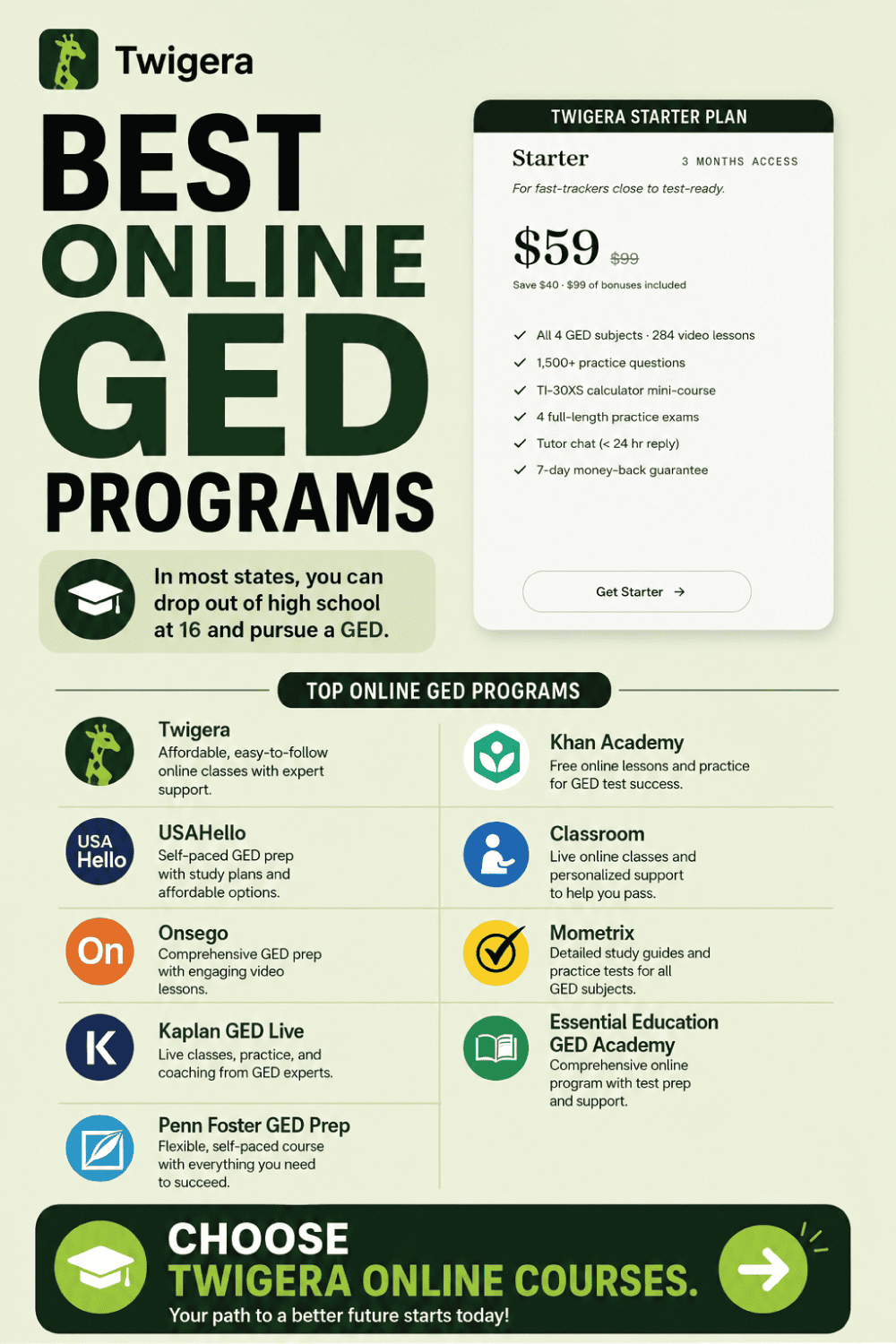
Cost: Three one-time tiers — Starter $59 (3 months), Standard $99 (6 months), Pro $159 (12 months). All plans include a 7-day money-back guarantee. The Pro plan adds a Pass Guarantee: complete the course, attempt the official GED within 90 days, and Twigera refunds every dollar if you do not pass.
What you get: Self-paced GED prep across all four subjects with 284 video lessons, 1,500+ practice questions, a TI-30XS calculator mini-course, and a diagnostic so you do not waste time on what you already know. Standard and Pro add CBT-style full-length exams, essay review, and live teacher video sessions.
Strengths: One-time pricing (no surprise renewals), a real Pass Guarantee on Pro, calculator coverage that most prep skips, and 7-day refund on every tier. Built for learners balancing work, family, and study.
Weaknesses: Newer brand than Kaplan or Onsego, which matters to shoppers who want longer market history. No live group classes on Starter and Standard tiers.
Choose Twigera if: You want affordable self-paced prep with simple pricing, a guided study path, and (on Pro) a real Pass Guarantee.
Skip Twigera if: You need live scheduled instructor-led classes every week.
Cost: $79–$199 depending on access length and features. Plans include all four GED subjects, video lessons, practice tests, GED Ready vouchers, flashcards, and calculator support.
What you get: Self-paced video prep aligned to the GED test. Short lessons, regular practice, and YouTube visibility that makes the brand familiar to many learners before they pay.
Strengths: Established brand, video-first format, and clear lesson sequencing. Search terms like "is Onsego GED legit" usually come from cautious shoppers — based on its official materials and GED alignment claims, it is a legitimate provider.
Weaknesses: Not the cheapest option once you compare one-time low-cost programs. Heavy video dependency does not fit every learner — some need text-based study or guided practice instead.
Choose Onsego if: You want established video-based prep with multiple plan levels.
Skip Onsego if: You want the lowest one-time price or prefer text- and practice-driven study.
Cost: Kaplan GED Live starts at $79 through GED.com. GED Marketplace also lists $79 for one subject and $170 for all four subjects.
What you get: Live online prep developed by GED Testing Service and Kaplan Test Prep — live interactive classes, recorded class replays, and email access to GED experts.
Strengths: One of the strongest options for learners who need live teaching. Live instruction adds structure and accountability if you struggle alone. Kaplan also has decades of brand authority, and the printed Kaplan GED prep book is a reliable self-study companion.
Weaknesses: Live instruction costs more than self-paced options and requires you to fit a class format into a busy schedule.
Choose Kaplan if: You want live classes, instructor support, and a formal GED prep setup.
Skip Kaplan if: You want cheaper self-paced prep and already study well on your own.
Cost: Penn Foster’s adult high school diploma program lists a pay-in-full price of $1,149. This matters because many people searching for "Penn Foster GED" end up comparing GED prep with Penn Foster’s online high school diploma path — they are not the same product.
What you get: Penn Foster is best understood as a diploma-focused education provider. Its own GED-vs-diploma content explains the difference between earning a GED by passing four tests and earning a full high school diploma through coursework.
Strengths: Long education history and brand recognition. A good fit for learners who actually want a high school diploma rather than only GED test prep.
Weaknesses: Confusion. A "Penn Foster GED" search does not always mean the learner needs a diploma program. If your goal is passing the GED test, a full diploma path costs more time and money than you need.
Choose Penn Foster if: You actually want a full online high school diploma program.
Skip Penn Foster if: You only want focused GED test prep.
Cost: Free.
What you get: Khan Academy is not a dedicated GED course. It offers strong practice content that maps to all four GED subjects — Mathematical Reasoning, Reasoning Through Language Arts, Social Studies, and Science — through short videos and exercises.
Strengths: One of the best free tools for GED math and science review. Works well for students who already know what they need to study and want extra practice without paying.
Weaknesses: Not a full GED program. No GED-specific course structure, no scored full-length practice tests, no test-day strategy.
Choose Khan Academy if: You are self-disciplined and need free subject review.
Skip Khan Academy if: You need a complete course built around the GED test.
Cost: Free.
What you get: Self-paced, mobile-friendly, ad-free online GED classes built with immigrants and ESL learners in mind.
Strengths: One of the most helpful free resources for adult learners — simple, safe, accessible from a phone or computer, and structured enough to follow without external scaffolding.
Weaknesses: May not offer enough testing depth for every learner. You will likely still need official practice tests or a paid course if you want stronger scoring feedback.
Choose USAHello if: You need a free, beginner-friendly GED study option — especially as an ESL learner.
Skip USAHello if: You want stronger practice, scoring feedback, or a more complete paid plan.
Cost: Around $39.99 for common study guide options, depending on format and retailer.
What you get: A study guide and practice resource rather than a full online course. Mometrix focuses on lessons, review, drills, and test-taking strategy.
Strengths: Affordable and useful for extra drills. Fits learners searching for "best GED prep online" when they do not need a full course wrapper.
Weaknesses: Does not give the same level of guidance as a structured online program. Some learners need more support than a study guide alone offers — see our roundup of the best GED prep books for stronger book-based alternatives.
Choose Mometrix if: You want low-cost practice and strategy review on top of free content.
Skip Mometrix if: You need lessons, accountability, and a full study path.
Cost: $19.99/month, with a $99.99 lifetime access option mentioned in its student cost guidance.
What you get: An online, mobile-friendly course with built-in practice tests and adaptive learning. Lessons adjust to your skill gaps so you focus on what you still need to master.
Strengths: Works well for learners who want adaptive lessons instead of a fixed course. Strong adoption in adult education settings, which is a real signal of quality for self-study.
Weaknesses: Monthly pricing adds up when study takes longer than planned. Learners who prefer one-time pricing should look elsewhere.
Choose Essential Education if: You want adaptive GED lessons and a personalized study plan.
Skip Essential Education if: You dislike subscriptions or want a simpler one-time payment.
Free GED prep can work, but it takes discipline. You will need to build your own study plan, track your weak areas, and know when you are ready for the real exam. Use this stack only if you can study consistently without external accountability.
Use Khan Academy to strengthen core skills — algebra, word problems, graphs, basic science, and reading charts. Tag the exercises that map to the GED Mathematical Reasoning and Science sections and work through them in 30-minute blocks.
USAHello gives you a more organized curriculum, which matters when random videos and worksheets feel hard to follow. Use it as your week-by-week structure spine.
Use the official GED subject guides at ged.com to understand what each test covers before you study. These are written by the same organization that builds the exam, so they are the closest thing to an answer key for what to prioritize.
This is the one part we would not skip. Each GED Ready test costs about $6.99 per subject, so all four subjects cost about $28. It is the closest signal of whether you are ready before paying for the real test — and the GED Testing Service is explicit that GED Ready scores correlate strongly with actual test performance.
Many state-funded adult education centers offer free or low-cost GED help. Some provide hybrid support with online lessons and in-person guidance. If you are not sure where you can take the exam locally, see our guide on where to take the GED.
This free stack works best for learners who are self-disciplined, patient, and able to study without much support — and especially if you are already strong in one or two GED subjects.
Twigera and Onsego are the two most common self-paced GED prep choices for learners who do not want live classes. The right pick depends on how you like to study and how much you want to spend.
Feature | Twigera | Onsego |
|---|
2026 price | $59–$159 one-time | $79–$199 |
Format | Self-paced + diagnostic + 1-on-1 video (Pro) | Self-paced video lessons |
Best strength | Simple one-time pricing + Pass Guarantee on Pro | Established brand and strong YouTube presence |
Best for | Learners who want structure, affordability, and a guarantee | Learners who prefer video-led study |
Main drawback | Newer brand | Pricing can feel less simple |
Best choice if | You want one-time pricing and guided prep | You learn best through videos |
For the typical learner in 2026, Twigera is the better value if you want lower one-time pricing, a guided study path, and a Pass Guarantee on the Pro plan. Onsego is still a solid choice — it has more YouTube visibility and may feel more familiar if you already like its teaching style. Choose Onsego if video-first learning matters most. Choose Twigera if you want affordable self-paced prep with clearer pricing and more reassurance before test day.
Some GED prep programs look helpful at first, but the details tell a different story. Before you sign up, slow down and check for these warning signs. For a deeper look at outright scams, see our fake GED warning.
Be wary of any program promising you will pass the GED in a few days. Some learners do move fast, but real prep takes time, scored practice, and honest feedback. Crash promises usually translate into either thin curriculum or pressure tactics that hide the real time investment.
A program that hides its price may lead you into sales calls, upsells, or pressure to pay more than planned. Clear, posted pricing protects your budget — every legitimate program in this guide lists prices on its own site.
Free GED prep exists. A real GED credential is not something you download from a random website. Pages promising a free GED diploma online are almost always scams — the test itself is administered through official testing centers and PearsonVUE-proctored online sessions.
Outdated course content
The GED test was redesigned in 2014 and continues to receive minor updates. Look for programs with current 2026 content, recent practice materials, and lessons updated within the past two years.
Be cautious with programs that make big claims but do not show pass rates, student outcomes, reviews, or any evidence behind their promises.
Monthly plans are not bad on their own, but they should be clear. Avoid any subscription that renews without simple cancellation terms or clear reminders 7 days before charging your card.
Most GED learners should start with a clear, affordable path — not the most expensive program their search returned. For paid prep, Twigera is the strongest fit if you want one-time pricing, guided study, and a Pass Guarantee on the Pro plan. Onsego is a solid alternative if you prefer an established video-based program.
For a free path, use Khan Academy for subject review, USAHello for structure, and the $6.99 GED Ready Practice Test to check whether you are test-ready. If your real question is whether the test itself can be free (not just prep), see is the GED really free — many states subsidize the fee for eligible adults. Choose Kaplan GED Live only if live instruction matters and your budget allows. Skip Penn Foster GED Prep unless you already trust the brand and understand you are paying for a diploma-style track rather than focused GED test prep.
Whichever option you choose, start with a diagnostic to find your real weak spots, set a 6–12 week schedule, and use the GED Ready Practice Test as your final go/no-go signal. If you have already studied and want to verify your readiness, take a look at how to get your GED online to see the full path from prep through scheduled test day.