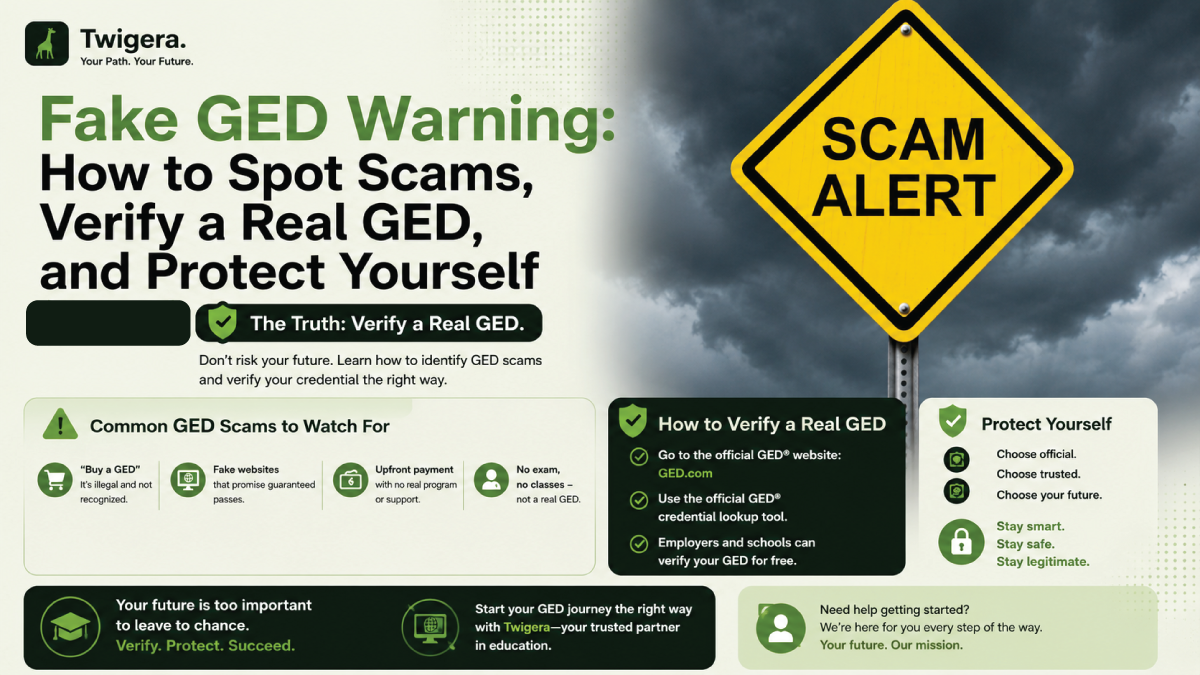
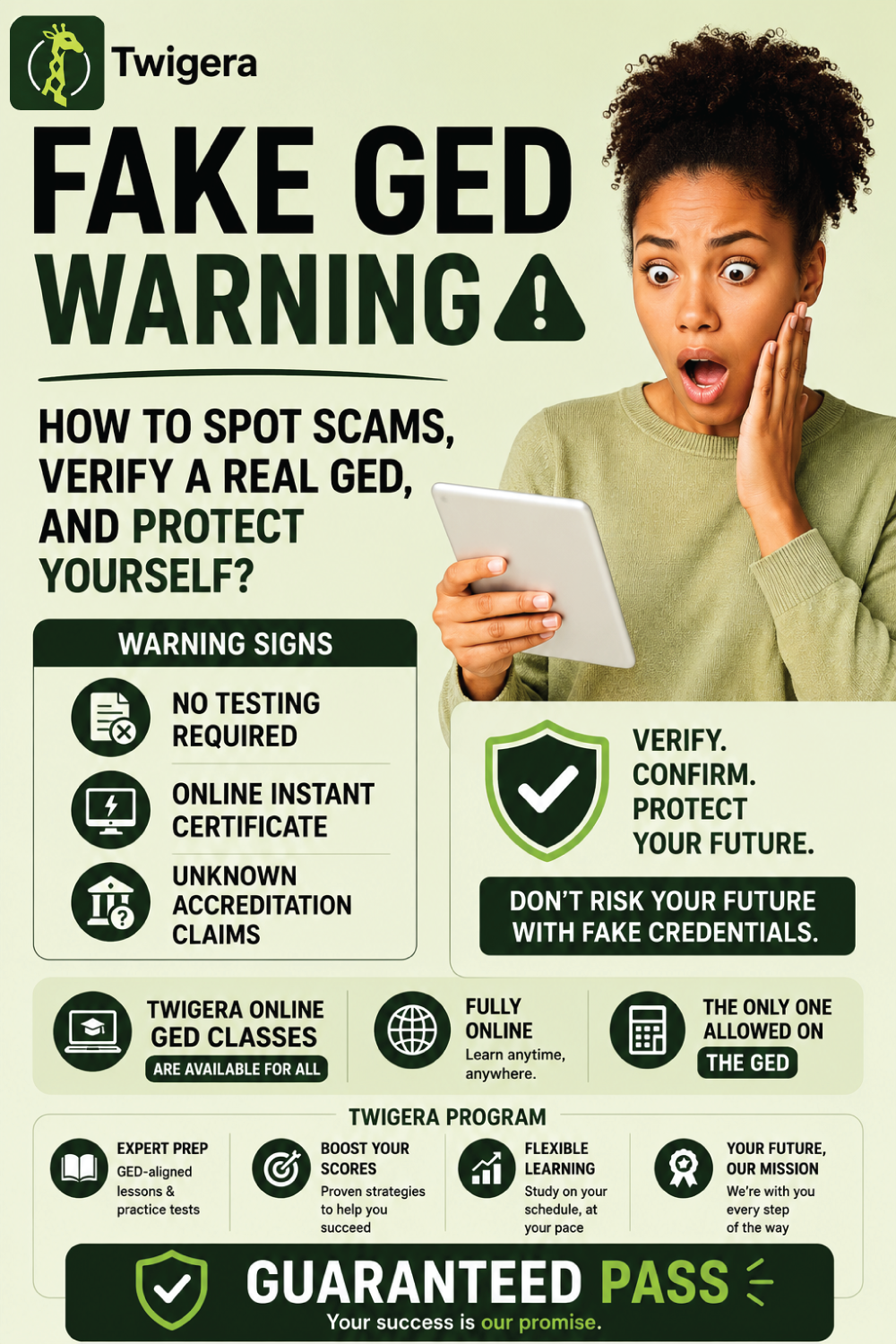
Fake GED Warning: How to Spot Scams and Verify a Real GED
Diploma mills sell fake GED certificates for $100–$300. They are legally worthless, fail background checks, and can cost you your job, college admission, and federal financial aid. Learn the red flags, how to verify a real GED, and what to do if you've already been scammed.
Fake GED certificates sold online for $100–$300 are diploma mill scams. They are legally worthless, easily caught by background checks, and can cost you your job, college admission, and federal financial aid. The only legitimate GED is issued by a state department of education through GED Testing Service at ged.com. Verify any GED through ged.com/verify or the issuing state.
Last reviewed
Earning a legitimate GED prepares you for education advancement and better wages. But diploma mills sell fake GED certificates online for $100 to $300, and the document you receive is legally worthless.
Before you pay anyone for a GED, you need to know how to tell a real credential from a scam.
Fake credentials are a serious problem. Experts estimate that 4.7 billion people globally have been affected by fake degrees, which shows how widespread the diploma mill industry has become.
If you are asking what does a real GED look like, that concern deserves a clear answer. A legitimate GED has specific markers, comes from the right source, and must be verified through official channels.
This guide covers how to spot fake GED offers, how to verify a real GED, the consequences of using a fake one, and what to do if you have already been scammed.
The Real GED: Only One Legitimate Source
A real GED is an official high school equivalency credential issued by your state department of education after you pass the required GED tests. The GED is administered through GED Testing Service, a program connected to the American Council on Education and Pearson.
You do not receive a valid GED from a private "academy," "institute," or website selling instant certificates.
That matters because many searches for how to get a fake GED lead to diploma mills. These sites often promise fast results, but they do not issue legal credentials.
A real GED requires you to pass four subject tests. There is no valid life experience option, no shortcut, and no paid certificate that replaces testing.
The only other widely recognized high school equivalency test is HiSET, offered through ETS. If you want the legitimate path, see how to get your GED online.
Red Flags of Fake GED Offers
Fake GED scams often look polished, but the warning signs are usually easy to spot once you know what to check. Before you pay for any GED certificate, look closely at the promise, the price, the issuer, and the testing process.
If you see any of the red flags below, treat the offer as a scam.
"Earn Your GED in Days or Weeks"
A real GED is not instant. Most learners need 1 to 6 months of preparation, depending on their starting point, schedule, and comfort with the four test subjects.
If a website promises a GED in a few days, it is selling a shortcut that does not exist. A fast certificate is not the same as a valid credential.
"No Testing Required"
This is one of the clearest signs of a fake GED offer. A real GED requires you to pass four subject tests: Math, Science, Social Studies, and Reasoning Through Language Arts.
Someone might create a fake-looking document, but it will not match official state or GED Testing Service records.
"Life Experience Credit"
Scam sites often use "life experience" to make the offer feel reasonable. But no legitimate GED program gives you a GED based on work history, age, job skills, or personal experience.
High school equivalency credentials require testing. If a site says your life experience qualifies you for a GED, treat it as a diploma mill.
"Online Instant Certificate"
Some scams sound believable because the real GED does offer online testing. But the official online GED is still a proctored test, not an instant certificate.
Through OnVUE online proctoring, your identity, testing space, and exam session are monitored. A PDF sent after payment is not proof of a real GED.
High Prices for an "Instant GED"
Fake GED sellers often charge $200 to $500 or more for a worthless document. That is far above the typical real GED testing cost of about $144 total, though fees vary by state.
For the actual breakdown, see how much does the GED cost. If the price is high and the process sounds too easy, pause.
Scammers charge for panic, not education.
Unknown Accreditation Claims
Scam websites often list impressive-sounding accreditation agencies. Those names do not matter if they are not connected to official GED or state education records.
A real GED credential is connected to GED Testing Service, ACE, Pearson, and your state department of education. If you cannot verify the issuing authority through official channels, do not trust it.
The U.S. Department of Education maintains guidance on diploma mills that is worth reading before you pay anyone.
Fake-Sounding Authority Names
Some sites use names like "American GED Academy" or "National GED Institute" to look official. These names may sound credible, but they are not GED authorities.
A legitimate GED comes through your state, not a private company using official-sounding language. The name on the certificate should lead back to a real state education agency.
Job Promises and Fake Testimonials
Another warning sign is a site promising jobs, raises, college admission, or guaranteed approval. No official GED issuer makes those promises.
A GED can support your next step, but it does not guarantee employment or admission. Scam sites often use fake testimonials, stock photos, and generic success stories to make the offer feel safe.
Offshore or Unclear Company Details
A legitimate U.S. GED comes through state education agencies and GED Testing Service. If the company is based overseas, hides its address, avoids naming the issuing state, or gives vague contact details, be careful. I
f the offer avoids testing, hides the issuer, promises instant results, or asks for a large payment upfront, it is not a real GED.
Save for later
Pin this guide so you can find it again.
We refresh these every season. Save it to a Pinterest board and you’ll get the latest version next time you come back.
Using a fake GED might feel like a quick way around a difficult step, but it puts your future at risk. A fake certificate is not a private shortcut — it is a record that can be checked.
Employers, colleges, financial aid offices, licensing boards, and the military can verify whether your GED is real. Once they check official records, a fake GED creates problems that are much harder to fix than taking the real test.
You Could Lose Your Job
Many employers run background checks before hiring, promoting, or renewing contracts. If your GED does not match official records, the employer may treat it as false information on your application.
That can lead to a withdrawn job offer or immediate termination. Even if you are qualified for the role, the issue becomes trust.
You Could Be Expelled From College
Colleges and training programs often require proof of high school completion or a valid GED. If you enroll with a fake credential, the school can cancel your admission or remove you after classes have started.
You may also lose credits, tuition, scholarships, or program eligibility. A fake GED can turn an education opportunity into a serious setback.
You Could Lose Federal Financial Aid
Federal student aid depends on verified eligibility. If you use a fake GED to qualify for aid, you may be required to repay money you received, including grants, loans, or other support tied to your enrollment.
In serious cases, false documents can also lead to fraud investigations.
You Could Face Legal Trouble
Document fraud laws vary by state, but using a fake GED can move beyond a school or work issue. If you knowingly submit a fake credential, it may be treated as fraud.
That risk grows when the document is used for employment, education, government benefits, financial aid, or licensing.
You Could Damage Your Military Future
The military verifies education records. If you use a fake GED to enlist, qualify, or advance, the consequences can be severe.
You could lose your position, benefits, or future eligibility. A fake GED can close doors that a real credential would help open.
You Could Hurt Your Reputation Long Term
Once a fake credential is discovered, the damage can follow your career history. Future employers may question your honesty, even years later.
The safer path is clear — do not use a fake GED. Verify your credential, report scams, and work toward a real GED through official channels.
How to Verify a Real GED
A fake GED can look convincing, but a real credential is not verified by appearance alone. The safest way to confirm a GED is to check it against official records.
This matters because fake credentials get exposed. In one South Florida nursing school fraud case, federal prosecutors said more than 7,600 fake nursing diplomas were distributed before the operation was caught.
Use GED.com/verify
The first place to check is ged.com/verify, the official GED Testing Service verification portal. You enter the credential details, such as the graduate name and credential number, to confirm whether the record is authentic.
If the GED is real, the information should match the official record. If the system cannot verify it, do not rely on the certificate alone.
Contact the State Department of Education
A real GED is issued through a state department of education, so the issuing state is another trusted verification source. Each state adult education or high school equivalency office can confirm credentials issued in that state.
This step is especially useful if the certificate is older, missing details, or issued before newer online verification systems became common.
Use a Background Check Service
Employers often use professional background check services such as SterlingCheck or HireRight to verify education records. These services do not simply look at a document and accept it.
They compare the credential against official records, which is why fake GEDs often get caught during hiring, licensing, or school admission.
What Verifiers Look For
Verifiers usually check for a valid serial number, exact name match, issuing state, date of issue, and record consistency. If one detail does not match, the credential may be flagged.
A real GED should hold up under verification. If a certificate only looks official but cannot be confirmed, treat it as a warning sign.
Visual Markers of a Real GED Certificate
If you are asking what does a real GED certificate look like, start with the issuer. A real GED certificate should come from a state department of education, not a private GED academy, online institute, or paid certificate website.
The certificate should include your full legal name, the date of completion, and a credential or serial number that matches official GED or state records. These details matter because verification is based on records, not appearance alone.
A real GED certificate also usually includes a state official seal. This should be the seal of the issuing state or education department, not a generic badge, school-style logo, or fake "national GED" mark.
Many certificates also include official signatures, often from a state education superintendent or another authorized state official. Some states may include extra security details, such as a holographic element, QR code, watermark, or secure paper.
The document is usually printed on a standard certificate size, often 8.5×11 or 11×17, depending on the state. The design can vary, so do not judge a GED by color, layout, or decorative borders alone.
The main point is simple: a real GED should look official, name a real state authority, and be easy to verify through official records.
What to Do If You Have Been Scammed
If you already paid for a fake GED, do not use it. Do not add it to a resume, job application, college form, financial aid application, military record, or licensing form.
Using the document creates a bigger problem than buying it. A fake GED can be flagged during verification, and that can put your job, admission, aid, or reputation at risk.
Next, report the scam to the FTC at reportfraud.ftc.gov. You should also file a complaint with your state consumer protection office, especially if the company targeted you with false education claims.
If you paid by credit card, contact your card issuer and contest the charge. Share the website, receipt, emails, and any messages that show the company sold you a fake credential.
Then focus on how to get your GED online the legal way. The real path is through GED Testing Service and your state approved testing process.
A fake GED closes doors. A real GED gives you a credential you can use without fear.
Getting a Real GED Is Achievable
Getting a real GED may feel hard at first, but the legitimate path is more achievable than most people think. Many learners prepare in 1 to 6 months, depending on their schedule, subject strengths, and how much support they have.
The full GED test usually costs about $144 total, though the exact price depends on your state. Some states, including New York, Illinois, West Virginia, Connecticut, and Maine, offer the GED at no cost to eligible test-takers.
You also do not have to prepare alone — free learning resources, state adult education programs, and guided prep options can help you build the skills you need before test day.
A fake GED puts your future at risk. A real GED gives you proof of effort, a valid credential, and a safer path toward better education and work opportunities.
Bottom Line
Fake GEDs are a trap. They may look official, but they fail verification and can cost you job offers, college admission, financial aid, or trust.
A real GED is affordable, achievable, and worth the effort. Before trusting any certificate, verify the issuer, check official records, and avoid any offer that promises shortcuts.
If you are not sure where you stand right now, take a few minutes to find out before you commit to anything.
Frequently asked
Questions people ask.
Are online GED certificates real?
ShowHide
Only certificates issued by GED Testing Service (ged.com) and your state department of education are real. Third-party websites selling instant online GED certificates are diploma mill scams — their documents are legally worthless and fail background checks.
Can you fake a GED?
ShowHide
You can create a fake document, but it will be detected. Background checks, employer verification services, and state department of education records reveal fakes. Using a fake GED can cost you your job, college admission, federal financial aid, and in some states result in fraud charges.
What does a real GED look like?
ShowHide
A real GED certificate is issued by your state department of education. It includes the state seal, your full legal name, a credential serial number, the date earned, and signatures from state officials. Many states include holographic security elements or a QR code.
How do I verify a GED is real?
ShowHide
Three methods: (1) use ged.com/verify with the credential number; (2) contact the issuing state department of education; (3) use a professional background check service such as SterlingCheck or HireRight. Any of these can confirm authenticity quickly.
How much does a real GED cost?
ShowHide
About $144 total in most states (around $36 per subject across four subjects). Five states — New York, Illinois, West Virginia, Connecticut, and Maine — offer the GED at no cost to eligible test-takers. Any website charging $200 or more for an instant GED is a scam.
What happens if I use a fake GED?
ShowHide
You can lose your job if a background check flags it, be expelled from college, be required to repay federal financial aid, and in some states face fraud charges. Background checks catch fakes during hiring, licensing, and admissions reviews.
How do diploma mills trick people?
ShowHide
They use professional-looking websites, fake testimonials, official-sounding names like "American GED Institute," and promises of life experience credit or instant certification. They prey on people who want a shortcut. The product is a worthless document.
What should I do if I already paid for a fake GED?
ShowHide
Do not use the document on any application. Report the scam to the FTC at reportfraud.ftc.gov, file a complaint with your state consumer protection office, and contest the charge with your credit card issuer. Then plan to earn a real GED through your state and GED Testing Service.
Amara is the editor at Twigera. She came to publishing the long way — a decade teaching the GED in community colleges and adult-learning centers, where she watched students pass not on talent or time, but on the strength of a study plan they actually trusted. Now she shapes the guides students read here for the parent studying after a closing shift, the second-career welder, the grandmother finishing what she started forty years ago. Expect honest timelines, math made survivable, and study plans built around real life — not around a textbook's idea of one.
Enjoyed this?
Take the next step — start today.
Our online GED course includes every subject, a free 30-minute diagnostic, and a 7-day refund on every plan.