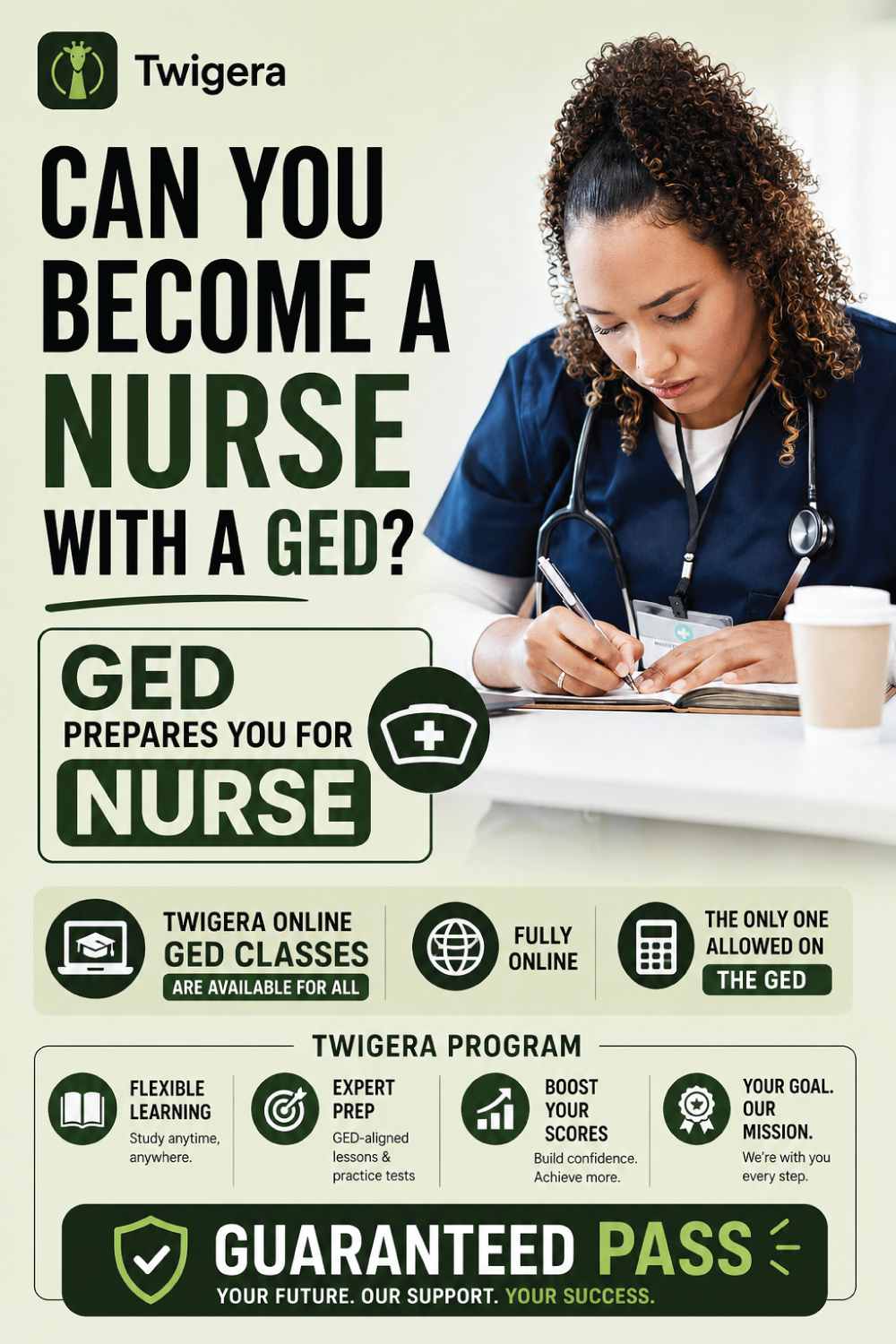
Are you asking yourself, can you become a nurse with a GED? The short answer is yes.
Earning a GED is not easy. It takes focus, discipline, and steady effort over time.
About 85.3% pass once all four sections are completed, and the result changes things — a GED is a recognized credential that opens nursing school the same way a high school diploma does.
Yes, LPN and RN programs accept GEDs. Nursing school is within reach, and your GED is a valid starting point.
In this guide, you will see the full path from GED to nurse, step by step, so you know where to start and what comes next.
Virtually all nursing schools accept a GED as equivalent to a high school diploma. With a GED, you can pursue multiple nursing paths — Licensed Practical Nurse (LPN) programs, Associate Degree in Nursing (ADN) programs, and Bachelor of Science in Nursing (BSN) programs are all open to you.
There are no legal barriers preventing GED holders from entering nursing school. Each school sets its own admission requirements — prerequisite courses, entrance exams, immunization records — but the credential itself is a valid first step toward a rewarding nursing career.
Once you earn your GED, you have more than one way into nursing. The path you choose depends on how fast you want to start working, how much time you can commit, and your long-term goals.
Path | Program Length | Where You Study | GED Accepted | Licensing Exam | Outcome |
|---|
LPN | About 12 months | Community college, trade or vocational school | Yes | NCLEX-PN | Entry-level nurse |
ADN to RN | About 2 years | Community college | Yes | NCLEX-RN | Registered Nurse |
BSN | About 4 years | 4-year university | Yes | NCLEX-RN | RN with broader roles |
Licensed Practical Nurse (LPN) is the fastest route. You train for about a year, then sit for the NCLEX-PN.
After passing, you start working in clinics and long-term care facilities. This path works well if you want to enter the workforce quickly and build experience from the ground up.
Associate Degree Nurse (ADN to RN) is a step up. It takes about two years at a community college.
You still use your GED to apply, and after graduation you take the NCLEX-RN. This path opens more job options, higher pay, and greater responsibility in patient care.
Bachelor of Science in Nursing (BSN) is the longest and most competitive route — usually four years at a university. Your GED is accepted, but schools often expect strong scores, completed science prerequisites, and a solid TEAS exam result.
You may also need essays and recommendations. This path prepares you for leadership roles and specialized nursing fields.
A GED gets you in the door. Nursing programs also want to see whether you are ready for science classes, patient care, and clinical training.
Here is what to expect.
Most nursing programs require science courses before admission, often Anatomy and Physiology, Microbiology, and Chemistry. You can usually take these at a community college, and they may count toward your nursing degree.
Many nursing schools require the TEAS, the Test of Essential Academic Skills, administered by ATI. It covers reading, math, science, and English.
A strong TEAS score can help your application, especially for competitive ADN or BSN programs. If you are still wondering can I become a nurse with a GED, the answer is yes — but the GED is only the first requirement.
Nursing students complete clinical training in real healthcare settings. Schools require a background check and drug screening before placement.
You will need proof of required immunizations and basic health screenings before working with patients. These requirements protect you, your classmates, and the people under your care.
Most programs require Basic Life Support CPR certification before clinical training begins. It is usually a short course, but it is an important part of patient safety.
Some programs prefer applicants with healthcare experience. A Certified Nursing Assistant (CNA) credential can help you stand out and feel more prepared on day one.
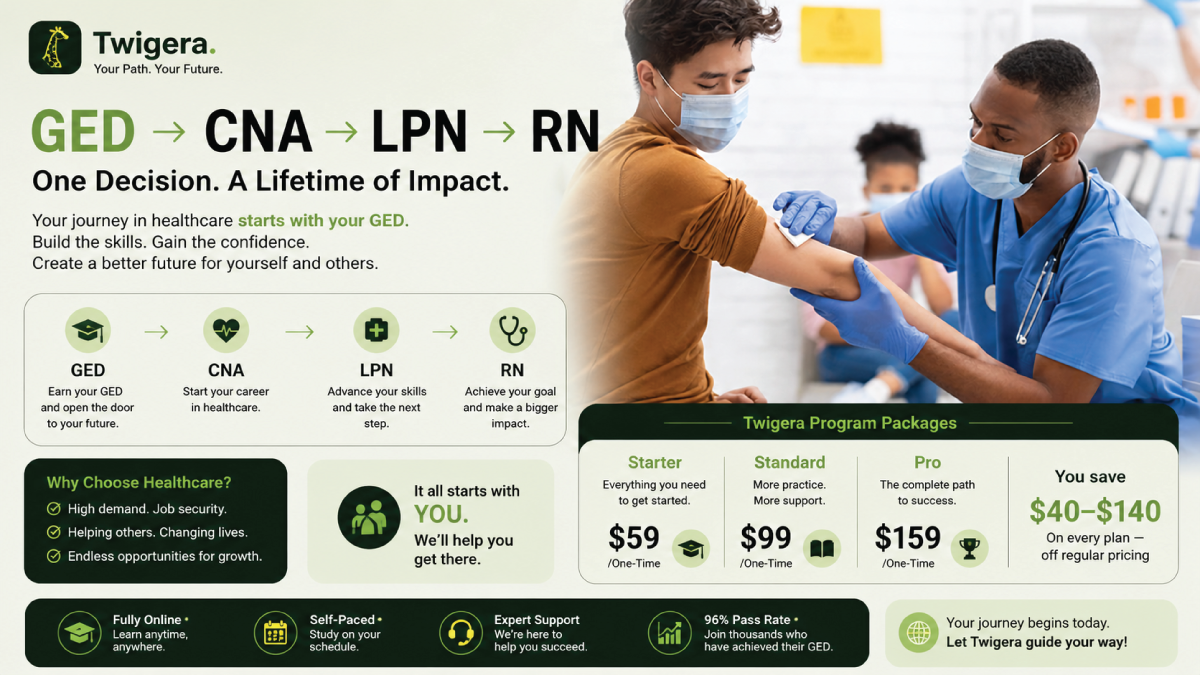
If you want a clear and practical path into nursing, this step-by-step approach works well for many students. It helps you build experience, earn income, and grow your credentials over time.
Start by completing your GED. Aim for a score of 165 or higher, which is considered College Ready and can help with placement and admissions later.
If you need a structured plan, see how to get your GED in 6 steps.
Next, train as a Certified Nursing Assistant (CNA). This usually takes 4 to 12 weeks.
You begin working in healthcare settings and learn basic patient-care skills.
Work as a CNA while taking your science prerequisite courses. This keeps income coming in while you prepare for nursing-school requirements.
Once you meet the requirements, apply to either an LPN program or an ADN program. LPN gets you working faster; ADN leads directly to becoming an RN.
After becoming an RN, you can enroll in an RN-to-BSN program. These programs are flexible and designed for working nurses, so you keep earning while you finish the bachelor's.
This path works because you are not waiting years to get started. You gain hands-on experience early, build confidence, and move forward step by step.
Paying for nursing school is a real concern, but your GED does not hold you back here. You qualify for the same financial aid as someone with a high school diploma — the same federal aid that students bound for trade school tap into.
As a GED holder, you are eligible for federal aid programs. This includes Pell Grants, which do not need to be repaid, and Direct Loans, which help cover tuition and living costs.
Many states offer additional funding for students entering healthcare fields. Programs vary, so it is worth checking what is available in your state. A few examples:
California — BSN/ADN scholarships up to about $10,000, with a 12-month service requirement at a designated underserved site after graduation.
Maryland — Loan Repayment Program (MLRP) for nurses and nursing support staff repays part of qualifying education-loan debt in exchange for two-year service contracts at eligible facilities.
Kentucky — matching-fund nursing loan repayment up to $15,000 per year for two years in a Health Professional Shortage Area, with a dollar-for-dollar employer match (up to $60,000 total).
Tennessee and Virginia — higher-cap loan repayment up to $50,000 over two years (Tennessee allows additional years up to $20,000/year; Virginia uses a 1:1 employer match up to $100,000 total).
Programs like HRSA funding and the NURSE Corps Scholarship Program help cover tuition in exchange for service in high-need areas.
The first step is completing the FAFSA, the Free Application for Federal Student Aid. This form determines what aid you qualify for and opens access to most funding options.
With the right support, nursing school becomes more manageable — your GED does not limit your access to funding.
Nursing offers steady income growth and long-term career stability. Your earning potential increases as you move from LPN to RN and into specialized roles.
Licensed Practical Nurses (LPNs) earn solid entry-level pay. The U.S. Bureau of Labor Statistics reports a median annual wage around $60,790 for LPNs as of 2024, depending on location and setting.
Registered Nurses (ADN or BSN) see a significant jump in earnings. BLS reports a median annual salary of about $93,600 for RNs as of 2024.
With experience and additional education, specialized and leadership roles such as nurse practitioners, managers, or advanced practice nurses can reach $100,000 or more — BLS lists a median north of $129,000 for nurse practitioners.
The outlook is strong. Employment for registered nurses is projected to grow about 5% from 2024 to 2034, faster than average across all occupations.
The demand comes from an aging population, increased need for healthcare services, and ongoing workforce gaps.
For you, this means one thing — nursing is not only accessible with a GED, it is also a career with long-term security and growth.
Yes, nursing is open to you with a GED. You can start as an LPN in about 12 months or become an RN in around 2 years.
A full BSN is also within reach with the right preparation.
The path is clear, and it starts with one step. If you are ready to move forward, focus on your GED, build your prerequisites, and take action toward nursing school.
Before you commit to a prep package, take a few minutes to see exactly where you stand right now.