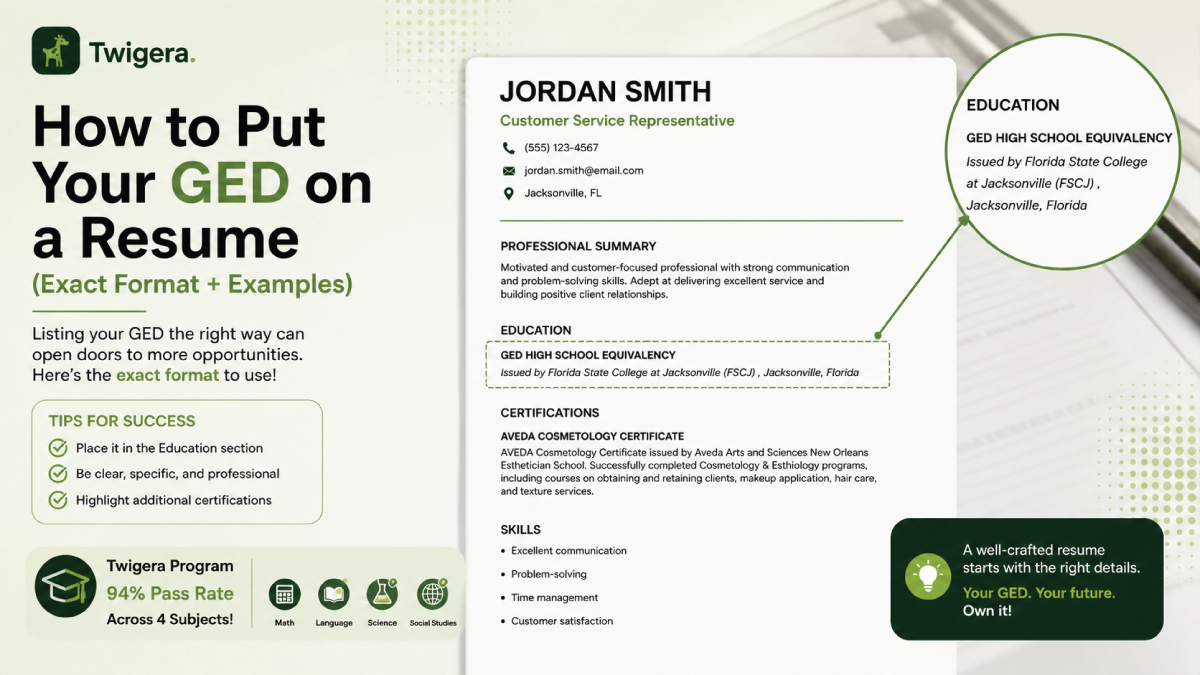
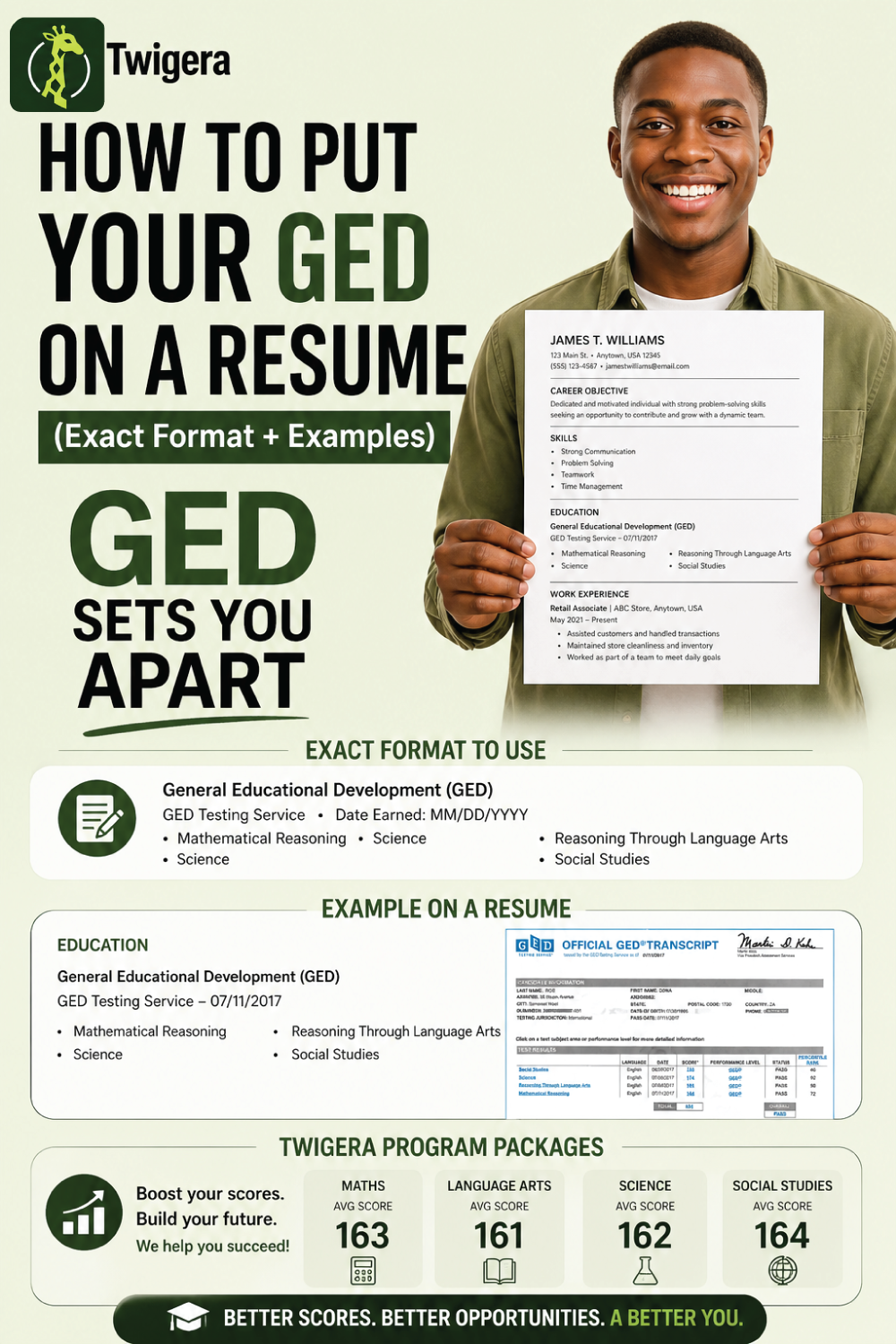
How to Put Your GED on a Resume (Format + Examples)
Exactly how to list your GED on a resume — the format hiring managers expect, score tiers worth including, where it goes by career stage, and the wording that gets caught in background checks.
List your GED in the Education section of your resume. Use the format: "GED Certificate (General Educational Development), [Issuing State], 2026." Include score tier if 165+ (College Ready) or 175+ (College Ready + Credit). Never call it a high school diploma — that's inaccurate and background checks verify. If you also have college credits, list them first, then GED below.
Last reviewed
Did you know that adding your GED to your resume could improve your chances of getting hired? Yes, you got it right.
Roughly 95% of U.S. employers treat GED holders the same as high school graduates, with similar starting pay.
But here is where many people get stuck. They are unsure how to put GED on a resume, or they worry about getting it wrong and hurting their chances.
A small mistake here matters. Writing your GED the wrong way or mislabeling it as a high school diploma is considered fraud and is easily caught during background checks.
The good news is this is easy to fix once you know the correct format. A clear, honest entry shows employers you are qualified and serious.
In this guide, you will learn exactly how to put your GED on your resume, where to place it, and the formats that hiring managers expect to see.
Where Should You Put Your GED on a Resume?
Knowing how to list a GED on a resume correctly can make a big difference in how employers view your qualifications.
Your GED belongs in the Education section of your resume, but its placement depends on your career stage and other credentials.
If you have college or university credits, list those first, followed by your GED. For example:
Education
Austin Community College — 12 Credit Hours, 2023–Present
GED Certificate, Texas Education Agency — 2022
If you hold professional certifications, your GED should appear above them.
For early-career resumes, place the Education section near the top to highlight your academic achievements. On experienced-career resumes, move the Education section further down, focusing first on your work experience and skills.
Exact Format (Copy-Paste Examples)
When listing your GED on a resume, clarity and accuracy are key. Below are examples tailored to different scenarios to help you present your GED effectively.
Basic Format
For most resumes, a straightforward one-line entry works:
This format provides all necessary details in a clean and professional manner.
With Score Tier
If your GED score qualifies for a higher tier, such as College Ready or College Ready + Credit, include it to highlight your academic achievement:
Education
GED — College Ready + Credit, New York State Education Department, 2023
This demonstrates that your performance exceeded the standard passing level.
With College Credits
If you've earned college credits, list them first, followed by your GED:
Education
Austin Community College, 18 Credit Hours, 2023–Present
GED Certificate, Texas Education Agency, 2022
This format emphasizes your ongoing education while still acknowledging your GED Certificate.
Alternative (Spelled Out)
For a more formal approach, you can spell out the GED credential:
Education
General Educational Development (GED) Certificate
Florida Department of Education, 2021
This option works well for industries that value detailed presentation.
Each of these formats ensures your GED is listed accurately and professionally, making it easy for employers to recognize your qualifications. Select the format that aligns best with your career stage and other credentials.
Pro Tip: Preparing for the GED test? With a 94% success rate, Twigera is the go-to program designed by U.S. credentialed teachers. I
t's flexible, effective, and tailored to help you pass with confidence.
What NOT to Do
When learning how to write GED on a resume, your goal is to present your education clearly without creating doubt. A GED is a valid credential, so you do not need to hide it, rename it, or explain it too much.
Here is what not to do:
Do Not Call It a High School Diploma
Never write high school diploma if you earned a GED. A GED is a high school equivalency credential, but it is not the same credential as a traditional diploma.
This matters because employers can verify education during a background check. Misrepresenting your GED as a high school diploma can cost you the job, even if you are qualified.
Do Not Leave the Education Section Blank
Leaving Education blank can make hiring managers pause. It may look like you forgot to include your background or are trying to avoid the question.
List your GED clearly under Education instead. A simple, honest entry looks stronger than an empty section.
Do Not List a Fake GED
Only include a GED earned through an official testing program. Fake GEDs and diploma-mill certificates are easy to question and can damage your credibility fast.
Do Not Add a Fake GPA
A GED does not produce a standard GPA. Adding one creates inaccurate information and may make your resume look unreliable.
If you performed well, use an official score tier instead. For example, GED, College Ready or GED, College Ready + Credit.
Do Not Over-Explain
Your GED does not need a long explanation. In most cases, one clear line under Education is enough.
Keep the focus on your skills, experience, and readiness for the job.
Save for later
Pin this guide so you can find it again.
We refresh these every season. Save it to a Pinterest board and you’ll get the latest version next time you come back.
When deciding how to put a GED on a resume, your score only matters if it adds value. Not every score needs to be shown, and in many cases, leaving it out is the better choice.
A GED score is divided into tiers, and each tier signals a different level of academic readiness. Employers do not expect to see your score, so include it only when it strengthens your profile.
If your score falls in the passing range, keep it simple. A clean GED entry is enough, and most employers will not expect more detail.
If you scored higher, including the designation helps show academic strength. It signals that you are prepared for college-level work, which can matter in competitive roles.
The key is to stay intentional. Only include your GED score when it improves how your resume is perceived, not just to fill space.
Should You Mention Your GED in the Cover Letter?
When thinking about how to add a GED to a resume, many people also wonder if they should mention it in a cover letter. In most cases, the answer is no.
A cover letter is meant to highlight your skills, experience, and results, not repeat your education. Your GED is already listed on your resume, so there is no need to bring it up again.
Employers care more about what you can do than how you earned your credential. That is why your focus should stay on your strengths, work history, and what you bring to the role.
There is one exception. If the job posting asks about your education or requires you to explain your background, address it briefly and move forward.
For example, you can write: "I earned my GED in 2022 and have since built hands-on experience in [industry]."
Keep it short and direct. One sentence is enough, then shift back to your qualifications.
The goal is simple. Keep your cover letter focused on value, while your resume handles the details of your education.
Handling Application Forms That Require "High School Diploma"
When filling out job applications, you will often see the question, "Do you have a high school diploma or equivalent?" This is where many people hesitate.
If you have a GED, the correct answer is yes. A GED is legally recognized as a high school equivalency credential, so you meet that requirement.
Some forms go a step further and ask you to select the exact credential. In that case, choose GED or High School Equivalency if the option is available.
Do not select high school diploma if you only have a GED. Even though they are treated similarly in hiring, they are not the same credential.
This detail matters because employers verify education during background checks. Selecting the wrong option can be seen as misrepresentation, which can affect your chances later in the hiring process.
The right approach is simple. Be accurate, be clear, and match your application to what you list on your resume.
Consistency across your resume, application, and background check builds trust and keeps your application moving forward without issues.
Resume Examples by Career Stage
Career Stage
Best Placement
Resume Example
Why This Works
Entry-Level
Near the top of your resume, especially if you recently earned your GED.
Education
GED Certificate, [State], 2024
Relevant coursework: [trade or skill-based training]
Your GED is one of your strongest qualifications at this stage, so it should be easy to find.
Mid-Career
Below your work experience section.
Education
GED Certificate, [State], 2018
Your job history carries more weight now, so your GED should support your experience without taking too much space.
Career Changer
Under Education, with your new training listed first.
Education
HVAC Certification, Trade Career Institute, 2024
GED Certificate, Ohio Department of Education, 2022
This shows growth and helps employers see your newer skills before your foundational credential.
Bottom Line
List your GED under the Education section using one clear line with accurate wording. Keep it simple, place it correctly based on your experience, and avoid adding unnecessary details.
Accuracy builds trust, and trust is what gets your resume noticed.
Frequently asked
Questions people ask.
How do I put a GED on my resume?
ShowHide
List it under the Education section with this format: 'GED (General Educational Development), [Issuing State], [Year Earned].' If you scored 165+ (College Ready) or 175+ (College Ready + Credit), you can include that designation.
Should I write 'high school diploma' for a GED?
ShowHide
No — never call your GED a 'high school diploma.' The GED is legally equivalent but technically a different credential. Misrepresenting it is fraud and will be caught in background checks. Always write 'GED' or 'GED Certificate.'
Where should the GED go on my resume?
ShowHide
Under the Education section. On an early-career resume, Education is usually near the top. On an experienced resume, Education goes further down. Always list college credits (if any) before the GED.
Should I include my GED score on a resume?
ShowHide
Include it only if it's impressive. A 165+ ('College Ready') or 175+ ('College Ready + Credit') designation is worth showing. A minimum passing score (145) doesn't need to be listed — just 'GED Certificate' is enough.
How do I answer 'Do you have a high school diploma or equivalent?' on a job application?
ShowHide
Answer YES. A GED is legally equivalent to a high school diploma. If the application asks for the specific credential, select 'GED' or 'High School Equivalency.' Never select 'High School Diploma' if you have a GED.
Should I mention my GED in the cover letter?
ShowHide
Usually not. Cover letters focus on skills and experience, not credentials. Only mention it if the job specifically asks about your educational background or if you want to briefly address career gaps. One sentence is plenty.
Can I put my GED in progress on a resume?
ShowHide
Yes. Use: 'GED Certificate — In Progress (Expected Completion: [Month Year]).' This shows commitment and progress. Better than leaving the Education section empty.
Amara is the editor at Twigera. She came to publishing the long way — a decade teaching the GED in community colleges and adult-learning centers, where she watched students pass not on talent or time, but on the strength of a study plan they actually trusted. Now she shapes the guides students read here for the parent studying after a closing shift, the second-career welder, the grandmother finishing what she started forty years ago. Expect honest timelines, math made survivable, and study plans built around real life — not around a textbook's idea of one.
Enjoyed this?
Take the next step — start today.
Our online GED course includes every subject, a free 30-minute diagnostic, and a 7-day refund on every plan.