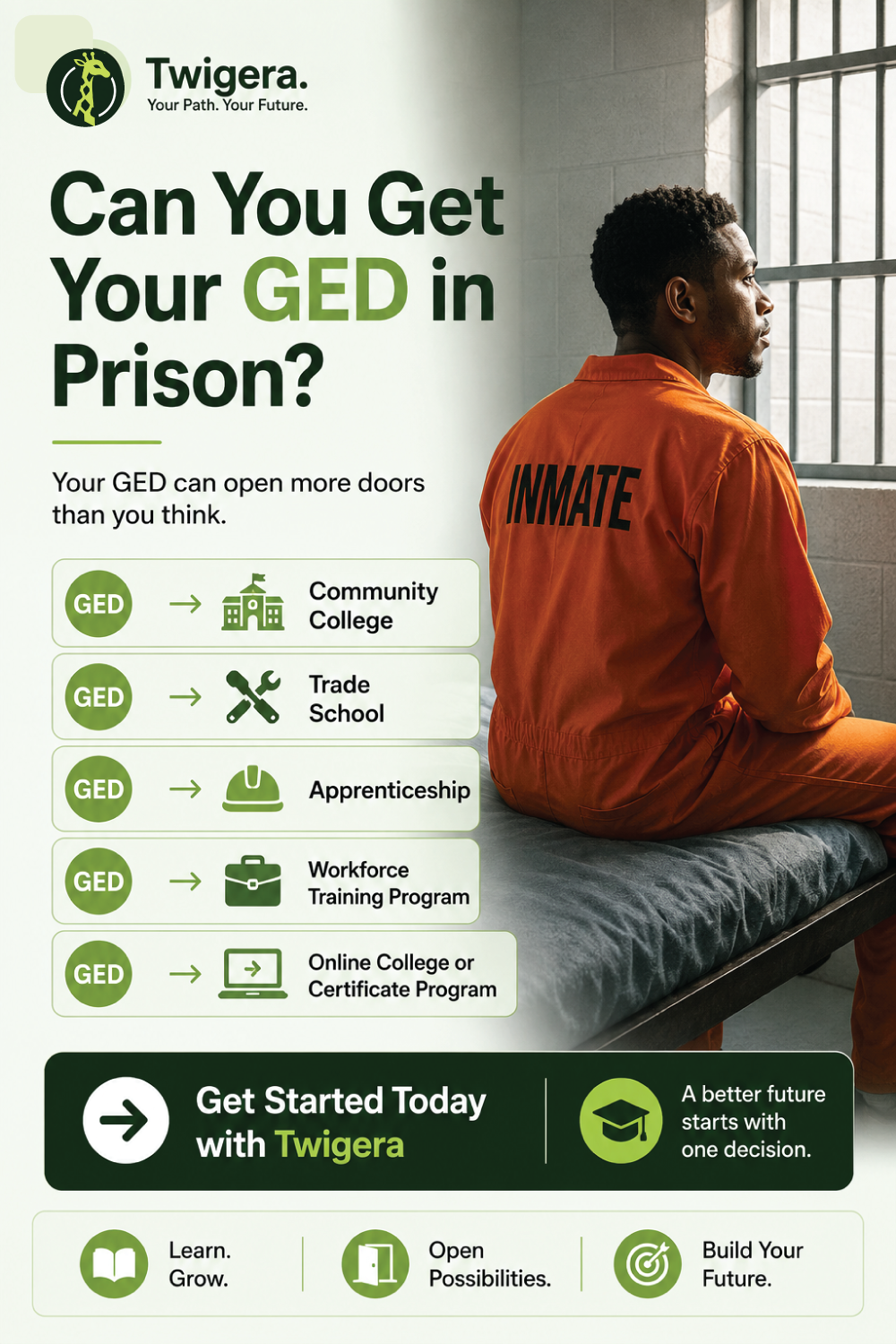
Can You Get Your GED in Prison? Programs, Process & Records
Yes — most US state and federal prisons offer free GED programs, and the credential is legally identical to one earned outside. Here is how enrollment, testing, good-time credit, and post-release transcripts actually work.
Yes — you can earn your GED while incarcerated. Most US state and federal prisons offer GED programs, usually free for inmates. A prison-earned GED is legally identical to any other: same test, same 145 passing score, same recognition. Federal prisons require enrollment for inmates without a credential, and many systems award good-time credit for progress.
Last reviewed
A GED is a high school equivalency credential that shows you have skills in the same range as a high school graduate, across four subjects: math, reasoning through language arts, science, and social studies. So if you are wondering whether you can get a GED in prison, the short answer is yes — and this guide walks through what to expect both while incarcerated and after release.
That question usually leads to bigger ones about access, records, and what comes next. A GED can help you qualify for jobs such as construction, where earnings can range from $37,520 to $97,860 per year. What matters here is not hype — it is knowing which steps are real, which rules vary, and where a GED can take you next.
Quick Answer: Yes, You Can Get a GED in Prison
If you are asking whether you can get a GED in prison, the answer is yes. Many state prisons and the federal prison system offer education programs for people who do not yet have a high school diploma or equivalency credential. The real question is usually more specific: What does this facility offer, how soon can someone enroll, and what happens after they pass?
Program availability
Many correctional systems provide GED programs for inmates through adult basic education or literacy departments. Some facilities have regular classes, trained instructors, and clear testing schedules. Others have waitlists, limited computer access, or fewer class seats. That does not mean the GED is unavailable, but it can affect timing.
Cost
For incarcerated learners, GED classes and testing are usually provided through the correctional system, and families are typically not expected to pay for the prison education program. The bigger issue is access: a person may be eligible but still need to wait for placement, testing dates, or transfer-related delays.
Eligibility
People without a verified high school diploma or GED are usually the priority group. In federal custody the rule is especially clear: inmates without a verified credential must attend adult literacy programming for at least 240 instructional hours or until they earn the GED, whichever comes first, according to the Federal Bureau of Prisons Literacy Program Statement. So yes, you can get your GED while incarcerated — but the process starts inside the facility, not through a regular public sign-up page.
Federal Bureau of Prisons GED Programs
Federal prisons have written rules that make this part easier to explain. If someone is in federal custody, education is not treated as a side activity for people who lack a high school credential.
Mandatory literacy enrollment
The BOP requires eligible inmates without a verified GED or high school diploma to attend an adult literacy program for a minimum of 240 instructional hours or until they earn the GED. People who worry they missed their chance should know that in federal custody the system is designed to identify that need and place the person into education.
Instructor-led classes
BOP literacy programming is structured through education staff, scheduled classes, progress reviews, and official records — students are not simply left alone with a workbook. Classes may include reading, writing, math, and GED preparation, building the skills needed for the official test and for life after release.
Federal good-time impact
Education can also connect to good conduct time rules for some federal inmates. BOP policy explains that satisfactory progress in literacy programming can affect good conduct time under certain laws. That is why there is no single answer to how much time inmates earn for GED classes — it depends on the sentence, the law that applies, and the person progress record.
State Prison GED Programs
State prison systems vary more than federal prisons. Each state sets its own policies, staffing model, and education structure.
State-by-state variation
Most state correctional systems offer some form of adult education or GED preparation, but the experience can differ by facility. One prison may have a strong education department, while another may struggle with staffing or testing access. That is why local searches like "GED completion for jail inmates in Michigan" are common — people are trying to find the local process. Common differences include:
class size and waitlist length
teacher availability and testing schedule
study materials and computer access
transcript support after release
High-quality examples
Some states have more visible prison education systems. Texas operates correctional education through the Windham School District, which serves people in the Texas prison system. California offers academic and career education through the California Department of Corrections and Rehabilitation. Still, do not assume every facility in a large system works the same way — a state program can be strong overall and still have delays at a specific prison.
Verification check
If you are helping someone inside, contact the facility education department when possible and ask direct questions. Those answers are more useful than general advice — the GED path is real, but the details are local.
How GED Programs Work in Prison
A prison GED program usually follows a practical sequence: assess, place, teach, test, and issue the credential.
Enrollment and assessment
During intake or early placement, staff usually review a person education history. If there is no verified diploma or GED, the person may be assessed for literacy level and placed into education. In federal prisons, BOP policy says inmates ordinarily begin literacy programming within 120 days after arriving at an institution, though waitlists and facility conditions may affect timing. That first assessment helps determine whether a student needs basic reading and math support before full GED preparation.
Curriculum and materials
The GED test covers four subjects — Mathematical Reasoning, Reasoning Through Language Arts, Science, and Social Studies — according to GED Testing Service. Prison classes prepare students for those same areas. The setting may be different, but the test content is not. Materials can vary: some students use printed packets and textbooks, while others have supervised computer access, tablets, or classroom software.
Official testing
The GED passing score is 145 on each subject test, and students must pass all four subject tests to earn the credential. That standard is the same outside prison — a correctional facility does not get a lower passing score or a special version of the exam.
Credential issuance
After a student passes, the credential is issued through the state normal high school equivalency process. The prison may help coordinate testing, but the credential itself is not a prison-only document — an important point for anyone worried about how the diploma will look later.
Is a GED Earned in Prison the Same as a Regular GED?
Yes. A prison-earned GED uses the same subject areas and the same passing score as any other GED — the official passing score remains 145 per subject. It is not a lesser credential, and there is no separate prison GED category with reduced value.
Wide acceptance
A GED can be used for many of the same next steps as a high school diploma, including job applications, going to college with a GED, trade school, and training programs. Some programs may have extra admissions rules, placement tests, or background requirements, but that is separate from the GED itself.
The diploma appearance
A common worry is that the credential will say it was earned in prison. In general, the GED record is issued through the state system, not as a prison-branded diploma. So getting your GED in prison does not make the credential itself look different from one earned after release.
Save for later
Pin this guide so you can find it again.
We refresh these every season. Save it to a Pinterest board and you’ll get the latest version next time you come back.
Education can affect more than academics. Some systems use incentives to encourage GED progress.
Good-time credit
People often ask how much time inmates earn for GED classes, and there is no single national number. In some systems, GED completion or satisfactory education progress may connect to good-time credit or sentence-related benefits. In federal custody, BOP policy connects literacy progress to good conduct time rules for certain inmates. For state prisons, the answer depends on state law and facility policy, so always verify with the case manager, education department, or correctional records office.
Institutional privileges
Some facilities also use smaller incentives. BOP policy says wardens must establish incentives to encourage inmates to obtain a GED credential, and examples may include small cash awards, consumables, or certificates. So do GED programs give you money in prison? Sometimes there may be small incentives, but they are limited and facility-specific. Do not treat prison education as a paid job — treat it as a credential path.
Long-term benefits
The larger benefit is what the GED can support after release. It can help with job applications and the jobs you can get with a GED, trade training, community college, apprenticeships, reentry planning, and confidence with paperwork and testing. It will not solve every barrier, but it gives a person one recognized credential to build from.
Post-Release: Accessing Your GED Records
After release, the GED only helps if you can prove you earned it — which means transcripts matter.
How to request transcripts
If you are searching how to get a copy of a GED received in prison, start with the state where the GED was issued. The prison may have helped with classes, but the state usually controls the official record. Use the exact legal name, date of birth, and approximate test year connected to the record.
Situation
Best place to start
GED earned in a state prison
State GED office or state education department
GED earned in federal custody
State where the test was issued, then BOP records if needed
Unsure which state issued it
Facility education office or release paperwork
Older or hard-to-find record
State GED administrator, DiplomaSender, or Parchment if used by that state
Standard costs
Transcript fees vary by state and vendor, and many states charge a small fee for duplicate transcripts or diplomas. That fee is usually the same type of fee other GED holders pay — it is not charged because the GED was earned in prison.
Common logistical challenges
The hard part is often finding the right issuing state. A person may live in one state now but earned the GED while incarcerated somewhere else, which is why requesting a record earned in an Ohio prison has a different answer than one earned in Texas, California, or federal custody. Older records can take longer, and name changes, missing ID, and pre-digital files can slow the process too.
Post-Release Education Pathways
A GED is not the finish line — it is a starting point.
Community college and trade schools
Many community colleges and trade schools accept GED holders. That can open paths into programs such as HVAC, welding, construction, automotive technology, culinary training, commercial driving, and health care support roles.
Pell Grants restored
Federal Student Aid says a person may be eligible for a Federal Pell Grant if they are confined or incarcerated and enrolled in an approved Prison Education Program. For the 2026–2027 award year the maximum Federal Pell Grant is $7,395, though the actual amount depends on financial need, school cost, and enrollment status. This can matter for both incarcerated students in approved programs and people continuing school after release.
Online prep and adult education
Some people leave prison before finishing all four GED subjects; others never got into classes while inside. Post-release options include free adult education programs, community college adult basic education, library study support, nonprofit reentry programs, and getting your GED online. Online study can help fill the gaps with adaptive practice tests, credentialed teachers, and flexible scheduling.
Background Check Realities
A GED helps, but it does not erase every employment barrier — and pretending otherwise would be dishonest.
The difference between a GED and a background check
The GED is an education record. A background check is a separate process. The GED itself does not need to reveal incarceration history, but a background check may reveal conviction history depending on the job, state law, and type of screening.
Ban the Box laws
Many states and cities have Ban the Box policies that limit when employers can ask about criminal history, so applicants get considered before their record becomes part of the discussion. Rules vary by location and employer type — government jobs, licensed roles, and sensitive positions may have different standards.
Employer perspectives
Some employers will hesitate, and some will discriminate — that reality should not be hidden from readers. Others may view a GED earned during incarceration as evidence of effort, discipline, and follow-through. When you discuss it, focus on the credential, the skills, and what you are doing now.
Resources for Inmates and Families
You do not have to solve every step alone. Use the right office for the right problem.
Federal and state resources
Start with the Federal Bureau of Prisons Literacy Program Statement, the GED Testing Service test-subjects and scores pages, your state GED administrator, the facility education department, and the state department of corrections education office.
Reentry and advocacy organizations
After release, education is often tied to housing, work, transportation, and ID recovery. Helpful supports may include local reentry councils, workforce development offices, community colleges, public libraries, employment nonprofits, legal aid organizations, and adult education centers. Ask for programs that serve justice-involved adults — many communities have support, but it may not be advertised clearly.
Family support
Families can help in practical ways: calling the facility education office, saving release documents, tracking the state where testing happened, helping request transcripts, finding local adult education programs, and supporting a study schedule after release. Small steps matter — one correct phone call can save weeks of confusion.
Note for Teachers and Volunteers
Some readers arrive here because they want to teach, not because they need the GED themselves. If you are looking at paid work, check state department of corrections job boards, school district postings, community college correctional education roles, and federal USAJobs listings. If you want to volunteer, check the relevant state department of correction, local prison education nonprofits, faith-based programs, and community college partnerships.
Bottom Line
Yes — you can get a GED in prison, and the credential holds the same value as one earned outside. What differs is access: some facilities have stronger programs, shorter wait times, and better support than others. If you are still working toward your next step, do not write yourself off. A GED can help you move toward jobs, training, or college after release — and if you are now studying on the outside, you do not have to figure it all out alone.
Frequently asked
Questions people ask.
Can you get a GED in prison?
ShowHide
Yes — most US state and federal prisons offer GED programs, and they are typically free for inmates because the state funds them. The Federal Bureau of Prisons requires inmates without a high school credential to enroll in literacy and GED programming. Quality and wait times vary by state and facility.
Is a GED earned in prison the same as a regular GED?
ShowHide
Yes — it is legally identical. Same four subjects, same 145 passing score per subject, same state-issued credential, and the same recognition by employers, colleges, and training programs in all 50 states. The credential itself does not reveal where it was earned.
How do I get a copy of my GED transcript if I earned it in prison?
ShowHide
Use the same process as any GED holder: contact the Department of Education in the state where the test was issued, or the BOP Records Office for a GED earned in federal custody. Many states use DiplomaSender or Parchment for transcript requests. A duplicate transcript typically costs around $25.
Do inmates get reduced sentences for getting a GED?
ShowHide
Often, yes. Many state and federal systems award good-time credit for GED completion or for satisfactory progress in literacy programming. The amount depends on the sentence, the law that applies, and the person record, so always verify with the case manager or education department.
Are GED programs in prison free?
ShowHide
Yes — they are typically free for inmates because the correctional system pays for instruction and testing. Some facilities also pay small participation wages, and some award small incentives for completion, but education should be treated as a credential path rather than a paid job.
Can I take the GED test while in jail instead of prison?
ShowHide
Jails (usually shorter-term, county-run) often do not have on-site GED testing centers. Many jails offer GED prep classes but require the test to be taken at an outside Pearson VUE center after release. Some larger jails may have testing arrangements — ask the facility education office.
How can I get a GED after being released from prison?
ShowHide
The same way any adult does: enroll in a state-funded adult education center (free for eligible adults), use online prep like Twigera, use free options such as Khan Academy, or work with reentry organizations. Pell Grants are restored for both incarcerated and post-release students in approved programs.
Will employers discriminate against a GED earned in prison?
ShowHide
The GED itself does not show where it was earned. A background check is a separate process that may reveal conviction history depending on the job and state law. Ban the Box laws in many states limit when employers can ask about criminal history. Focus applications on the credential and your current skills.
Can incarcerated individuals get Pell Grants for college?
ShowHide
Yes. As of 2024, Pell Grant eligibility was restored for incarcerated students enrolled in approved Prison Education Programs, and it continues post-release. The maximum Federal Pell Grant for the 2026–2027 award year is $7,395, though the actual amount depends on financial need, cost of attendance, and enrollment status.
What if I lost the GED I earned in prison?
ShowHide
Contact the Department of Education in the testing state, or the BOP Records Office for a federally earned GED. Provide your legal name as registered, date of birth, and approximate test dates. A replacement transcript typically costs around $25.
Amara is the editor at Twigera. She came to publishing the long way — a decade teaching the GED in community colleges and adult-learning centers, where she watched students pass not on talent or time, but on the strength of a study plan they actually trusted. Now she shapes the guides students read here for the parent studying after a closing shift, the second-career welder, the grandmother finishing what she started forty years ago. Expect honest timelines, math made survivable, and study plans built around real life — not around a textbook's idea of one.
Enjoyed this?
Take the next step — start today.
Our online GED course includes every subject, a free 30-minute diagnostic, and a 7-day refund on every plan.