The right adult education path depends on where you are starting, not where someone else thinks you should be. Use this quick guide to match your current need with the program type that fits best.
Your situation | Right program type | Typical cost |
|---|
Need basic reading or math skills | Adult Basic Education (ABE) | Free through state-funded programs |
Need a high school credential | GED or HiSET prep | Free through state programs to ~$200 (Twigera) |
English is not your first language | ESL classes | Free through state-funded programs |
Have a credential, want vocational training | Community college or workforce development | $50 to $5,000 |
Have a credential, want a college degree | Community college → 4-year college | $1,000 to $10,000+ per year |
Need a mid-career skills upgrade | Industry certificates, MOOCs, or certificate programs | Free to $2,000 |
Want an online accredited diploma, not GED | Accredited distance-learning HS diploma program | $1,000 to $2,200 |
16+ teen who left school | ABE → GED → next step | Free through state-funded programs |
If you need structure but have a busy schedule, online adult education programs may fit better than a classroom. If you are unsure, start with your local adult education center or the National Literacy Directory, then compare free options with paid programs before choosing. For the GED path specifically, our what is a GED guide is the right place to start.
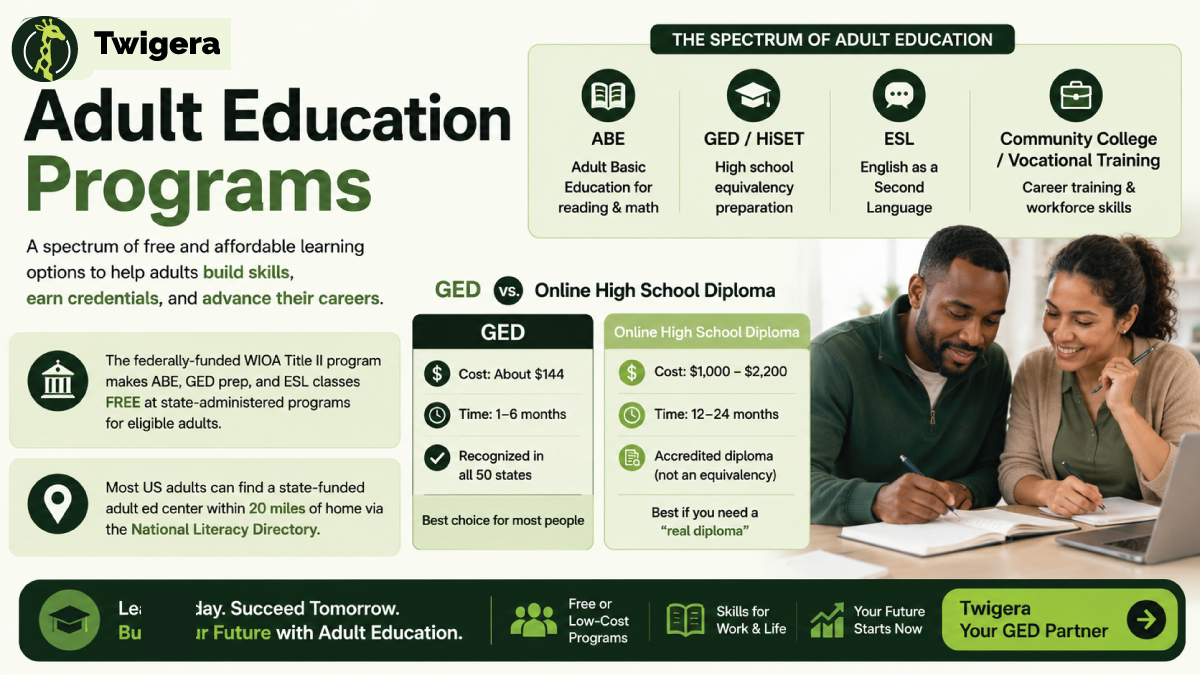
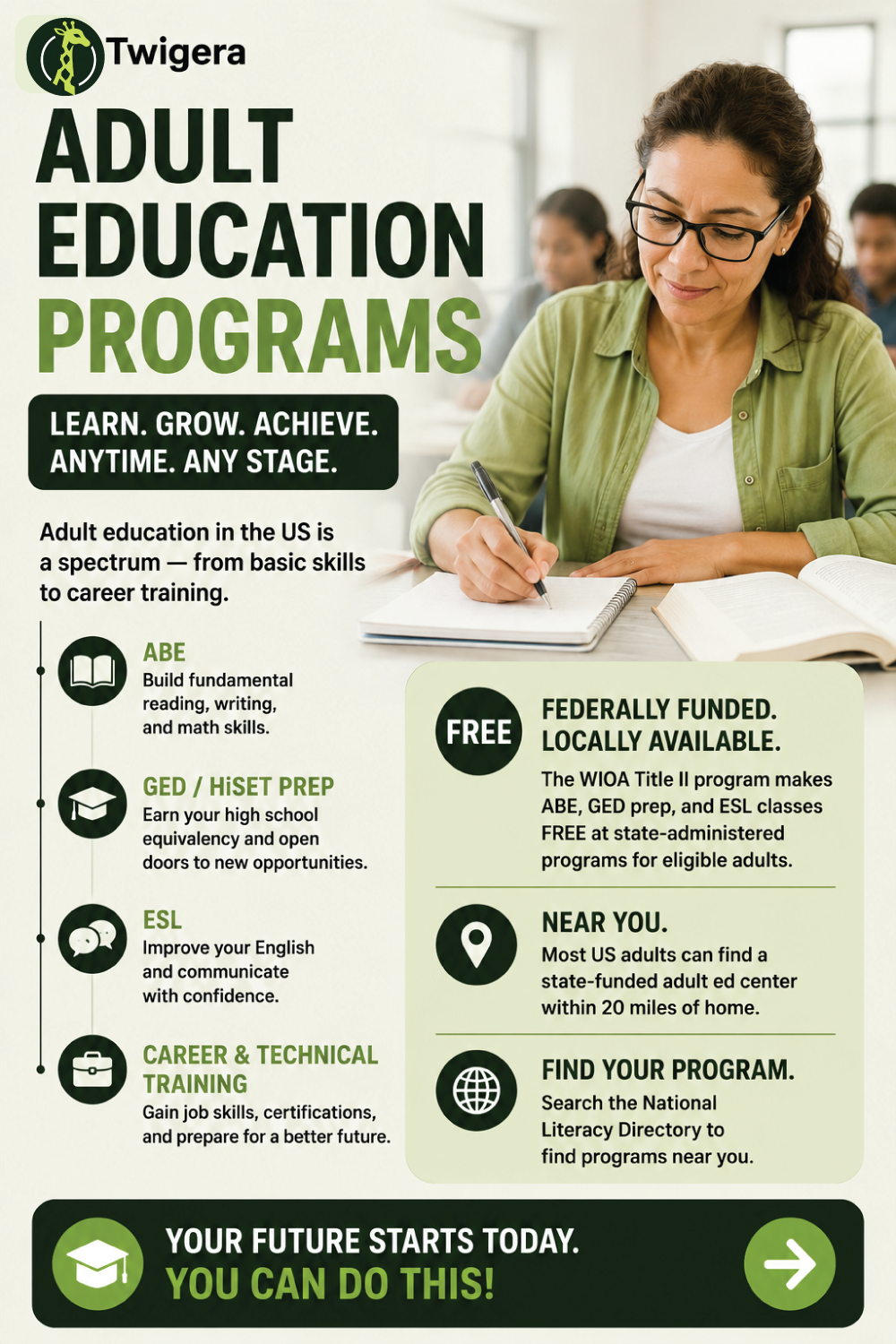
Many adults searching for how to go back to school as an adult miss one of the best starting points: the public adult education system. In the US, this system is largely supported through WIOA Title II — the Workforce Innovation and Opportunity Act, also called the Adult Education and Family Literacy Act — which funds state-administered adult education and literacy programs.
WIOA Title II helps adults build the skills needed for work, family life, further education, and long-term self-sufficiency. The programs often include:
Adult Basic Education (ABE) for reading, writing, and math
GED or HiSET prep for a high school equivalency credential
English as a Second Language (ESL) classes
Workforce preparation and career-pathway support
Transition support into college, training, or employment
You may qualify for a WIOA-funded adult education program if you are:
Age 16 or older
Not enrolled, or not required to be enrolled, in K-12 school
Missing a high school diploma or recognized equivalent
Needing stronger basic reading, writing, or math skills
Learning English as a second language
State rules vary. Sixteen- and seventeen-year-olds often need parent or guardian approval, school-withdrawal paperwork, or a state waiver before enrolling. The detailed age and dropout rules are covered in our can you drop out and get your GED at 16 guide.
At participating state adult education centers, many learners get free or low-cost help with Adult Basic Education, GED or HiSET prep, ESL classes, basic digital literacy, and career-readiness support. This is why checking public programs first matters — if a free local class fits your schedule and learning needs, you may not need to pay for private support right away. Our is the GED really free breakdown covers what is and is not free across the prep path.
Most programs follow a simple process: contact the program or fill out an interest form, attend an intake session, take a placement test or skills assessment, discuss your goal with an advisor, get placed into the right class level, then start classes in person, online, or hybrid.
If you are searching for adult education programs near me, start with your State Department of Education adult education office or the National Literacy Directory. The Directory lists literacy centers across the US and helps learners search for local programs and high school equivalency testing support.
Classes are not always daytime-only. Depending on your area, you might find morning or evening classes, weekend options, online or hybrid classes, self-paced study support, help with basic computer skills, and referrals for transportation, childcare, or workforce services.
WIOA is one of the main reasons adult learners still have access to free public education support after leaving the K-12 system. Roughly 1.2 million adults enroll in WIOA-funded adult education programs in a typical year, yet many people do not know this option exists.
Adult Basic Education, or ABE, is for adults who need stronger reading, writing, or math skills before moving into GED prep, job training, or college-level work. If school felt hard the first time, ABE gives you a safer starting point.
Think of ABE as a pre-GED step. You work on the skills the GED expects you to know: reading passages, writing clear sentences, using numbers, solving word problems, and building study habits. Many learners skip this step and struggle later, so starting here saves time.
ABE classes are usually free at state-funded adult education centers. Some programs offer classroom learning, while others include self-paced lessons, tutoring, or online adult education programs for learners with work, family, or transport limits.
The timeline depends on your starting level. Some adults need a few months; others may spend six months to two years building confidence and core skills. ABE is not a certificate program, and it is not a sign you are behind — it is practical support. When your foundation is stronger, GED prep, career training, and the next step all become easier.
GED and HiSET prep is for adults who are ready to earn a high school equivalency credential. If you already have basic reading and math, this path moves you toward work, college, or training. The two tests have different state acceptance — see our GED vs HiSET guide for which one your state offers.
Most state adult education centers offer GED or HiSET prep for eligible adults. These programs are often free and may include classroom lessons, online or hybrid classes, placement testing, instructor support, practice tests, and — in some locations — test vouchers. This is a smart first place to check if cost is your main concern.
Online GED prep works well when you need flexible study hours. Twigera offers all four subjects in one course, one price, and lets you study early morning, late at night, or whenever your schedule allows — plans range from $59 to $159 one-time, with a Pass Guarantee on Pro. Free self-directed support is also available through state adult education programs and public library learning portals. For a structured comparison of paid online prep, see our best online GED programs roundup.
Self-study fits disciplined learners who prefer free or low-cost materials. You might use official ged.com subject PDFs and the GED Ready practice test (about $6.99 per subject), supplemented by state adult education materials. For deeper help, see our best GED study guides and how to get your GED in 6 steps walkthrough before choosing.
ESL programs support adults who want to build English reading, writing, speaking, and listening skills. They are a core part of adult education and serve learners who need English for work, school, citizenship, or daily life.
Most state adult education centers offer free ESL classes for eligible adults. These classes usually place you by skill level, so you are not expected to start where someone else starts. You may study grammar, conversation, reading, workplace vocabulary, and everyday communication — some programs also include digital skills or career-readiness support.
Many ESL programs include citizenship preparation, especially for adults preparing for the naturalization interview and civics test — these may cover US history, government, interview questions, and basic spoken English. Working adults may also find workplace English programs through community colleges, employers, libraries, or nonprofits, focusing on job applications, interviews, safety instructions, customer service, and communication with supervisors.
If your schedule is tight, online adult education programs give you more flexibility. Many state adult education offices, public libraries, and refugee or immigrant support nonprofits offer free online English lessons for adults. A general-purpose language app can help with basic vocabulary, but it should not replace a structured ESL class if you need real support for work, citizenship prep, or academic coursework. When learners ask who offers the best adult learning programs, the honest answer depends on goal, level, and schedule — the best online programs for adult education are the ones you can follow consistently.
An online accredited high school diploma is an alternative to the GED or HiSET. It is a better fit if you specifically want an actual high school diploma and are willing to spend more time completing coursework. For the full credential comparison, see our GED vs high school diploma guide.
Program type | What you earn | Typical cost | Typical timeline |
|---|
Accredited distance-learning HS diploma program | Accredited HS diploma + transcript with GPA | $1,000–$2,200 | 12–24 months |
Library-partner adult HS diploma program | Accredited HS diploma + career certificate | Tuition-free for eligible library patrons | 12–24 months |
State adult HS diploma program | State-issued adult HS diploma | Free for eligible adults via WIOA-funded adult ed | Varies by state |
The main difference is the credential. GED and HiSET are high school equivalency tests. An accredited online high school diploma comes from completing a diploma program. This route often takes longer and costs more than GED prep, but some learners prefer having a diploma instead of an equivalency credential. Before enrolling, confirm accreditation (look for Cognia or DEAC, both recognized by the US Department of Education), total price, monthly fees, transfer-credit rules, and whether the program is accepted by your target college, employer, or training program. Some public libraries partner with an accredited online adult high school program to offer tuition-free access to eligible patrons — check your library website before paying out of pocket.
If you already have a high school diploma, GED, or HiSET, your next step may be college — and you do not have to start with a 4-year university right away.
Community college is often the easiest college entry point for adults who already have a credential. Many schools use open admission, which means you do not need a perfect academic record to begin. In-state tuition often falls around $3,500 to $5,500 per year, though costs vary by state, program, and credit load. Pell Grants, state grants, scholarships, and payment plans may lower what you pay out of pocket.
Many adults start at community college, then transfer to a 4-year university after completing general education classes. This path reduces cost while giving you time to rebuild study habits. Some colleges offer bridge or transfer agreements, so your credits move into a bachelor's degree program with fewer surprises.
If work or family responsibilities make campus hard, online schools such as WGU, University of Phoenix, Southern New Hampshire University, and ASU Online may fit your schedule. Employer education benefits, Pell Grants, and state aid can cover part of the cost. Always confirm transfer rules, accreditation, tuition, and student support before enrolling.
If your goal is a job-specific skill, vocational training may fit better than a degree.
WIOA-funded workforce training — free for some eligible dislocated workers, depending on state rules and approved programs.
Community college vocational programs — good for welding, HVAC, medical assisting, cosmetology, and CDL training.
Apprenticeships — paid training for trades such as electrical work, plumbing, and carpentry.
Industry certificates — useful for IT, healthcare, business, and credentials such as CompTIA or AWS.
MOOCs — Coursera and edX offer low-cost online learning, often free to audit or about $39+ per month for certificates.
If you want to go back to school as an adult, start with the lowest-cost option that fits your goal. Free public programs, grants, employer benefits, and veteran benefits may lower what you pay before you look at private programs. For the full GED-specific cost map, see our how much does the GED cost breakdown.
Program type | Funding option | What to know |
|---|
ABE, GED, HiSET, ESL | WIOA Title II | Often free for eligible adults through state-funded centers. |
Community college | Pell Grants, state grants, scholarships, payment plans | Pell Grants are federal need-based aid and may reduce tuition. |
4-year university | Pell Grants, state aid, scholarships, loans | Transfer credits from community college can lower costs. |
Online HS diploma | Public-library partner programs or out-of-pocket | Some libraries provide tuition-free access for eligible patrons. |
Vocational training | WIOA dislocated worker funds, state workforce grants, apprenticeships, employer benefits | Useful for trades, healthcare support, CDL, and career-focused programs. |
MOOCs and certificates | Free audits, paid certificates, employer reimbursement, financial aid | Coursera, edX, and similar platforms work for skill upgrades. |
Walmart Live Better U — tuition and books for eligible associates.
Amazon Career Choice — education and skills training for eligible employees.
Starbucks College Achievement Plan — tuition coverage through ASU Online for eligible partners.
Veterans Affairs GI Bill — education and training benefits for eligible veterans.
Going back to school as an adult often brings questions you might not say out loud. These concerns are valid, but they should not stop you from finding the right support.
Adult education programs are built for adult learners, not recent high school students. Many classrooms include learners in their forties, fifties, sixties, and beyond. Your age does not disqualify you from learning reading, math, English, GED skills, job skills, or college prep.
Most adult education classes are full of adults. You are likely to meet people with jobs, children, caregiving duties, military backgrounds, and long gaps since school. That shared experience often makes the classroom less intimidating.
ABE programs are confidential and built for learners starting at different levels. A placement test helps teachers understand where you should begin — it is not a judgment, it is a tool for placing you in the right class.
Many adult basic education, GED, HiSET, and ESL programs are free or low-cost through WIOA-funded centers. College students may also qualify for Pell Grants, state aid, employer education benefits, or scholarships. Free is real here — it is just often not advertised.
Many programs offer evening, weekend, online, or hybrid classes. Start with what fits your real schedule, then build from there. Online options exist precisely because adult schedules are not 9-to-5 academic.
Adult education is a spectrum — from basic literacy and math support through GED prep, ESL, trade school, community college, and degree completion. If you do not have a high school credential, the path often starts with ABE if needed, then GED or HiSET prep through a free state-funded program or a flexible online option.
If GED prep is your next step, Twigera gives you four GED subjects in one course, one price, and lessons that fit your schedule. Start with the Twigera diagnostic, compare the GED study guide and free GED resources, then choose the plan that lets you study with confidence and prepare to pass on the first try.