GED Classes 2026: Online, In-Person, and Free Options
Three main types: free local adult-education classes (often WIOA-funded), online prep ($0–$399), and 1-on-1 tutoring. Choose by schedule, budget, and how much in-person support you actually need.


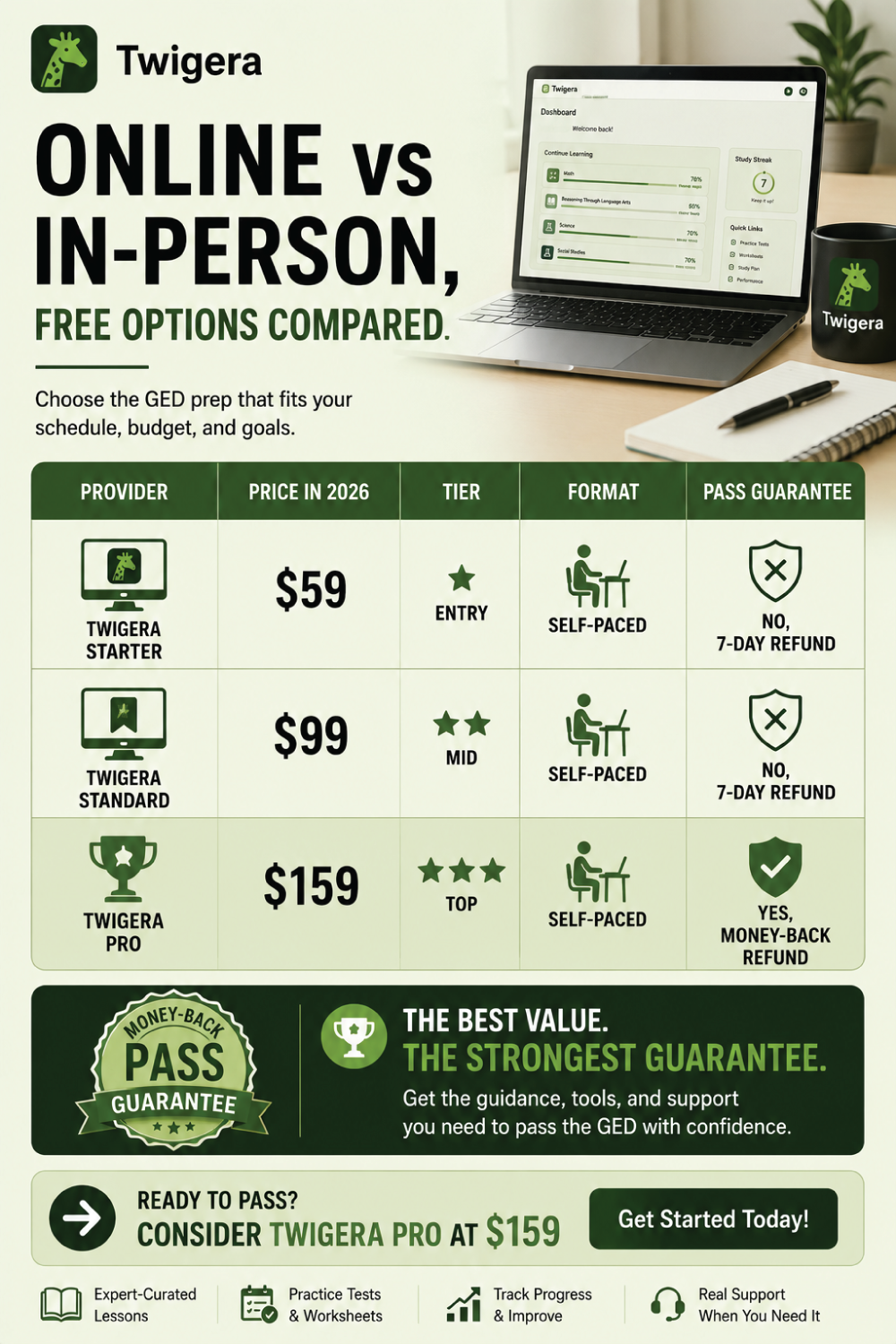
GED classes come in three main types: free local adult-education classes (often funded via Workforce Innovation and Opportunity Act Title II), online prep programs ($0–$399), and 1-on-1 tutoring ($25–$80/hr). Free local options work if you qualify and want in-person support. Online prep fits learners who need flexibility. Tutoring helps when one subject needs focused attention. Most learners do well with either free local classes or a structured online course like Twigera ($59–$159).
Pin this guide so you can find it again.
We refresh these every season. Save it to a Pinterest board and you’ll get the latest version next time you come back.
Save to PinterestQuestions people ask.
- What are GED classes?
GED classes are prep courses that help you study for the GED test. They usually fall into three groups: free local adult-education classes, online prep courses, and 1-on-1 tutoring. Most cover all four subjects (Math, RLA, Science, Social Studies) and run 6 to 24 weeks depending on your starting level.
- Are GED classes free?
Some are. State-funded adult education programs often offer free classes for eligible learners — usually adults 16 or older who are not enrolled in K-12 school and do not yet have a high school credential. Free online options include Khan Academy and USAHello Classroom. Paid options range from Twigera ($59–$159) to Kaplan ($199–$399).
- How long are GED classes?
Most in-person state-funded classes run for 6 to 24 weeks, meeting two to four times per week for two or three hours per session. Online programs are more flexible — some learners finish in a few weeks, others take several months. Total study time typically ranges from 30 to 150 hours.
- Where can I take GED classes near me?
Start with three places: GED.com's class finder, the National Literacy Directory, and your state adult education office. Local libraries, community colleges, workforce centers, and nonprofit literacy programs are also strong options. Confirm cost, schedule, format, and eligibility before signing up.
- Are online GED classes as good as in-person classes?
They can be — quality depends on the provider, not just the format. A well-built online course works well if you are self-disciplined and can study consistently. In-person classes are stronger if you need a set schedule, classroom support, and local community. Many learners use both.
- What is the difference between GED classes and GED tutoring?
Classes usually offer group instruction or a structured online curriculum, preparing you across all four GED subjects. Tutoring is 1-on-1 and works best when you need focused help in one weak area — math, essay writing, or reading passages.
- Can I take GED classes online for free?
Yes. Khan Academy and USAHello Classroom are free, and some state-funded adult education programs offer free online GED classes. The GED test itself is not always free, but prep can be — through public programs, libraries, and no-cost online resources.
- How do I sign up for GED classes near me?
Use GED.com's class finder, contact your local public library, or reach out to your state adult education office. Ask about cost, eligibility, schedule, format, and whether the program offers placement testing or GED Ready practice support.
- How much do paid online GED classes cost?
Paid online GED classes range widely. Mometrix is $39.99 self-paced. Twigera runs $59 to $159 across three tiers, with one-time pricing on every tier. Onsego runs $79 to $199. Kaplan GED Live is $199 to $399 for live instruction. Pick the tier that matches your starting point and timeline.
- Do I need a class to get my GED?
No — classes are recommended but not required. The GED only requires that you pass all four subject tests at 145+ each. Some learners self-study with free resources; others enroll in classes for structure. The right answer depends on how self-disciplined you are and whether you can stay consistent without external accountability.
Amara is the editor at Twigera. She came to publishing the long way — a decade teaching the GED in community colleges and adult-learning centers, where she watched students pass not on talent or time, but on the strength of a study plan they actually trusted. Now she shapes the guides students read here for the parent studying after a closing shift, the second-career welder, the grandmother finishing what she started forty years ago. Expect honest timelines, math made survivable, and study plans built around real life — not around a textbook's idea of one.
Take the next step — start today.
Our online GED course includes every subject, a free 30-minute diagnostic, and a 7-day refund on every plan.