The eight grammar rules that carry most of the editing questions, the reading tactics that find evidence fast, and a four-part essay template with a 45-minute pacing plan — condensed to what fits on one page.
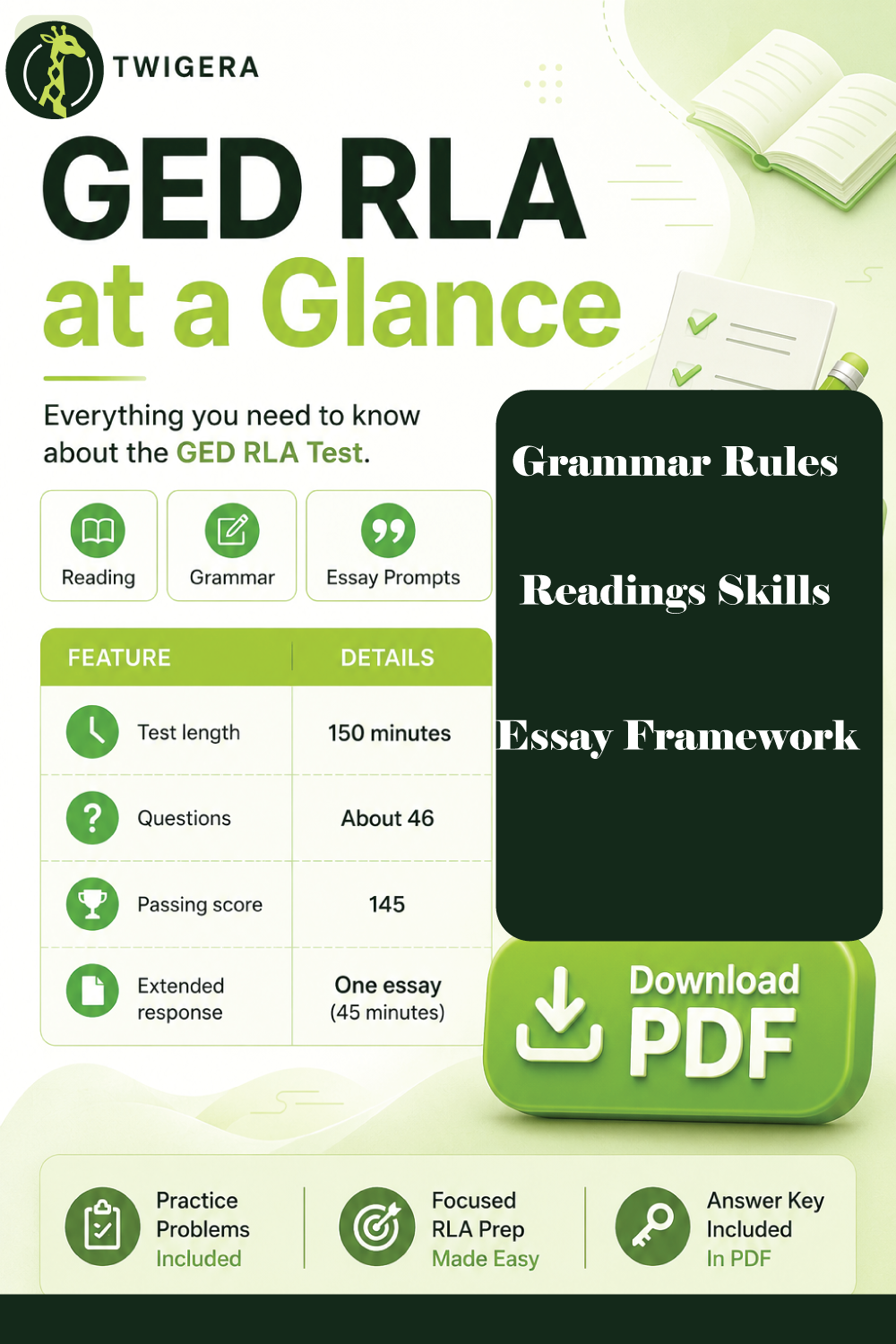
A GED language arts cheat sheet gives you the highest-value information to review before test day. Instead of rereading a full study guide, you focus on eight grammar rules, a handful of reading tactics, and a repeatable essay framework. The GED RLA test lasts 150 minutes and includes one 45-minute Extended Response, and you need 145 to pass.
Last reviewed
A GED RLA cheat sheet gives you the highest-value information to review before test day. Instead of rereading a full study guide the night before, you focus on the grammar rules, reading tactics, and essay framework most likely to earn points. Everything below is built to compress onto one page.
One caveat worth stating up front: a cheat sheet is a memory aid, not a teaching tool. It works when you already understand the material and need a fast refresher. If a rule here does not make sense on reading it, treat that as a signal to study the topic properly — our GED language arts study guide covers each area at depth. Use this GED RLA cheat sheet for the last mile, not the first one.
GED RLA at a Glance
Feature
Details
Test length
150 minutes, including about 3 minutes of instructions
Sections
Three, with a 10-minute break between parts 2 and 3
Extended Response
One essay, 45 minutes
Passing score
145 out of 200
Question count
Not published by GED Testing Service — plan around the clock, not a number
You can confirm the length, section count, break, and essay allocation on the official GED test subjects page. Note what is not there: a fixed question count. Plenty of prep sites quote a specific number, but GED Testing Service does not publish one on its subject overview, so this page will not invent one either.
Grammar Rules to Know Cold
Grammar questions reward careful editing more than memorization. Learn these eight rules and you will catch most of what the test throws at you. Each one below carries the error pattern the test actually uses, because recognizing the pattern is what earns the point.
Subject-Verb Agreement
A singular subject takes a singular verb; a plural subject takes a plural verb. Incorrect: "The student study every evening." Correct: "The student studies every evening." The test rarely makes it that obvious — it usually buries a phrase between the subject and the verb, as in "The list of assignments is on the desk," where the subject is list, not assignments. Find the subject first, then ignore everything between it and the verb.
Verb Tense
Keep tense consistent unless the sentence clearly shifts time. Incorrect: "Yesterday, Maria studies for the exam." Correct: "Yesterday, Maria studied for the exam." Watch for time words — yesterday, last week, tomorrow, next month. They are your signal to check the tense. In longer passages the shift is often between sentences rather than inside one, so read the sentence before the underlined portion too.
Sentence Fragments
Every sentence needs a complete thought. "Because she practiced every day" is a fragment. "She passed the test because she practiced every day" is complete. If a sentence leaves you asking "what happened?", it is probably a fragment. Words like because, although, while, since, and when at the start of a clause are the usual culprits — they signal a thought that still needs finishing.
Run-On Sentences
Two complete sentences cannot sit side by side without proper punctuation or a conjunction. Incorrect: "I finished the passage I answered every question." Correct: "I finished the passage, then I answered every question." The trickier version is the comma splice, where a comma alone joins two complete sentences: "The passage was difficult, I read it again" still needs a conjunction, a semicolon, or a full stop.
Commas
Use a comma to separate items in a list, to join two complete sentences with a coordinating conjunction, and to set off an introductory word or phrase. Incorrect: "After the test we celebrated." Correct: "After the test, we celebrated." The rule that catches people is the opposite one — do not add a comma simply because you would pause when reading aloud. Pauses are breathing, not grammar.
Apostrophes
Apostrophes show possession or form contractions: "the student's notebook," "it's time to begin." The single most missed pair on GED editing questions is its versus it's. Its shows possession; it's means "it is." The test that always works: substitute "it is" into the sentence. If it still reads correctly, you want it's. If it does not, you want its.
Transition Words
Transition words connect ideas and carry the reader from one point to the next. On the test you are usually choosing which relationship the sentence needs, so match the transition to the logic rather than to the sound.
Purpose
Examples
Addition
Also, in addition, besides, furthermore
Contrast
However, although, instead, nevertheless
Cause and effect
Because, therefore, as a result, consequently
Sequence
First, next, finally, meanwhile
Example
For example, for instance, specifically
Parallel Structure
Items in a list should share the same grammatical pattern. Incorrect: "She enjoys reading, to write, and swimming." Correct: "She enjoys reading, writing, and swimming." Read the sentence aloud — if one item sounds off against the others, that is your parallel structure error. The same rule governs comparisons and paired phrases, not just lists.
Save for later
Pin this guide so you can find it again.
We refresh these every season. Save it to a Pinterest board and you’ll get the latest version next time you come back.
Most RLA questions measure comprehension, not memorization. The goal is finding evidence and understanding the author's point, not recalling facts about the topic. That distinction matters: background knowledge about libraries or climate policy will not help you, and can actively hurt if it tempts you toward an answer the passage never supports.
Reading skill
Quick reminder
Preview the question
Know what you are looking for before you read the passage
Find the main idea
Ask what the author wants readers to understand overall
Use evidence
Every correct answer traces back to a line in the passage
Make inferences
Combine clues from the text instead of guessing
Compare paired passages
Find where the authors agree, disagree, or use different evidence
Context clues
Use surrounding words to work out unfamiliar vocabulary
Before moving on from any reading question, run four checks: did I answer the actual question asked, can I point to the evidence, did I eliminate the choices the passage does not support, and did I avoid picking an answer because I personally agree with it? The last one accounts for more lost points than most people expect. If the terminology in the questions is what slows you down, our GED language arts vocabulary guide covers the instruction verbs.
The Four Traps That Cost the Most Points
Some wrong answers are wrong. Others are true but useless. Knowing the difference is most of the skill. These four patterns account for a large share of avoidable losses, and none of them require new knowledge to fix — only a habit.
The true-but-narrow answer. It appears in the passage. It is accurate. It is still not the main idea. Check scope before accuracy.
The reasonable-sounding inference. It could be true in real life. The passage never supports it. Ask which line proves it. If none does, drop it.
The grammatically correct but unclear option. Revision questions often offer two correct sentences. Pick the clearer one, not the first correct one.
The answer you agree with. Your opinion is not evidence. The test asks which argument is better supported, never which one is right.
The Extended Response Essay Template
The Extended Response gives you two passages, and your job is to decide which argument is better supported and back that up with evidence from both texts. Memorize this structure rather than trying to memorize an essay.
Introduction — state which argument is stronger and briefly explain why.
Body paragraph 1 — present one piece of evidence and explain how it supports your position.
Body paragraph 2 — present a second piece of evidence and explain why it strengthens your argument.
Conclusion — restate your position and summarize your strongest evidence.
Pace it as 5 minutes reading both passages and planning, 30 minutes writing, and 10 minutes reviewing for grammar, spelling, and punctuation. That last 10 minutes is the one people sacrifice first and regret most, because clarity and command of Standard English is one of the traits the essay is scored on — a strong argument in messy prose loses points that a quick reread would have saved.
A note on scoring: this template covers structure and pacing, not the trait-by-trait language graders use. For the full breakdown, see our GED Extended Response essay guide rather than relying on a cheat sheet for that part.
How to Actually Use a Cheat Sheet
The mistake is treating a cheat sheet as a shortcut around studying. It is not one, and used that way it produces false confidence — you recognize every rule on the page and still miss the questions, because recognition is not the same as application. Used correctly, it does three things. It gives you a fast pre-practice warm-up so you enter a question set with the rules already active. It gives you a checklist to run against a missed question, so you can name what went wrong instead of just noting the right letter. And it gives you a final review the morning of the test, when learning something new is no longer realistic and reinforcement is all that is left.
The practical test of whether this page is working for you: read a rule, then explain it out loud without looking. If you can, the cheat sheet is doing its job. If you cannot, that rule is not ready to be compressed yet, and it belongs in a study session instead. When you want to check whether the rules have stuck, our GED RLA practice test puts them inside real questions, and the wider strategy lives in our guide on how to pass the GED Language Arts. Closer to test day, the official GED Ready practice test is the only practice score built to predict your result.
Frequently asked
Questions people ask.
What is included on a GED RLA cheat sheet?
ShowHide
Grammar rules, reading strategies, transition words, and a simple essay template — built for quick review rather than detailed instruction. A cheat sheet is a memory aid for material you have already studied, so pair it with a full study guide when you are still learning a topic.
Which grammar rules should I study for the GED RLA test?
ShowHide
Eight cover most of the editing questions: subject-verb agreement, verb tense, sentence fragments, run-on sentences, commas, apostrophes, transition words, and parallel structure. The test applies these in context rather than asking you to name them.
Is there an essay template for the GED RLA test?
ShowHide
Yes. An introduction stating which argument is stronger, two body paragraphs each presenting and explaining one piece of evidence, and a conclusion restating your position gives you enough structure to stay organized through the 45-minute Extended Response.
Is there a printable GED RLA cheat sheet?
ShowHide
Yes. Everything on this page is designed to condense onto a single printed page — grammar rules, reading reminders, the transition-word table, the essay template, and a test-day checklist. Keep it beside your practice questions rather than reading it as an article.
How long is the GED RLA test and what is the passing score?
ShowHide
The RLA test runs 150 minutes across three sections, with a 10-minute break between parts 2 and 3 and 45 minutes allocated to the Extended Response. You need 145 out of 200 to pass, the same standard as every other GED subject.
How many questions are on the GED RLA test?
ShowHide
GED Testing Service does not publish a fixed total question count on its RLA subject overview — it describes three sections plus one written Extended Response. Treat any specific number you see quoted elsewhere with caution, and plan around the 150-minute limit rather than a question count.
Can a GED language arts cheat sheet replace studying?
ShowHide
No, and using one that way is a common mistake. A cheat sheet compresses material you already understand into a form you can review quickly. If a rule on this page does not make sense to you, that is a signal to study it properly rather than to memorize the line.
What is the difference between its and it's on the GED?
ShowHide
Its shows possession ("the dog wagged its tail"). It's is a contraction of "it is" ("it's time to begin"). This pair is among the most commonly missed on GED editing questions. The test: if you can substitute "it is" and the sentence still works, use it's.
Amara is the editor at Twigera. She came to publishing the long way — a decade teaching the GED in community colleges and adult-learning centers, where she watched students pass not on talent or time, but on the strength of a study plan they actually trusted. Now she shapes the guides students read here for the parent studying after a closing shift, the second-career welder, the grandmother finishing what she started forty years ago. Expect honest timelines, math made survivable, and study plans built around real life — not around a textbook's idea of one.
Enjoyed this?
Take the next step — start today.
Our online GED course includes every subject, a free 30-minute diagnostic, and a 7-day refund on every plan.