

GED Science Cheat Sheet 2026: Variables, Graphs, Data
A one-page GED Science reference for the things the test does not hand you — how to spot the variables, read a graph before you interpret it, choose between mean and median, and say only what the evidence supports.

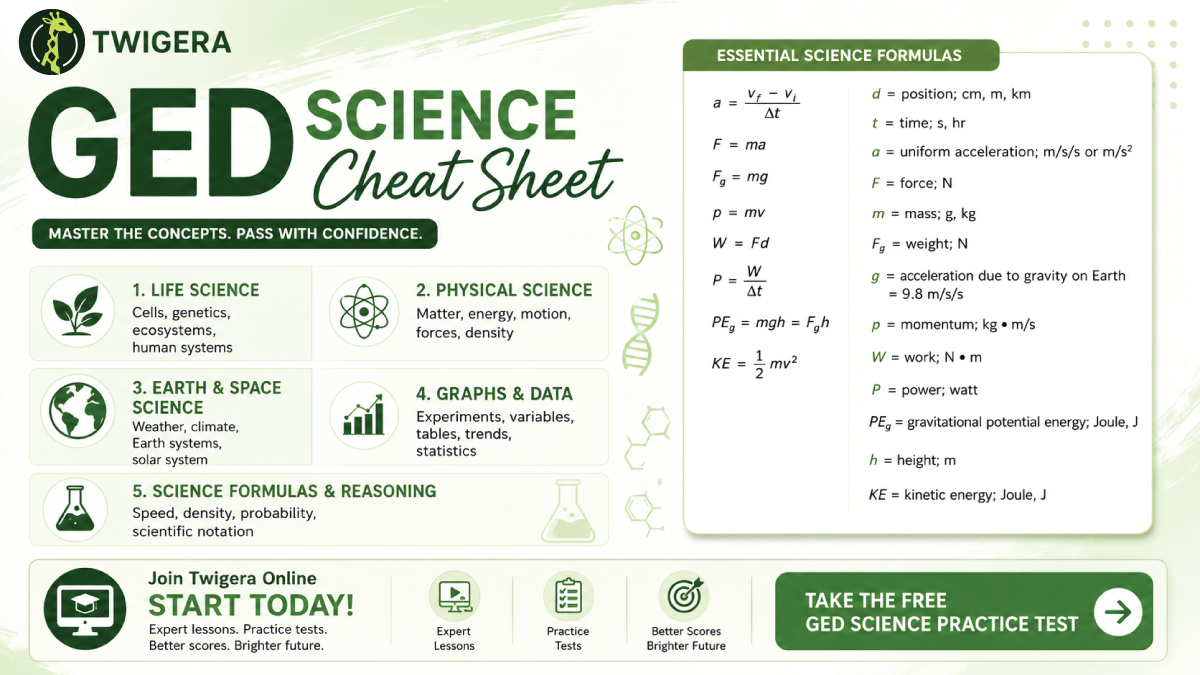
A GED Science cheat sheet should hold reasoning tools, not facts. The test supplies the information you need for calculations, so memorising formulas is wasted effort. What pays off is spotting the independent and dependent variables, checking a graph's axes and scale before reading its trend, knowing when the median beats the mean, and choosing the answer the evidence actually supports.
Pin this guide so you can find it again.
We refresh these every season. Save it to a Pinterest board and you’ll get the latest version next time you come back.
Save to PinterestQuestions people ask.
- What should be on a GED science cheat sheet?
Reasoning tools rather than facts. Include how to identify the independent, dependent and controlled variables, a checklist for reading a graph before interpreting it, the difference between mean, median, mode and range, when an outlier makes the median the better measure, the probability formula, and the rule that you answer only what the evidence supports.
- Do I need to memorise formulas for GED Science?
No. GED Testing Service states that you are given the information needed to answer questions correctly rather than being expected to memorise formulas. The skill being tested is recognizing which quantities in a scenario go where. Knowing that density is mass divided by volume does not help if you cannot tell which number is the mass.
- Is there a printable GED science cheat sheet?
Yes. Everything on this page is written to condense onto a single printed page — the variable definitions, the graph checklist, the statistics rules, the probability formula and the high-yield concepts. Print it and keep it beside your practice questions rather than reading it as an article.
- What is the difference between independent and dependent variables?
The independent variable is what the researcher deliberately changes, such as the amount of fertiliser given to a plant. The dependent variable is the outcome they measure, such as plant height after four weeks. A quick test: the dependent variable is whatever the experiment measures at the end.
- When should I use the median instead of the mean on the GED?
When the data contains a large outlier. Take 12, 13, 14, 15 and 86. The mean is 28, which describes none of the values well, while the median stays at 14. If a question asks which measure best represents the center of data with an extreme value, the median is usually the better answer.
- How do I read a graph on the GED Science test?
Check the structure before the trend. Read the title, then the x-axis, then the y-axis, then the units, then the scale. Only then identify whether the measured variable rises, falls or stays flat, and compare specific values rather than judging by how tall a point looks. Misread scales cause more graph errors than misread trends.
- What is the most common GED Science mistake?
Choosing an answer that claims more than the data shows. A set of results about four fertiliser concentrations supports a statement about those four concentrations, not a general law about fertiliser. The correct option on these items is almost always the most cautious one, which is exactly why it looks least impressive.
- Does a cheat sheet replace studying for GED Science?
No, and using one that way is the common mistake. A cheat sheet compresses material you already understand into something you can review quickly. If a line on this page does not make sense when you read it, that is a signal to study the topic properly rather than to memorise the line.
Amara is the editor at Twigera. She came to publishing the long way — a decade teaching the GED in community colleges and adult-learning centers, where she watched students pass not on talent or time, but on the strength of a study plan they actually trusted. Now she shapes the guides students read here for the parent studying after a closing shift, the second-career welder, the grandmother finishing what she started forty years ago. Expect honest timelines, math made survivable, and study plans built around real life — not around a textbook's idea of one.
Take the next step — start today.
Our online GED course includes every subject, a free 30-minute diagnostic, and a 7-day refund on every plan.