How to Pass the GED Science Test in 2026: Chart-Reading Strategy
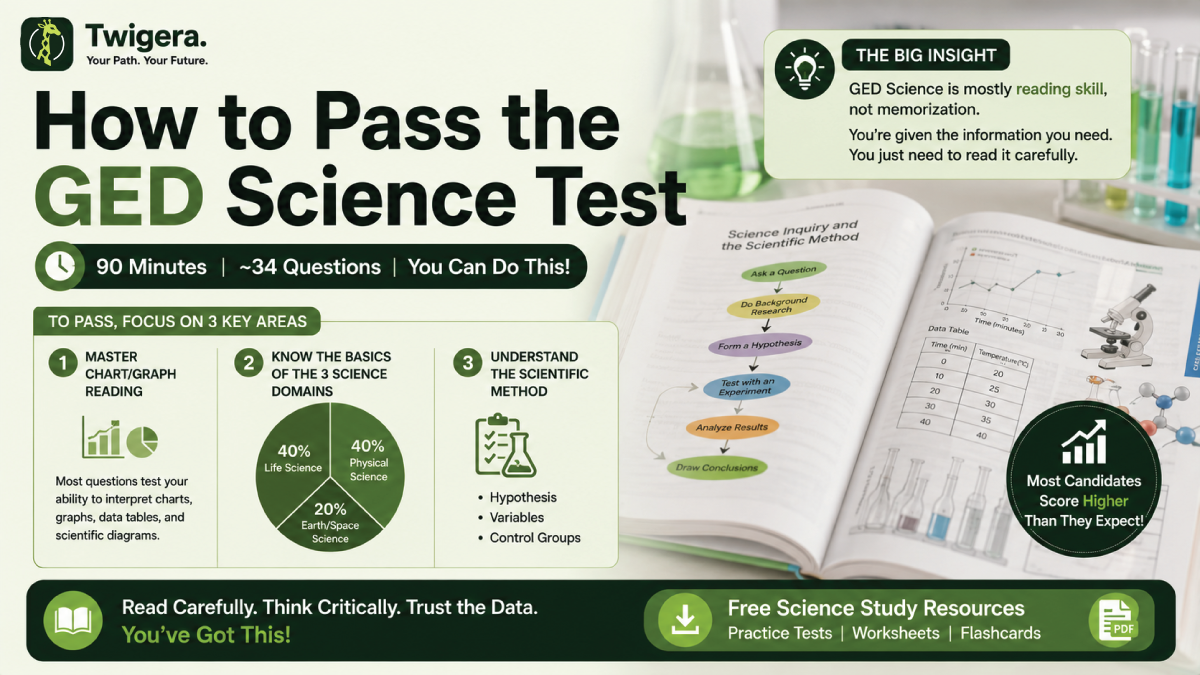
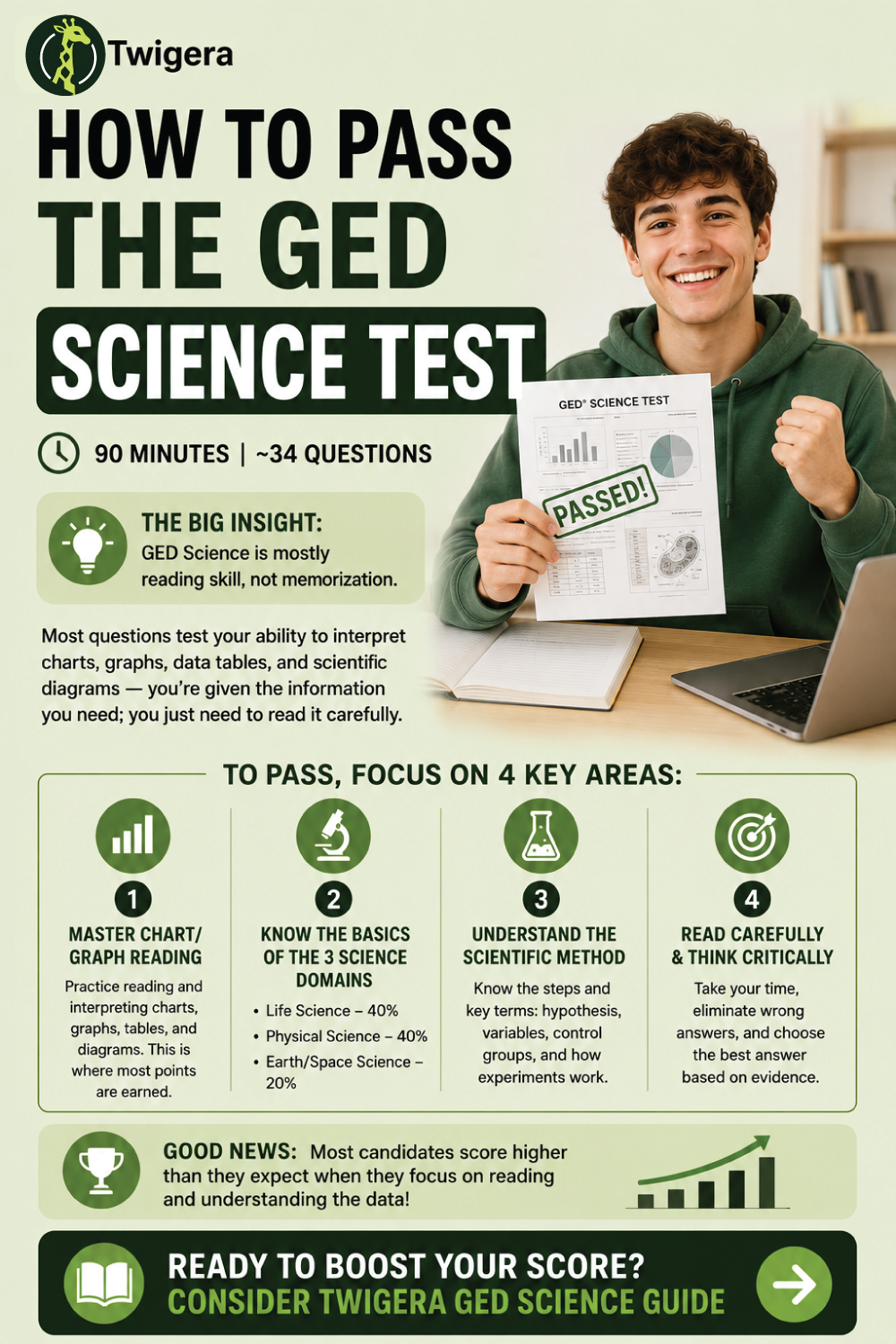
GED Science is 90 minutes of reading skill, not memorization. About 70% of questions test chart and data interpretation. This 2026 guide covers the strategy + basic concepts in life, physical, and earth science.
GED Science is 90 minutes for about 34 questions, scored 100 to 200 with a 145 passing score. The big insight: about 70% of questions test chart/graph/data interpretation, not memorization. To pass: master chart and graph reading, know the basics of life science (40%), physical science (40%), and earth and space science (20%), and understand scientific method (hypothesis, variables, control groups). Most candidates score higher than they expect — Science is the 2nd-easiest of the 4 GED subjects.
Last reviewed
If you are searching for how to pass the GED Science test, you might be worried you forgot too much science to pass. Many people see the word "science" and assume they need to memorize facts, formulas, and terms from years ago. The truth: GED Science focuses far more on reading charts, graphs, and data than on memorizing science facts. If you read closely and follow what the question is actually asking, you are in a much stronger position than you think — Science is the 2nd-easiest of the 4 GED subjects for most candidates.
A GED Science score from 165 to 174 means College Ready, and a higher score shows colleges you are prepared for college-level work — it might also help you skip placement testing. The pass floor is 145. This guide covers what to study, what to ignore, how the test works, and how to prepare with less stress.
For broader context on adult learning outcomes after the GED, the National Center for Education Statistics tracks postsecondary enrollment — and consistently shows that adults who pass the GED move into postsecondary education and the workforce at meaningfully higher rates than those without a credential. The Science section is not the gate most candidates fear it is.
Quick Facts: GED Science at a Glance
Fact
Value
Time
90 minutes
Question count
About 34
Score range
100 to 200 (passing: 145)
Difficulty
Often easier for strong readers — tests data reading more than memorization
Formula sheet?
No general Science formula sheet
Calculator?
No onscreen calculator (unlike GED Math)
Content split
~40% life, ~40% physical, ~20% earth and space science
GED Science does not give you a calculator — see our GED calculator policy guide for the full breakdown of which subjects allow one. The Science test rewards careful reading, chart skills, and basic science knowledge more than rote memorization.
The One Insight Most Candidates Miss
Here is the big honest truth about how to pass the GED Science test: it is not about memorizing facts. The test is designed to evaluate your ability to read and interpret information. About 70% of the questions involve analyzing charts, graphs, data tables, scientific diagrams, or experimental scenarios. You are given the data — your task is to make sense of it. Memorization plays a much smaller role, about 30%, and even then it focuses on basic concepts rather than complex details. This is why a strong reader, even without a science background, can pass the test.
Many candidates fear the Science test because of the word "science" — for most adults, it has been years since they studied the subject. But the test is reasoning-based, not encyclopedia-based. Many test-takers report they expected Science to be the hardest GED subject and found Social Studies and Math more challenging in practice. If you are preparing for this section, focus on improving your reading and data interpretation skills. Analyzing trends, comparing data, and drawing logical conclusions is far more valuable than memorizing formulas or terms.
Content Domain 1: Life Science (~40%)
Life science makes up about 40% of GED Science. Focus on the basic ideas below, not a full biology textbook. Cells: know that the nucleus controls cell activity, the cell membrane controls what enters and leaves, mitochondria produce energy, and DNA carries genetic information (DNA → RNA → protein, at a simple level). Genetics: genes are sections of DNA that help determine traits — these are passed from parents to children. Basic Punnett-square questions usually test whether you understand inheritance patterns, not advanced genetics. Evolution: natural selection means organisms with helpful traits survive and reproduce. Understand adaptation and the common-ancestor idea. The test may ask you to use a chart, diagram, or passage to explain how a population changes over time.
Ecosystems: food chains, food webs, producers, consumers, decomposers. Know how energy moves through an ecosystem. Predator-prey relationships may appear in charts showing population changes over time. Human body: focus on the major systems and their basic jobs — circulatory (heart and blood vessels), digestive (breaks down food), respiratory (oxygen in, carbon dioxide out), and basic reproductive system anatomy and its role.
Content Domain 2: Physical Science (~40%)
Physical science is the other 40% of the test, split across chemistry, physics, and energy basics. Chemistry essentials: atoms (protons, neutrons, electrons in the nucleus and shells), periodic table groups (metals on the left, non-metals on the right, noble gases in the rightmost column — recognize the basic pattern, do not memorize the whole table), chemical reactions (reactants → products with conservation of mass), states of matter (solid, liquid, gas, and plasma), and the pH scale (0–14, with 7 neutral, below 7 acidic, above 7 basic). Physics basics: Newton three laws conceptually (inertia, F=ma, action–reaction — no need to memorize the equations), types of energy (kinetic from motion, potential from position, thermal, chemical, electrical), basic wave properties (sound and light have frequency, wavelength, amplitude), and simple machines (levers, pulleys, inclined planes) shown in diagrams. Energy conservation is a frequently tested principle: energy can change forms but cannot be created or destroyed. Know the difference between renewable energy sources (solar, wind, hydro, geothermal) and non-renewable (coal, oil, natural gas, nuclear fuel).
Save for later
Pin this guide so you can find it again.
We refresh these every season. Save it to a Pinterest board and you’ll get the latest version next time you come back.
Earth and space science is the smallest domain at about 20%, but do not skip it. These questions are often easier once you understand the basic cycles, patterns, and relationships. Earth science: the rock cycle (igneous from cooled magma or lava, sedimentary from compacted layers of material, metamorphic from existing rock changed by heat or pressure), water cycle (evaporation lifts water to the atmosphere, condensation forms clouds, precipitation returns water as rain or snow, runoff and infiltration feed rivers and groundwater), plate tectonics (continents move on plates; earthquakes and volcanoes concentrate near plate boundaries where plates collide, separate, or slide past each other), and climate vs. weather (weather is short-term daily conditions, climate is long-term regional patterns measured over decades). Space science: solar system structure (eight planets orbit the sun, with terrestrial planets closer in and gas giants further out — know the order: Mercury, Venus, Earth, Mars, Jupiter, Saturn, Uranus, Neptune), stars (large balls of hot gas that fuse hydrogen into helium), galaxies (huge gravitationally-bound systems of stars, gas, and dust — the Milky Way is one of billions). Earth-sun-moon relationships: Earth tilt creates seasons; moon gravity drives ocean tides; the moon phases cycle every ~29.5 days.
Scientific Method (Cross-Cutting)
Scientific method questions appear throughout GED Science because they test reasoning, not memorization. Learn the terms below and practice spotting them in short experiment scenarios.
Term
Meaning
Simple example
Hypothesis
A testable prediction
Plants will grow taller with more sunlight.
Independent variable
What the scientist changes
Amount of sunlight
Dependent variable
What the scientist measures
Plant growth
Control group
Baseline used for comparison
Plants kept under normal sunlight
Confounding variable
Outside factor that affects results
Different soil, water, or plant type
A common GED Science question: "A scientist wants to test whether sunlight affects plant growth. Which is the best experimental design?" The right answer changes only the sunlight amount, measures plant growth, and uses a control group. The plants should use the same soil, water, container size, and plant type so the test stays fair.
How to Pass GED Science in 4 Steps
Master chart and graph reading: practice bar graphs, line graphs, scatter plots, data tables, pie charts, scientific diagrams. For each chart, check title, axis labels, units, trend, and unusual data points.
Learn the basic concepts in each of the 3 content domains. Spend about 10 to 15 focused hours reviewing the basics. Khan Academy biology, chemistry, and physics lessons are free and useful — do not go too deep.
Practice scientific method questions. Study 5 to 10 practice items on hypotheses, independent/dependent variables, control groups, and fair experiments.
Take GED Ready Science ($7.99) 1 to 2 weeks before scheduling the real exam. A green score means you are likely ready. Yellow or red means review weak areas before booking.
Time Strategy for GED Science
90 minutes for about 34 questions = ~2.6 minutes per question. Steady progress beats spending too long on one hard item.
Time
What to do
0:00–0:30
Answer the first 12 questions. Move through easier items first; flag harder ones.
0:30–1:00
Work through the middle 12 questions. Check pace; avoid slowing down too much.
1:00–1:25
Finish the last 10 questions and return to flagged items.
1:25–1:30
Final check; make sure no answer is blank.
Short-answer questions take more time, so set a limit. If you feel stuck after about 3 minutes, choose your best answer, flag the question if allowed, and move on. Do not leave blanks — a careful guess gives you a chance; a blank answer gives you nothing. For broader subject prep, see our best GED study guides roundup and the how to pass the GED Math test companion guide.
Top Mistakes on GED Science
Do not try to memorize the full periodic table — focus on basic group patterns (metals, non-metals, noble gases).
Read charts carefully before choosing an answer — check title, labels, units, and trend so you do not miss key data.
Do not confuse a hypothesis with a conclusion — a hypothesis is a testable prediction; a conclusion explains what results show.
Read the question before the full passage — helps you know what information to look for.
Do not spend too long on hard short-answer items — cap them at about 3 minutes, then move on.
Use the final minutes to check answers and fill every blank.
The Bottom Line
GED Science is mostly a reading and reasoning test, not a memorization test. To improve your chance of passing, focus on chart reading, basic life science, physical science, earth and space science, and the scientific method. The test gives you 90 minutes for about 34 questions, so steady pacing matters. There is no general Science formula sheet and no onscreen calculator — do not depend on Math-style support. Most candidates underestimate how doable this section is; with 10 to 25 hours of focused prep on chart reading and basic concepts, the 145 pass threshold is well within reach.
One last tactical note for test day. If you finish Science early, do not race out — use the remaining time to reread your flagged questions. Many candidates leave 10 to 15 minutes on the clock and still bomb a question they could have caught by checking the chart axis labels one more time. The most common pattern: a learner reads a chart, picks an answer that "looks right," and never goes back to verify the units. The fix is mechanical — reread the axis labels of every chart-based question before locking in your answer.
And do not over-prepare the wrong content. Many candidates spend hours memorizing periodic-table groups, planet orbital periods, or detailed cellular biology that does not actually show up. Spend that time on chart reading drills instead — the highest-yield activity for this subject by a wide margin. Use Khan Academy and ged.com practice questions to build chart-reading speed; everything else is a smaller lift.
Frequently asked
Questions people ask.
How hard is the GED Science test?
ShowHide
Easier than most candidates expect. GED Science is the 2nd-easiest of the 4 GED subjects (Social Studies is easiest, Math is hardest). About 70% of questions test your ability to read charts and interpret data — not your memorization of obscure science facts. A strong reader without a science background can pass.
How do I pass the GED Science test?
ShowHide
4-step strategy: (1) master chart and graph reading (most questions involve data interpretation); (2) learn basic concepts in life science (cells, ecosystems, body systems), physical science (atoms, energy, motion), and earth and space science (rock cycle, water cycle, solar system); (3) understand the scientific method (hypothesis, variables, control groups); (4) take the official GED Ready Science Practice Test ($6.99) to verify readiness.
Do I need to know a lot of science to pass GED Science?
ShowHide
No. The GED Science test focuses on reasoning and data interpretation, not memorization. You should know basic concepts (cells, atoms, energy, ecosystems, body systems, scientific method) but you do not need to memorize the periodic table or recall dates of scientific discoveries.
Is there a calculator on the GED Science test?
ShowHide
No. Unlike GED Math (which provides a TI-30XS MultiView calculator), the Science test does NOT provide an onscreen calculator. Math-style questions on the Science test are typically simple enough to do mentally or on scratch paper.
Is there a formula sheet for GED Science?
ShowHide
No. Only GED Math has a dedicated formula sheet. The Science test provides some reference data within individual questions (e.g., a small table of chemical properties for a specific question), but no general formula sheet.
What is the passing score for GED Science?
ShowHide
145 out of 200 — the same passing score as the other 3 GED subjects. The Science test has about 34 questions over 90 minutes. College Ready is 165; College Ready + Credit is 175.
What GED Science topics show up on the test?
ShowHide
Three domains: life science (~40% — cells, genetics, evolution, ecosystems, human body systems), physical science (~40% — chemistry basics, physics basics, energy), and earth and space science (~20% — geology, weather, climate, solar system). Scientific method questions are scattered throughout.
How long should I study for the GED Science test?
ShowHide
Less than you would think — typically 10 to 25 hours of focused study is sufficient for most candidates, because the test is reasoning-based, not memorization-heavy. Focus on chart-reading practice plus the basic concepts in each domain.
Amara is the editor at Twigera. She came to publishing the long way — a decade teaching the GED in community colleges and adult-learning centers, where she watched students pass not on talent or time, but on the strength of a study plan they actually trusted. Now she shapes the guides students read here for the parent studying after a closing shift, the second-career welder, the grandmother finishing what she started forty years ago. Expect honest timelines, math made survivable, and study plans built around real life — not around a textbook's idea of one.
Enjoyed this?
Take the next step — start today.
Our online GED course includes every subject, a free 30-minute diagnostic, and a 7-day refund on every plan.