

GED Success Stories 2026: Real Before-and-After Journeys
Four verified Twigera students — one who left school at sixteen, one capped at work, one who failed three times, and one who sat the writing test in her second language. What each of them changed, and what you can take from it.

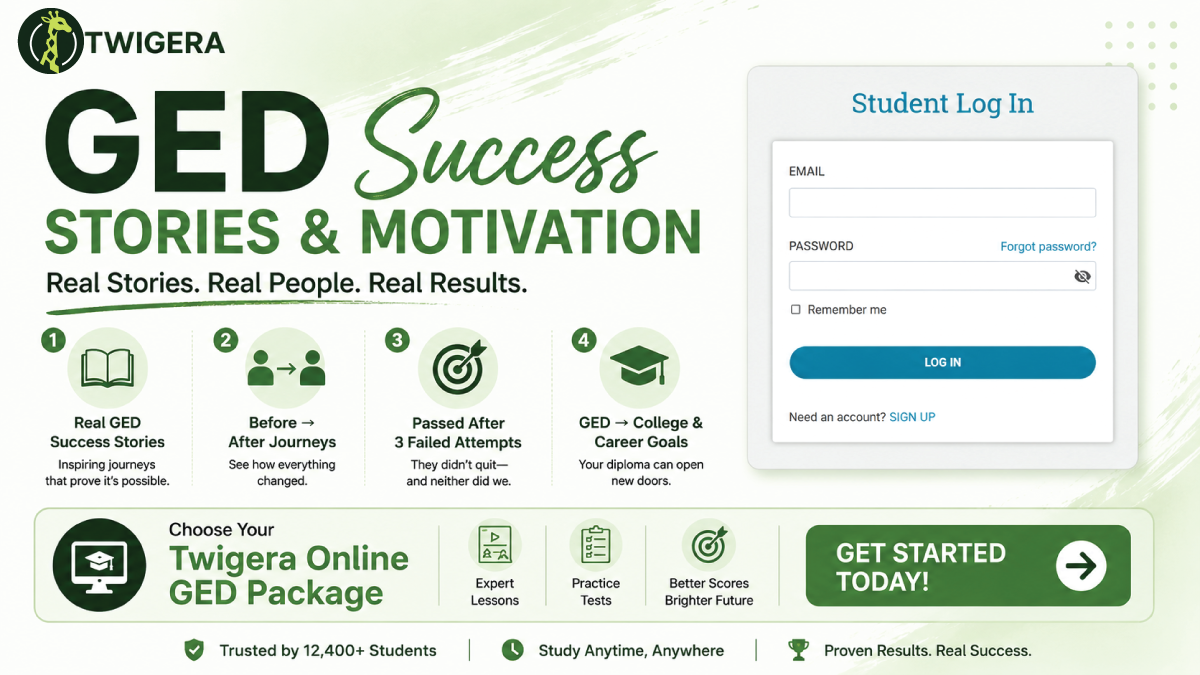
A GED success story rarely starts with someone feeling ready. It usually starts with a missed opportunity, a career ceiling, or a decision to finish something. The four verified Twigera students below left school at sixteen, hit a promotion cap, failed three times, and faced a writing test in a second language. None waited for the perfect moment to begin.
I left school at sixteen for reasons that are nobody’s business. Eleven years later I needed the diploma to apply. Twigera got me there in nine weeks.
My manager told me I was capped without the diploma. I studied on lunch breaks for two months. Got the GED. Got the bump. Got my evenings back.
I failed the real GED three times before finding this. The difference was the practice tests — by the time I sat for the fourth attempt, nothing on the screen surprised me.
English is my second language and the writing section scared me most. The essay module taught me the exact structure graders look for. I scored 172 on RLA — the highest in my cohort.
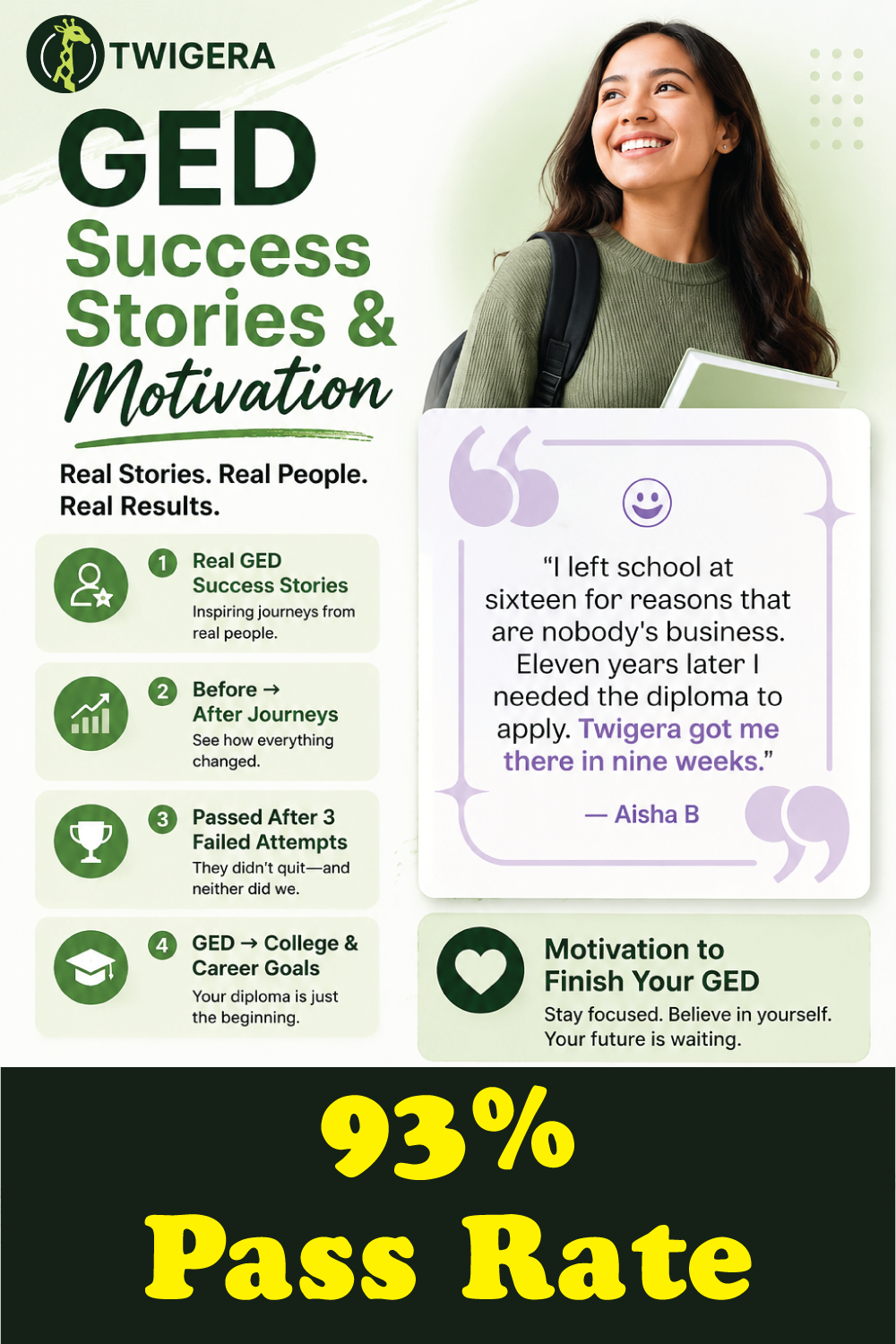
Pin this guide so you can find it again.
We refresh these every season. Save it to a Pinterest board and you’ll get the latest version next time you come back.
Save to PinterestQuestions people ask.
- Are these GED success stories real?
Yes. All four are verified Twigera student reviews, quoted in their own words from our reviews records rather than paraphrased or composited. Each student consented to their review being published. Individual results vary — these are what four particular people achieved, not a promise of what any programme delivers.
- Is getting a GED something to be embarrassed about?
No. People leave school for family responsibilities, financial pressure, health, relocation, learning difficulties, or circumstances that make traditional schooling unworkable. None of that describes ability. More than 20 million people have earned the credential since the programme began, and the useful question is not why you did not finish the usual way but what you do next.
- What changes after you earn a GED?
Realistically, one barrier is removed and a next step becomes available. It is not a transformation overnight. The four students here moved into a nursing programme, a shift lead role, CDL training and pre-nursing study. Those are individual outcomes rather than guarantees, but each one had been blocked beforehand by a missing credential.
- Can you pass the GED after failing multiple times?
Yes. Jordan Reyes failed the official test three times before passing on his fourth attempt. What changed was not effort but method — he shifted to practice tests so the question types, timing and screen were familiar. A failed attempt tells you the preparation was not enough, not that you cannot pass.
- How do I stay motivated to study for the GED?
Build a routine rather than relying on feeling inspired, because motivation fluctuates and a routine does not. Study one named skill rather than a whole subject, keep a log of what caused each mistake, set small targets, keep your reason visible, and mark each finished subject. Five hard questions reviewed carefully beat thirty rushed.
- Can you pass the GED if English is not your first language?
Yes. Leila Hassan found the writing section the most intimidating part and targeted it directly rather than avoiding it, scoring 172 on Reasoning Through Language Arts — well above the 145 pass mark and the highest in her cohort. The GED is also available in Spanish, and accommodations exist for qualifying test-takers.
- How long does it take to earn a GED?
It varies enormously and depends on your starting point. Aisha prepared in nine weeks; Marcus studied on lunch breaks for two months. Others take a year. Speed is a poor target — the students who finish are the ones with a specific reason to, not the ones who set the most ambitious timeline.
- What is the best first step toward a GED?
Find out where you actually stand rather than guessing. A diagnostic or practice test tells you which subject and which skills need attention, so your study time goes where it changes the score. Working through every topic equally is the most common way people spend months and see little movement.
Amara is the editor at Twigera. She came to publishing the long way — a decade teaching the GED in community colleges and adult-learning centers, where she watched students pass not on talent or time, but on the strength of a study plan they actually trusted. Now she shapes the guides students read here for the parent studying after a closing shift, the second-career welder, the grandmother finishing what she started forty years ago. Expect honest timelines, math made survivable, and study plans built around real life — not around a textbook's idea of one.
Take the next step — start today.
Our online GED course includes every subject, a free 30-minute diagnostic, and a 7-day refund on every plan.