GED vs HiSET: Which High School Equivalency Test Is Right for You?
GED and HiSET are the two nationally available high school equivalency tests. Compare cost, format, subjects, and scoring — TASC was discontinued in 2021, so your real choice is between these two.
GED and HiSET are the two nationally available high school equivalency tests in the US. TASC was discontinued in 2021. Both produce a state-issued credential recognized as equivalent to a high school diploma. Key differences: HiSET has 5 subtests (GED has 4), offers paper-and-pencil format (GED is computer-only), and is often cheaper. Your state determines which option you have.
Last reviewed
Are you asking yourself, is HiSET the same as GED? That is a fair question because both are high school equivalency exams that earn you a credential accepted as equal to a traditional high school diploma.
The confusion grows because both tests open the same doors for college, jobs, military enlistment, and career growth. Still, they are not identical.
What's even more interesting is the passing threshold. To pass each HiSET subtest, you need to answer about 40% of the questions correctly, while the GED requires around 45% per subject.
These small differences can shape your experience depending on your strengths.
Below, we break down what makes the GED and HiSET different, which test costs less, which one feels easier for most students, how state availability shapes your choice, what happened to TASC, and which option fits your learning style best.
If you completed some TASC subtests before the shutdown, your scores may transfer toward a GED or HiSET credential. Each state handles score transfers differently, so contact your state's adult education department for current rules.
Today, the only nationally recognized high school equivalency exams are the GED and HiSET. Some states offer both exams, while others only provide one option.
Your options are clear: GED or HiSET. But is HiSET and GED the same?
Not entirely.
Side-by-Side Comparison
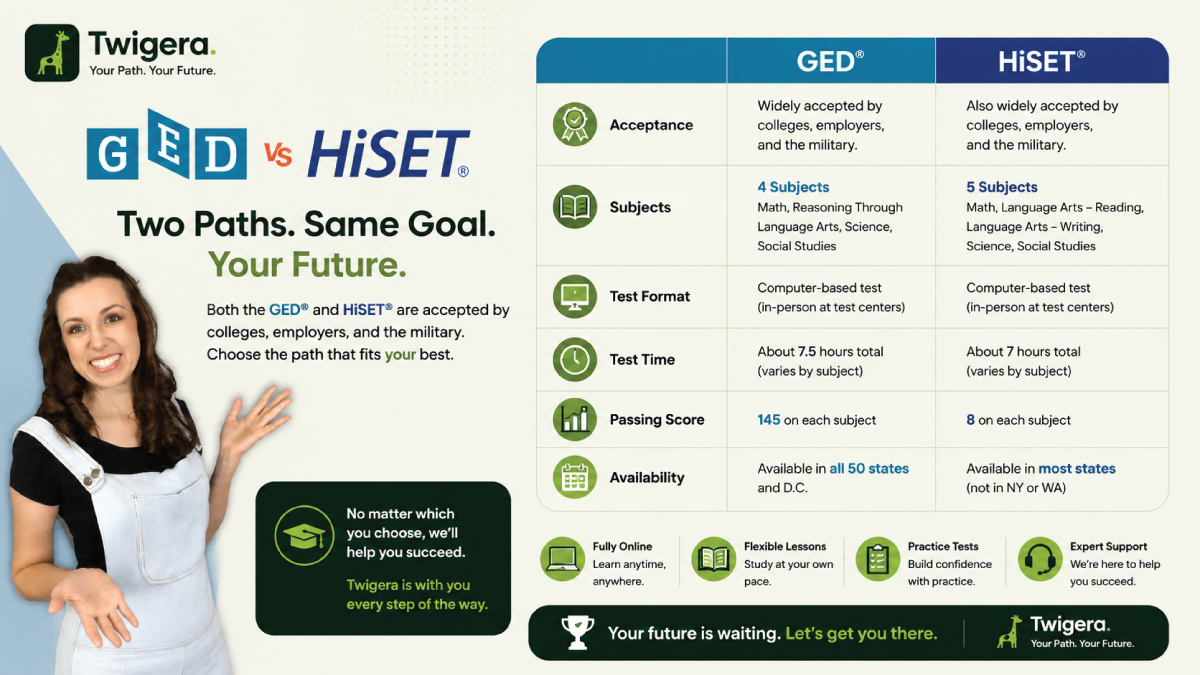
What is the difference between HiSET and GED? The GED is computer-only, while the HiSET offers both paper and computer formats. Here is a side-by-side comparison:
Factor
GED
HiSET
Vendor
GED Testing Service (ACE + Pearson)
ETS (Educational Testing Service)
Number of subtests
4
5
Format
Computer only
Paper or computer
Subjects
Math, RLA (Reading + Writing), Science, Social Studies
Math, Language Arts Reading, Language Arts Writing, Science, Social Studies
Scoring
100 to 200 per subject; 145 passing score
1 to 20 per subtest; minimum 8 per subject; 45 total; 2 of 6 essay
Online testing
Yes, through OnVUE
Limited, mostly in-person
Cost
Around $120 to $180 total
Around $35 to $100 total, varies by state
Language
English and Spanish
English and Spanish
Online prep availability
Extensive
Moderate
The biggest structural difference between the two exams is the number of subtests. The GED combines reading and writing into one Reasoning Through Language Arts section, while the HiSET separates them into two different tests — which is why the GED has 4 subtests and the HiSET has 5.
Testing format also matters for many adult learners. The GED is fully computer-based, while the HiSET still offers a paper-testing option in participating states.
Students who are less comfortable with computers sometimes prefer the HiSET for this reason.
Pricing changes depending on where you live and whether your state offers subsidies or free retesting.
Both exams lead to the same outcome: a state-recognized high school equivalency credential accepted by employers, colleges, trade schools, and the military.
Which States Offer GED and HiSET?
Your state determines which high school equivalency exam you are allowed to take. Some states offer both exams, while others only approve one.
GED Availability
The GED is offered in approximately 40 states plus Washington, D.C. It is the more widely available option across the United States and has broader online testing access through the official OnVUE platform.
The HiSET is accepted in more than 25 states. Several states expanded HiSET access after TASC was discontinued in 2021.
States That Offer Both
Most states that accept the HiSET also allow students to choose between the GED and HiSET. This gives test takers flexibility based on:
Cost
Testing format
Online availability
Personal learning preference
States That Offer Only One Exam
A smaller number of states only provide:
GED only, or
HiSET only
Because state policies change, always confirm current testing options before registering. Many students searching what's the difference between HiSET and GED do not realize that state approval is one of the biggest differences.
In some locations, your state makes the decision for you by offering only one exam provider.
Are you wondering, is HiSET easier than GED? The truth is, there is no official data to say one is easier than the other.
Both tests are designed to measure the same high-school-level skills, so the difficulty depends on you and how you approach the test.
Some people feel the HiSET's flexible time allotments make it less stressful, especially if you need more time to process questions. The option to take the HiSET on paper is also a plus if you are not comfortable with computer-based exams.
On the other hand, the GED has only four subjects, which means fewer tests to complete. This can make the process feel quicker and more manageable.
It is not about which test is easier — it is about which one fits your needs better. If you prefer flexibility and a paper option, HiSET might be your choice.
If you want fewer tests and strong online support, the GED could be the better fit.
Is HiSET Cheaper Than GED?
For many students, testing cost plays a major role when choosing between the GED and HiSET. In most states, the HiSET costs less than the GED, mainly because individual HiSET subtests are priced lower.
Still, pricing changes by state. Some states subsidize testing fees or provide free retakes for eligible students, which reduces the final amount you pay.
Students asking is HiSET better than GED sometimes focus only on cost. Price matters, but testing format, state availability, online access, and personal learning preference are equally important when choosing the right exam.
Cost Factor
GED
HiSET
Estimated total cost
Around $120 to $180
Around $35 to $100
Number of subtests
4
5
Average cost per subtest
Higher
Lower
State-funded discounts
Available in some states
Available in some states
Free retake programs
Offered in select states
Offered in select states
Online testing availability
Extensive
Limited
The GED usually costs more because of higher per-subject testing fees and broader online testing infrastructure. The HiSET remains the lower-cost option in many locations, especially for students taking the exam in person.
Before registering, check your state for updated pricing, voucher programs, and retake policies.
Which Should You Choose?
The right exam depends on your state, learning style, testing preference, and budget. Both exams lead to the same type of high school equivalency credential, so the better choice is the one that fits your situation best.
Choose the GED if You Want Online Testing
The GED offers the most established online testing system through OnVUE. If you want the flexibility to test remotely from home, the GED gives you more online scheduling options in participating states. The GED also works well for students who prefer:
Fewer subtests
Computer-based testing
Larger online prep ecosystems
Choose the HiSET if You Prefer Paper Testing
The HiSET still offers paper-based testing in participating states. This helps students who:
Feel more comfortable writing on paper
Struggle with computer testing
Prefer longer timing flexibility per section
The HiSET is also the lower-cost option in many states.
Your State Might Decide for You
Some states only offer the GED or only offer the HiSET. Before comparing features, check which exam providers your state approves.
Students searching is HiSET better than GED are usually trying to find the "safer" or "easier" choice. Neither exam is objectively better — they produce the same state-issued credential, accepted by the same colleges, employers, trade schools, and branches of the military.
The right answer depends on three things: which test your state actually offers, how you prefer to take a test (paper vs computer), and what you can afford. HiSET wins on lower cost in most states and the paper-and-pencil option for test-takers who struggle with on-screen reading.
The GED wins on online proctored testing through OnVUE, deeper prep ecosystems, and broader nationwide visibility on resumes and college applications. If both exams are approved in your state, weigh format and cost.
If only one is offered, that decision is already made for you.
The HiSET stands out for:
Lower testing costs
Paper-format availability
Flexible pacing
The GED stands out for:
Wider online testing access
More prep resources
Stronger national visibility
Credential Value Is the Same
Both exams produce a state-recognized high school equivalency credential accepted by colleges, employers, trade schools, and the military. Your long-term opportunities depend more on passing the exam than on which test provider issued it.
What If I Already Took TASC?
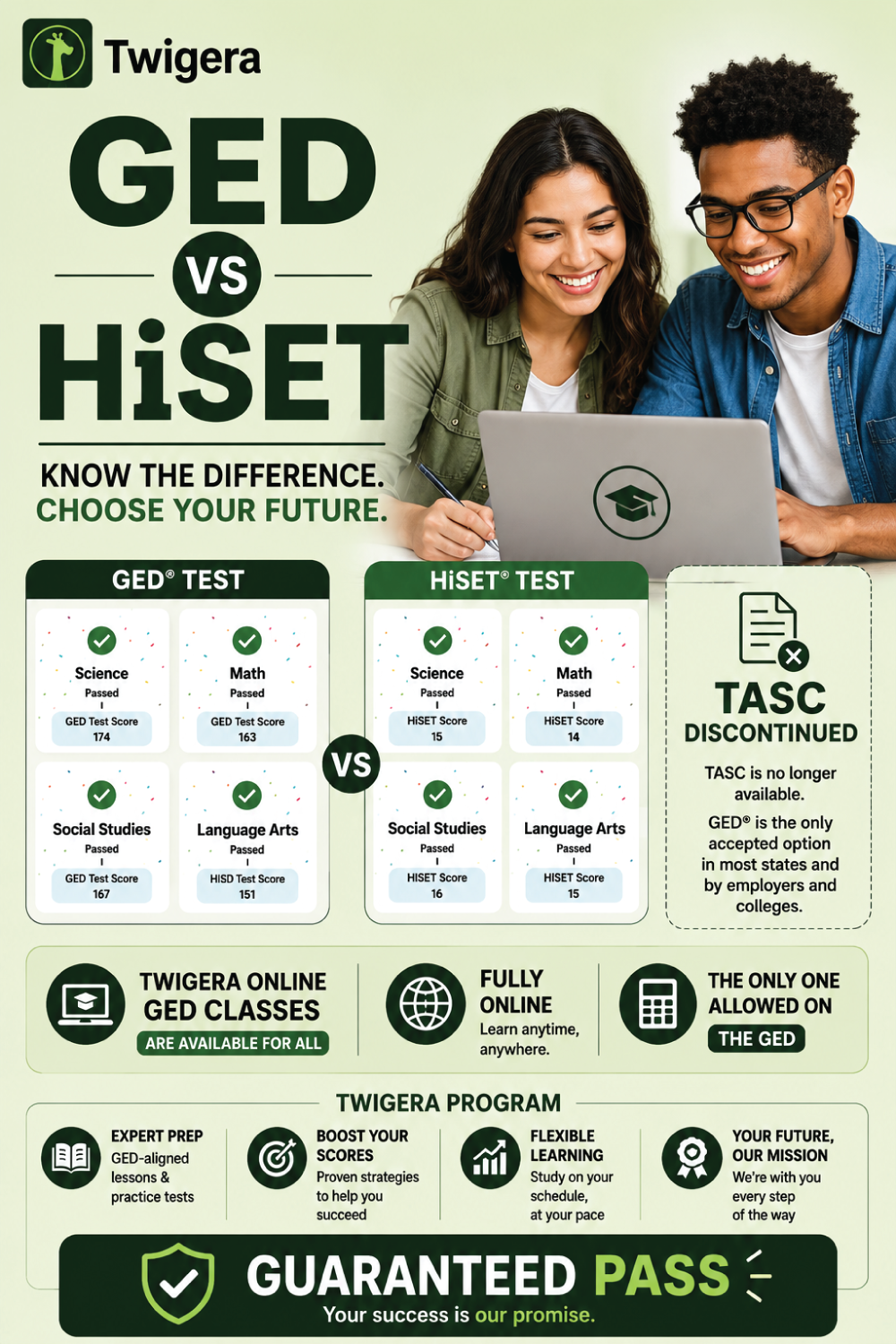
TASC was officially discontinued on December 31, 2021, and new students can no longer register for the exam. Today, the only nationally recognized high school equivalency testing options are the GED and HiSET.
New York moved its testing program to TASC in 2014 and then to HiSET after 2021; other states made similar transitions on their own timelines. If you started under TASC and never finished, your situation depends on two things: which subtests you passed before the cutoff, and which exam your state moved to next.
If you completed some TASC subtests before the exam ended, do not assume your scores are lost. Many states still allow previously passed TASC sections to transfer toward a GED or HiSET credential — especially in states that adopted HiSET as the TASC successor.
Score transfer windows vary, and some states require you to retest in any subject you did not finish before a state-set deadline.
Contact your state's adult education department or official testing office for transfer rules, expiration timelines, and remaining testing requirements. Each state handles TASC score conversions differently.
Bottom Line
The GED and HiSET lead to the same outcome: a state-recognized high school equivalency credential accepted by colleges, employers, trade schools, and the military. The main differences come down to testing format (HiSET still offers paper-and-pencil; the GED is computer-only), cost (HiSET often costs less per subtest), number of subtests (GED has 4, HiSET has 5), and state availability (some states only approve one).
If your state offers both exams, choose the one that matches your learning style and testing preference best — paper-test-takers tend to prefer HiSET; readers who already use a laptop daily tend to prefer the GED and its OnVUE remote-testing option. If your state only approves one, register for that exam and skip the comparison entirely.
Either credential opens the same doors after you pass. Before you commit to a prep package, take a few minutes to see exactly where you stand right now — a diagnostic costs nothing and saves you weeks of mis-targeted study.
Frequently asked
Questions people ask.
Is HiSET the same as GED?
ShowHide
No — they are different tests administered by different organizations. HiSET (by ETS) has 5 subtests and is available in paper or computer format; GED (by GED Testing Service) has 4 subtests and is computer-only. Both produce a state-issued credential recognized as high school equivalency.
What's the difference between HiSET and GED?
ShowHide
HiSET has 5 subtests (GED has 4), offers paper-and-pencil testing (GED is computer-only), and is often less expensive. The GED has more extensive online testing and prep resources. Credential value is equivalent — both are accepted by colleges, employers, and the military.
Is HiSET easier than GED?
ShowHide
Both tests are calibrated to the same high-school-senior academic level. HiSET has slightly more generous timing and a paper option (helpful for some test-takers), while the GED has fewer subtests. "Easier" is personal — no official data says one is inherently easier.
Is HiSET cheaper than GED?
ShowHide
Usually yes. HiSET total costs typically range $35–$100 for all 5 subtests, while GED runs $120–$180 in most states. State subsidies and free testing programs may reduce either. Check your state's current pricing.
Is HiSET better than GED?
ShowHide
Neither is objectively better — they produce the same credential. HiSET wins on paper availability and cost; GED wins on online testing access and prep ecosystem. Your state may decide the question by offering only one.
What happened to TASC?
ShowHide
TASC was discontinued on December 31, 2021. If you were taking TASC, your scores may transfer to the GED or HiSET depending on your state. Contact your state's adult education department.
Which states accept HiSET?
ShowHide
HiSET is accepted by approximately 25+ states (the list has grown since TASC was discontinued). Check hiset.ets.org for your state's current status. Most states that accept HiSET also accept the GED.
Amara is the editor at Twigera. She came to publishing the long way — a decade teaching the GED in community colleges and adult-learning centers, where she watched students pass not on talent or time, but on the strength of a study plan they actually trusted. Now she shapes the guides students read here for the parent studying after a closing shift, the second-career welder, the grandmother finishing what she started forty years ago. Expect honest timelines, math made survivable, and study plans built around real life — not around a textbook's idea of one.
Enjoyed this?
Take the next step — start today.
Our online GED course includes every subject, a free 30-minute diagnostic, and a 7-day refund on every plan.