What Math Is on the GED? Complete Topic List + How to Pass
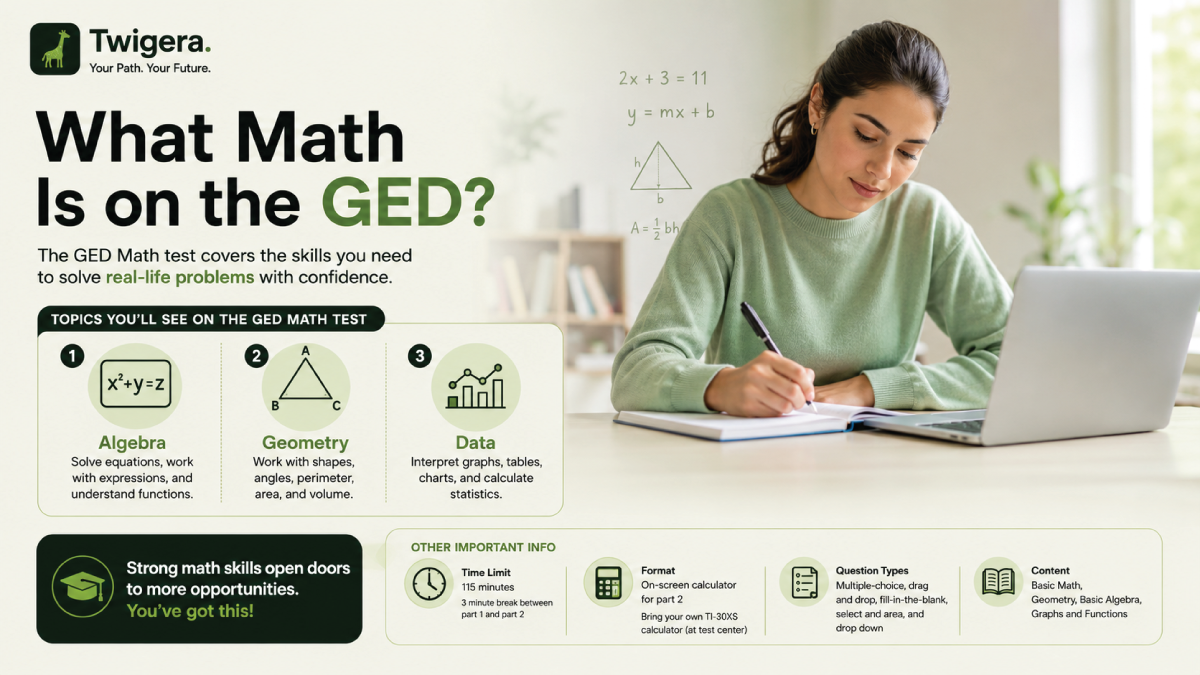
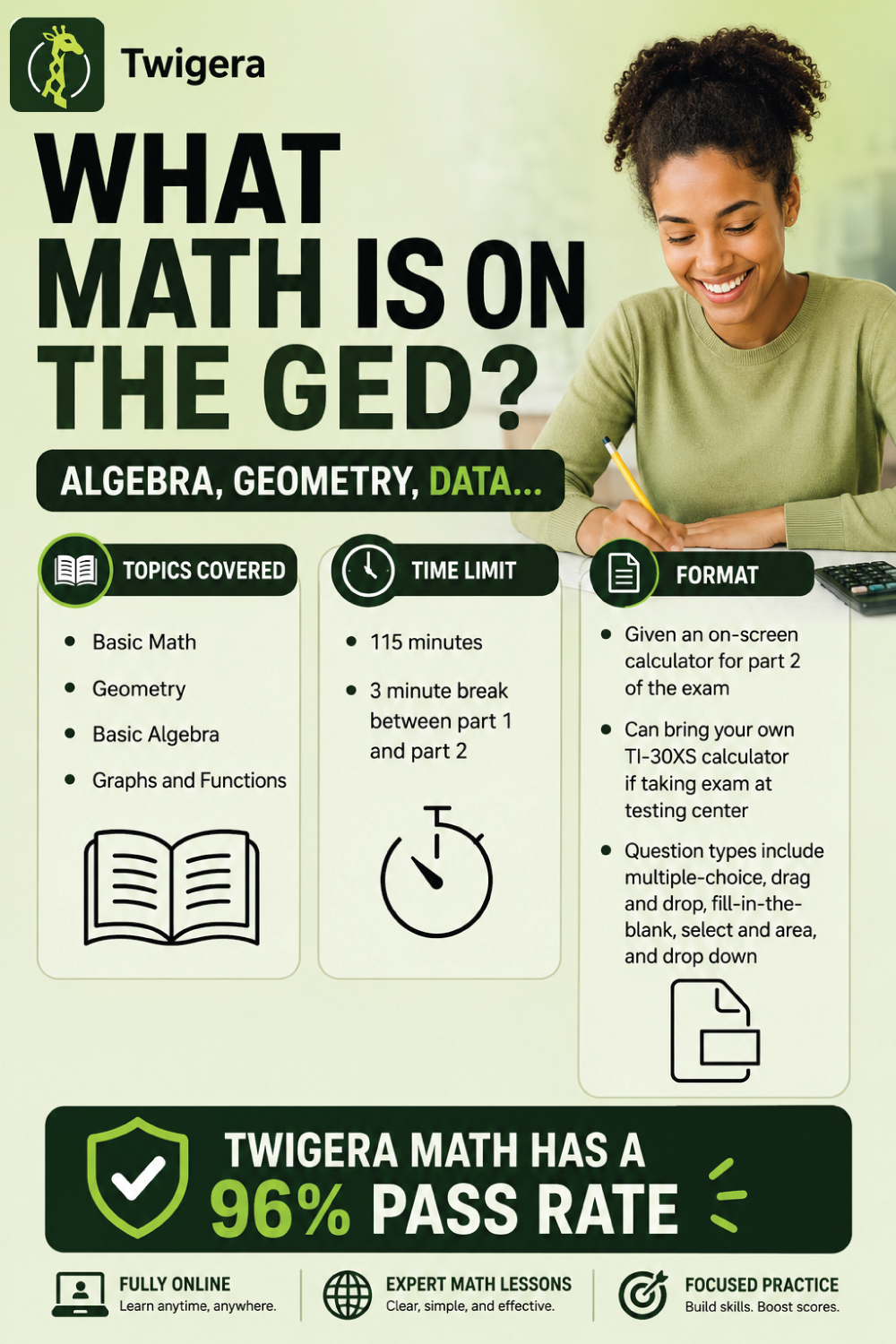
GED Math has ~46 questions in 115 minutes — basic algebra, geometry, data, ratios, and percentages. No trigonometry, no calculus. TI-30XS calculator and formula sheet provided.
GED Math (Mathematical Reasoning) has ~46 questions in 115 minutes and covers basic algebra (~55%) and quantitative problem solving (~45%). Topics: number operations, ratios, percentages, data and statistics, linear equations, basic functions, polynomials, coordinate graphing, and basic geometry. The on-screen TI-30XS calculator is available on most questions, plus a formula reference sheet. Passing score: 145.
Last reviewed
Math is the GED subject most students worry about. Fractions, algebra, word problems, and formulas often feel harder when you have been away from school for a while.
A reported 85% of GED test-takers struggle with the math section, and many lose confidence before they even start preparing. You do not need to be a math genius to pass — you need the right topics, steady practice, and a clear plan for what to study first.
This guide covers the full topic list, what is not tested, how the calculator and formula sheet work, and the study plan that helps you prepare with confidence.
GED Math at a Glance
Before answering what kind of math is on the GED test, it helps to understand the test format. Here is a quick look at the key GED Math details you should know before you start preparing.
Factor
Detail
Number of questions
About 46 questions
Time limit
115 minutes
Test parts
Part 1: no calculator, ~5–6 questions. Part 2: calculator allowed, ~40 questions
Calculator
TI-30XS on-screen calculator
Passing score
145
College Ready score
165
College Ready + Credit
175
For a deeper look at the cutoffs and what each tier unlocks for college, see our breakdown of the GED passing score.
What Topics Are on GED Math?
When students ask what kind of math is on the GED test, the answer is more focused than many expect. GED Math mainly covers two areas: quantitative problem solving and algebraic problem solving.
GED Math Area
What It Covers
Approx. Test Share
Quantitative Problem Solving
Numbers, ratios, percentages, measurement, data, statistics, and probability
45%
Algebraic Problem Solving
Equations, inequalities, functions, graphing, polynomials, basic quadratics, and geometry
55%
Quantitative Problem Solving
This part tests how well you use math in practical situations. You may need to solve problems with whole numbers, fractions, decimals, and percentages. You should also know how to work with ratios and proportions — comparing amounts, scaling recipes, or solving rate problems.
Measurement is another key area. Expect questions involving units, conversions, perimeter, area, volume, and real-world measurements. You will also see data questions that ask you to read graphs, tables, charts, and number patterns. For basic statistics, focus on mean, median, mode, and range, plus simple probability — finding the chance of a basic event happening.
Algebraic Problem Solving
This is the larger part of GED Math. You will need to solve linear equations with one or two variables, such as finding the value of x or comparing two unknown values, and practice linear inequalities where answers may be greater than, less than, or equal to a number.
GED Math may include systems of linear equations, where you solve two connected equations. Functions are also tested — you may need to read, evaluate, or graph a function using a table, equation, or coordinate plane. Expect basic polynomials (mostly addition, subtraction, and multiplication) and basic-level quadratics.
Coordinate graphing is another must-know skill: plotting points, slope, intercepts, and reading lines on a graph. Geometry is included under algebraic problem solving — you should know area, volume, perimeter, the Pythagorean theorem, and similar or congruent figures.
Save for later
Pin this guide so you can find it again.
We refresh these every season. Save it to a Pinterest board and you’ll get the latest version next time you come back.
When learning what kind of math is on the GED test, it also helps to know what you do not need to study. GED Math does not test:
Trigonometry — no sine, cosine, or tangent
Calculus — no derivatives or integrals
Advanced algebra — no matrices, complex numbers, or conic sections
Formal proofs — no formal geometry proofs
GED Math focuses on basic algebra, geometry, data, ratios, percentages, and problem-solving. If you understand Algebra I and basic geometry, you are covering most of the math skills tested on the GED.
The GED Math Formula Reference Sheet
The GED Math test gives you an on-screen formula reference sheet during the test, so you do not need to memorize every formula. The sheet includes area formulas for triangles, rectangles, trapezoids, and circles, plus volume formulas for rectangular solids, cylinders, cones, pyramids, and spheres.
You will also see formulas such as the distance formula, slope-intercept form, quadratic formula, Pythagorean theorem, and simple interest. The formula sheet only helps when you know how to use it. A key part of how to pass the GED Math test is learning how to choose the right formula, plug in the numbers, and check whether your answer makes sense.
Practice with the reference sheet from the start of your prep, so using it feels familiar before test day.
How Hard Is GED Math?
GED Math is often the hardest GED section for many test-takers — but the difficulty is more about how long you have been out of school than the content itself. For a deeper breakdown, see our honest take on whether the GED is hard.
GED Math is not advanced. Many adults struggle because they have been away from school for years and have lost confidence with algebra, fractions, formulas, and word problems. The good news is that GED Math is limited and well-defined. Once you know the topics, practice the right skills, and follow a steady study plan, the test becomes much easier to prepare for.
How Many Questions on GED Math?
If you are asking how many questions are on the math GED test, the answer is about 46. The test is split into two parts — a short no-calculator section first, and a longer calculator section after that. For the full section-by-section breakdown of every GED subject, see our guide on how many questions are on the GED.
GED Math Detail
What to Expect
Total questions
About 46 questions
Question types
Multiple-choice, drag-and-drop, fill-in-the-blank, and hot-spot
Part 1
About 5–6 questions, no calculator allowed
Part 2
About 40 questions, TI-30XS calculator allowed
Main takeaway
Most of the test allows the calculator — but you still need strong basic math and problem-solving skills
For more on the calculator itself — when it is allowed and which one — see our guide on using a calculator on the GED.
How to Pass GED Math
Passing GED Math starts with a clear plan, not random practice. Here is how to pass your GED Math test with steady preparation and the right order of topics.
Take a Diagnostic First
Before you start studying, take a GED Math diagnostic test so you know your current level. This helps you avoid wasting time on topics you already understand. Use your results to list your weak areas — fractions, equations, graphing, geometry — and build your study plan around those gaps instead of guessing what to review.
Review Math Foundations First
Start with whole numbers, fractions, decimals, and percentages in Week 1 and Week 2. These skills show up in word problems, ratios, data questions, and algebra. Do not rush this stage — if you struggle with fractions or percentages, algebra will feel harder than it needs to be.
Build Algebra Skills
From Week 3 to Week 5, focus on linear equations, basic functions, and the coordinate plane. Algebra makes up a large part of the GED Math test, so this section deserves steady practice. Learn how to solve for x, read equations, understand slope, and plot points on a graph.
Add Geometry
In Week 6, study area, volume, perimeter, and the Pythagorean theorem. GED geometry is practical, so expect questions about shapes, measurements, and formulas. Use the formula reference sheet while you practice — your goal is not to memorize every formula, but to know when and how to use each one.
Practice Data and Statistics
In Week 7, work on charts, tables, graphs, mean, median, mode, and range. These questions test how well you read information and make sense of numbers. Pay close attention to labels, units, and what the question asks. Many students lose points here by rushing through the chart instead of reading it carefully.
Take GED Ready
In Week 8, take the official GED Ready practice test and aim for a "green" score, which means you are likely ready for the real GED Math test. Review every missed question after the test — your mistakes show you exactly what to fix before scheduling the official exam.
Master the TI-30XS Calculator
Practice with the TI-30XS on-screen calculator throughout your study plan. Since most GED Math questions allow the calculator, you should know how to use it before test day — for fractions, decimals, percentages, square roots, exponents, and multi-step problems. The calculator saves time only when you already understand what to enter.
Once you have the math under control, the next step is the timeline. Our guide on how to get your GED in 6 steps covers the full path from prep to credential.
Best Resources for GED Math Prep
The best GED Math prep resources help you learn the topic, practice the skill, and test yourself before exam day. Use a mix of free practice, official test-style questions, and structured support if you need a guided plan.
Free resources like Khan Academy Math help you review fractions, decimals, percentages, algebra, graphing, and geometry. GED.com also offers free practice tools and official information to help you understand the test format.
Paid resources are useful when you want test-style practice and clearer feedback. The GED Ready practice test is a strong option because it shows whether you are likely to pass before taking the official test. If you want personal help, you can also work with a GED math tutor through local adult education programs or online tutoring.
Bottom Line
GED Math comes down to basic algebra, geometry, data, and problem-solving. You will answer about 46 questions in 115 minutes, with the TI-30XS calculator available for most of the test and a formula reference sheet provided on-screen.
With 4 to 8 weeks of focused prep, you can build the skills and confidence you need. Start with a diagnostic, work foundations first, then layer in algebra and geometry — and use the on-screen calculator and formula sheet from day one of practice, not just on test day.
Frequently asked
Questions people ask.
What math is on the GED?
ShowHide
GED Math covers basic algebra (~55% of test) and quantitative problem solving (~45%). Topics include number operations, ratios and percentages, data and statistics, linear equations, basic functions, polynomials, coordinate graphing, and basic geometry (area, volume, Pythagorean theorem). No trigonometry or calculus.
How many questions are on the GED math test?
ShowHide
About 46 questions. The first 5–6 questions (Part 1) do not allow a calculator. The remaining ~40 questions (Part 2) allow use of the TI-30XS on-screen calculator. Total testing time: 115 minutes.
How hard is GED math?
ShowHide
GED Math is the hardest section for most test-takers because adults have often been away from algebra for years. The content is limited and well-defined though — no trigonometry or calculus. With 4–8 weeks of focused prep, most adults reach a passing level.
What kind of math is on the GED test?
ShowHide
Pre-algebra and basic algebra (Algebra I level), plus basic geometry, data analysis, and statistics. Nothing beyond — no trigonometry, no calculus, no advanced algebra. If you remember early high school math, you know most of the material.
Do you get a formula sheet on GED math?
ShowHide
Yes. An on-screen formula reference sheet is available throughout the math test, including area/volume formulas, the Pythagorean theorem, slope-intercept form, the quadratic formula, and more. You don't memorize these — you apply them.
How do I pass the GED math test?
ShowHide
Take a diagnostic to find your weak areas, work through pre-algebra foundations first (fractions, decimals, percentages), then algebra (equations, functions, graphing), then geometry. Practice with the TI-30XS calculator. Take GED Ready until you score "green." Plan 4–8 weeks of prep.
Is there a calculator on the GED math test?
ShowHide
Yes — the TI-30XS on-screen calculator, available on Part 2 (about 40 of 46 questions). Part 1 (the first 5–6 questions) is calculator-free. You don't bring a personal calculator for online testing; an on-site test center allows your own TI-30XS.
Amara is the editor at Twigera. She came to publishing the long way — a decade teaching the GED in community colleges and adult-learning centers, where she watched students pass not on talent or time, but on the strength of a study plan they actually trusted. Now she shapes the guides students read here for the parent studying after a closing shift, the second-career welder, the grandmother finishing what she started forty years ago. Expect honest timelines, math made survivable, and study plans built around real life — not around a textbook's idea of one.
Enjoyed this?
Take the next step — start today.
Our online GED course includes every subject, a free 30-minute diagnostic, and a 7-day refund on every plan.