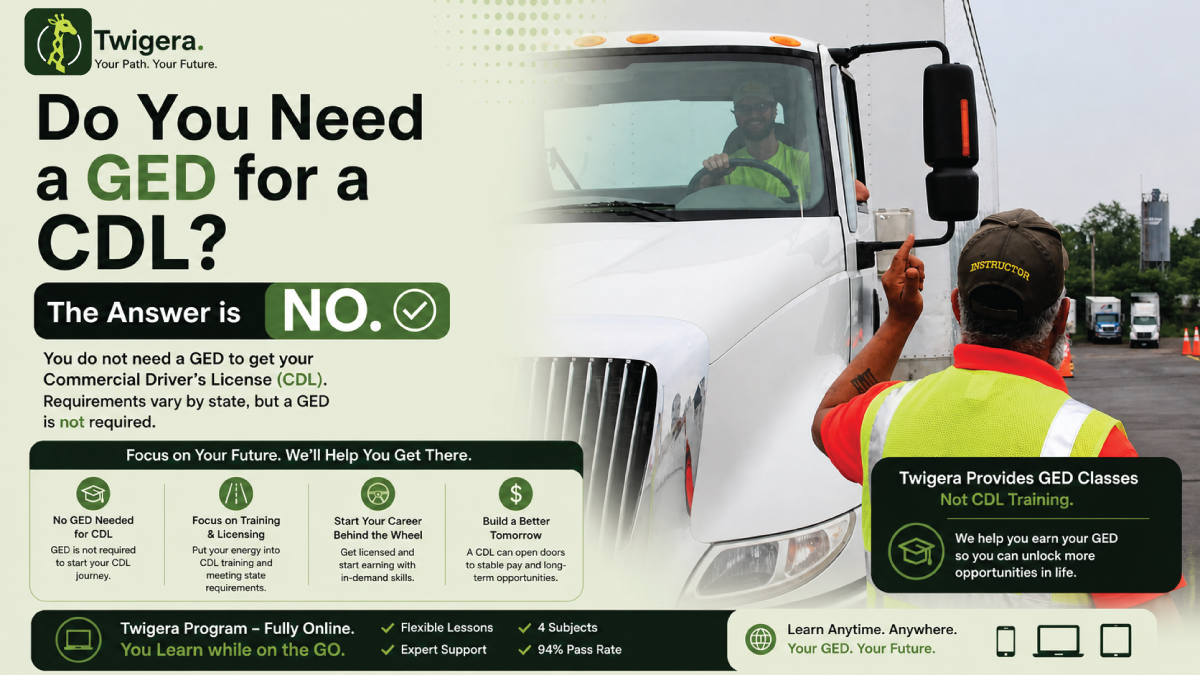
Do You Need a GED for a CDL? Federal Rule + Reality
Federal law: no GED required to get a commercial driver's license. But many trucking companies and CDL schools require one — here's what that actually means for your career.
No — federal FMCSA rules do not require a GED for a commercial driver's license. You need a DOT physical, Entry-Level Driver Training, and to pass written and skills tests. But many trucking companies and CDL schools still require a GED for hiring, financial aid, or higher-paying contracts. Having one expands your options and pay.
Last reviewed
A CDL, or commercial driver's license, is the license you need to legally drive heavy vehicles like semi trucks, buses, and delivery rigs.
If you're thinking about getting one, the first question often sounds simple but feels confusing: do you need a GED to get a CDL.
You might have heard people say you do. Others say you don't.
That back and forth can leave you stuck before you even start.
Here's the truth you need early. You do not need a GED to get a CDL under federal law.
But this is where many people make a costly assumption. They hear "no requirement" and think it won't affect their path.
Some drivers move forward without a GED and find work. Others run into limits when certain companies turn them away or offer fewer options.
So this is not only about what the law says. It is about what your real opportunities look like once you step into the industry.
Let's walk through what the law requires, how a GED impacts your options, and the steps you can take to build a successful trucking career.
Does Federal Law Require a GED for a CDL?
If you're asking do you need ged for cdl, the federal answer is no.
The FMCSA, which sets nationwide standards for commercial driving, does not require a GED or high school diploma to get a CDL.
The Federal Motor Carrier Safety Administration (FMCSA) sets the baseline requirements for obtaining a CDL. These include:
Age: You must be at least 18 years old for intrastate driving (within your state) and 21 for interstate driving (crossing state lines).
Licensure: A valid driver's license is required before applying for a CDL.
Testing: You'll need to pass written knowledge tests and a skills test, which includes pre-trip inspection, basic controls, and an on-road driving exam.
Medical Certification: A DOT physical exam is mandatory to ensure you're medically fit to operate commercial vehicles.
Entry-Level Driver Training (ELDT): Since February 2022, first-time CDL applicants must complete FMCSA-approved ELDT, covering both theory and behind-the-wheel training.
Before walking through the federal CDL requirements in detail, here is the short version of where a GED matters across every context — federal law, schools, hiring, financial aid, and endorsements — in one quick reference:
Context
GED Required?
Why / Notes
Federal Law (FMCSA)
No
DOT physical, ELDT, and age 18/21 are the only baseline requirements
Trucking Companies
Varies
Larger carriers usually require GED; regional and smaller carriers often do not
CDL Training Schools
Varies
Most private schools do not; community college CDL programs usually do
Federal Financial Aid
Yes (or ATB)
Pell Grants and federal loans require a GED, diploma, or Ability-to-Benefit test pass
HazMat Endorsement
No
TSA Security Threat Assessment only — education level is not part of the check
Owner-Operator (loans, insurance)
Often Yes
Business loans and commercial insurance providers commonly screen credentials
What Does a CDL Actually Require?
If you're asking, do you need your GED to get your CDL, the answer is no under federal law. But meeting the federal requirements for a CDL involves several important steps. Here's a clear checklist of what you'll need:
1. Valid Driver's License (Class D)
Before applying for a CDL, you must already hold a valid standard driver's license. This ensures you have basic driving experience.
2. Minimum Age: 18 or 21
The federal minimum age is 18 years old to drive commercially within your state (intrastate). For interstate driving, which involves crossing state lines, the minimum age is 21.
3. DOT Medical Card
A Department of Transportation (DOT) physical exam is required to confirm you're medically fit to operate commercial vehicles. Passing this exam earns you a DOT medical card, which must remain valid throughout your CDL career.
4. Commercial Learner's Permit (CLP)
Before taking the CDL skills test, you'll need to obtain a CLP. This permit must be held for at least 14 days, allowing you to practice driving a commercial vehicle under supervision.
5. Entry-Level Driver Training (ELDT)
Beginning February 2022, first-time CDL applicants are required to complete ELDT from an FMCSA-approved provider. This training includes both classroom instruction and behind-the-wheel practice.
6. Pass Written Knowledge Tests
You'll need to pass written exams covering general knowledge and any endorsements you're pursuing, such as HazMat or passenger transport.
7. Pass the Skills Test
The final step is the CDL skills test, which includes three parts: a pre-trip inspection, basic vehicle control, and an on-road driving test.
CDL School: Do They Require a GED?
Save for later
Pin this guide so you can find it again.
We refresh these every season. Save it to a Pinterest board and you’ll get the latest version next time you come back.
Do you need your ged to get your cdl when applying to a training school? The answer depends on the school you choose, not federal law.
Private CDL training schools set their own admission policies. Many of these schools accept students without a GED, focusing more on your ability to complete training and pass the CDL tests.
Some schools still require a GED based on their internal standards or employer partnerships.
Financial aid can change your options. Certain programs, including federal funding like Pell Grants, usually require a high school diploma or GED.
Without one, you may need to pay out of pocket or look for schools that offer alternative payment plans.
Community college CDL programs follow stricter academic rules. These programs typically require a GED or high school diploma as part of admission.
They are more structured and may include additional coursework beyond basic driving training.
So when you ask do you need ged to get cdl, the real factor is where you enroll. Always check the school's requirements before applying.
This step helps you avoid delays and choose a program that fits your situation from the start.
Trucking Companies: Do They Require a GED?
Trucking companies set their own hiring standards, and those standards vary. Some companies focus on getting drivers on the road quickly, while others are more selective about who they hire.
Large carriers, especially those offering higher pay, better routes, or long-term contracts, tend to require a GED or high school diploma. These companies often work with major clients who expect a certain level of screening.
Smaller and regional carriers are more flexible. Many of them hire drivers without a GED, especially if you already have your CDL and a clean driving record.
These companies can be a starting point, but the tradeoff may include lower pay or fewer route options.
HazMat endorsements do not include a formal GED requirement. The process involves a TSA background check, which reviews your criminal history and legal status.
Your education level is not part of that check, but companies hiring for these roles may still have their own standards.
Do i need a ged to get a cdl if your goal is to get hired after training? This is where the answer becomes more practical.
The key is to approach this with a plan. Apply to multiple companies, be upfront about your credentials, and understand that your options may expand if you decide to get a GED later.
Why Should You Get a GED Anyway?
While you don't need your GED to get your CDL, having one can significantly improve your career prospects in the trucking industry. Here's why.
1. Access to Higher-Paying Companies
Many top-paying trucking companies require a GED or high school diploma. Without one, you may miss out on opportunities with these employers.
2. Better Routes and Contracts
Some government and corporate contracts require drivers to have a GED. This means having one can open doors to more desirable routes and higher-value loads.
3. Owner-Operator Opportunities
If you plan to become an owner-operator, a GED can help. Business loans and insurance providers often check credentials, and having a GED can make the process smoother.
4. Career Flexibility Beyond Trucking
A GED provides long-term career flexibility. If you decide to leave trucking, it can help you transition into other industries or pursue further education.
5. Higher Earning Potential
Salary data shows that drivers with a GED or high school diploma often earn more. While this is a correlation and not direct causation, it reflects the broader opportunities available to those with a secondary credential.
Investing the time to earn your GED can pay off in better job options, higher earnings, and greater career stability, even if it's not a federal requirement for a CDL.
Pro Tip: If you're planning to take your GED test, consider using a structured online preparation program designed to fit your schedule. With flexible packages and comprehensive resources, Twigera helps you prepare effectively and confidently, no matter where you are.
Can a 17-Year-Old Get a CDL?
Can you get a CDL at 17? The federal answer is no.
The minimum age set by the FMCSA is 18 years old for intrastate driving, which means driving within your state only. To drive across state lines, you must be 21 years old.
There is one exception worth knowing. The FMCSA Safe Driver Apprenticeship Pilot Program allows some drivers aged 18 to 20 to operate interstate under strict training and supervision.
This is limited and not available to everyone.
For anyone under 18, there is no legal pathway to get a CDL at the federal level. You must wait until you meet the minimum age requirement before starting the process.
The best move at 17 is to prepare. Work toward meeting the licensing requirements, and if needed, use this time to strengthen your qualifications so you can move faster once you turn 18.
What's the Bottom Line?
You do not need a GED to get a CDL under federal law. The process is built around training, testing, and safety requirements, not your education level.
But schools and trucking companies set their own rules. Some will hire or train you without a GED, while others will not.
That difference affects your options, pay, and long-term growth. Getting a GED puts you in a stronger position from the start.
Ready to move forward? Before you commit to a study plan, see exactly where your skills stand today with our free diagnostic — it takes about 30 minutes and gives you an honest read on what test day will look like.
Frequently asked
Questions people ask.
Do you need a GED to get a CDL?
ShowHide
No. Federal FMCSA regulations do not require a GED or high school diploma to obtain a commercial driver's license. You need a valid driver's license, a DOT medical card, to pass written and skills tests, and to complete Entry-Level Driver Training (ELDT).
Do trucking companies require a GED?
ShowHide
Some do, many don't. Hiring standards vary by company. Larger carriers with higher pay and better benefits are more likely to require a GED or high school diploma. Smaller and regional carriers often don't.
Can you go to CDL school without a GED?
ShowHide
Most private CDL training schools don't require a GED, though some do. Community college CDL programs often require a GED or high school diploma. Financial aid eligibility may also depend on your credentials. Check each school's requirements.
How old do you have to be to get a CDL?
ShowHide
Federal minimum: 18 years old for intrastate (in-state only) trucking; 21 for interstate (crossing state lines) trucking. A pilot apprenticeship program (FMCSA SDAP) allows 18-20-year-olds to drive interstate in certain circumstances.
Is it better to have a GED when applying for trucking jobs?
ShowHide
Yes. Even though not federally required, having a GED expands the number of trucking companies that will hire you, improves access to better-paying contracts, and often correlates with higher overall pay. It also supports long-term career flexibility outside of trucking.
What is Entry-Level Driver Training (ELDT)?
ShowHide
ELDT is a federal requirement (since February 2022) for first-time CDL applicants. You must complete training from an FMCSA-approved provider before taking the CDL skills test. Training covers theory and behind-the-wheel instruction.
Do you need a GED for a HazMat endorsement?
ShowHide
No formal GED requirement for the HazMat endorsement. However, you must pass a TSA security threat assessment (background check), which reviews criminal history and immigration status — but not your education level.
Amara is the editor at Twigera. She came to publishing the long way — a decade teaching the GED in community colleges and adult-learning centers, where she watched students pass not on talent or time, but on the strength of a study plan they actually trusted. Now she shapes the guides students read here for the parent studying after a closing shift, the second-career welder, the grandmother finishing what she started forty years ago. Expect honest timelines, math made survivable, and study plans built around real life — not around a textbook's idea of one.
Enjoyed this?
Take the next step — start today.
Our online GED course includes every subject, a free 30-minute diagnostic, and a 7-day refund on every plan.