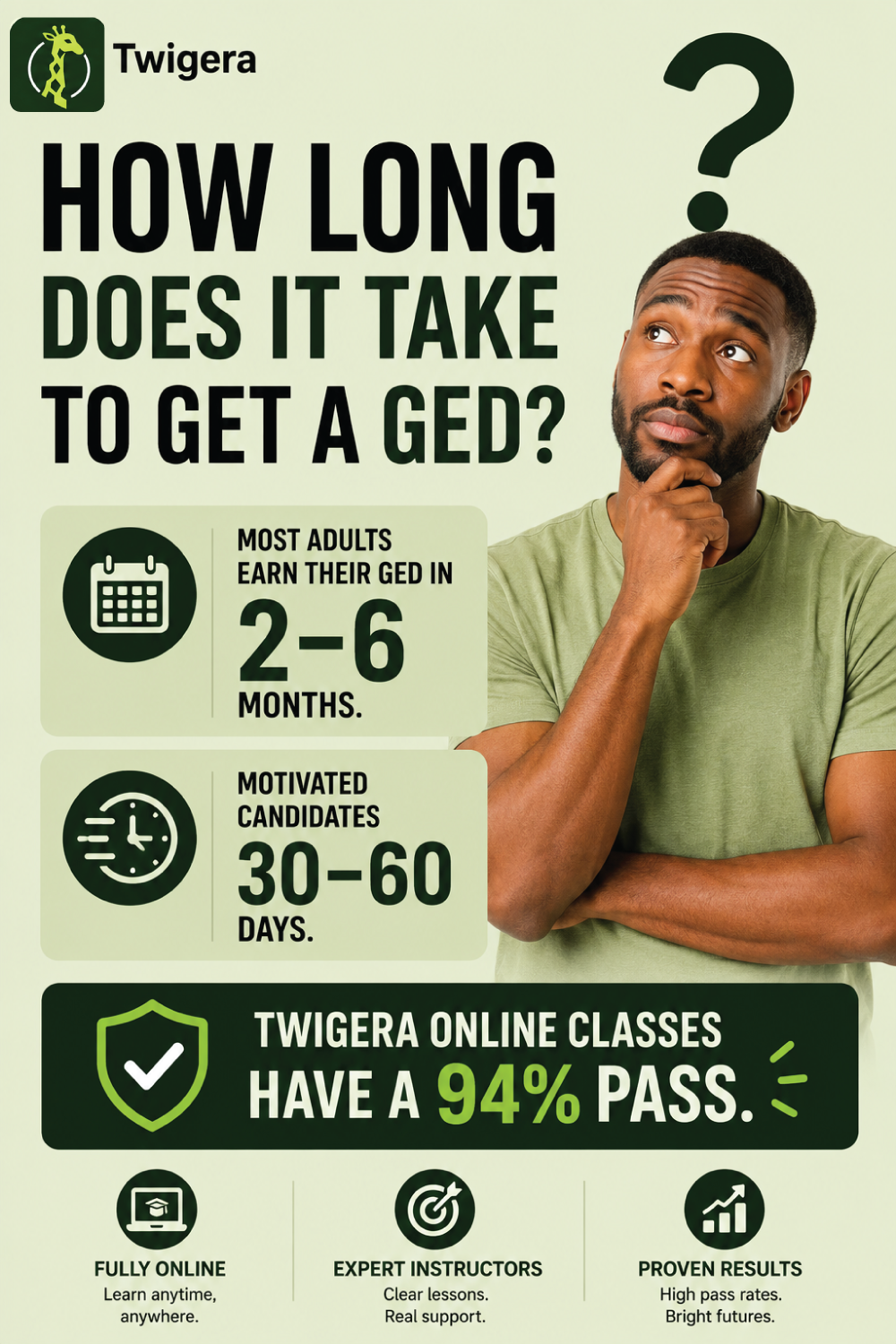
Most adults earn their GED in 2 to 6 months. A proper preparation plan can shorten that path — and the right plan starts with knowing where you actually stand.
Every year, 150,000 people earn their GED, and you can be one of them. Instead of spending four years in high school, you can earn your GED faster and move on to college, the trades, or better-paying work.
But how long does it actually take to get a GED? That's the question this guide answers honestly — by starting level, by component, and with the speedups that actually work.
Most adults earn their GED in 2 to 6 months, but your timeline depends on where you are starting from. If you were recently in school or still feel confident with reading, writing, and basic math, you might be ready in 4 to 8 weeks. If you have been out of school for years, a 2 to 4 month timeline is more realistic.
Starting Level | Typical Timeline |
|---|
Strong, recently in school | 4 to 8 weeks |
Average adult | 2 to 4 months |
Weaker skills or ESL | 4 to 6 months |
Very low starting skills | 6 to 12 months |
The GED test itself does not take months. The four subject tests run about 7 hours total, and many candidates split them across different days. What takes the most time is preparation — enough time to review the subjects, take practice tests, build confidence, and pass each section without paying for retakes.
When people ask how long it takes to get a GED, they often expect one simple answer. The better answer: your GED timeline has several steps, and each step affects how soon you finish. Here is the full breakdown from your first assessment to your final credential.
Start with a diagnostic test. It takes 1 to 2 hours and gives you a clear picture of where you stand. This step keeps you from studying blindly — you will know whether math, reading, writing, science, or social studies needs the most attention.
The prep phase is the part that changes most from one learner to another. Some people need 4 weeks; others need up to 6 months. You may use a structured course or a self-study plan. A moderate pace is about 2 to 5 hours per week; an intensive pace is about 2 to 4 hours per day. Focus first on your weakest subjects — that is where a clear plan saves time and avoids repeated mistakes.
Before booking the official test, take the GED Ready practice tests. Each one takes about 1 to 2 hours and costs around $7.99 per subject. Aim for a green score, which means "Likely to Pass." This is the signal that you are ready instead of guessing.
Once you are ready, book your test on GED.com. You may take all four subjects in one day or split them across several days. The full GED test takes about 7 hours total, but most learners spread the subjects out so they stay focused. If you are unsure how the four sections break down, our guide on how many questions are on the GED breaks every section down minute-by-minute.
Step 5 — Post-Test: Wait for Your Results
After testing, multiple-choice sections are usually scored within hours. The RLA essay may take up to 3 business days. Once you pass all four subjects, your digital credential should appear in your MyGED account within hours of your final pass.
Your physical certificate is mailed by your state department of education. This usually takes 2 to 6 weeks, though some states are faster.
So how long to get a GED from start to finish? Most learners should plan for 2 to 6 months. If you want a structured walk-through of every step, our companion guide on how to get your GED in 6 steps covers the same path with more detail on each phase.
The GED test itself takes about 7 hours total, but you do not have to complete everything in one sitting. The official GED test has four separate subject exams, and you can take them one at a time and move at your own pace.
Most students split the test across 2 to 4 days. If you are testing online through OnVUE, plan for one subject at a time so you have enough focus, time, and energy for each session. Pearson VUE lists the online testing rules — technology, ID, testing space, and device requirements — so online test day takes more planning than simply logging in.
The GED Math test takes 115 minutes. It covers basic math, geometry, basic algebra, graphs, and functions. You also get access to a formula sheet, calculator reference sheet, and an on-screen TI-30XS calculator for most of the test (your own TI-30XS is allowed at a test center).
The Reasoning Through Language Arts test takes 150 minutes. It includes reading, grammar, argument skills, and a written essay. The section includes a 45-minute written essay and a 10-minute break between parts.
The Science test takes 90 minutes. It focuses on reading for meaning in science, interpreting experiments, and using numbers and graphics. There is no break, so practice reading charts and questions without rushing.
If you are asking how long is the social studies GED test, the answer is 70 minutes. This section covers reading for meaning in social studies, analyzing historical events and arguments, and using numbers and graphs. There is no break, so manage your time during the test.
If you want to get your GED online, the full timeline is usually close to the in-person path. Most learners still need 2 to 6 months, depending on starting level, study time, and confidence with each subject. The main difference is flexibility — you prepare from home, study around your schedule, and book each subject when you feel ready.
Before you schedule an online GED test, you need a green score on the GED Ready practice test within the last 60 days for the subject you plan to take online. You should also run a system test before exam day to check your computer, webcam, internet connection, ID, and testing space.
Online testing is done through OnVUE, and each subject is usually booked as a separate session. This helps you focus on one test at a time instead of sitting through all four subjects in one long day. On test day, log in early for check-in, ID verification, system checks, and workspace review — that extra step is one reason online testing still needs planning.
GED classes are not required, but they help many learners stay organized, study the right topics, and avoid wasting time on scattered materials. The typical answer to "how long are GED classes" is 8 to 16 weeks for adult education or community-based programs. Many classes meet 2 to 4 times per week, so the pace depends on the program schedule and how much work you do outside class.
Adult education and community-based GED classes usually run for 8 to 16 weeks. They often work well if you need a set schedule, teacher support, and accountability. You attend sessions each week, review the four GED subjects, complete assignments, and prepare for practice tests before booking the official exam. This route is helpful if you have been out of school for years or need someone to guide your study plan.
Structured online courses are more flexible. Most learners finish in 4 weeks to 6 months, depending on effort, starting level, and study time. Online classes are often the better choice if you want to study from home, move faster through subjects you already understand, and spend more time on weaker areas. A learner studying a few hours each week may need several months; a focused learner studying daily may finish much sooner.
One-on-one tutoring is flexible and usually built around your needs. A tutor can target the exact areas slowing you down — algebra, reading comprehension, essay writing, or test anxiety. This path may shorten your prep time if you already know where you struggle.
Self-study is fully on your schedule. You choose the materials, set your pace, and decide when to take practice tests. This option works if you are disciplined and know how to study. It is less effective if you keep stopping, switching resources, or avoiding your weakest subject.
Yes, you can get a GED in 30 days, but only if you are starting from a strong place. A 30-day timeline is realistic if you have strong recent academic skills, enough time to study daily, and quick access to test dates in your state. You also need to pass the GED Ready practice test on the first attempt for each subject before booking your official exams.
A 30-day path may work if you can study 4 or more hours per day with a focused plan. This timeline is best for someone who already understands the basics of math, reading, writing, science, and social studies — the work is more about review, practice, and test readiness. You also need to feel comfortable with computer-based testing. The GED is taken on a computer, so typing, on-screen tools, and managing time on a screen should not slow you down.
For many motivated learners, 60 days is a better target than 30. A 60-day plan gives you more space to review weak subjects, retake a GED Ready test if needed, and schedule your official exams without panic. It also lowers the risk of rushing into a test before you are ready — and if the difficulty is what you are worried about, our honest take on whether the GED is hard is the next read.
Be careful with any website or service promising a GED in a few days without real testing. A real GED requires official testing — if someone says you can buy a GED certificate without taking the exam, that is a GED scam, not a shortcut. Employers and the official credentialer verify it.
Your GED timeline usually slows down when your study time is limited. If you work part-time, care for family, or have an unpredictable schedule, you may need a longer plan that fits your real life instead of forcing a rushed target.
Starting level also matters. If you need to rebuild basic reading, writing, or math skills, your prep phase will take longer than someone who recently left school or already feels confident with the subjects.
English language support can add time, mainly for the Reasoning Through Language Arts test. Many ESL learners need an extra 2 to 4 months to build reading speed, vocabulary, grammar, and essay confidence.
Math is another common delay. Weak algebra skills, calculator confusion, or math anxiety can make students avoid the subject until the end, which often stretches the whole process. Low test confidence can slow progress too — some learners understand the material but need more practice tests before they feel ready to book the official exam.
Testing availability may affect your schedule too. If you live in a rural area or have limited test center options, open seats may not match your preferred timeline. Check test dates early, even while you are still preparing.
Take a diagnostic test first so you know which subjects need the most work.
Focus prep on your weakest areas instead of studying everything with the same effort.
Use a structured online course rather than random videos that leave gaps in your learning.
Set a target test date and work backward with a weekly study plan.
Take GED Ready practice tests often to check whether you are ready.
Book each subject once you score green, so you keep moving without rushing.
Want a sanity check on what passing actually requires across the four subjects? Our breakdown of the GED passing score shows the cutoffs and the higher tiers that can save college time and money.