GED Math Formula Sheet 2026 (Free PDF + Every Formula Explained)
The GED gives you a formula sheet during Mathematical Reasoning — you don't need to memorize it. Know what's on it, what's missing, and how to use it on test day. Free printable PDF included.
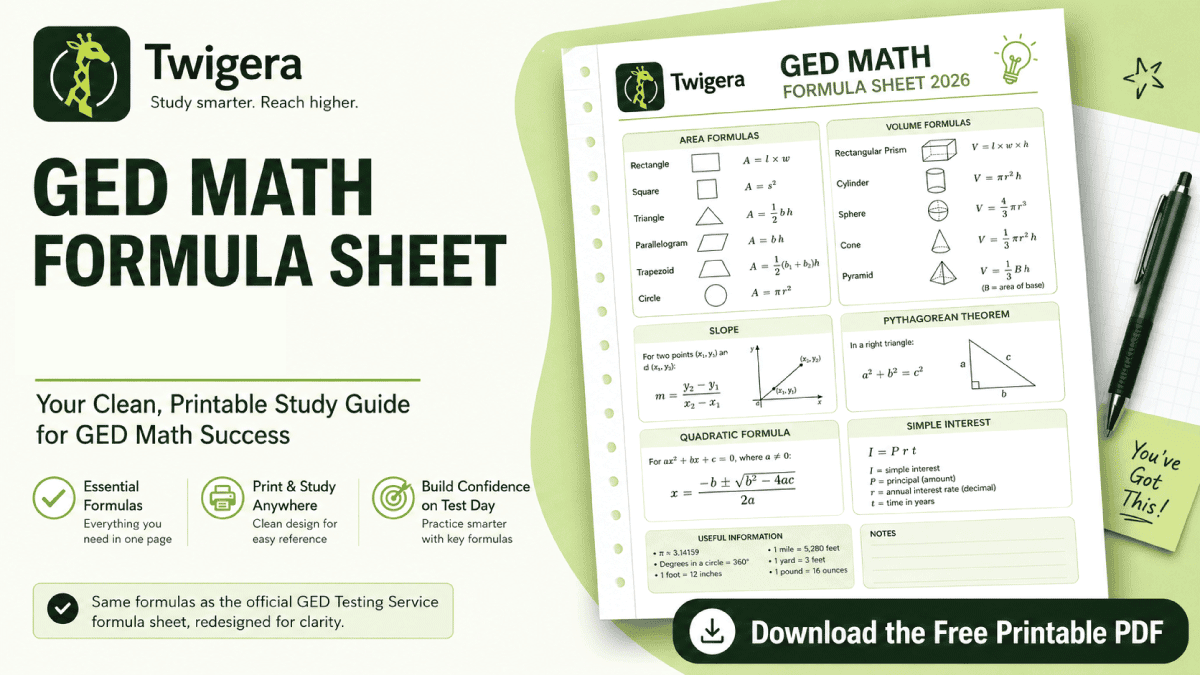
The GED Mathematical Reasoning test provides a formula sheet — you don't need to memorize the formulas. It covers area, volume, slope, the Pythagorean theorem, the quadratic formula, and simple/compound interest. It does NOT include PEMDAS, percent conversions, or basic geometry rules — those you still need to know. Download the free PDF and review before test day.
Last reviewed
This GED math formula sheet guide walks through every formula on the sheet with worked examples — so you know which formula fits each question type before test day. The GED Mathematical Reasoning test provides the formula sheet on-screen, but knowing what is on it and how to use it is what separates prepared test-takers from those who scan it in a panic.
According to GED Testing Service 2023 data, math had the lowest pass rate at 75% — compared to 88% for science. The National Center for Education Statistics reports that millions of adults in the US lack a high school credential — the GED math section is often the final hurdle. That gap shows why memorizing random steps without understanding the formulas is risky.
With proper mastery of GED math formulas, you start seeing what each question is asking and which formula fits. Use the free PDF download below, study every worked example in this guide, and go into test day knowing exactly what the sheet includes.
Quick Facts About the GED Formula Sheet
The GED formula sheet appears during the Mathematical Reasoning test. You access it through an on-screen button, so you do not need to bring your own copy.
Does not cover basic arithmetic, percent conversions, PEMDAS, or basic geometry rules — you must know those
There is no separate GED Science formula sheet — see the FAQ below
The current sheet has been in use since the 2014 GED test redesign — it has not changed
The sheet appears as a clickable reference button on your test screen. You can open and close it at any time during the calculator-allowed portion of the exam. Your job is not to memorize these formulas — your job is to know which formula matches each problem type and how to plug the correct values in correctly.
Save for later
Pin this guide so you can find it again.
We refresh these every season. Save it to a Pinterest board and you’ll get the latest version next time you come back.
Download the free GED math formula sheet and keep the key formulas in front of you while you study. The official GED Testing Service formula sheet is available at ged.com. Print it and keep it beside you during your math study sessions so you're not encountering it for the first time during the test.
If you searched for a GED science formula sheet PDF, note that GED Science does not have a separate formula sheet. This download is for the Mathematical Reasoning test only.
When you study with the formula sheet in hand, you train yourself to recognize which formula belongs to each problem. That habit is what saves time on test day. Instead of staring at a question about a cone or a trapezoid and trying to reconstruct the formula from memory, you open the sheet, find the formula, copy it onto your scratch paper, and solve. Print this PDF and keep it visible during every math practice session.
Every Formula on the Sheet, Explained with Worked Examples
The GED formula sheet gives you the formulas, but the test still expects you to know which one fits the question. Use this section to understand each formula, place the right numbers into it, and work through the steps. See our full guide on what math is on the GED for a complete topic breakdown beyond just formulas.
Area Formulas
Square: A = s²
Use this when all four sides are equal. Example: A square sign has sides of 8.5 inches. What is the area?
A = s² A = 8.5² A = 8.5 × 8.5 A = 72.25 square inches
Rectangle: A = lw
Use this when you know the length and width. Example: A garden is 18.4 feet long and 9.5 feet wide. What is the area?
A = lw A = 18.4 × 9.5 A = 174.8 square feet
Triangle: A = ½bh
Use this when you know the base and the height. The height must be the straight vertical height, not the slanted side. Example: A triangular roof section has a base of 14 feet and a height of 9.6 feet.
A = ½bh A = ½ × 14 × 9.6 A = 7 × 9.6 A = 67.2 square feet
Parallelogram: A = bh
Use this for a slanted four-sided shape. Use the base and the vertical height — not the slanted side. Example: A parallelogram tile has a base of 11.5 inches and a height of 7.2 inches.
A = bh A = 11.5 × 7.2 A = 82.8 square inches
Trapezoid: A = ½(b₁ + b₂)h
Use this when the shape has two parallel bases of different lengths. Example: A tabletop has a shorter base of 6.5 ft, a longer base of 10.5 ft, and a height of 4 ft.
A = ½(b₁ + b₂)h A = ½(6.5 + 10.5)4 A = ½(17)4 A = 8.5 × 4 A = 34 square feet
Surface Area and Volume
Rectangular Prism: V = lwh
Use this for boxes, storage containers, and rooms. Example: A storage bin is 2.5 ft long, 1.8 ft wide, and 3 ft tall.
V = lwh V = 2.5 × 1.8 × 3 V = 13.5 cubic feet
Cylinder: V = πr²h
Use this for cans, tanks, and round columns. Example: A water tank has a radius of 4 ft and a height of 7.5 ft. Use 3.14 for π.
V = πr²h V = 3.14 × 4² × 7.5 V = 3.14 × 16 × 7.5 V = 376.8 cubic feet
Pyramid: V = ⅓Bh
Use this when you know the base area and the height. Example: A pyramid has a square base with sides of 9 inches and a height of 12 inches.
Step 1 — find the base area: B = s² = 9² = 81 square inches
Step 2 — find the volume: V = ⅓Bh V = ⅓ × 81 × 12 V = 324 cubic inches
Cone: V = ⅓πr²h
Use this for cone-shaped objects. Example: A cone has a radius of 3.5 cm and a height of 10 cm. Use 3.14 for π.
V = ⅓πr²h V = ⅓ × 3.14 × 3.5² × 10 V = ⅓ × 3.14 × 12.25 × 10 V ≈ 128.22 cubic centimeters
Sphere: V = ⁴⁄₃πr³
Use this for ball-shaped objects. Example: A ball has a radius of 4.2 inches. Use 3.14 for π.
V = ⁴⁄₃πr³ V = ⁴⁄₃ × 3.14 × 4.2³ V = ⁴⁄₃ × 3.14 × 74.088 V ≈ 310.18 cubic inches
Algebra Formulas
Slope: m = (y₂ − y₁) ÷ (x₂ − x₁)
Use this to find how steep a line is between two points. Example: Find the slope between (−2, 5) and (4, −7).
m = (y₂ − y₁) ÷ (x₂ − x₁) m = (−7 − 5) ÷ (4 − (−2)) m = −12 ÷ 6 m = −2
Slope-Intercept Form: y = mx + b
Use this when you know the slope and the y-intercept. Example: A line has a slope of −3 and crosses the y-axis at 8. Write the equation.
y = mx + b → y = −3x + 8
Point-Slope Form: y − y₁ = m(x − x₁)
Use this when you know one point and the slope. Example: A line has slope 2 and passes through (5, −1).
y − (−1) = 2(x − 5) → y + 1 = 2(x − 5)
Distance Formula: d = √[(x₂ − x₁)² + (y₂ − y₁)²]
Use this to find the distance between two points on a coordinate plane. Example: Find the distance between (−3, 2) and (5, −4).
d = √[(5−(−3))² + (−4−2)²] d = √[64 + 36] d = √100 = 10 units
Pythagorean Theorem: a² + b² = c²
Use this only with right triangles. c is always the hypotenuse (the side opposite the right angle). Example: A ladder leans against a wall. The base is 5 ft from the wall, and the ladder reaches 12 ft up. How long is the ladder?
Use this to solve equations in the form ax² + bx + c = 0. Example: Solve 2x² − 7x − 4 = 0. Here a = 2, b = −7, c = −4.
x = (−(−7) ± √((−7)² − 4(2)(−4))) ÷ 2(2) x = (7 ± √(49 + 32)) ÷ 4 x = (7 ± √81) ÷ 4 x = (7 ± 9) ÷ 4 x = 4 or x = −0.5
Financial Formulas
Simple Interest: I = Prt
Use this when interest is based only on the original principal amount. Example: You borrow $850 at 7% simple interest for 18 months. How much interest will you pay?
Convert 18 months to years: 18 ÷ 12 = 1.5 years I = Prt I = 850 × 0.07 × 1.5 I = $89.25
Compound Interest: A = P(1 + r/n)^(nt)
Use this when interest is added to the principal more than once. Example: You deposit $1,200 at 5% interest, compounded quarterly, for 3 years.
P = 1200, r = 0.05, n = 4, t = 3 A = P(1 + r/n)^(nt) A = 1200(1 + 0.05/4)^(4×3) A = 1200(1.0125)^12 A ≈ $1,392.91
What's NOT on the Formula Sheet — Memorize These
The GED math formula sheet is helpful, but it is not a full cheat sheet. Even if you practice with the formula sheet open during your prep, you still need to know the basic rules the test expects you to apply without any reference material.
Order of operations (PEMDAS) — parentheses, exponents, multiplication/division, addition/subtraction. Not on the sheet.
Fraction/decimal/percent conversions — know that ¼ = 0.25 = 25%, ½ = 0.5 = 50%, ¾ = 0.75 = 75%, and common fractions with 5ths and 8ths.
Basic geometry rules — angle sums in triangles (180°), supplementary angles (180°), complementary angles (90°), and parallel line rules.
Probability — favorable outcomes ÷ total possible outcomes.
Factoring patterns — difference of squares (a² − b²) = (a+b)(a−b), and perfect square trinomials.
Mean, median, and mode — these may appear on the test but are not defined on the formula sheet. Know how to calculate each one.
How to Use the Formula Sheet During the Test
The GED formula sheet is built into the Mathematical Reasoning test interface. You will open it through an on-screen tab or button — so practice using a digital formula sheet while you study, not just a printed version.
Do not waste time deriving a formula that is already listed. If a problem asks for the volume of a cone, the area of a trapezoid, or the slope between two points, open the sheet and copy the formula first.
Use the scratch paper provided during the test to write down the formula before solving any multi-step problem. This prevents you from mixing up numbers, skipping parentheses, or using the wrong value for height, radius, or base.
The GED also provides the TI-30XS MultiView on-screen calculator for the calculator-allowed portion of math. Use the can you use a calculator on the GED guide to understand exactly which questions allow the calculator and how to avoid common calculator mistakes.
Your main job is the setup: read the question, choose the right formula, plug in the values carefully, then let the calculator handle the arithmetic.
Is There a GED Science Formula Sheet?
No — there is no standalone GED Science formula sheet like the one provided for GED Math. If you searched for a GED science formula sheet PDF, the Science test works differently.
GED Science gives you an on-screen calculator and may include reference information inside specific questions. Any needed chart, data table, unit detail, or formula clue is built into the item itself.
You should still know a few common science relationships. The main one is density: D = m/V, where density equals mass divided by volume. For a full prep plan, see the GED Science prep guide.
If the formula sheet feels overwhelming, the best next step is understanding how hard the GED really is — most test-takers find math the hardest section, but it is also the most improvable with the right prep.
Frequently asked
Questions people ask.
Does the GED give you a formula sheet?
ShowHide
Yes. The GED Mathematical Reasoning test provides a formula sheet accessible via a button on the test interface. You do not need to memorize the formulas — but you should know which ones are listed so you can find them quickly during the exam.
What formulas are on the GED math formula sheet?
ShowHide
The official GED math formula sheet includes: area formulas (square, rectangle, triangle, parallelogram, trapezoid); surface area and volume (rectangular prism, cylinder, pyramid, cone, sphere); slope and line equations (slope formula, slope-intercept form, point-slope form); the distance formula; the Pythagorean theorem; the quadratic formula; and simple and compound interest.
Is there a GED science formula sheet?
ShowHide
No. The GED Science test does not have a standalone formula sheet. The test provides an on-screen calculator and may include reference data within specific questions, but there is no formula sheet equivalent to the one provided for GED Math.
Do I need to memorize the GED math formula sheet?
ShowHide
No — the formula sheet is provided during the test. However, you should be familiar enough with it to quickly locate the formula you need. Practice with the formula sheet open during your study sessions so you are not scanning it for the first time on test day.
Where can I download the GED math formula sheet PDF?
ShowHide
You can download the free printable PDF from this page. The official version is also available directly from GED Testing Service at ged.com under their Math resources. The current formula sheet has been in use since the 2014 GED redesign.
Can I use a calculator on the GED math test?
ShowHide
Yes — the GED provides an on-screen TI-30XS MultiView calculator for most of the Mathematical Reasoning test. The first five to seven questions are calculator-restricted. See the full guide on using a calculator on the GED for what the calculator can and cannot do for you.
What math formulas are NOT on the GED math formula sheet?
ShowHide
The GED math formula sheet does not include: order of operations (PEMDAS), fraction/decimal/percent conversions, basic geometry rules (angle sums, parallel line rules, supplementary angles), probability formulas, factoring patterns, or mean/median/mode formulas. These are skills you need to know by memory before test day.
Is the GED math formula sheet the same in every state?
ShowHide
Yes. The GED is a nationally standardized test administered by GED Testing Service. The formula sheet is identical for all US states and for online-proctored versions of the test.
Amara is the editor at Twigera. She came to publishing the long way — a decade teaching the GED in community colleges and adult-learning centers, where she watched students pass not on talent or time, but on the strength of a study plan they actually trusted. Now she shapes the guides students read here for the parent studying after a closing shift, the second-career welder, the grandmother finishing what she started forty years ago. Expect honest timelines, math made survivable, and study plans built around real life — not around a textbook's idea of one.
Enjoyed this?
Take the next step — start today.
Our online GED course includes every subject, a free 30-minute diagnostic, and a 7-day refund on every plan.