

GED Physical Science 2026: Chemistry, Physics & Energy
Physical science is 40% of GED Science, tied with life science for the largest share — and the area most people under-prepare. Matter, reactions, energy, motion, forces and electricity, each with a worked example.

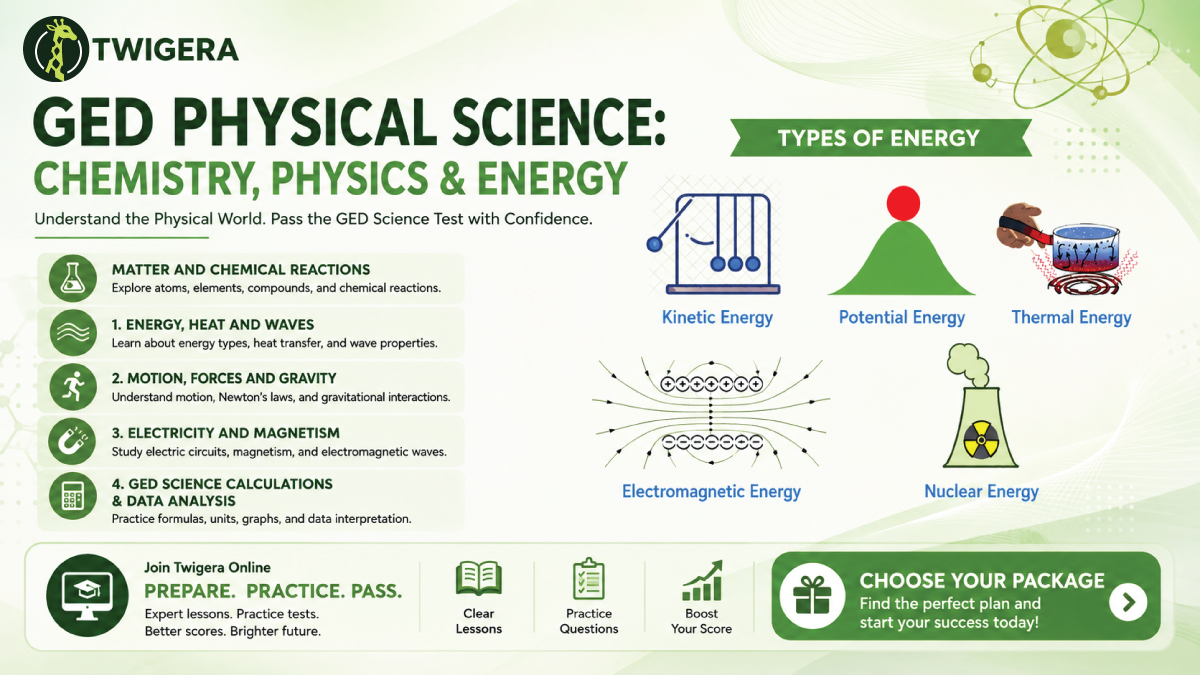
Physical science is about 40% of the GED Science test, tied with life science as the largest content area. It covers chemical properties and reactions, energy, work, motion and forces. Formulas are supplied during the test, so the marks sit in recognizing which one applies and reading the scenario correctly rather than in memorising equations.
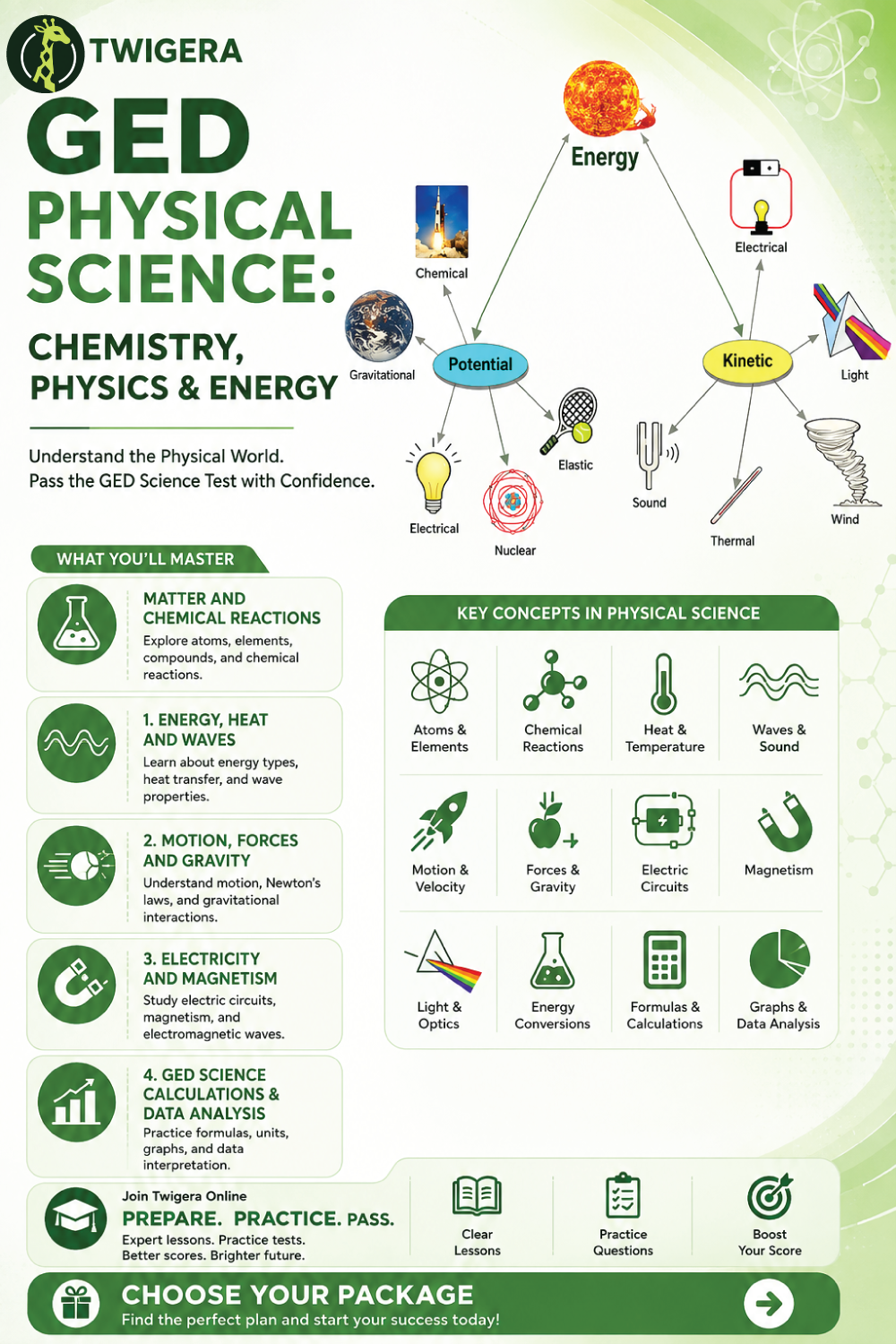
Pin this guide so you can find it again.
We refresh these every season. Save it to a Pinterest board and you’ll get the latest version next time you come back.
Save to PinterestQuestions people ask.
- What physical science is on the GED?
Chemical properties and reactions, energy, work, motion and forces. In practice that means matter and the periodic table, states of matter and phase changes, density, conservation of mass, heat and temperature, waves, speed and acceleration, Newton laws, work and power, and basic electricity including Ohm law.
- How much of the GED Science test is physical science?
About 40%, tied with life science as the largest content area and twice the share given to Earth and space science. It is also the area most people under-prepare, usually because the chemistry and physics vocabulary looks intimidating relative to biology.
- What is the difference between mass and weight on the GED?
Mass measures the amount of matter and does not change with location. Weight is the gravitational force acting on that mass, so it changes when gravitational acceleration changes. A 65 kg person weighs 65 × 9.8 = 637 N on Earth but has the same 65 kg mass anywhere.
- What is the difference between heat and temperature?
Temperature describes the average kinetic energy of particles. Heat is energy transferred because of a temperature difference. Two materials heated identically can reach different temperatures, and that does not by itself tell you which absorbed more total thermal energy — you would need more information.
- How does conservation of mass work on the GED?
In a sealed container, the total mass of the products equals the total mass of the reactants, because nothing can enter or leave. If reactants weigh 84 grams, the products weigh 84 grams. Atoms are rearranged during a reaction, never destroyed, which is why you can count them on both sides of an equation.
- What is the difference between speed and velocity?
Velocity includes direction; speed does not. Two objects moving at 15 m/s in opposite directions have the same speed and different velocities. Questions that mention direction, or that ask about a change in direction at constant speed, are usually testing whether you noticed the distinction.
- Do I need to memorise physics formulas for the GED?
No. The official GED Science Study Guide states that the science formulas will be provided. What you need is the ability to recognize which relationship a scenario calls for, identify the quantities, and rearrange the formula when the unknown is not already isolated.
- What is Newton third law in GED terms?
When one object exerts a force on another, the second exerts an equal and opposite force back. A swimmer pushes water backward and the water pushes the swimmer forward. The key detail for diagram questions is that the two forces act on different objects, so they do not cancel each other out.
Amara is the editor at Twigera. She came to publishing the long way — a decade teaching the GED in community colleges and adult-learning centers, where she watched students pass not on talent or time, but on the strength of a study plan they actually trusted. Now she shapes the guides students read here for the parent studying after a closing shift, the second-career welder, the grandmother finishing what she started forty years ago. Expect honest timelines, math made survivable, and study plans built around real life — not around a textbook's idea of one.
Take the next step — start today.
Our online GED course includes every subject, a free 30-minute diagnostic, and a 7-day refund on every plan.