

GED Science Formula Sheet 2026: Every Formula Explained
The GED provides science formulas during the test — so the skill worth practicing is picking the right one, naming the quantities, and tracking units. Every formula here comes with a worked example.

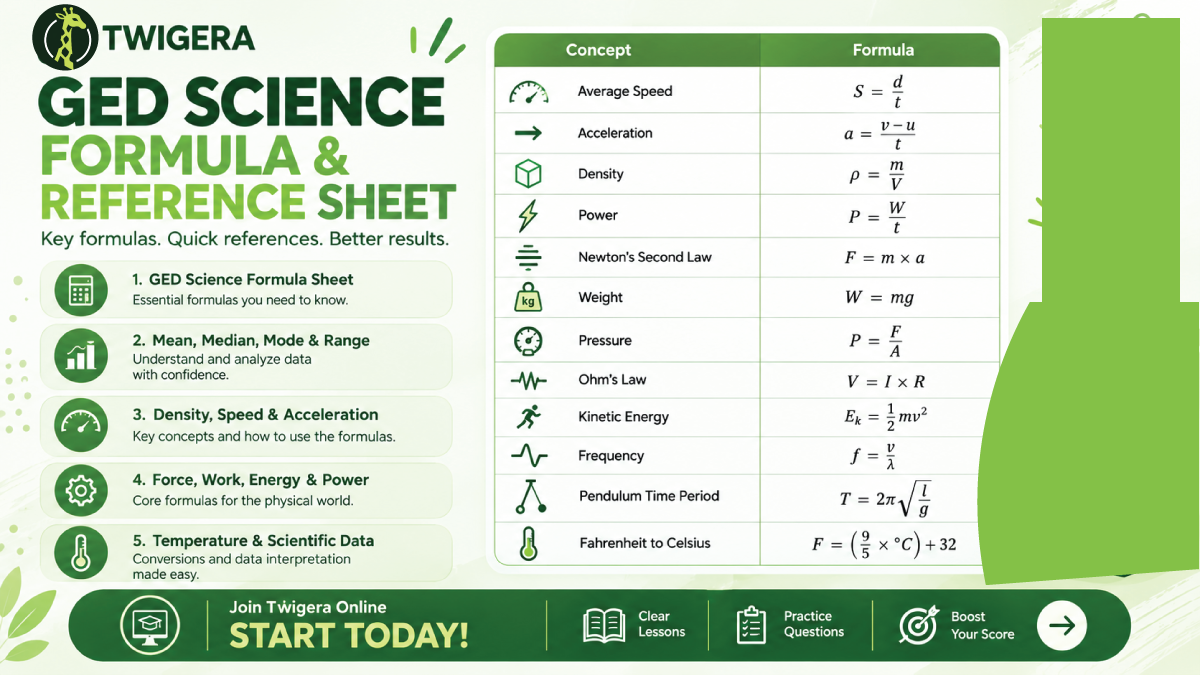
Yes, GED science formulas are provided during the test. The official GED Science Study Guide states that you will be asked to apply science formulas and that the formulas will be provided. That does not make them free marks. You still have to recognize which formula a question needs, identify each quantity in the scenario, substitute correctly, and track units through to the answer.
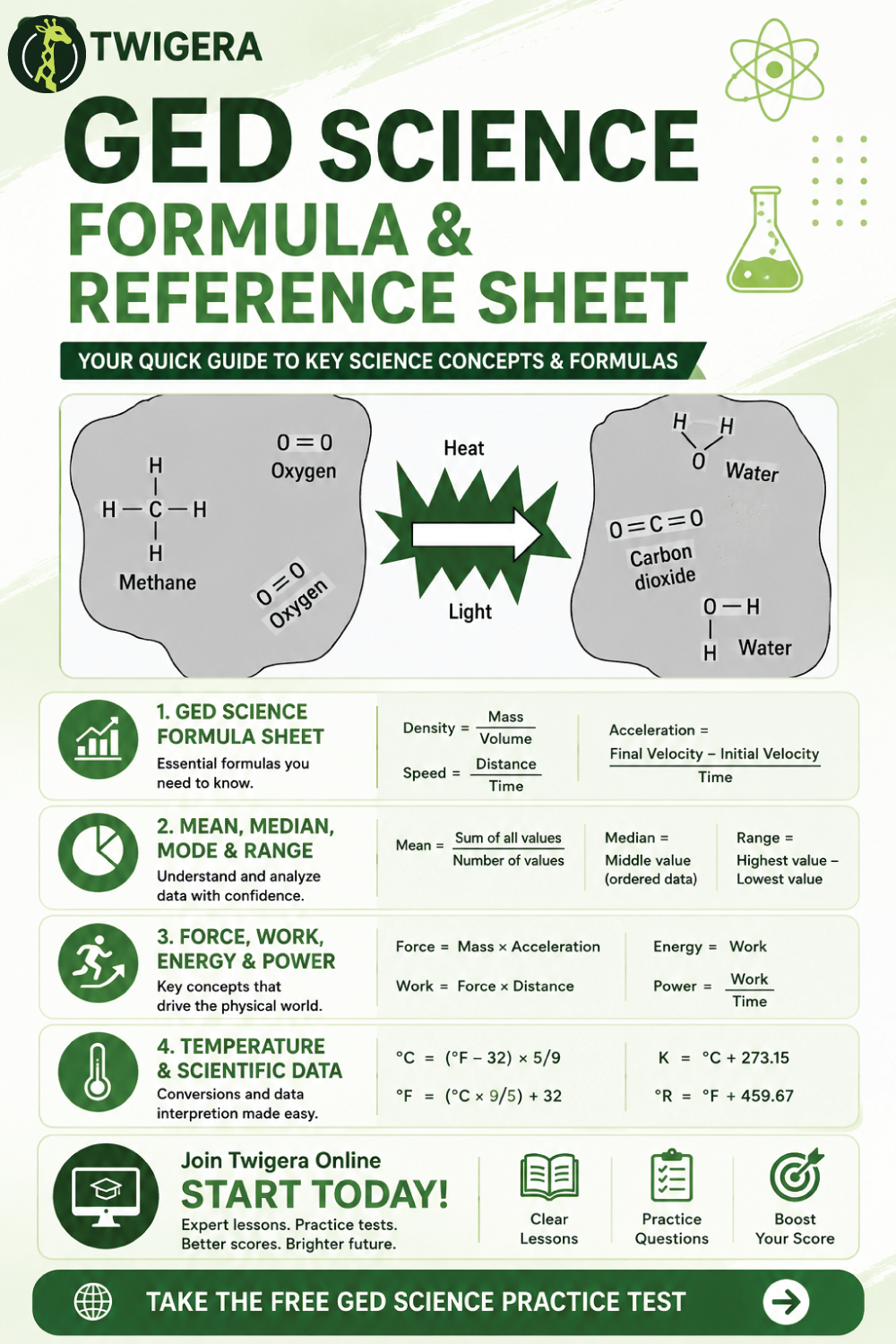
Pin this guide so you can find it again.
We refresh these every season. Save it to a Pinterest board and you’ll get the latest version next time you come back.
Save to PinterestQuestions people ask.
- Are formulas provided on the GED Science test?
Yes. The official GED Science Study Guide states that you will be asked to apply science formulas and that the science formulas will be provided. It also says plainly that the science test is not a memorisation test. You still need to recognize which formula fits a question and which numbers in the scenario are which quantities.
- Do I need to memorise GED science formulas?
No, but you do need to understand them. Being handed the equation for kinetic energy is worthless if you cannot tell which value in a scenario is the mass and which is the velocity, or if you forget that velocity is squared. The provision of formulas shifts the test from recall to application, which is harder to fake.
- What formulas are on the GED Science test?
The recurring ones are percent and percent change, mean, median, mode and range, density, speed, acceleration, force, weight, work, power, kinetic energy, gravitational potential energy, momentum, Ohm law, wavelength and heat transfer. Temperature conversion and scientific notation also appear when data is presented in mixed forms.
- How do I calculate percent change on the GED?
Divide the change by the original value, then multiply by 100. A population rising from 2,400 to 3,600 changes by 1,200, and 1,200 divided by 2,400 is 0.5, so the increase is 50%. The most common error is dividing by the new value instead of the original one, which produces a plausible but wrong answer.
- Why do units matter so much on GED Science questions?
Because a correct formula with mismatched units still gives a wrong answer. If a question mixes 2 kilometres with 500 metres, convert first — 2 km is 2,000 m. Speed in metres and seconds gives m/s; in kilometres and hours it gives km/h. Reading the units before touching the calculator prevents a whole class of avoidable errors.
- Is a calculator allowed on the GED Science test?
Yes. An on-screen calculator is available for items involving calculation, you may bring your own TI-30XS to a test center, and a calculator reference sheet is provided. The calculator handles the arithmetic; deciding which formula applies and which numbers go into it is the part being measured.
- How does scientific notation work on the GED?
A positive exponent moves the decimal point right and a negative exponent moves it left. So 4.2 × 10⁵ is 420,000 and 4.2 × 10⁻⁵ is 0.000042. Science questions use it for microscopic structures, astronomical distances and very large populations, where writing the number out would be impractical.
- When should I use the median instead of the mean?
When one value is far from the rest. For bacteria counts of 84, 91, 91, 103 and 151, the median is 91 while the mean is 104, because the 151 drags the average upward. If a question asks which measure better represents the center of the data, an obvious outlier usually points to the median.
Amara is the editor at Twigera. She came to publishing the long way — a decade teaching the GED in community colleges and adult-learning centers, where she watched students pass not on talent or time, but on the strength of a study plan they actually trusted. Now she shapes the guides students read here for the parent studying after a closing shift, the second-career welder, the grandmother finishing what she started forty years ago. Expect honest timelines, math made survivable, and study plans built around real life — not around a textbook's idea of one.
Take the next step — start today.
Our online GED course includes every subject, a free 30-minute diagnostic, and a 7-day refund on every plan.