GED RLA Score 2026: What You Need to Pass + Essay Weight
You need 145 to pass RLA. Here are the four score tiers, exactly how the Extended Response is scored and double-weighted, the three reporting categories and their weights, and why the "essay is 20%" figure is a misreading.
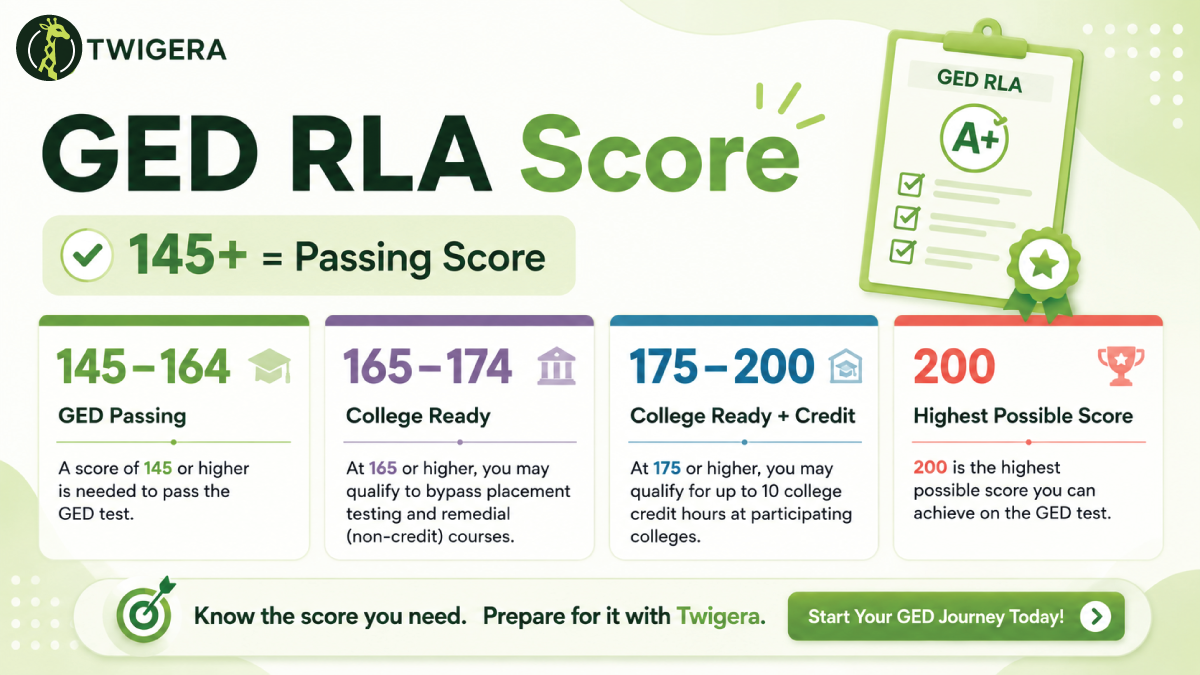
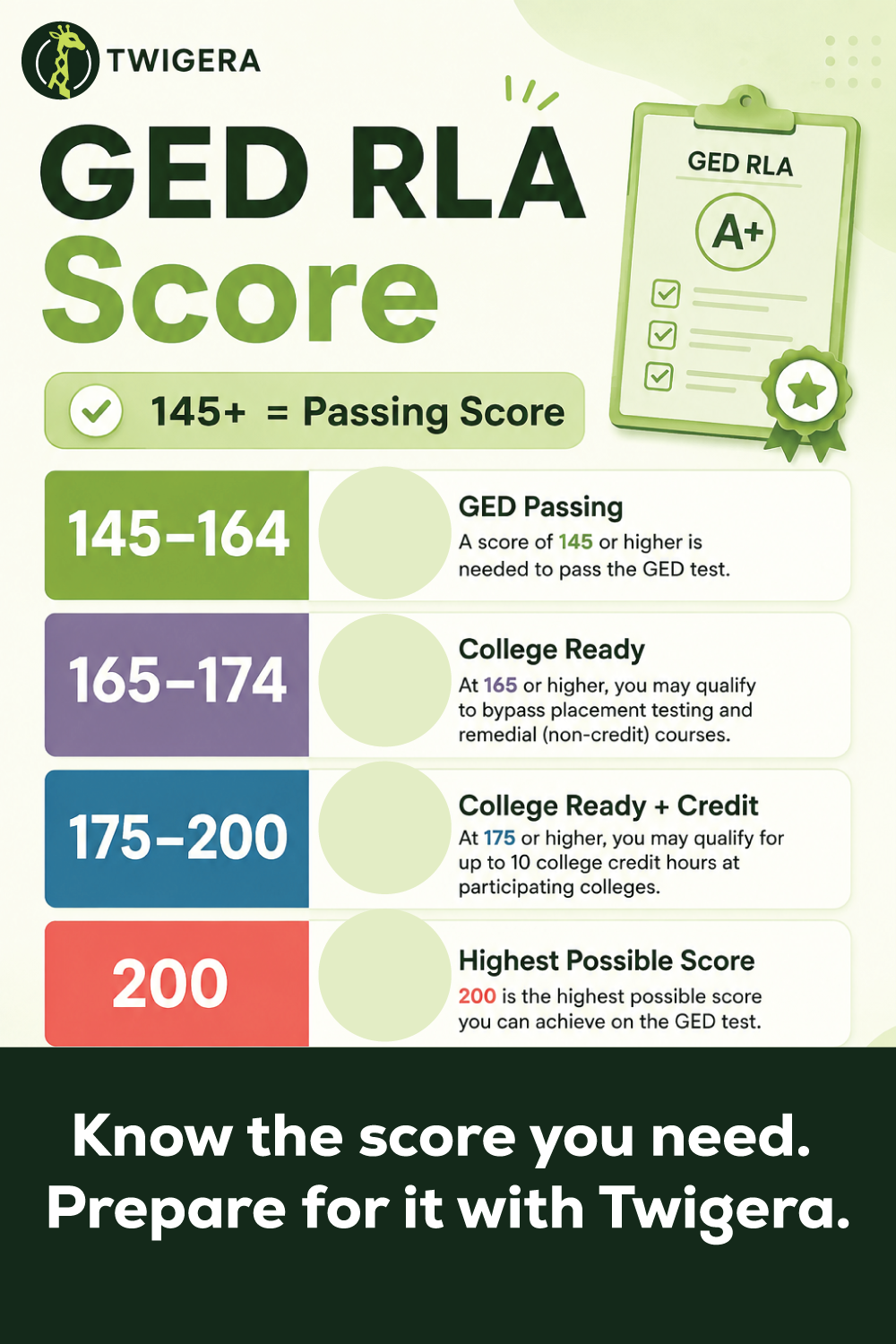
You need a GED RLA score of 145 or higher to pass. The scale runs 100 to 200: 145 to 164 is GED Passing, 165 to 174 is College Ready, and 175 to 200 is College Ready + Credit. The Extended Response is scored on three traits worth up to two points each, and that six-point raw score is then double-weighted to represent up to 12 raw-score points on the overall RLA test.
Last reviewed
Your GED RLA score needs to reach 145 to pass the subject. The GED uses a 100 to 200 scale for each of the four subjects, and you must clear 145 on all of them — Reasoning Through Language Arts, Mathematical Reasoning, Science, and Social Studies — to earn the credential. There is no averaging between subjects, so a 180 in Science will not carry a 140 in RLA.
The Extended Response also contributes. It is not a separate pass-or-fail test, but its raw score is double-weighted inside the overall RLA calculation, which makes it worth preparing for even if your only goal is reaching 145. The exact mechanics are further down, sourced from the official assessment guide rather than from the figures that circulate on prep sites.
What Is the GED RLA Score Scale?
Your score falls into one of four levels. Only the first boundary decides whether you passed; the rest decide what the score unlocks afterwards.
Score
Level
What it means
100–144
Below Passing
You have not reached the passing standard and will need to retake RLA
145–164
GED Passing
You meet the passing standard for the subject
165–174
College Ready
May waive placement testing or developmental coursework at some colleges
175–200
College Ready + Credit
May qualify for up to 10 college credit hours, at the institution's discretion
A 145 is enough to pass RLA. You do not need the higher tiers unless you want what they unlock, and you should not retake a passed subject just because you landed at 148 rather than 165. These tiers are published on the official GED score scale, and they apply identically to every subject — our GED passing score guide covers what each tier is worth across the whole test.
Save for later
Pin this guide so you can find it again.
We refresh these every season. Save it to a Pinterest board and you’ll get the latest version next time you come back.
This is where most explanations get vague, so here is the mechanism straight from the GED Assessment Guide for Educators: RLA. You get 45 minutes in a separately timed section to read two source texts, compose a response, and review and edit it. The response is scored on three traits:
Creation of Arguments and Use of Evidence
Development of Ideas and Organizational Structure
Clarity and Command of Standard English Conventions
Each trait is worth up to two points, giving a six-point scale overall. The guide then states that the final raw score on the Extended Response item is double-weighted so that it represents up to 12 raw score points on the overall RLA test. That is the whole reason the essay deserves preparation time: each point you earn there is worth two toward your raw total, so it moves your score faster than an equivalent effort spent on multiple-choice questions. Our GED Extended Response essay guide walks through each trait with sample responses.
Worth being precise about what double-weighting does and does not mean. It does not mean the essay is half your GED RLA score, and it does not mean failing the essay fails the subject. It means the six points you can earn there are counted as twelve when your raw total is assembled. The scaled score you finally receive is derived from that total, not reported as a percentage of it.
Is the GED Essay 20% of Your RLA Score?
You will see this figure repeated across prep sites, and it appears to be a misreading. The official assessment guide does list a 20% figure — but it belongs to Reporting Category 3: Applying knowledge of English language conventions and usage. That is a content domain spanning the whole RLA test, not the Extended Response. The three reporting categories and their published weights are:
Reporting category
Weight
Using evidence to understand, analyze and create arguments
45%
Analyzing and creating text features and technique
35%
Applying knowledge of English language conventions and usage
20%
Extended Response
Described in raw-score terms — 6 points, double-weighted to 12
The practical takeaway is that evidence work carries the heaviest weight on RLA at 45%, which is why so much of the test asks you to locate support for a claim rather than recall a fact. Note also that Reporting Category 2 and the Extended Response reward the same underlying skill — using evidence to build an argument — so essay practice pays twice.
What the Category Weights Mean for Your Study Time
Those percentages are a study plan if you read them that way. Evidence work is 45% of RLA — nearly half. Text features and technique is 35%. Language conventions is 20%. Most people study in the opposite order, because grammar rules feel concrete and finite while "using evidence" feels vague. Grammar is the smallest slice.
A more useful allocation follows the weights. Spend the most time on locating a claim, judging whether evidence actually supports it, and comparing two positions. Spend real but lesser time on structure, purpose, tone, and how a passage is organized. Spend the least on grammar drills — enough to recognize the eight repeating patterns, and no more. Grammar has a hard ceiling on what it can earn you, and most learners hit it quickly.
This also explains a common frustration. Learners who grind grammar worksheets often report their practice scores stalling. They are optimising a fifth of the test while the largest category goes untouched. If your score has plateaued, check which category your misses actually fall into before adding more study hours.
What Makes an Essay Score Zero?
Separately from the trait scores, the assessment guide lists conditions that make a response non-scorable — an automatic zero regardless of quality. These are worth knowing because most are avoidable by accident rather than by skill. A response scores zero if any of the following apply:
It contains only text copied from the source texts or the prompt.
It shows no evidence the test-taker read the prompt, or it is off-topic.
It is incomprehensible.
It is not in English.
It has not been attempted — a blank response.
The first one catches people out. Quoting the sources is expected and good. Building a response that is mostly quotation, with little of your own analysis holding it together, is not. The rubric wants you to explain how the evidence supports the argument, and copied text cannot do that job for you.
The last one is the costliest. A blank essay forfeits the full 12 raw-score points. Even a rough, short response that names which argument is better supported and cites one piece of evidence will out-score a blank page. If you are running out of time, write something.
How Many Questions Do You Need Right to Pass RLA?
There is no fixed number of correct answers that guarantees a 145, and anyone telling you otherwise is guessing. The GED reports a scaled score rather than converting your percentage correct straight into a result, and the RLA score also folds in the double-weighted Extended Response. So a formula like "I need 70% correct to pass" does not hold — the same raw performance can scale differently, and two test-takers with identical multiple-choice results can land on different scaled scores once their essays are counted.
Your practice-test percentage is still useful, just not as a prediction. Use it to find weak skills. Our GED RLA practice test is built for exactly that — 20 questions with explanations naming the skill behind each miss, rather than a percentage pretending to be a score.
Can You Pass RLA With a Low Essay Score?
Yes. There is no separate Extended Response passing score. The essay contributes to your overall RLA result alongside every other scored component, so a weak essay does not automatically fail you, and a strong essay does not on its own guarantee a pass. What matters is the overall scaled score.
The nuance is what happens near the line. Because the essay raw score is double-weighted, every point there carries twice the raw value of a comparable point elsewhere. If you are sitting around 140 in practice, the essay is usually the fastest available gain. Not because it is easy — because the arithmetic favours it.
Consider what that means in practice. Moving one trait from a 1 to a 2 adds one raw point, which doubles to two. Getting two extra multiple-choice questions right adds two raw points as well. But improving one trait is often a single fixable habit — citing evidence from both sources instead of one, or breaking a wall of text into paragraphs. Finding two more correct answers across a 150-minute test is rarely that targeted.
That is the argument for practicing the essay even when you dislike writing. It is not that the essay is more important than reading. It is that the essay is where a small, specific change moves the most score.
How to Prepare for the RLA Score You Want
Start with the score you need, then work backward. If 145 is the goal, spread your effort across the skills RLA actually measures rather than studying whatever feels most comfortable.
Reading comprehension — main ideas and supporting details
Inference and evidence — the 45% category, so weight it accordingly
Grammar and language conventions
Argument analysis — comparing which position is better supported
Extended Response writing — double-weighted, so never skipped
If you are aiming past the minimum, note that the higher tiers are worth real money rather than bragging rights. College Ready can waive placement testing or developmental coursework, and College Ready + Credit can be worth up to 10 college credit hours — courses you do not pay for or sit through. For the quick pre-test review of the underlying rules, keep our GED RLA cheat sheet beside your practice sets, and the full walkthrough lives in our GED language arts study guide.
Frequently asked
Questions people ask.
What is a passing GED RLA score?
ShowHide
You need 145 or higher to pass the RLA subject. You must also earn at least 145 on Mathematical Reasoning, Science, and Social Studies to earn the high school equivalency credential. There is no averaging across subjects — each one must clear 145 on its own.
What is the highest GED RLA score?
ShowHide
The highest possible score is 200. Scores from 175 to 200 fall into the College Ready + Credit tier, which may qualify you for up to 10 college credit hours depending on the institution. You do not need anywhere near 200 to earn your GED — 145 is the passing standard.
Does the GED RLA essay count toward the score?
ShowHide
Yes. Per the official GED Assessment Guide for Educators, the Extended Response is scored on three traits worth up to two points each — a six-point scale. That raw score is then double-weighted so it represents up to 12 raw-score points on the overall RLA test.
How many questions do I need to get right to pass GED RLA?
ShowHide
There is no fixed number. The GED reports a scaled score rather than converting your percentage correct directly, and the RLA result also incorporates the double-weighted Extended Response. Treat any "you need X% correct" formula with suspicion — GED Testing Service does not publish one.
Can you pass GED RLA with a low essay score?
ShowHide
Yes. There is no separate Extended Response passing score — the essay contributes to your overall RLA result alongside everything else. A weak essay does not automatically fail you. But because the raw score is double-weighted, it matters more per point than a single multiple-choice item, so it is worth attempting properly if you are near the line.
What happens if I leave the GED essay blank?
ShowHide
A completely blank Extended Response receives zero on each of the three traits. Because that raw score is double-weighted, you forfeit up to 12 raw-score points on the overall RLA test. You do not need a perfect essay to benefit — attempting the task at all recovers points a blank response cannot.
Is the GED essay 20% of the RLA score?
ShowHide
That figure is widely repeated but appears to be a misreading. In the official Assessment Guide for Educators, 20% is the weight of Reporting Category 3 — "Applying knowledge of English language conventions and usage" — which is a content domain covering the whole test, not the Extended Response. The guide describes the essay in raw-score terms instead: six points, double-weighted to twelve.
Did the GED RLA passing score change in 2026?
ShowHide
No. The passing standard remains 145 for RLA and for every other GED subject. The tiers are unchanged too: 145 to 164 GED Passing, 165 to 174 College Ready, and 175 to 200 College Ready + Credit.
Amara is the editor at Twigera. She came to publishing the long way — a decade teaching the GED in community colleges and adult-learning centers, where she watched students pass not on talent or time, but on the strength of a study plan they actually trusted. Now she shapes the guides students read here for the parent studying after a closing shift, the second-career welder, the grandmother finishing what she started forty years ago. Expect honest timelines, math made survivable, and study plans built around real life — not around a textbook's idea of one.
Enjoyed this?
Take the next step — start today.
Our online GED course includes every subject, a free 30-minute diagnostic, and a 7-day refund on every plan.