

GED Earth Science 2026: Earth and Space Science Lesson
Earth and space science is 20% of GED Science — the smallest content area, and the one with the clearest data questions. Earth systems, cycles, plate tectonics, resources and astronomy, each tied to the question type it appears in.

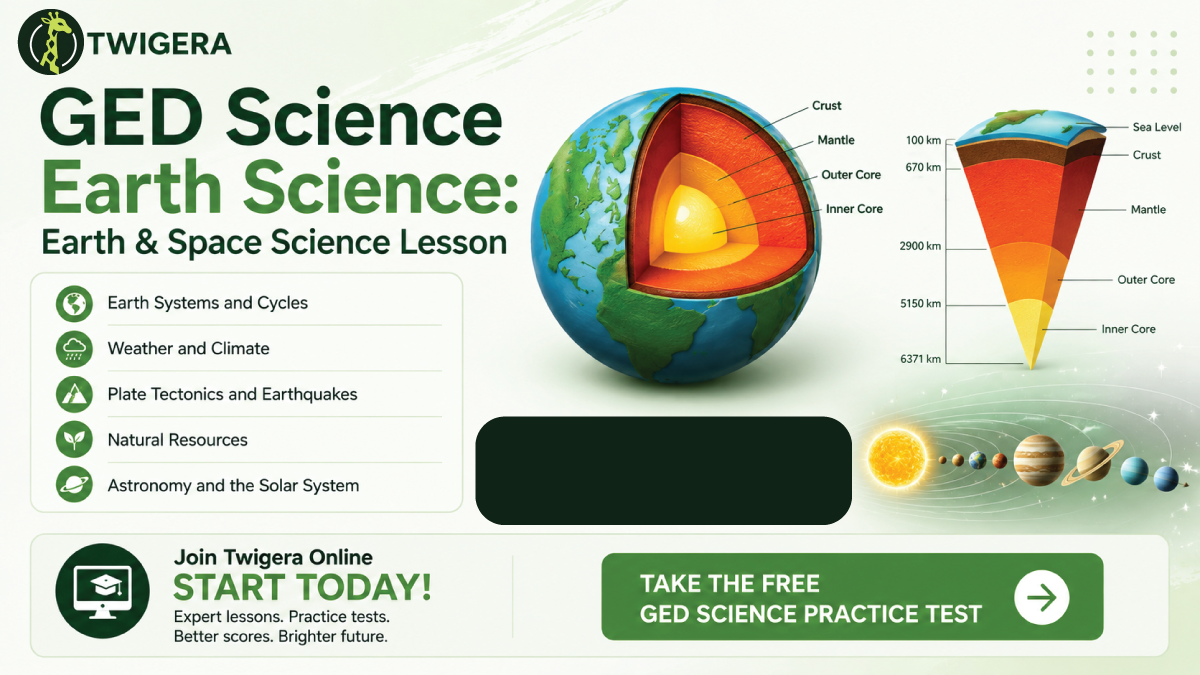
Earth and space science is about 20% of the GED Science test, the smallest of the three content areas. It covers Earth's systems and how they interact, the water and carbon cycles, weather versus climate, plate tectonics, the rock cycle, natural resources, and basic astronomy. You are not asked to recall advanced astronomy — you are asked to read data and say what it supports.
Pin this guide so you can find it again.
We refresh these every season. Save it to a Pinterest board and you’ll get the latest version next time you come back.
Save to PinterestCheck the time scale on a graph before deciding whether the data describes weather or climate. That one habit answers most of these questions.
Questions people ask.
- What earth science is on the GED?
Earth systems and how they interact, interactions between Earth and living things, and the structure and organization of the cosmos. In practice that means the geosphere, hydrosphere, atmosphere and biosphere, the water and carbon cycles, weather and climate, plate tectonics, the rock cycle, natural resources, and basic astronomy.
- How much of the GED Science test is earth and space science?
About 20%, which makes it the smallest of the three content areas. Life science and physical science are roughly 40% each. That ratio should shape your study time — earth and space science deserves around half the hours you give either of the other two, but not zero.
- What is the difference between weather and climate on the GED?
Weather is short-term atmospheric conditions; climate is the long-term pattern, usually measured over decades. The distinction is almost always tested through time scale. One unusually hot day, or even one hot week, says nothing about climate. Check the time period on a graph before deciding which one the data describes.
- Do I need astronomy for the GED Science test?
Only the basics. You need the relationships between objects — the Sun is a star, Earth orbits it in about a year and rotates in about 24 hours, the Moon reflects sunlight rather than producing it. Questions supply the data you need. A star table listing surface temperatures is answered by reading the numbers, not by recalling stellar physics.
- What are the three rock types on the GED?
Igneous rock forms when molten rock cools and solidifies. Sedimentary rock forms when sediments are compacted and cemented. Metamorphic rock forms when existing rock is altered by heat and pressure without melting. That last condition matters — if the rock melts and then cools, you get igneous rock instead.
- What causes earthquakes according to the GED?
Movement between tectonic plates creates stress, which is released as earthquakes. The three boundary types are divergent, where plates move apart, convergent, where they move together, and transform, where they slide past each other. Questions usually give you a map of quake locations and ask what pattern explains it.
- What is the difference between renewable and non-renewable resources?
How quickly they can be replaced. Solar, wind, hydropower and some biological resources are renewable because they are continuously resupplied. Coal, petroleum, natural gas and most mineral deposits are non-renewable because they form over geological timescales. Questions usually present consumption data rather than asking for the definition.
- How do I read an earth science graph on the GED?
Identify the variables, check the units, then examine the time period before you interpret anything. A ten-year dataset supports very different claims from a thousand-year one. Most earth science graph errors come from reading a trend correctly but over-claiming what a short time span can show.
Amara is the editor at Twigera. She came to publishing the long way — a decade teaching the GED in community colleges and adult-learning centers, where she watched students pass not on talent or time, but on the strength of a study plan they actually trusted. Now she shapes the guides students read here for the parent studying after a closing shift, the second-career welder, the grandmother finishing what she started forty years ago. Expect honest timelines, math made survivable, and study plans built around real life — not around a textbook's idea of one.
Take the next step — start today.
Our online GED course includes every subject, a free 30-minute diagnostic, and a 7-day refund on every plan.