GED Social Studies Study Guide 2026: Notes and Plan
All four content areas in the proportions the exam uses, the seven reasoning skills behind the questions, and a study order that starts where the marks are. Civics and government is half the test — this guide treats it that way.
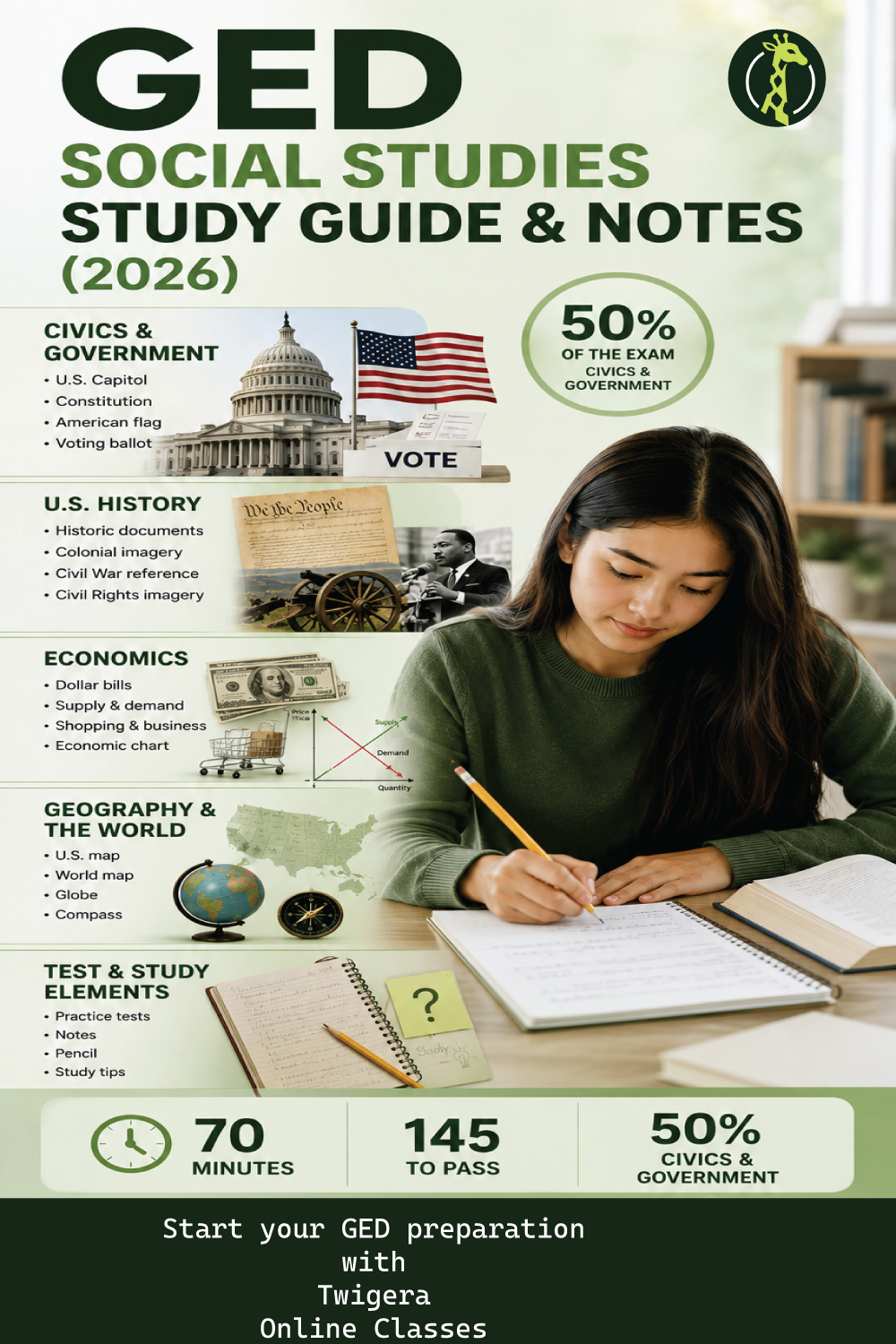
The GED Social Studies test allows 70 minutes with no break, and you need 145 to pass. Civics and government is about 50% of the content, U.S. history 20%, economics 15%, and geography and the world 15%. It is not a memorization test — questions give you a passage, chart or map and ask what it supports, so study reasoning alongside content.
Last reviewed
GED social studies study guide work is most efficient when it starts from what the test rewards rather than from what feels like social studies. The exam allows 70 minutes with no scheduled break, and the passing standard is 145. It covers civics and government, U.S. history, economics, and geography and the world — and those four areas are nowhere near equally weighted.
Civics and government is about half the test. That single fact should reorganize most study plans, because the instinct is to start with history, which is only a fifth of it. These notes work through all four areas in proportion, then cover the seven reasoning skills every question is built on, and end with a study order you can actually follow.
GED Social Studies at a glance
Here is the shape of the exam before the content.
Item
Detail
Test time
70 minutes, one section, no scheduled break
Passing score
145 on the 100 to 200 scale
College Ready
165 to 174
College Ready + Credit
175 to 200
Calculator
Allowed, with access to a calculator reference sheet
Question formats
Multiple choice, drag and drop, fill in the blank, hot spot, drop down
Question count
Not published by GED Testing Service; varies by form
That last row matters more than it looks. GED Testing Service does not publish a fixed number of items for Social Studies, and its official study guide lists time, formats and calculator policy without ever stating a count. Plenty of prep sites quote a specific number anyway. Plan against the clock instead — read at a steady pace, and do not let an invented question target push you into rushing sources.
Content area
Approximate weight
Civics and government
50%
U.S. history
20%
Economics
15%
Geography and the world
15%
The official GED Social Studies study guide is also unusually blunt about what the test is not: "the social studies test is not a memorization test", and you do not need the capitals of countries or the timeframes in which particular wars occurred. You need concepts, and the ability to apply them to whatever source the question puts in front of you.
Civics and government: your highest-priority topic
At roughly 50% of the test, civics deserves the largest share of your time by a wide margin. Five constitutional principles carry most of the questions.
Separation of powers: authority is divided among legislative, executive and judicial branches so no one branch holds unlimited power.
Checks and balances: each branch can constrain the others — a presidential veto, a congressional override, judicial review.
Federalism: authority is divided between the national government and the states, with some powers shared.
Popular sovereignty: governmental authority derives from the people.
Rule of law: law applies to everyone, including those who govern.
the Constitution is the source behind most of those principles, and reading its structure once is worth more than rereading a summary of it three times. A typical item describes the president vetoing a bill passed by Congress and asks which principle is illustrated. The answer is checks and balances, not separation of powers — separation is the division of responsibilities, while checks and balances is one branch actively constraining another. The exam tests that distinction repeatedly because candidates blur it.
Know the three branches by function rather than by list: the legislative branch makes federal law, the executive enforces it, and the judicial interprets it and resolves disputes. Questions usually describe an action and ask which branch is acting. Learn the levels of government the same way — federal, state and local each carry characteristic responsibilities, and the exact responsibility can depend on the situation described, so read before choosing.
Learn how a law is made as a chain, because items often drop you midway and ask what happens next: a bill is introduced, considered in committee, approved by both the House and the Senate, then goes to the president, who signs or vetoes it. A veto can be overridden by a two-thirds vote in both chambers. Finally, study rights and civic responsibilities through the Bill of Rights, and recognize the foundational documents — the Declaration of Independence, the Constitution, the Bill of Rights and the Federalist Papers — by what each one is for.
Save for later
Pin this guide so you can find it again.
We refresh these every season. Save it to a Pinterest board and you’ll get the latest version next time you come back.
U.S. history is about 20% of the test. Study it as a sequence of causes and effects rather than a list of dates, because that is how the questions are framed.
Work through the eras in order: the colonial period and the Revolution, the Constitution and early republic, the Civil War and Reconstruction, industrialization and immigration, the world wars and the Cold War, and the civil rights movement. For each one, hold onto what changed and why. A question may hand you a passage about sectional conflict and ask which development contributed to it. That is a causal question, and a memorized date will not answer it.
Causal chains are worth rehearsing explicitly. Industrial growth led to more factories, which increased demand for workers, which drove urban growth. Once you can state a chain like that, you can answer questions about any link in it. The GED social studies history lesson works through each era in this form.
Economics: learn the concepts behind the charts
Economics is about 15% of the test, and it is the most predictable area because the concept list barely changes. Cover scarcity and choice, supply and demand, economic systems, government and the economy, consumer and labor economics, and economic data.
Scarcity means resources are limited, so choices must be made. Every choice carries an opportunity cost: the next best alternative given up. Supply and demand questions turn on identifying which side changed first. Know market, command and mixed systems well enough to name one from a description. Keep fiscal policy, meaning government spending and taxation, cleanly separate from monetary policy, meaning the money supply and interest rates. That pair generates more items than any other single distinction.
Consumer and labor economics covers wages, employment, credit, interest, savings and consumer protection, and it is the most practical material on the test. For the full treatment with worked examples, see the GED economics lesson.
Geography and the world: read the relationships
Geography and the world is the other 15%, and it quietly carries the world history content too. There is no separate world history section on the GED.
Read maps in a fixed order: title, legend, scale, labels, then the data. Skipping the legend is the most common and most expensive error, because color and shading carry no meaning without it. Then study human-environment interaction. That means how physical conditions influence settlement, and how people change the environment in turn. Finally study migration, framed as push factors that drive people out and pull factors that draw them in.
Connect geography to history wherever you can, since a trade-route map or an urbanization chart is simultaneously a geography source and a history source. The GED geography lesson covers this area in full, including what is not worth memorizing.
The seven skills behind the questions
Content knowledge gets you to the question. These seven reasoning skills get you through it, and they are what the test is really measuring. The GED groups them under three practices — reading for meaning, analyzing historical events and arguments, and using numbers and graphs — but it is more useful to hold them as seven concrete moves you can rehearse one at a time.
Find the central idea: ask what the author is mainly trying to communicate, not what the passage mentions in passing.
Draw an inference: reach a conclusion the source supports without stating outright, and stop there.
Evaluate evidence: judge whether the evidence offered actually supports the claim being made.
Identify purpose and point of view: work out why a source was created and whose perspective it carries.
Compare sources: set two accounts side by side and account for their differences rather than picking the longer one.
Interpret charts and graphs: read title, axes, units and scale before reading the trend.
Use statistics: mean is the average, median is the middle value once ordered, mode is the most frequent.
Every one of those is trainable independently of social studies content, and that is genuinely good news. A week spent on evidence evaluation lifts your score across all four content areas at once. A week spent memorizing the Cold War improves one fifth of one fifth of the test. If your practice misses cluster around a skill rather than a topic, that is where the cheap marks are, and most people's misses do cluster that way.
A study order that matches the exam
Order your study by weight, not by preference. Civics first, then history, then economics and geography, with source-analysis practice running through all of it rather than bolted on at the end.
If you have one week, spend the first three days on civics and government, one day on U.S. history, one day splitting economics and geography, and the final two days entirely on practice questions with source material. That allocation feels lopsided and is correct. Three days on half the test is proportionate.
If you have more time, run the same order but add a diagnostic at the start and a full practice set at the end of each area, so you are always studying the thing you just failed rather than the thing you already know. Our GED social studies practice test gives you 20 weighted questions with worked explanations to generate that signal.
Improve your reading pace
Time pressure on this test comes from the source material, not from the questions themselves. Four habits recover most of the lost minutes.
Read the question first, so you know what you are looking for before you meet the source. Then read the source carefully rather than skimming it. This is the step people cut under pressure, and it is the step that costs marks. Eliminate answers that introduce unsupported information, which usually removes two options immediately. Finally, check the evidence by asking where in the source your answer is supported. If you cannot point to it, it is not your answer.
Time management on the day is its own skill. The GED test day guide covers what to bring and how to pace a section, and the GED social studies cheat sheet condenses all four content areas onto a single page for final review.
Do not spend the last night memorizing. Spend it reviewing the reasoning checklist and sleeping, because this test rewards a clear head reading carefully far more than it rewards one extra fact.
Frequently asked
Questions people ask.
How long is the GED Social Studies test?
ShowHide
The Social Studies test lasts 70 minutes, completed in one section with no scheduled break, according to the official GED Social Studies study guide. That time includes instructions and any final review, so the working time is slightly less than the headline number.
How many questions are on the GED Social Studies test?
ShowHide
GED Testing Service does not publish a fixed question count for Social Studies, and the number can vary between test forms. Its official study guide lists the time, formats and calculator policy but no item count. Pace yourself against the 70-minute clock rather than a target number of questions.
How to study for GED social studies, and in what order?
ShowHide
Start with civics and government, because it is about 50% of the test. Then work through U.S. history, economics, and geography and the world, practicing source analysis, evidence evaluation and data interpretation throughout rather than saving them for the end.
Do I need to memorize historical dates?
ShowHide
Not as your main strategy. The official study guide states plainly that Social Studies is not a memorization test and that you do not need to know country capitals or the timeframes of particular wars. Historical context still helps, but interpreting evidence is what earns marks.
Is there math on the GED Social Studies test?
ShowHide
Yes, though it stays basic. You may interpret charts and graphs and work with statistical measures such as mean, median and mode. A calculator is allowed, with access to a calculator reference sheet, but it only helps on the minority of items involving numbers.
What score do I need to pass GED Social Studies?
ShowHide
145 on the 100 to 200 scale. Above that, 165 to 174 is GED College Ready and 175 to 200 is College Ready plus Credit. Each subject is scored on its own and the four are never averaged, so you need 145 in Social Studies specifically.
What should a GED social studies study plan include?
ShowHide
Content in proportion to the weightings, plus deliberate practice on the seven reasoning skills. A plan that allocates equal time to each of the four content areas is already mis-weighted, because civics alone is about half the test and geography is about a seventh of it.
Do these GED social studies notes cover everything on the test?
ShowHide
They cover every content area and every reasoning skill the exam assesses, at summary depth. Use them as the spine of your revision and drop into the individual civics, history, economics and geography lessons wherever a section feels thin.
Is Social Studies the easiest GED subject?
ShowHide
There is no universal answer. Some find it manageable because it rewards reading and reasoning over recall, while others struggle with the volume of source material under time pressure. Your own practice results are a far better indicator than the subject's reputation.
Amara is the editor at Twigera. She came to publishing the long way — a decade teaching the GED in community colleges and adult-learning centers, where she watched students pass not on talent or time, but on the strength of a study plan they actually trusted. Now she shapes the guides students read here for the parent studying after a closing shift, the second-career welder, the grandmother finishing what she started forty years ago. Expect honest timelines, math made survivable, and study plans built around real life — not around a textbook's idea of one.
Enjoyed this?
Take the next step — start today.
Our online GED course includes every subject, a free 30-minute diagnostic, and a 7-day refund on every plan.