How to Pass the GED Math Test in 2026: 6-Step Plan
GED Math fails about 30% of first-time test takers. This 2026 guide gives you a 6-step strategy — diagnostic, formula sheet, TI-30XS calculator, Khan Academy, GED Ready, and test-day time management.
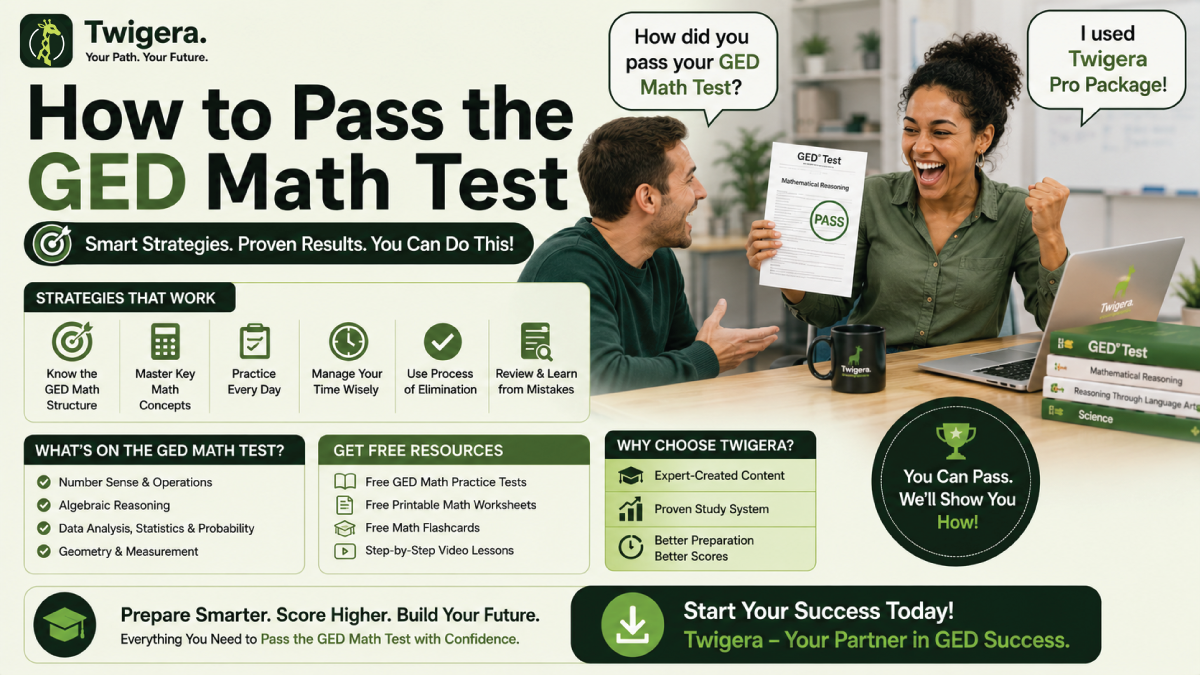
GED Math is 115 minutes, ~46 questions, 145 passing score. About 30% of first-time takers fail. The 6-step pass strategy: (1) take a diagnostic first to find weak areas; (2) master the formula sheet that the test provides; (3) practice with the TI-30XS MultiView calculator (not available for the first 5-7 questions); (4) use Khan Academy for weak topics; (5) take the official GED Ready Math ($6.99) and only schedule once you score green; (6) manage time on test day — skip hard questions, never leave blanks.
Last reviewed
About 30% of first-time GED test takers fail the math section — the highest failure rate of any GED subject. Math slows everything down when you have been away from school for years or struggled with numbers in the past. The good news: GED Math is the subject where focused, structured prep moves the needle most. Learning how to pass the GED Math test comes down to six steps — diagnostic, formula sheet, calculator, targeted study, official practice, and test-day timing. This guide walks through each one and the mistakes that cost easy points.
According to GED Testing Service, about half of GED learners continue to college within four years — and math is the subject most likely to gate that progress. A passing score of 145 unlocks the credential; 165 puts you in College Ready range; 175 may earn college credit. For a deeper look at what comprises each score band, see the official GED Testing Service scoring page. The structure below assumes 145 is your floor.
Quick Answer: How Hard Is GED Math?
GED Math is challenging but not college-level math. It tests high-school-level skills — arithmetic, ratios, fractions, percentages, equations, expressions, functions, graphs, and real-life problem solving. For a deeper look at the content, see our what math is on the GED guide.
GED Math detail
What to know
Time limit
115 minutes
Number of questions
About 46 questions
Average pace
About 2.5 minutes per question
Score range
100 to 200 (passing: 145)
Calculator
TI-30XS MultiView, available for most questions
No-calculator section
First 5 to 7 questions
Formula sheet
Provided during the test
Main content split
~45% quantitative, ~55% algebraic problem solving
The test is hard for learners who skip the basics or wait until test day to learn the calculator. The formula sheet helps, but it will not solve the problems — you still need to know which formula fits each question. GED Math becomes easier when you practice the exact skills tested, learn the calculator, and manage your time well.
The 6-Step Pass Strategy
Passing GED Math gets easier when your study plan has order. Do not start with random videos or long worksheets — start with what the test actually measures, where your weak spots are, and which tools you will use on test day. The six steps below sequence the prep deliberately: you discover what you do not know first (Step 1), then study the official tools (Steps 2 and 3), then drill the content where the diagnostic flagged weakness (Step 4), then verify readiness with the official pass-prediction test (Step 5), and finally schedule the real exam only when the data says you are ready (Step 6). Skipping any step is the most common reason candidates fail their first attempt. Diagnostic-first prep cuts study time by roughly half compared to topic-by-topic review — every hour you spend on a topic you already know is an hour you did not spend on the one costing you points.
Step 1: Take a diagnostic first
Start with a diagnostic before you study. Take a free GED Math practice test on ged.com. Do not guess your weak areas. After the test, record your accuracy by topic — separate fractions, decimals, percentages, ratios, equations, graphs, geometry, and word problems. This shows where your time should go first. A diagnostic protects you from wasting hours on topics you already know while skipping the areas costing you points.
Step 2: Master the formula sheet
The GED Math formula sheet is provided during the test, so you do not need to memorize every formula. Still, you need to know what is on it before test day. Learn where area, volume, slope, distance, and the quadratic formula appear so you do not waste time looking during the exam. See our full GED Math formula sheet walkthrough — get used to opening the sheet as a tab or button, since that is how most test interfaces present it.
Step 3: Practice with the TI-30XS MultiView
The GED Math test uses the TI-30XS MultiView as the on-screen calculator for most questions. If you wait until test day to learn it, simple calculations may take longer than they should. Practice entering fractions, exponents, square roots, decimals, and multi-step calculations. Learn how the display works, how to clear entries, and how to check work without starting over. Texas Instruments has a free downloadable emulator. See our GED calculator guide for full coverage of when the calculator is available and which buttons trip up most learners.
Save for later
Pin this guide so you can find it again.
We refresh these every season. Save it to a Pinterest board and you’ll get the latest version next time you come back.
Khan Academy is a strong free resource for GED Math prep when you use it with focus. Start with Pre-Algebra, Algebra 1, and High School Geometry — together they cover most GED Math skills (arithmetic, ratios, equations, functions, graphs, measurement). The goal is not to watch every lesson. Use your diagnostic results to decide what matters first. Spend about 60% of your study time on weak areas and the rest reviewing skills you can already do. If word problems are hard, practice translating sentences into equations. If fractions and percentages slow you down, fix those before moving into harder algebra.
Step 5: Take GED Ready Math ($6.99) before scheduling
GED Ready Math is the official practice test and pass-prediction tool. It costs $6.99 per subject and gives you a clearer idea of whether you are ready for the real exam. Take it 1 to 2 weeks before scheduling GED Math. A green score means you are about 95% likely to pass the real test. If your result is yellow or red, pause scheduling and return to your weak areas first.
Step 6: Test-day time management
Schedule the real test once your GED Ready score is green. On test day, answer easier questions first, skip hard ones, and return later. Use scratch paper or a whiteboard throughout the test — write steps down, estimate answers, check units. In the last 10 minutes, make sure no question is blank. There is no penalty for guessing, so every unanswered question is a missed chance.
Top 10 GED Math Test-Day Mistakes
Forgetting the formula sheet exists — it is usually available as a tab or button. Use it when a question needs area, volume, slope, distance, or other listed formulas.
Trying to use the calculator too early — the TI-30XS MultiView is not available for the first 5 questions (a separate no-calculator section). Practice basic arithmetic without a calculator before test day.
Solving everything in your head — use scratch paper or a whiteboard. Writing out steps helps you catch signs, units, fractions, and small arithmetic errors.
Staying too long on one hard question — skip it and return later. One hard question should not steal time from easier points.
Reading the question only once — read twice before solving. One missed word, number, unit, or comparison can change the answer.
Mixing fractions, decimals, and percents — convert them into the same format before comparing or calculating.
Forgetting order of operations — PEMDAS still matters even when the calculator is allowed. Enter expressions carefully.
Skipping estimation — in multiple-choice questions, estimate first. Eliminate answers that are clearly too high or too low.
Checking time too late — by the halfway point you should be around 55 minutes in. If you are far behind, speed up and skip harder questions.
Leaving answers blank — there is no penalty for wrong answers. Guess when needed, but answer every question before time runs out.
Content-Area Strategies
GED Math is not one undifferentiated subject — it splits into four content areas with different weights. Per the official GED content blueprint, the test draws ~25% from quantitative problem-solving with rational numbers (arithmetic, fractions, decimals, percentages, ratios), ~20% from measurement and geometry, ~30% from algebraic expressions and equations, and ~25% from graphs and functions. Treat that as a study priority list: the biggest weight goes to algebra (combined ~55% of the test), the smallest to data analysis and probability (~5%). Allocate study hours in roughly the same proportion. If your diagnostic shows you are already strong in arithmetic but weak on slope and linear equations, that is where the next 10 hours of practice belong. Below is what to drill in each content area to convert weak topics into reliable points.
Arithmetic and number sense (~25%)
Start with fractions, decimals, and percents. You should be able to convert between them without guessing — 0.25, 25%, and 1/4 mean the same thing. Expect real-life questions on discounts, markups, simple interest, ratios, and proportions. The first 5 questions form a separate no-calculator section, so mental math and basic number sense matter here most.
Algebra (~55%)
Algebra takes the largest share of GED Math. Focus on solving linear equations, simplifying expressions, understanding slope, using slope-intercept form, and reading graphs. Many algebra questions begin as word problems — your job is to turn the sentence into an equation, then solve it step by step. Watch for words that signal operations (total, difference, per, more than, less than, equal to). The quadratic formula is provided on the formula sheet, but you still need to recognize when a question needs it.
Geometry and measurement (~15%)
Geometry questions often connect math to real spaces and objects — area of a room, perimeter of a fence, volume of a container. The formula sheet gives area, perimeter, volume, and the Pythagorean theorem. Do not memorize every formula, but learn what each one does — when to use length times width, when to use volume, when a right triangle calls for the Pythagorean theorem.
Data analysis and probability (~5%)
This section is smaller but still scores points worth chasing. Practice reading charts, tables, graphs, and simple probability questions — common formats include bar graphs, line graphs, scatter plots, frequency tables, and basic single-event probability scenarios. Mean, median, and mode are NOT on the formula sheet, so memorize them: mean is the average (sum divided by count), median is the middle number when values are ordered (or the average of the two middle numbers if the count is even), and mode is the number that appears most often. Probability questions on the GED stay at the level of dice rolls, coin flips, and simple combinations — no advanced probability theory. Time-wise, do not over-invest here; the 5% weighting means a few minutes of focused review is enough.
The Bottom Line
GED Math is one of the hardest GED subjects, but the right strategy makes it manageable. Start with a diagnostic, learn the formula sheet, practice with the TI-30XS MultiView, use Khan Academy for weak areas, take GED Ready Math, and manage your time on test day. Do not lose easy points by forgetting the formula sheet, trying to use the calculator on the first 5 questions, or spending too long on one hard problem. Plan on 20 to 80 hours of focused study depending on your starting point — and only schedule the real test when GED Ready is showing green.
Two final reminders for test day: bring a photo ID matching your GED registration, and arrive at least 30 minutes early so room intake does not eat into your testing time. If you test online at home, run the technical readiness check on your computer at least 24 hours in advance so you do not lose time troubleshooting on test day. The math section runs 115 minutes from the moment you start, so every minute saved on logistics is a minute you can spend on questions.
And take the score you earn as data, not verdict. If you miss 145 by a few points on Math, the GED retake policy lets you sit the test again — twice in a row without extra wait time in most states, with a 60-day pause after that. Many learners pass on attempt two with a tighter focus on the topic areas the first score report flagged.
Frequently asked
Questions people ask.
Is the GED Math test hard?
ShowHide
For most candidates, yes — GED Math has the highest failure rate of the 4 GED subjects (~30% fail on first attempt). It requires high-school-senior level algebra and geometry skills. The good news: it is also the subject where targeted study makes the biggest difference. The provided formula sheet and TI-30XS calculator make it more accessible than people expect.
How can I pass the GED Math test?
ShowHide
Six-step strategy: (1) take a diagnostic to identify weak topics; (2) master the formula sheet (provided on the test); (3) practice with the TI-30XS MultiView calculator (also provided); (4) use Khan Academy (Pre-Algebra + Algebra 1 + Geometry covers about 95% of content); (5) take the official GED Ready Math test ($6.99) to predict pass probability; (6) use proper time management on test day.
Can I pass the GED Math test without studying?
ShowHide
For most people, no. Math anxiety, unfamiliarity with the TI-30XS calculator, and missed formula-sheet usage make studying essential. Strong-math learners who have not been out of school long may pass with minimal prep — but take GED Ready first. Most candidates need 20 to 60 hours of focused study.
What math is on the GED test?
ShowHide
Two main domains: quantitative problem-solving (~45% — arithmetic, percentages, ratios, fractions) and algebraic problem-solving (~55% — equations, expressions, inequalities, functions). Geometry and basic data/probability are mixed throughout. About 25% arithmetic, 55% algebra, 15% geometry, 5% data and probability.
Can I use a calculator on the GED Math test?
ShowHide
Yes — the TI-30XS MultiView calculator is provided on-screen during the GED Math test. However, it is NOT available for the first 5 questions, which form a separate no-calculator section testing mental arithmetic and basic number sense. The calculator is then available for the remaining ~41 questions.
What is the passing score for GED Math?
ShowHide
145 out of 200. College Ready is 165, and College Ready + Credit is 175. The 145 minimum applies to each of the 4 GED subjects independently — you must score 145+ on Math AND on each of the other 3 subjects.
What formulas should I memorize for the GED Math test?
ShowHide
Most formulas are provided on the GED Math formula sheet during the test — you do not need to memorize them. Exceptions to memorize: order of operations (PEMDAS), basic fraction and factoring patterns, and mean/median/mode (NOT on the formula sheet).
How long should I study for the GED Math test?
ShowHide
Depends on starting point: 15 to 25 hours if you are already comfortable with high-school math; 40 to 80 hours if you are returning to math after years away or have math anxiety. Take a diagnostic test first to set your timeline accurately.
Amara is the editor at Twigera. She came to publishing the long way — a decade teaching the GED in community colleges and adult-learning centers, where she watched students pass not on talent or time, but on the strength of a study plan they actually trusted. Now she shapes the guides students read here for the parent studying after a closing shift, the second-career welder, the grandmother finishing what she started forty years ago. Expect honest timelines, math made survivable, and study plans built around real life — not around a textbook's idea of one.
Enjoyed this?
Take the next step — start today.
Our online GED course includes every subject, a free 30-minute diagnostic, and a 7-day refund on every plan.