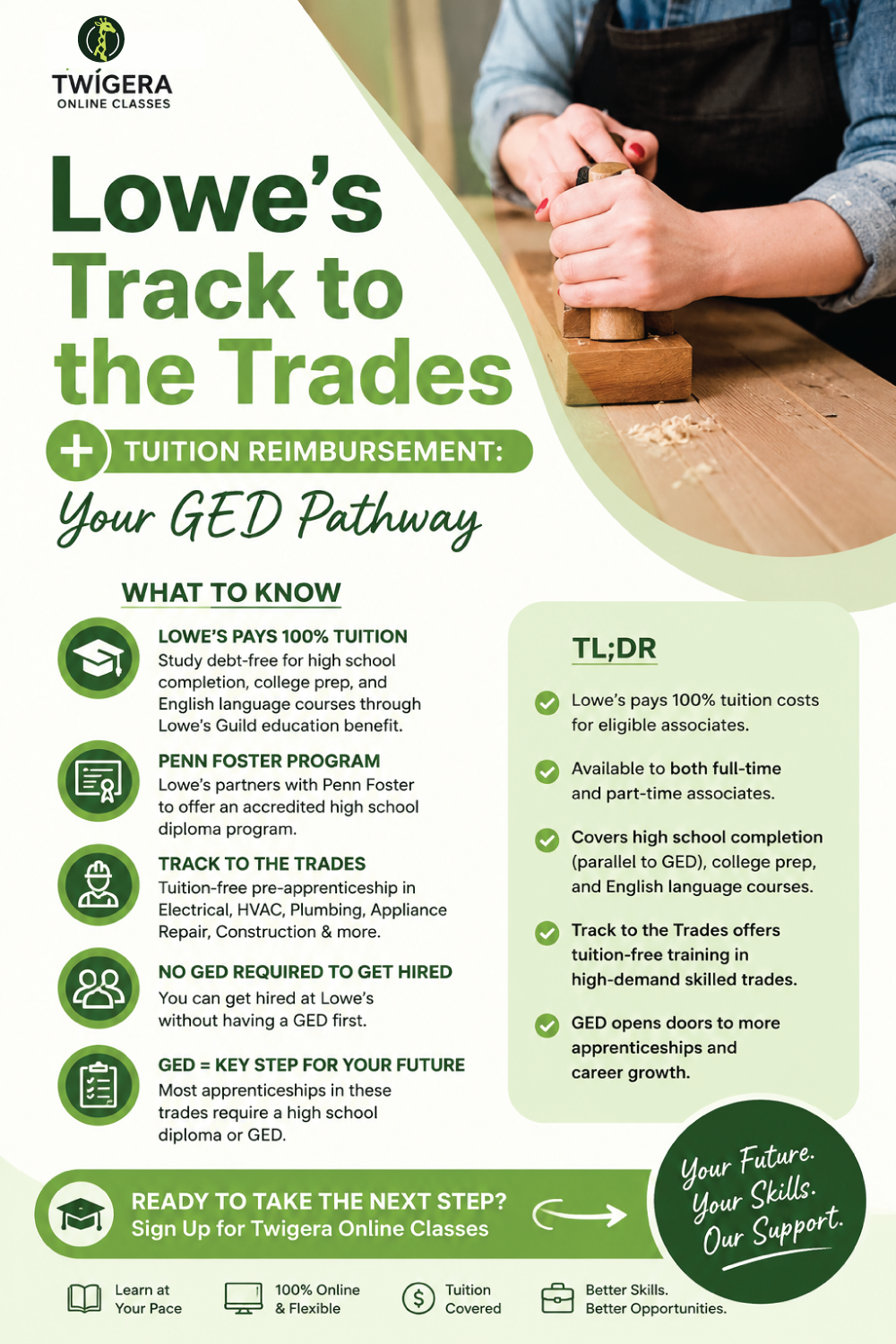
Lowe's Track to the Trades + Tuition Reimbursement & GED
Lowe's pays 100% for high school completion (the GED's parallel credential) through Guild and Penn Foster, and runs Track to the Trades, a tuition-free pre-apprenticeship across seven skilled trades. Here is the honest pathway.
Lowe's pays 100% of tuition for high school completion, college prep, and English language courses through its Guild benefit, for full- and part-time associates; Penn Foster provides the accredited diploma. Lowe's does not name the GED specifically, but high school completion is a parallel credential. Track to the Trades is a separate tuition-free pre-apprenticeship — but most apprenticeships still require a diploma or GED.
Last reviewed
Are you trying to build a better future but still feel stuck without a high school credential? You want steady work, better pay, and a clear next step, but the path feels harder when school has been sitting unfinished for years. Lowe's stands out here.
In 2026, the Lowe's Foundation said it plans to invest $250 million to train and develop 250,000 tradespeople by 2035. For workers who want a way in, Lowe's tuition reimbursement and education benefits deserve a close look — they offer a path to keep working while moving toward a high school credential and trade training. Here is how it all fits together, where Track to the Trades comes in, and why finishing your credential is often the step that moves everything forward.
Does Lowe's Pay for Your GED? Quick Answer
Lowe's does not advertise GED payment by name. Lowe's tuition reimbursement covers something close — and arguably better for most people: full high school completion through an accredited diploma program. Lowe's partners with Guild (an education benefit company) and Penn Foster (an accredited online school) that issues a real diploma once you finish the coursework. The GED is a different route to the same destination: a four-subject exam rather than a diploma program. Lowe's names "high school completion" on its benefit pages, not "GED" specifically, but both paths get you to a credential that opens doors. Lowe's funds the coursework route at 100%, debt-free.
If you would rather sit the GED test than work through a full diploma program, that is a separate decision you handle outside Lowe's benefit — and the difference between the two routes is worth understanding, which our guide on GED vs a high school diploma lays out in detail.
Lowe's Debt-Free Education Benefit, Explained
Lowe's launched this benefit in April 2022 through a partnership with Guild: education without debt for hundreds of thousands of associates who had never had that option through an employer before. Covered at 100% are high school completion (the Penn Foster diploma program), college preparation courses (some carrying transferable credit), English language learning, and select undergraduate certificates, degrees, bootcamps, and master's degrees — textbooks and course fees included, plus a Guild coach for one-on-one support. Both full-time and part-time associates can use it, which matters because many debt-free education promises from big employers quietly exclude part-timers. Lowe's does not.
One federal rule is worth knowing if employer education assistance is new to you: the IRS allows up to $5,250 a year in tax-free education assistance per employee; anything beyond that in a calendar year is treated as taxable income on your W-2. Most associates working toward high school completion will not hit this ceiling, but it is good to know if you are stacking the 100% catalog with additional reimbursed coursework in the same year.
Save for later
Pin this guide so you can find it again.
We refresh these every season. Save it to a Pinterest board and you’ll get the latest version next time you come back.
High School Completion vs. GED at Lowe's: The Honest Distinction
Penn Foster runs an accredited online high school: you enroll, work through courses, earn credits, and graduate with an actual diploma that functions like one earned at a traditional high school. The GED is a high school equivalency exam made up of four separate subject tests — Mathematical Reasoning, Reasoning Through Language Arts, Science, and Social Studies — which you can take separately on your own timeline. Pass all four, and your state (not the GED Testing Service) issues your official equivalency diploma, which carries the same weight as a traditional diploma with colleges, employers, and the military.
Which route is faster? A full diploma program means working through actual coursework over time; the GED is a test of what you already know plus whatever gaps you close through prep. For adults who left school years ago and remember more than they think, the GED route often moves faster — some prep and test in weeks, others need a few months. Lowe's official pages use "high school completion" and do not list a GED exam-prep program by name in the Guild catalog as of this writing, so if GED coverage by name matters to you, ask a Guild specialist directly when you set up your account. Either path reaches the same credential tier; choose the format that fits your life.
What Is Lowe's Track to the Trades?
Track to the Trades is not an apprenticeship — it is a pre-apprenticeship, and that distinction shapes everything. Lowe's built it as a benefit open to all associates, providing tuition-free courses and upfront funding for trade-skill certifications with no out-of-pocket cost and no reimbursement paperwork. Courses come from IACET-accredited designers and build toward industry-recognized credentials including OSHA-10, NATE RTW, and EPA-608, depending on your path. There are seven trade paths: Electrical, HVAC, Plumbing, Appliance Repair, Residential Construction, Multi-Family Housing, and Utility Maintenance. The program runs online and self-paced around your shift, and Lowe's connects participants to its nationwide contractor network.
This is not a job placement program, and you are not guaranteed a job after completing the program.
— Lowe's, official Track to the Trades page
That single sentence, quoted directly from Lowe's, should reset expectations for anyone assuming a job offer waits at the finish line. What you get instead is a real, employer-built credential and a network — and the certifications hold value well beyond Lowe's. OSHA-10 and EPA-608 in particular are recognized across the industry, so the training keeps its worth even if your path eventually takes you elsewhere. If you are weighing the trades specifically, our guide on going to trade school with a GED covers the wider landscape.
Do You Need a GED for Track to the Trades, or to Work at Lowe's?
The honest answer depends on where in the funnel you are. To get hired at entry level: no — cashier and stocker postings list basic reading, writing, and arithmetic, not a diploma or GED, which is exactly what makes the whole funnel work (you get hired first, then build the credential while earning). To move into supervisory or advancement roles: often yes — Head Cashier and many advancement paths list a diploma or GED. To enroll in Track to the Trades itself: Lowe's does not publicly state a requirement, so you can start the trade courses without one. But to enter the registered apprenticeship that comes after, you almost always need a high school diploma or GED, a minimum age of 18, and (for trades like electrical and plumbing) a math aptitude test.
So the credential is not a wall blocking you from starting — it is the gate further down the road, right where the paid, registered apprenticeship and the real trade wage live. Among employed U.S. workers in 2024, just 6.1% did not hold a high school diploma or equivalent, and the occupation group with the highest share of workers holding a high school diploma or associate degree was installation, maintenance, and repair, at 78.3% — the exact category most of Lowe's seven trade paths fall under. In this field the credential is not a formality; it is standard. Our guide on whether you need a GED for construction trades goes deeper on the apprenticeship requirements.
The Honest Pathway: From No Diploma to Trade-Career Ready
Get hired at Lowe's. No GED needed, and part-time counts toward eligibility for the education benefit — so even a part-time start gets you in the door for everything that follows.
Finish your high school credential. Use the 100% debt-free Guild and Penn Foster route to complete a diploma — or, if speed matters more, prep for the GED separately on your own timeline, then return to Lowe's other benefits.
Enroll in Track to the Trades. Pick one of the seven paths, work through the self-paced courses around your shift, and walk away with industry credentials and a contractor-network connection.
Move into a registered apprenticeship. This is where the diploma or GED requirement shows up again, along with age and aptitude requirements. Clear that gate, and you step into a paid, structured path toward a real trade career.
Where Twigera Fits
If the diploma-completion route feels slower than you want, or you would rather knock out a test than a multi-month course, the GED is your faster lane to the exact same credential tier. Twigera built its entire course around that situation — adults who left school years ago and need a direct path back without sitting in a classroom or relearning everything from scratch. It covers all four GED subjects in one course, uses an adaptive practice engine that targets your specific weak spots, gives you credentialed teachers seven days a week and full-length practice exams, and reports a 94% pass rate among students who complete it.
Twigera does not compete with Lowe's benefit. If the funded Penn Foster diploma path fits your timeline and goals, take it — it costs you nothing. Twigera exists for the moment when speed matters more: when you need that credential fast to hit an apprenticeship deadline, a job requirement, or just your own momentum. A free GED diagnostic test is the fastest way to see how close you already are. Either way, the only wrong move is leaving the credential unfinished.
Bottom Line
Lowe's covers 100% of tuition for high school completion through Penn Foster and Guild, letting associates earn a diploma debt-free. Direct GED coverage is not officially confirmed, but this gives employees a path to the same credential level. Track to the Trades gives current associates a tuition-free pre-apprenticeship across seven skilled trades, though Lowe's makes clear it does not guarantee a job. You do not need a GED to start in an entry-level role, but moving into skilled trades and registered apprenticeships usually requires a diploma or GED. Start with the opportunity in front of you, complete your credential, then take the next step — and if you want the fastest path to that credential, a structured GED prep program is the quicker on-ramp.
Frequently asked
Questions people ask.
Does Lowe's pay for your GED?
ShowHide
Lowe's pays 100% for high school completion through Penn Foster via Guild, plus college prep and ESL courses. It does not list the GED specifically, so confirm directly with a Guild specialist. Both options reach the same credential level.
How does Lowe's tuition reimbursement work?
ShowHide
Lowe's offers two mechanisms. Guild covers select programs (including high school completion) at 100% with no out-of-pocket cost — Lowe's pays Guild directly. Other approved Guild-catalog programs qualify for reimbursement up to $2,500 per year.
What is Lowe's Track to the Trades?
ShowHide
Track to the Trades is a tuition-free pre-apprenticeship for current associates, covering seven trades including Electrical, HVAC, Plumbing, and Construction. It builds toward credentials like OSHA-10 and EPA-608, but Lowe's states completion does not guarantee a job.
Do you need a GED to work at Lowe's?
ShowHide
No. Entry-level jobs like cashier or stocker do not require a diploma or GED. Higher roles and career advancement (such as Head Cashier) often require a high school diploma or GED.
Does Track to the Trades require a GED or diploma?
ShowHide
Lowe's does not publicly list a diploma or GED requirement for the pre-apprenticeship itself. But the registered apprenticeships that follow almost always require a high school diploma or GED, plus a minimum age of 18 and (for some trades) a math aptitude test.
How much does Lowe's tuition reimbursement cover?
ShowHide
Programs inside the Guild 100% catalog cost employees nothing. Other approved programs qualify for reimbursement up to $2,500 per year. Track to the Trades is also fully funded with no upfront cost.
Is Lowe's tuition reimbursement worth it?
ShowHide
Yes. It gives associates access to debt-free education and trade training, available to both full- and part-time workers. The main limitation is that Track to the Trades does not guarantee employment after completion.
Can I earn my GED faster than Lowe's diploma program?
ShowHide
In many cases, yes. A GED is a four-subject exam you can often complete faster than a full diploma program. If speed matters — for example to hit an apprenticeship deadline — preparing for the GED separately can be the quicker on-ramp to the same credential tier.
Amara is the editor at Twigera. She came to publishing the long way — a decade teaching the GED in community colleges and adult-learning centers, where she watched students pass not on talent or time, but on the strength of a study plan they actually trusted. Now she shapes the guides students read here for the parent studying after a closing shift, the second-career welder, the grandmother finishing what she started forty years ago. Expect honest timelines, math made survivable, and study plans built around real life — not around a textbook's idea of one.
Enjoyed this?
Take the next step — start today.
Our online GED course includes every subject, a free 30-minute diagnostic, and a 7-day refund on every plan.