Kroger Feed Your Future: Does It Cover GED? Honest Guide
Yes — Kroger's Feed Your Future benefit explicitly covers GED prep and testing, plus certifications and college: up to $3,500 a year and $21,000 lifetime, for full- and part-time associates after six months. Here is the honest 2026 guide.
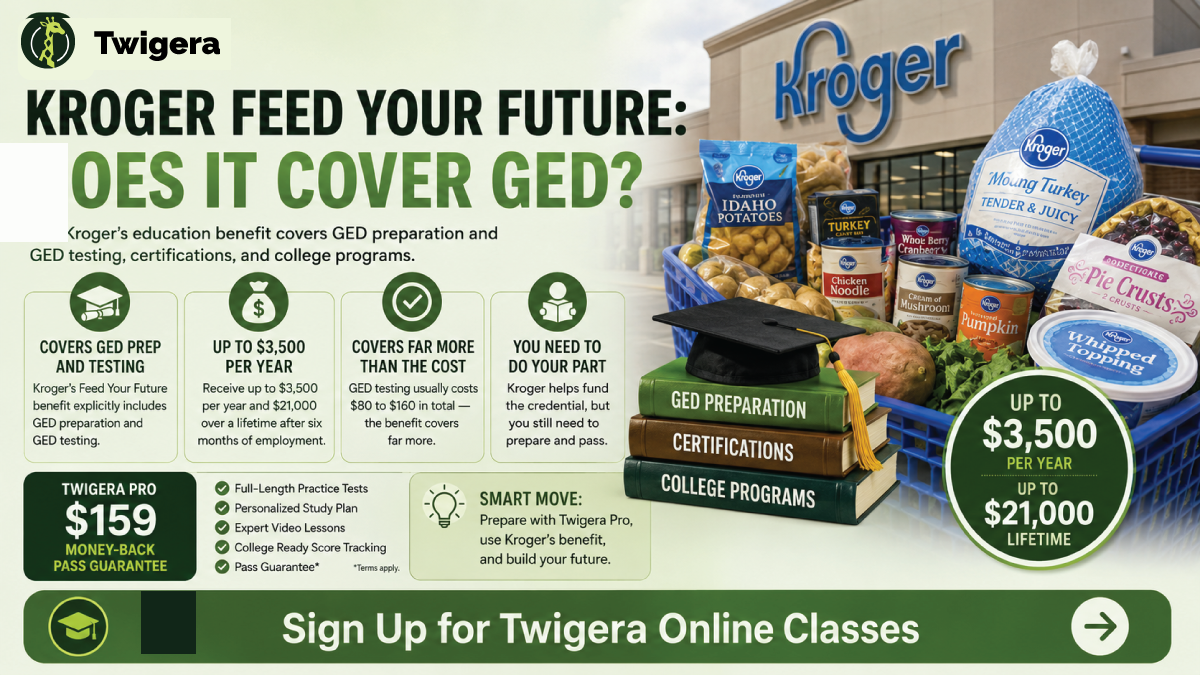
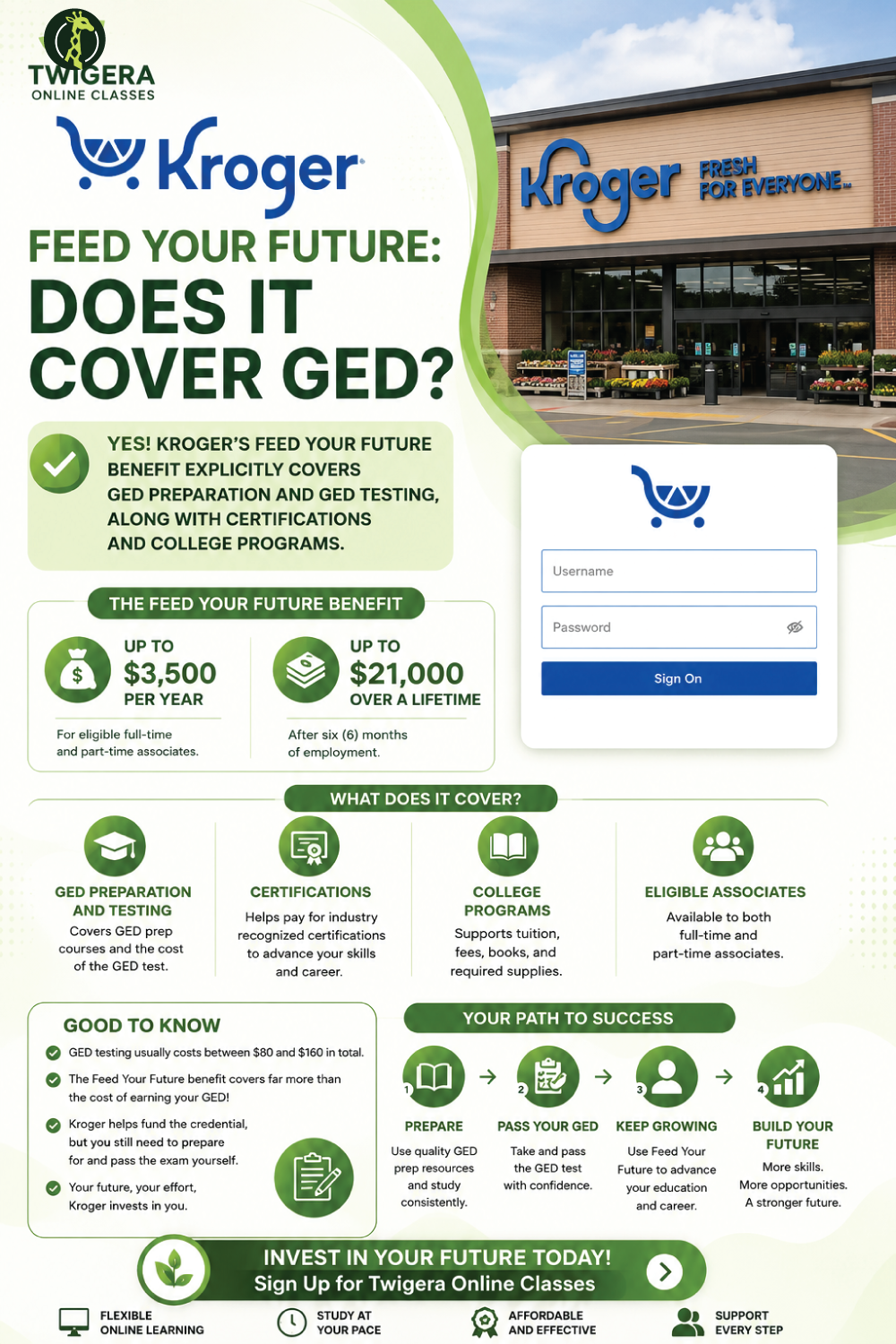
Yes. Kroger's Feed Your Future benefit explicitly covers GED preparation and testing, plus certifications and college programs. Eligible full-time and part-time associates receive up to $3,500 per year and $21,000 over a lifetime after six months of employment. Since the GED costs roughly $120–$160 total, the benefit covers far more than the credential — but you still prepare for and pass the exam yourself.
Last reviewed
The Kroger Feed Your Future program provides financial assistance for associates pursuing education, including college degrees and vocational training. But one question keeps coming up for workers trying to improve their future: does Kroger Feed Your Future help cover the cost of earning a GED? For many adults, going back to school feels harder than finding the motivation to start — and without a high school credential, many employer education benefits still feel out of reach.
Understanding how this works matters before you plan your next step, because education and income are directly linked. According to recent U.S. Census Bureau data, workers in 2023 without a high school diploma earned an average of $35,720, while high school graduates earned $46,720 — one credential creating a measurable difference in long-term earning potential. This guide unpacks what Feed Your Future covers, whether GED prep qualifies, and the smartest path if the GED is still the first milestone in your way.
Quick Answer: Does Kroger Feed Your Future Cover GED?
Yes. The official Kroger program language states the benefit covers associates pursuing a high school equivalency exam, professional certifications, and advanced degrees — and a GED is a high school equivalency credential, so it is covered. This is not a college-only program; it was built for every stage of education, starting wherever an associate currently stands. Three things to understand first: Feed Your Future is a reimbursement benefit with eligibility conditions (not unconditional free money), Kroger pays for the credential but does not prepare you for the exam, and you must get your program approved before spending a single dollar.
What Is Kroger Feed Your Future?
Feed Your Future launched in 2018 as part of Kroger's Restock Kroger strategy, increasing the company's annual investment in associate education fivefold. The benefit covers associates across Kroger's full family of banners — Fred Meyer, Ralphs, King Soopers, Fry's, Harris Teeter, QFC, Smith's, and Pick 'n Save — so if you work under any of those names, you are a Kroger associate for benefits purposes (verify your specific banner with HR, as details vary by division and union agreement). What it covers:
GED and high school equivalency prep and testing
Professional certifications across trades, healthcare, tech, and business
Associate and bachelor's degrees
Advanced and graduate degrees (books and materials may be eligible — confirm with HR)
The Money: $3,500 Per Year and $21,000 Lifetime
Kroger offers associates up to $3,500 annually, with a $21,000 cap over the course of employment. For a GED, those numbers are significant: the test has four subjects costing roughly $30–$40 each in most states, putting the total around $120–$160 when you pass all four on the first attempt — so the annual cap covers the test cost many times over. The real value is not the GED alone; it is the stacking opportunity. GED first, then certifications, then college, all under one $21,000 lifetime umbrella. If you want to see exactly how much the GED costs in your state, our cost guide breaks it down — and you can confirm the official per-state fees on ged.com.
Feature
Detail
Status
Annual benefit
Up to $3,500
Verified — official release
Lifetime cap
$21,000
Verified — official release
Eligible employees
Full-time and part-time
Verified
Tenure required
6 months continuous
Verified at launch; confirm current
GED / HS equivalency
Covered
Verified
Grade requirement
C or higher (reported)
Widely reported; confirm on portal
Hours-per-week minimum
~20 hrs (secondary sources)
Unconfirmed officially; verify with HR
Save for later
Pin this guide so you can find it again.
We refresh these every season. Save it to a Pinterest board and you’ll get the latest version next time you come back.
Confirmed requirements: you must be an active Kroger associate based in the United States, with six months of continuous employment completed before the benefit becomes available, and both full-time and part-time associates are eligible. That last point matters — most retail education benefits are restricted to full-time workers only, so extending coverage to part-time associates is uncommon in the industry. Be careful with two widely-repeated but officially-unconfirmed claims: a roughly 20-hour-per-week minimum and a C-or-better grade rule both appear across secondary sources but do not appear in Kroger's official materials, so verify them on the portal rather than planning your budget around them. And ignore the "day-one eligibility" claim some aggregator sites make — the official language is six months.
One more requirement catches people off guard: you must remain an active Kroger employee at the time the reimbursement is actually paid. An associate who completes a course and then leaves the company before the payment processes will not receive that reimbursement, since active employment is required at payout. If you are considering leaving Kroger, finish your reimbursement cycle first. And if you work at a Kroger-owned banner, you are generally covered under the same benefit — but coverage can vary by division and any applicable collective bargaining agreement, so confirm your store's specific eligibility directly with your HR team.
How to Use Feed Your Future for Your GED
Follow these steps in order — skipping any of them is the most common reason associates miss out on reimbursement. The single biggest trap is paying before your program is approved: Kroger reimburses approved programs, so submit yours and wait for confirmation first.
Honest Caveats: What Feed Your Future Will Not Do
It is a reimbursement model, so associates typically pay tuition upfront and submit for reimbursement after completing the course — budget for that timing gap, because a bill due at the start of a term is a genuine constraint on hourly retail wages. It does not teach you the material: funding a credential and preparing you for it are two different things, and walking into the GED unprepared wastes the benefit entirely. The six-month wait is real, so factor the tenure requirement into your timeline. And some conditions (the 20-hour rule, the C-or-better grade rule, books coverage, and the rumored Guild Education administration) remain unverified in official materials — confirm them on the portal rather than assuming.
How Kroger Feed Your Future Compares
Feed Your Future explicitly names high school equivalency in its covered benefits, where many employer programs begin only at the community-college level — leaving GED-seeking associates with no coverage at all. Walmart's Live Better U covers tuition upfront for approved programs at partner schools but limits funding to specific degrees within its network, and Target tuition reimbursement offers tuition-free options for certain approved programs and capped funding for others. Kroger's differentiators are explicit GED coverage from the start, full- and part-time inclusion, and flexibility to choose institutions outside a locked partner network. If you do not work at Kroger, do not assume you have no options — see the full guide to employer-sponsored GED programs to compare what is available across the industry.
Where Twigera Fits: Get Your GED Faster
Kroger handles the funding; Twigera handles the preparation. That is the honest division of labor, and it is exactly why the two work well together. In 2024, 6.1% of employed workers still lacked a high school diploma or equivalent — and most of them are not stuck because of money. They are stuck because they cannot find structured, effective preparation that fits around a work schedule. Twigera is an online GED prep program built for working adults: it covers all four subjects, is taught by credentialed teachers, includes adaptive practice and 1,500-plus questions, and reports a 94% pass rate. The smart play is simple — take a free GED diagnostic test, prepare across all four subjects, sit the GED once your scores show readiness, then submit the test fees to Feed Your Future for reimbursement and roll the remaining cap into a certification or college course.
The reason this pairing works is that it splits the problem cleanly into the two things that actually stop people. Money is one barrier, and Feed Your Future removes it. Preparation is the other, and it is the one most associates underestimate — the GED is not a formality you can wing after years away from a classroom. Twigera was designed entirely around passing the test without wasting your time or requiring you to quit your job to study: the four subjects each get focused coverage, the practice questions adapt to your weak spots, and the diagnostic tells you when you are genuinely ready rather than just hopeful. At $159 for the Pro plan, Twigera costs less than a single subject retake in many states — a small, refundable-on-failure investment against $3,500 in annual reimbursement and the full $21,000 lifetime cap waiting behind it.
Bottom Line
Kroger Feed Your Future is one of the most accessible employer education benefits in retail, precisely because it starts where most people actually need help: the GED level. The verified facts are up to $3,500 per year, up to $21,000 lifetime, full- and part-time associates both covered, six months of continuous employment required, and GED and high school equivalency explicitly in scope. Adults without a high school diploma face a poverty rate of 23.1%, compared to 4.1% for those with a bachelor's degree or higher — a GED is the credential that gets you off that floor, and Kroger is willing to pay for it. The funding is real and the path is clear — the only piece left is the preparation, and that is the part entirely within your control today. Start with a free diagnostic and take the first step.
Frequently asked
Questions people ask.
Does Kroger Feed Your Future cover GED?
ShowHide
Yes. Kroger's official launch language states the benefit supports a high school equivalency exam, professional certifications, and advanced degrees. Since the GED is a high school equivalency credential, eligible employees can use the benefit toward GED-related education and testing, up to $3,500 per year and $21,000 over a lifetime.
How much does Kroger pay for education?
ShowHide
Kroger provides up to $3,500 per year, with a lifetime maximum of $21,000 for eligible associates. Since the GED test itself usually costs $120–$160 total, the benefit covers far more than the cost of earning your GED, leaving room for future certifications or college.
Is Feed Your Future available to part-time Kroger workers?
ShowHide
Yes. Both full-time and part-time associates generally qualify after completing six months of continuous employment. That broad eligibility makes Feed Your Future one of the stronger employer education benefits in retail.
Do you have to work at Kroger for a while before you qualify?
ShowHide
Yes. Based on Kroger's official launch terms, employees usually need about six months of continuous employment before becoming eligible. Some secondary sources mention immediate eligibility, but the official information supports the six-month requirement — confirm current policy on the internal benefits portal.
How do I apply for Feed Your Future for my GED?
ShowHide
First confirm eligibility as an active employee who meets the tenure requirement, then access Kroger's internal education benefits portal through HR. Get approval for your GED-related program before paying, complete it successfully, then submit receipts and documents for reimbursement.
Is Kroger Feed Your Future run by Guild Education?
ShowHide
This remains unconfirmed. Kroger's official program materials do not publicly name Guild Education or another third-party administrator. The safest move is to check your internal employee benefits portal to confirm who currently manages the program.
Does Kroger pay for GED prep courses or only the GED test?
ShowHide
Verify this directly before enrolling. The program supports high school equivalency education broadly, but reimbursement depends on whether your chosen GED prep program meets approval requirements. Always get approval first so you know which expenses qualify.
What if I do not work at Kroger — can I still get help paying for a GED?
ShowHide
Yes. Several employers now help workers pay for GED or high school equivalency education, and many states offer free or low-cost adult education programs. If employer benefits are not available, structured prep platforms like Twigera give adult learners a practical, affordable path.
Amara is the editor at Twigera. She came to publishing the long way — a decade teaching the GED in community colleges and adult-learning centers, where she watched students pass not on talent or time, but on the strength of a study plan they actually trusted. Now she shapes the guides students read here for the parent studying after a closing shift, the second-career welder, the grandmother finishing what she started forty years ago. Expect honest timelines, math made survivable, and study plans built around real life — not around a textbook's idea of one.
Enjoyed this?
Take the next step — start today.
Our online GED course includes every subject, a free 30-minute diagnostic, and a 7-day refund on every plan.