
UPS Earn and Learn: Does It Pay for Your GED? Honest Guide
UPS Earn and Learn is one of the best part-time education benefits around — up to $5,250 a year and $25,000 lifetime, from day one. But it pays for college, not your GED. Here is the honest path: earn your GED first, then unlock it.


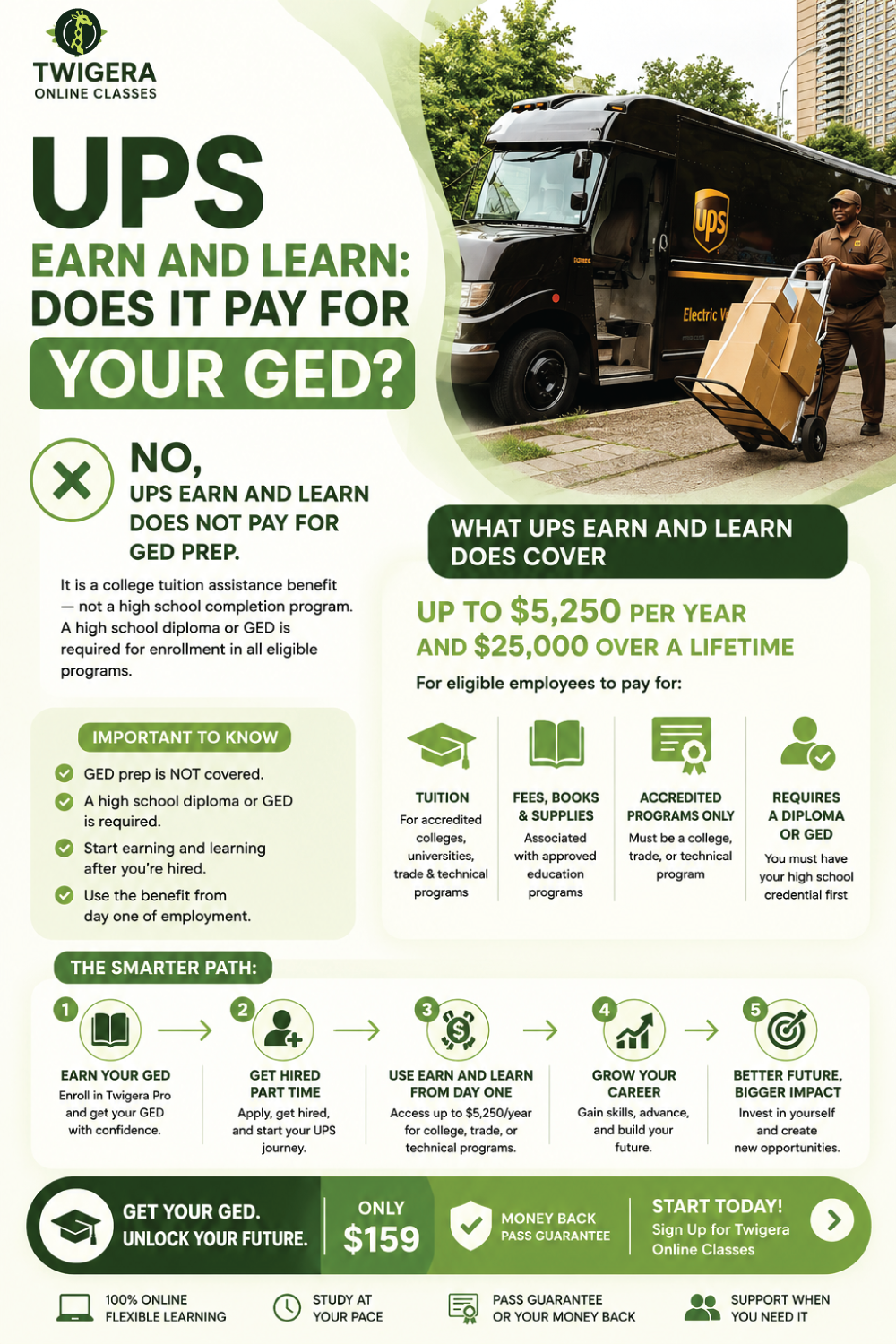
No, UPS Earn and Learn does not pay for GED prep. It is a college tuition assistance benefit worth up to $5,250 per year and $25,000 over a lifetime, covering tuition, fees, books, and supplies for accredited college, trade, and technical programs — all of which require a diploma or GED to enroll. The smarter path: earn your GED first, get hired part-time at UPS, then use the benefit from day one.
Pin this guide so you can find it again.
We refresh these every season. Save it to a Pinterest board and you’ll get the latest version next time you come back.
Save to PinterestQuestions people ask.
- Does UPS Earn and Learn pay for your GED?
No. UPS Earn and Learn is a college tuition assistance benefit for accredited college, trade, and technical programs, not GED preparation. No official UPS source covers GED study or test fees — you need to earn your GED separately before using the benefit for college.
- How much is UPS Earn and Learn worth?
The program offers up to $5,250 per calendar year, with a $25,000 lifetime maximum. It reimburses tuition, fees, textbooks, and supplies for approved accredited schools. Because it works through reimbursement, you pay first and receive repayment after meeting academic requirements.
- Do you need a GED to work at UPS?
It depends on the role and location. Many part-time package handler positions do not list formal education requirements, while some facilities ask for a high school diploma or GED. Check the specific job posting — and remember you will still need a GED to use the education benefit for college.
- Who is eligible for UPS Earn and Learn?
Active part-time, non-management employees at participating UPS locations qualify, and eligibility begins on your first day. Both union and union-free positions count. Temporary, co-op, and intern positions usually do not qualify, and management approval is not required.
- How does UPS Earn and Learn reimbursement work?
Get hired at UPS, enroll in an approved accredited school, apply through Edcor within the window (90 days before the term to 30 days after it starts), pay tuition yourself, complete the term with a passing grade, then submit proof for reimbursement up to the yearly limit.
- Does UPS pay for college from day one?
Yes. Unlike many benefits that require waiting periods, UPS Earn and Learn tuition assistance is available immediately for eligible part-time employees. You must still be enrolled in an approved program, which means having a high school diploma or GED remains necessary.
- What can you study with UPS Earn and Learn?
Almost any field, with no subject restrictions. Employees can pursue associate, bachelor's, and graduate degrees, plus certificate, certification, and trade or technical programs at approved accredited schools. GED preparation and pre-college adult education do not qualify.
- What is the smartest order — GED, UPS job, or college?
GED first. UPS does not pay for GED prep, but you need the credential before enrolling in the college programs the benefit supports. Earn your GED, secure a part-time UPS job, enroll in an approved program, then begin using UPS Earn and Learn from day one.
Amara is the editor at Twigera. She came to publishing the long way — a decade teaching the GED in community colleges and adult-learning centers, where she watched students pass not on talent or time, but on the strength of a study plan they actually trusted. Now she shapes the guides students read here for the parent studying after a closing shift, the second-career welder, the grandmother finishing what she started forty years ago. Expect honest timelines, math made survivable, and study plans built around real life — not around a textbook's idea of one.
Take the next step — start today.
Our online GED course includes every subject, a free 30-minute diagnostic, and a 7-day refund on every plan.