Can You Be an EMT Without a High School Diploma or GED?
The NREMT exam page does not list a diploma requirement, which is where the confusion starts. The two gates that actually decide whether you can work — your state EMS office and your EMT course — both do.
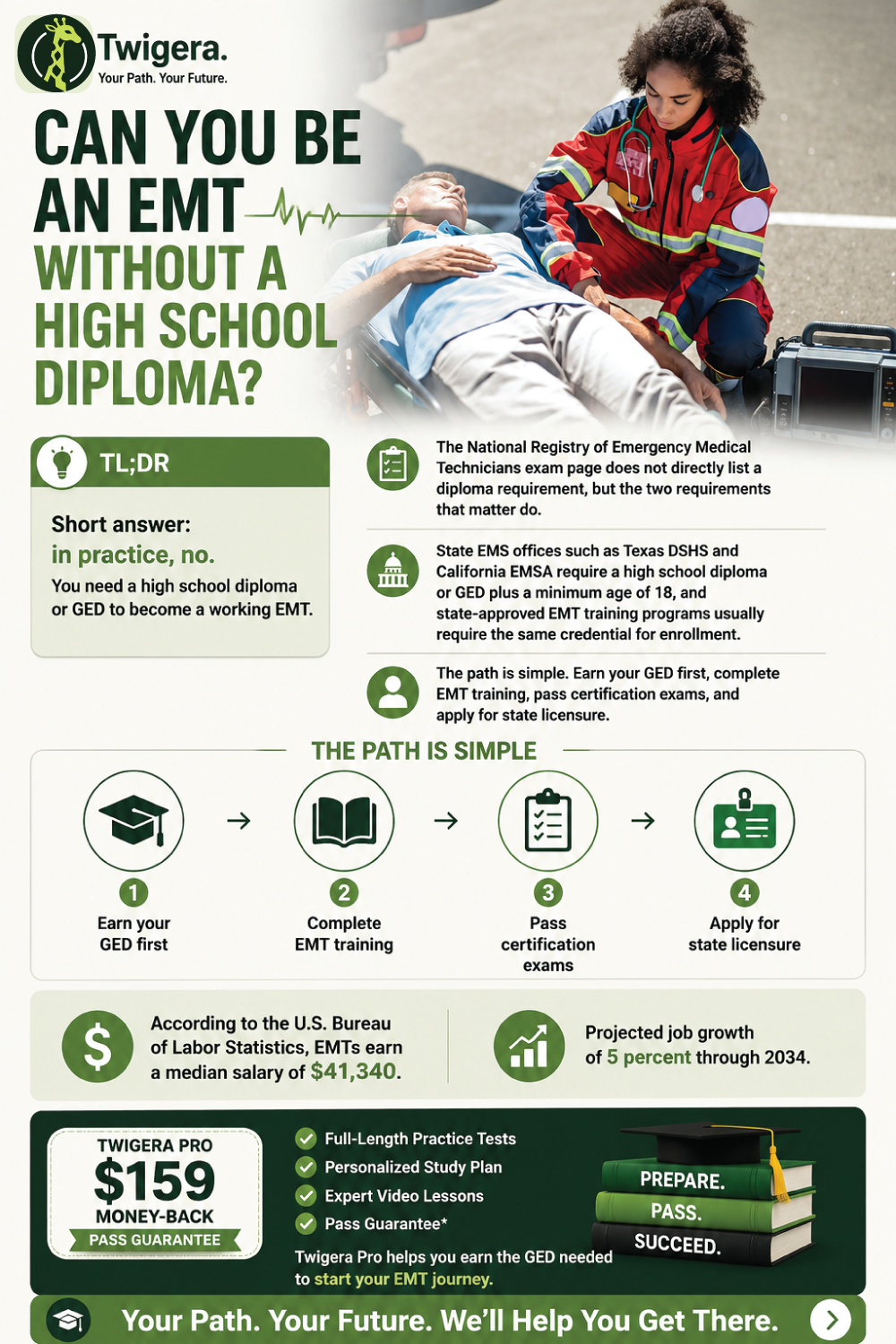
In practice, no. The NREMT cognitive exam page does not list a high school diploma or GED as its own requirement, but the two gates that decide whether you can work do. State EMS offices such as Texas DSHS and California EMSA require a diploma or GED plus age 18, and state-approved EMT courses require the same credential to enroll.
Last reviewed
Can you be an EMT without a high school diploma? In practice, no. You need a diploma or a GED to work as an EMT. The confusion has a specific source. The National Registry of Emergency Medical Technicians does not list a diploma on its exam eligibility page. That omission is accurate — and meaningless. Two other gates stand between you and a paycheck, and both ask for the credential.
This guide separates the three gates so you can see exactly where the requirement lives, walks the five-step path from where you are now to a state EMT license, and cites what Texas and California actually put in writing. If you are starting without a diploma, the fix is the same one that unlocks what jobs you can get with a GED more broadly: earn the GED first, then everything downstream stops asking.
Quick Answer: Can You Be an EMT Without a Diploma or GED?
No — not as a working, licensed EMT. Three separate gates control the path into emergency medical services, and they do not all ask the same question. The NREMT cognitive exam page does not name a high school diploma or GED as its own eligibility line item. Your state EMS office, the body that grants the legal right to work, does require one. The state-approved EMT course you must finish before the exam will even let you register almost always requires one at admission. Because you cannot reach the exam without the course and cannot work without the license, the gap on the NREMT page changes nothing about the outcome.
The cheapest fix is also the most obvious one. Earn your GED first and every version of this question stops getting asked. Prep typically runs one to six months depending on where you are starting — our guide on how long it takes to get a GED breaks that timeline down by study pace.
The Three Gates: NREMT vs. State License vs. Your EMT Course
Three separate gates stand between you and paid work as an EMT, and only two of them ask for a high school diploma or GED. The NREMT cognitive exam controls your eligibility to sit the national test, and its published requirements do not name a diploma. Your state EMS office controls the legal right to work, and Texas and California both require a diploma or GED in writing. The state-approved EMT course controls whether you can reach the exam at all, and nearly every program requires the credential at admission. Because the course comes before the exam and the license comes after it, the one gate that skips the requirement sits sandwiched between two that do not. That structure is the whole reason the honest answer is no, even though reading the NREMT page on its own might suggest otherwise.
Gate
What it controls
Diploma or GED required?
NREMT cognitive exam
Eligibility to sit the national EMT test
Not listed as a separate requirement
State EMS office license
Legal right to work as an EMT
Yes — confirmed in writing by Texas and California
State-approved EMT course
Whether you can reach the exam at all
Yes — set by each program at admission
Here is what the NREMT actually asks for under its Full Education Program pathway, the route most candidates use. You complete a state-approved EMT course within the past two years, with your Program Director verifying that completion. You pass the cognitive exam, and you complete a state-approved BLS psychomotor skills check. The exam costs $104 per attempt. Your Authorization To Test stays valid for 90 days once issued, and a passing result holds for 24 months.
None of those line items mentions a diploma. That is accurate, and it is misleading if you stop reading there. The course you must finish first sets its own admission bar, and nearly every program requires a high school diploma or GED before it will let you register. The state office that converts your passed exam into a working license adds the same requirement on its end. You cannot reach the exam without the course, and you cannot work without the license. Both doors ask for the same piece of paper the exam page never mentions — which is the precise version of this answer, and the version most competing articles get wrong by oversimplifying in one direction or the other.
Save for later
Pin this guide so you can find it again.
We refresh these every season. Save it to a Pinterest board and you’ll get the latest version next time you come back.
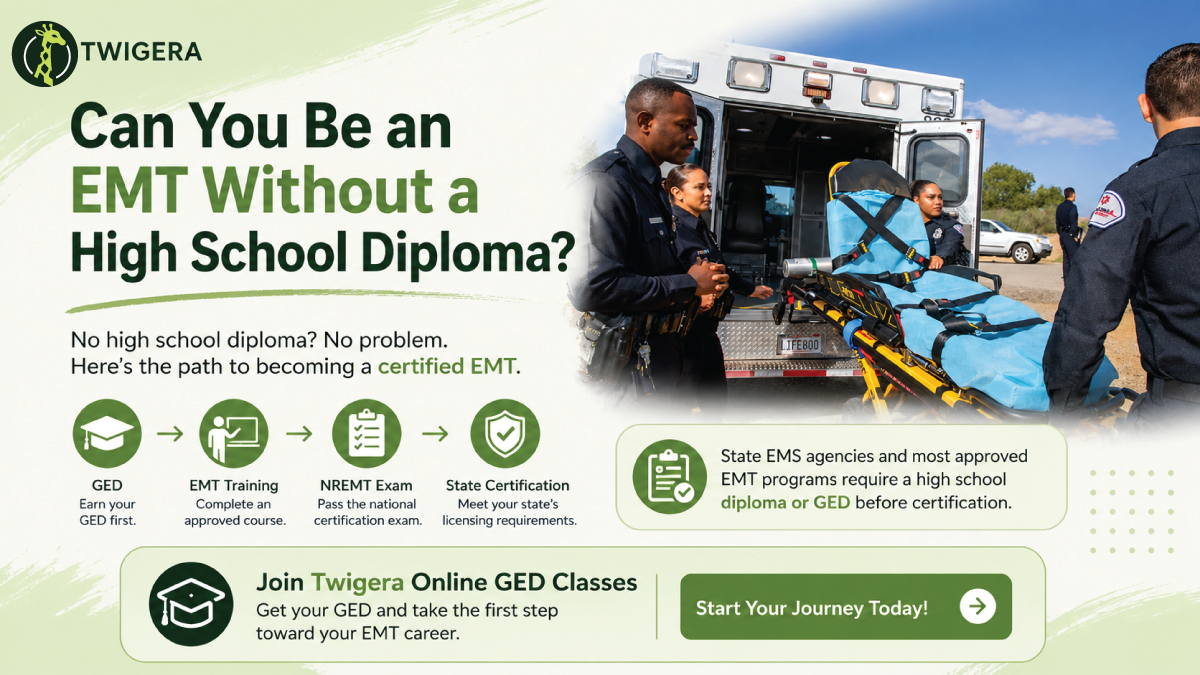
Becoming an EMT is a five-step sequence, and the steps are strictly ordered. First you earn a high school diploma or GED. Then you meet the basic entry requirements: age 18, plus current CPR and BLS certification. Next comes a state-approved EMT course of roughly 150 to 200-plus clock hours. After that you pass the NREMT cognitive exam and a state psychomotor skills check. Finally you apply to your state EMS office for certification. Starting from zero, expect four to nine months in total once GED prep is stacked on top of the course. Each step gates the one after it. That is why skipping the credential at step one stalls you at step three, then again at step five.
Step 1: Earn your GED first
This is the step that quietly unlocks everything else. Without it, step three does not happen and step five does not happen. GED prep runs one to six months depending on your starting point, and it is the cheapest item on this entire list. If money is the obstacle rather than time, GED scholarships and state-funded adult education programs cover testing fees in many states.
Step 2: Meet the basic entry requirements
Most states set 18 as the minimum age to be certified as a working EMT, though some courses admit students at 17 if they turn 18 before finishing. You will also need current CPR and Basic Life Support certification at the Healthcare Provider level, and most programs ask for immunization records and a negative TB test.
Step 3: Complete a state-approved EMT course
Course length runs roughly 150 to 200-plus clock hours, which usually translates to three to six months depending on whether you study full time or part time around a job. The course must be approved by your own state EMS office — an unapproved program will not make you eligible for the exam, no matter what its marketing says.
Step 4: Pass your exams
You sit the NREMT cognitive exam, a computer-adaptive test, plus a state-approved BLS psychomotor skills check. The cognitive exam costs $104 per attempt and your Authorization To Test is valid for 90 days. Pass both and your results stay valid for 24 months while you finish the licensing paperwork.
Step 5: Apply for state certification
This is where the fingerprint check, the application fee, and the final paperwork come together. Texas DSHS lists processing at up to four weeks from the date of submission, and other states run comparable timelines, so build that wait into your plan rather than treating the exam as the finish line.
Do EMT Courses Really Require a GED?
Yes, almost without exception. Community college EMT programs and private training providers set the same admission bar. They want a high school diploma or GED, current CPR and BLS certification at the Healthcare Provider level, proof of required immunizations, and often a negative TB test. This is the gate most people hit first, months before the NREMT exam enters the picture. It is also why the "the NREMT does not require a diploma" line is such a costly thing to believe. The admission policy belongs to the program, not the National Registry — and programs answer to their state EMS office.
EMT-Basic is not the same accreditation level as paramedic
This distinction gets confused constantly. EMT-Basic programs are state-approved, meaning your state EMS office reviews and approves the curriculum directly. Paramedic programs sit at a different level entirely, accredited through CoAEMSP under CAAHEP, with a far longer training requirement attached and an existing EMT or AEMT certification as a prerequisite. Treating the two as interchangeable is a mistake that shows up across a lot of competing content — they are different credentials with different gates.
The rare exception, and why it is not really a shortcut
A small number of programs admit students who are still finishing GED coursework, working toward the credential alongside the EMT material. Even there, the state certification step at the end still requires the completed credential before you can legally work. The exception changes the order slightly; it does not remove the requirement.
EMT Requirements by State: Texas and California
Every state runs its own EMS office and sets its own exact rules, but the diploma-or-GED requirement is consistent across the states that publish it plainly. Texas and California are useful reference points because both put the requirement in writing and both are large enough that their rules shape training programs regionally. Texas requires a high school diploma or GED certificate, a minimum age of 18, a DSHS-approved training course, a passing National Registry exam result, and Texas plus FBI fingerprints. California accepts a standard diploma, a home-school diploma, or a GED, and pairs it with an approved course and the same NREMT exam structure. The two states differ on paperwork and fees, not on the credential itself. If your own state is not listed here, treat these as the shape of the requirement rather than the exact wording, and confirm the details with your state EMS office before you enroll anywhere.
Texas spells this out plainly on its Department of State Health Services page. Applicants must be at least 18, must hold a high school diploma or GED certificate, must complete a DSHS-approved training course, must pass the National Registry assessment exam, and must submit fingerprints for a Texas and FBI criminal history check. If Texas is where you plan to certify, start with online GED classes in Texas.
California follows the same shape through its EMS Authority and the local EMS agencies, accepting a standard diploma, a home-school diploma, or a GED alongside an approved course and the NREMT exam structure. Regulations for EMTs sit in Title 22, Division 9 of the California Code of Regulations. If you are certifying there, online GED classes in California is the place to start. Do not assume your own state matches either one exactly — check with your state EMS office directly before planning around another state's rules.
A quick note on age
The NREMT cognitive exam itself carries no hard national minimum age, and some EMT courses will train students who are 16 or 17. Certification to actually work as an EMT is a different matter, and most states hold firm at 18 for that final step.
EMT Pay, Job Outlook, and the Career Ladder
The U.S. Bureau of Labor Statistics reports a median annual wage of $41,340 for emergency medical technicians as of May 2024. Paramedics, the level above EMT, earned a median of $58,410 over the same period, with the lowest 10 percent under $40,130 and the highest 10 percent above $82,420. Overall employment across EMTs and paramedics together is projected to grow 5 percent from 2024 to 2034, faster than the average for all occupations, with about 19,000 openings projected each year over the decade.
How the career ladder actually works
EMR — Emergency Medical Responder, the most basic level.
EMT — the standard entry-level certification most people start with.
AEMT — Advanced EMT, adding skills such as IV fluids and certain medications.
Paramedic — requires a current EMT or AEMT certification first, plus a CoAEMSP-accredited program often running 1,200-plus hours.
Each rung asks for the certification below it, which means your GED keeps paying off long after your first EMT job. Many firefighters hold EMT certification alongside their fire training, since the two roles overlap constantly on emergency calls — if that route interests you, can you be a firefighter with a GED covers it. The same credential is the entry point for becoming a nurse with a GED and for shorter healthcare on-ramps such as becoming a CNA with a GED, both of which sit a rung lower on the same ladder.
Earn Your GED First: The Honest Path
Everything in this guide traces back to one document. It is the cheapest and fastest unlock for the EMT course, for state certification, and for every advancement step that follows in paramedic training, nursing, or fire service work. Twigera builds GED prep for people who left school years ago and need a route back that respects how little spare time they have. All four subjects sit in one place, the video lessons are short, and the practice adapts to what you are actually getting wrong rather than what you already know.
Three plans — Starter at $59 for three months, Standard at $99 for six, Pro at $159 for a full year. One-time payment, no subscription.
Pass Guarantee on Pro — finish the course, take the official GED within 90 days, and if you do not pass, every dollar comes back.
All four subjects included on every plan — math, language arts, science, and social studies. You are not paying per subject.
A free diagnostic up front builds a personalised study plan, so your hours go toward real gaps instead of material you already have.
This matters specifically for EMS work because the GED is not just one hiring filter among many. It is the single credential that opens your EMT course, your state certification, and the funding pathway for whatever you train toward next.
Bottom Line
You cannot work as an EMT without a high school diploma or GED. The National Registry does not state the requirement on its exam page, but the process makes it unavoidable: state EMS offices and state-approved EMT training programs both require the credential before you can enroll and before you can be certified. The path is straightforward — earn your GED, complete an EMT training program, pass the certification exams, then apply for state licensure. With a BLS median wage of $41,340 for EMTs and a clear ladder into paramedicine, nursing, or fire service above it, the credential at the bottom of that ladder is the one worth handling first.
Frequently asked
Questions people ask.
Can you be an EMT without a high school diploma?
ShowHide
In practice, no. The National Registry of Emergency Medical Technicians does not list a diploma as a separate line item on its exam eligibility page, but the state-approved course you must finish before sitting that exam and the state EMS office that issues your license both require a high school diploma or GED. Both gates sit between you and paid work.
Do you need a GED to be an EMT?
ShowHide
Yes, if you do not have a high school diploma. A GED is accepted as an equivalent credential by state EMS offices and by EMT training programs. Texas DSHS states plainly that applicants must hold a high school diploma or GED certificate, and California accepts a standard diploma, a home-school diploma, or a GED.
Does the NREMT require a high school diploma?
ShowHide
Not as its own listed requirement. The NREMT Full Education Program pathway asks you to complete a state-approved EMT course within the past two years, verified by your Program Director, then pass the cognitive exam and a state-approved psychomotor skills check. The diploma requirement lives in the course admission policy and the state license, not on the exam page.
Can you take EMT classes without a GED?
ShowHide
In most cases, no. Community college and private EMT programs almost universally require a high school diploma or GED at enrollment, alongside current CPR and BLS certification, immunization records, and often a negative TB test. A small number of programs admit students who are actively finishing a GED, but state certification at the end still requires the completed credential.
Can a 17-year-old become an EMT?
ShowHide
Sometimes you can start training at 17. The NREMT cognitive exam carries no hard national minimum age, and some courses admit 17-year-olds who will turn 18 before completion. Certification to work is a different question — Texas and California both set 18 as the minimum age for the license itself.
How long does it take to become an EMT?
ShowHide
A state-approved EMT course runs roughly 150 to 200-plus clock hours, which usually means three to six months depending on whether you study full time. If you need a GED first, budget roughly four to nine months in total. GED prep alone typically takes one to six months depending on your starting point and study pace.
How much do EMTs make?
ShowHide
The U.S. Bureau of Labor Statistics reports a median annual wage of $41,340 for emergency medical technicians as of May 2024. Paramedics, the level above EMT, earned a median of $58,410 over the same period. Overall employment across both roles is projected to grow 5 percent from 2024 to 2034.
What is the difference between an EMT and a paramedic?
ShowHide
An EMT holds an entry-level certification from a state-approved course and provides basic emergency care. A paramedic completes a much longer program accredited through CoAEMSP under CAAHEP, often 1,200-plus hours, and must already hold EMT or AEMT certification to enroll. The pay gap reflects the training gap.
How much does EMT training cost?
ShowHide
Tuition varies widely by provider and region, so get a written figure from the specific program before you commit. On top of tuition, budget for the NREMT cognitive exam at $104 per attempt, your state application fee — $64 for an EMT in Texas — and fingerprinting through the state vendor. Earning a GED first costs considerably less than any of it.
Rules vary by state
Check the rules where you test.
Fees, minimum age and online-testing availability are set by each state, not nationally. These hubs carry the current details for the states covered in this guide.
Amara is the editor at Twigera. She came to publishing the long way — a decade teaching the GED in community colleges and adult-learning centers, where she watched students pass not on talent or time, but on the strength of a study plan they actually trusted. Now she shapes the guides students read here for the parent studying after a closing shift, the second-career welder, the grandmother finishing what she started forty years ago. Expect honest timelines, math made survivable, and study plans built around real life — not around a textbook's idea of one.
Enjoyed this?
Take the next step — start today.
Our online GED course includes every subject, a free 30-minute diagnostic, and a 7-day refund on every plan.