The GED hands you the formula sheet. It does not hand you the number rules, the conversions, the algebra steps, or the trap-spotting — so those are what this page condenses.
A GED math cheat sheet is a one-page reference for the rules the test does not give you. The GED provides a Mathematics Formula Sheet and a Calculator Reference Sheet during the Mathematical Reasoning test, so memorizing area and volume formulas is wasted effort. What pays off is knowing the number rules, conversions, algebra steps, and common traps cold.
Last reviewed
You do not need another giant list of formulas. The GED already provides a Mathematics Formula Sheet during the test, alongside a Calculator Reference Sheet. What it does not provide is the part that actually decides your score: the number rules, the conversions, the algebra steps, the calculator habits, and the misreadings that quietly cost points. That is what this GED math cheat sheet condenses.
Use it as a last look before a practice session or test day. The goal is narrow — recognize what a problem is asking, choose the right method, and avoid preventable mistakes. If you are still learning a topic rather than reviewing it, start with what math is on the GED instead and come back here at the end.
What the GED Math Test Actually Gives You
The GED Mathematical Reasoning test covers four areas: basic math, geometry, basic algebra, and graphs and functions. It runs 115 minutes across two parts, and you get an on-screen Mathematics Formula Sheet and Calculator Reference Sheet throughout. Part 1 is a short no-calculator section of about five items. Part 2 allows the on-screen TI-30XS MultiView, and you may bring your own handheld TI-30XS to a test center. That combination changes what is worth studying. Because the formulas are supplied, hours spent memorizing the volume of a cone are hours spent on the one thing the test refuses to charge you for. The scarce skill is application — reading an item, deciding which relationship it describes, and executing without a sign error.
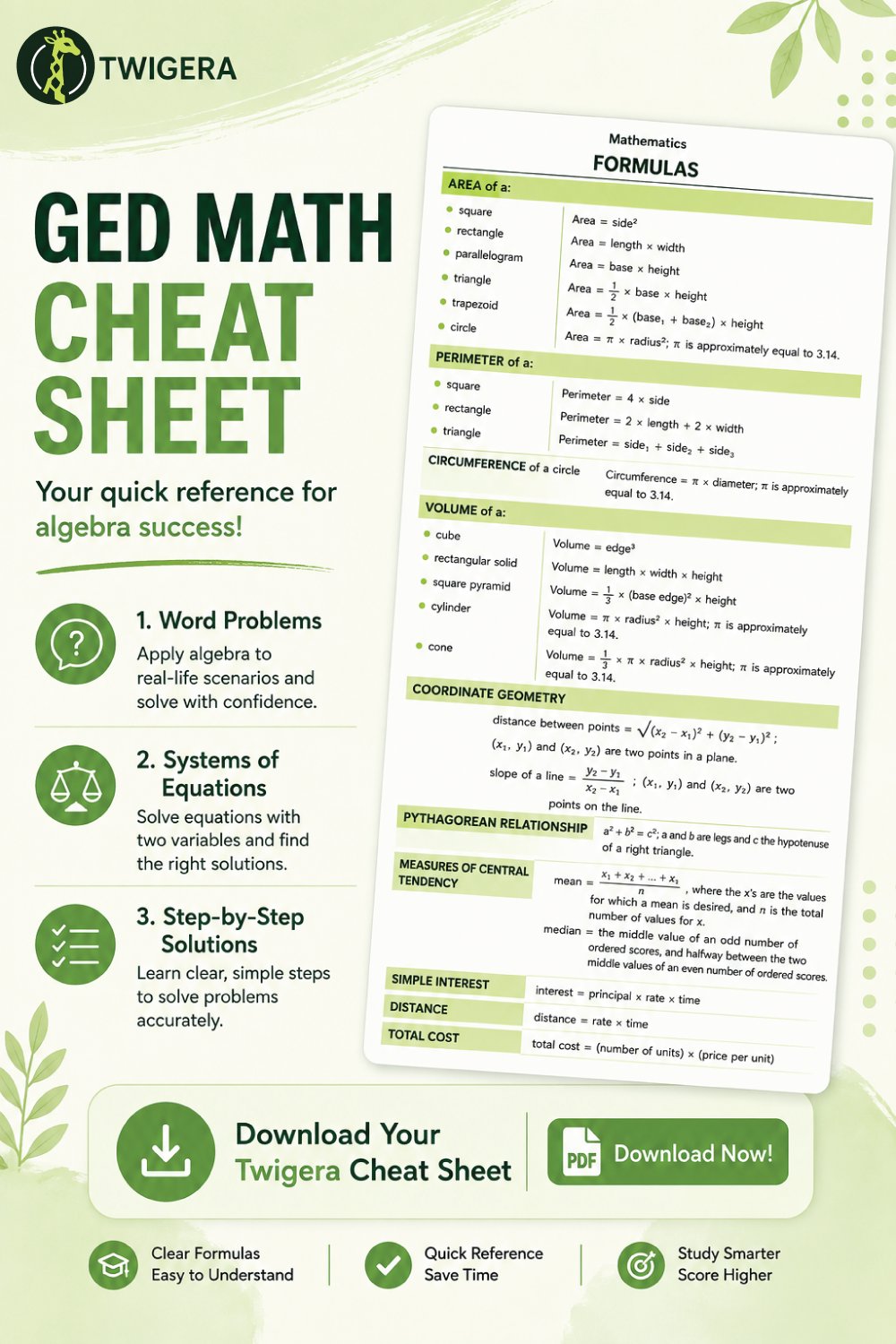
GED Testing Service states the point directly on its test subjects page: the formulas are provided so you can focus on applying them. If you want the sheet itself, with each formula worked through, our GED math formula sheet guide covers all of it. Everything below is the other half — the material you have to carry in yourself.
Number Rules to Know
These are the rules with no sheet behind them. Order of operations, sign behavior, absolute value, and exponents show up inside almost every other topic on the test, which means an error here contaminates a question you otherwise understood. A geometry item can be set up perfectly and still fail on a dropped negative. A percent item can use the right formula and still land on the wrong answer because the operations ran out of order. That is what makes this section disproportionately valuable: it is not a topic the test asks about directly, it is the layer underneath every topic it does ask about. It is also the fastest material on this page to get back to automatic, because none of it requires understanding a new concept — only reloading rules you have met before.
Order of operations
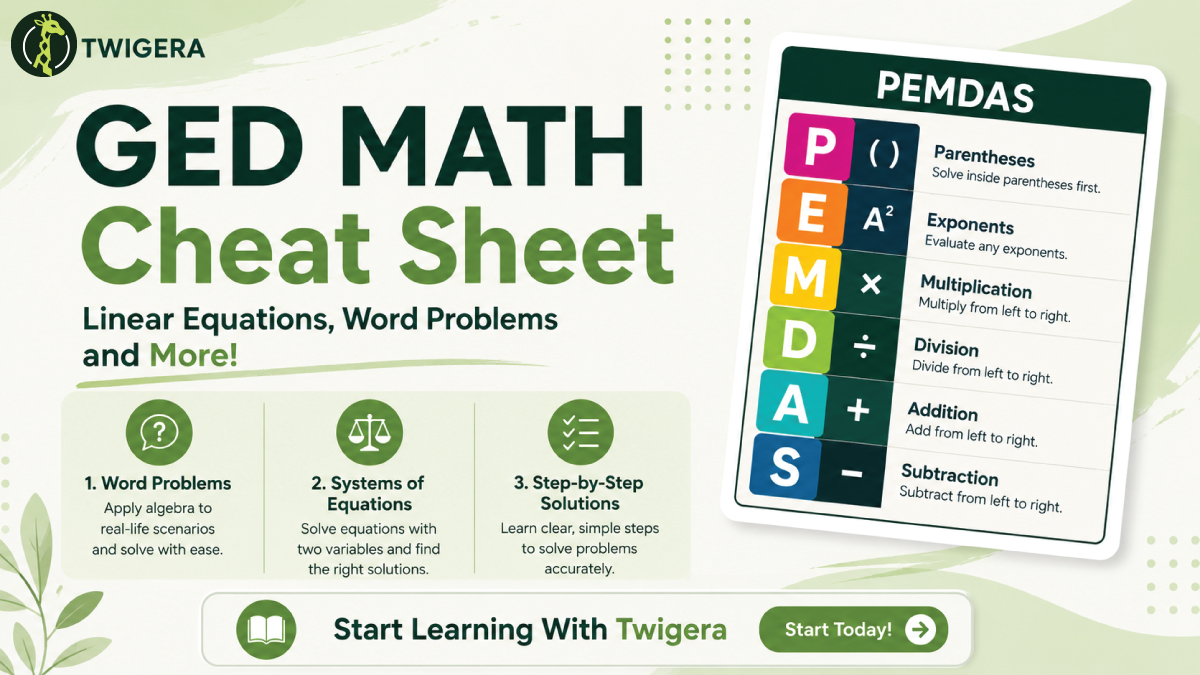
Work in PEMDAS order: parentheses, exponents, multiplication and division left to right, then addition and subtraction left to right. In 8 + 2 × 5, the multiplication runs first, giving 8 + 10 = 18. The answer is 18, not 50. Left-to-right matters within each pair — division does not automatically wait for multiplication.
Absolute value is distance from zero, so it is never negative: |−7| = 7 and |5| = 5. For exponents, 3² = 9 and 5³ = 125, and any non-zero number raised to the power of zero equals 1. When you multiply powers of the same base, add the exponents: x² × x³ = x⁵.
Save for later
Pin this guide so you can find it again.
We refresh these every season. Save it to a Pinterest board and you’ll get the latest version next time you come back.
Conversion between these three forms runs through the entire test, and the operations are short enough to memorize outright. To turn a fraction into a decimal, divide the numerator by the denominator: 3/4 = 0.75. To turn a decimal into a percent, multiply by 100: 0.75 = 75%. To go the other way, divide by 100: 75% = 0.75. For a portion of a whole, use part = percent × whole, so 25% of 80 is 0.25 × 80 = 20. Percent change has its own formula and its own trap: (new − original) ÷ original × 100. A price moving from $40 to $50 is (50 − 40) ÷ 40 × 100 = 25%.
Ratios and proportions
A proportion sets two ratios equal, in the form a/b = c/d. Given 3/5 = x/20, cross multiply to get 5x = 60, so x = 12. The trap here is confusing a percentage of a number with percentage change. They ask different questions and use different arithmetic, and the wrong one usually produces a plausible-looking answer that is on the answer list.
Algebra Quick Reference
The official formula sheet already supplies slope, slope-intercept form, the quadratic formula, simple interest, distance, and total cost. Your job is knowing how and when to use them. Combine like terms only when the variable and the exponent match, so 3x + 5x = 8x but 3x + 5 stays as it is. The distributive property multiplies the outside number by every term inside: 3(x + 4) becomes 3x + 12. To solve a linear equation, treat it as a balance — 2x + 6 = 16 becomes 2x = 10 after subtracting 6 from both sides, then x = 5 after dividing both sides by 2.
Inequalities — the one rule that catches people
Solve an inequality exactly like an equation, with one exception: when you multiply or divide by a negative number, reverse the inequality sign. So −2x > 8 becomes x < −4 after dividing by −2. Forgetting the flip produces an answer that is right in magnitude and wrong in direction, which is precisely the kind of near-miss a multiple-choice test rewards with a wrong option.
Slope and slope-intercept form
Slope is m = (y₂ − y₁) / (x₂ − x₁), which is rise over run. A positive slope rises from left to right; a negative slope falls. Slope-intercept form is y = mx + b, where m is the slope and b is the y-intercept. In y = 3x + 2, the slope is 3 and the y-intercept is 2. Reading a line off a graph is often faster than computing it — count the rise and the run between two clean grid points.
Geometry: Know What You Are Finding
A supplied formula only helps once you know which quantity the question wants, and geometry items on the GED are far more often lost to vocabulary than to arithmetic. Perimeter is the distance around a two-dimensional shape; for a rectangle, P = 2l + 2w. Area is the space inside it; for a rectangle, A = lw. Volume is the space inside a three-dimensional object; for a rectangular prism, V = lwh. Surface area is the total area covering the outside of a solid. For circles, A = πr² and C = 2πr. A triangle is A = ½bh, and the Pythagorean theorem, a² + b² = c², gives you the third side of a right triangle when you know two.
Geometry traps
Area is not perimeter. Fencing a yard is perimeter; grassing it is area.
Volume is not surface area. Filling a box is volume; wrapping it is surface area.
Diameter is twice the radius. Formulas take the radius, and items often hand you the diameter.
Square units describe area; cubic units describe volume. The unit in the answer choices is a hint.
Data, Statistics, and Probability
Do not let a chart make a simple question look hard. The mean is the sum divided by the number of values, so 4, 6, 8, 10 gives 28 ÷ 4 = 7. The median is the middle value once the list is ordered, so 3, 5, 7, 9, 12 gives 7; with an even count, average the two middle numbers. The mode is the value appearing most often — in 2, 4, 4, 6, 8 it is 4. The range is largest minus smallest. Probability is favorable outcomes divided by total possible outcomes, so a bag holding 3 red and 7 blue balls gives a 3/10 chance of drawing red.
Before you calculate anything from a graph or table, read the title, the axis labels, the scale, the units, and the question wording. Most lost points in this section come from answering a well-executed calculation on the wrong row.
Calculator Habits That Save Points
Part 2 gives you an on-screen TI-30XS MultiView, and a Calculator Reference Sheet covering fractions, percentages, powers, roots, and scientific notation — GED Testing Service walks through the setup in its Mathematical Reasoning overview. A calculator speeds up arithmetic; it cannot rescue an expression you typed wrong. Before you press enter, check the parentheses, check the negative signs, check the decimal placement, confirm you entered the whole expression, and decide what form the answer should take — fraction, decimal, percent, or whole number. Afterward, ask whether the result is plausible. If a 20% discount on a $50 item returns $400, the entry is wrong, not the item. For the rules on what you can bring and when, see can you use a calculator on the GED.
GED Math Traps to Avoid
Most missed items on this test are misreadings rather than mathematical failures, which is good news — misreadings are cheaper to fix than gaps in understanding. Five account for the bulk of them.
Confusing area and perimeter. Area is inside; perimeter is around.
Forgetting units. A length is in feet; the area of the same shape is in square feet.
Losing a negative sign. −3 × −4 = 12, but −3 × 4 = −12.
Rounding too early. Carry the full value through and round only where the question asks.
Answering the wrong question. You solve x = 12; the item wanted the total cost built from 12.
The countermeasure for the last one is mechanical and worth drilling until it is a reflex: solve, reread the question, then answer what was asked. It costs about four seconds per item and it is the single highest-return habit on this page. Working through how to pass the GED math test builds the rest of the pacing plan around it.
What You Actually Need to Memorize
The GED does not expect you to memorize its formula sheet, because it hands you the sheet. Spend your memory budget on the material that lets you use it: order of operations, sign rules, exponent rules, the three conversions between fractions, decimals and percents, the basic algebra procedures, what slope means, the measurement vocabulary that separates area from perimeter and volume from surface area, the four measures of center and spread, the calculator functions you will actually press, and the trap list above. That is a short list, and it is finishable in a week of honest review.
How to Use This GED Math Review Sheet
Reading a cheat sheet once does not make it stick. Use it in three passes. On the first pass, read the whole thing and mark every rule you do not immediately understand — that mark is the study list, and it is usually shorter than people fear. On the second, cover each rule and try to state it out loud without looking; the gap between recognizing a rule and recalling it is where most test-day failures live. On the third, solve one practice question for each area you struggled with, then return to the sheet and review only what you missed. That is what turns a GED math formulas cheat sheet into an active study tool rather than a page you glance at once and forget.
A worked example beats a reread every time. If you keep confusing area and perimeter, do not read the definitions again — solve one area problem and one perimeter problem back to back and let the difference land physically. Our free printable GED worksheets give you items to run that drill against, and this page is designed to condense onto a single sheet you can print and keep beside them.
Bottom Line
A GED math cheat sheet is worth keeping because it holds the half of the test the official sheet leaves out. The GED supplies the formulas on purpose, which means the score is decided by whether you can read an item correctly, pick the right relationship, run it without a sign error, and answer the question that was actually asked. Memorize the number rules, the conversions, and the trap list. Let the Mathematics Formula Sheet carry the geometry. Then spend the time you saved on practice items, which is the only part of this that cannot be condensed onto one page.
Frequently asked
Questions people ask.
What should be on a GED math cheat sheet?
ShowHide
The rules the test does not hand you: order of operations, positive and negative number rules, exponent rules, fraction-decimal-percent conversions, percent change, basic algebra procedures, slope, the area-versus-perimeter distinction, mean, median, mode, range, probability, and the misreading traps that cost points. Skip the area and volume formulas — the GED provides those on test day.
Is there a printable GED math cheat sheet?
ShowHide
Yes. Everything on this page is written to condense onto a single printed page — the number rules, the conversions, the algebra steps, the geometry vocabulary, the statistics formulas, and the trap list. Print it and keep it beside your practice questions rather than reading it as an article.
What formulas does the GED provide?
ShowHide
GED Testing Service provides a Mathematics Formula Sheet during the Mathematical Reasoning test, covering area, perimeter, circumference, surface area, volume, slope, the quadratic formula, simple interest, distance, and total cost. A separate Calculator Reference Sheet explains the on-screen calculator functions. Both are available on screen throughout the test.
What GED math do I actually need to memorize?
ShowHide
Not the formulas on the official sheet. Memorize the things that let you use that sheet correctly: order of operations, sign rules, exponent rules, conversions between fractions, decimals and percents, how to isolate a variable, what slope means, the difference between area and perimeter, and the four measures of center and spread.
Can I use a calculator on the GED math test?
ShowHide
On part of it. The Mathematical Reasoning test runs 115 minutes across two parts. Part 1 is a short no-calculator section of about five items. Part 2 allows the on-screen TI-30XS MultiView, and you may also bring your own handheld TI-30XS to a test center.
How long is the GED math test?
ShowHide
The Mathematical Reasoning test is 115 minutes in total, split across two parts with a short break between sections. The suggested pacing is roughly 12 minutes for the five no-calculator items in Part 1 and about 100 minutes for the remaining items in Part 2.
What is the most common GED math mistake?
ShowHide
Answering the wrong question. Solving correctly for x = 12 earns nothing when the item asked for the total cost, the remaining distance, or a quantity built from 12. The fix is mechanical: solve, reread the question, then answer what was actually asked.
Does a GED math cheat sheet replace studying?
ShowHide
No, and using one that way is the common mistake. A cheat sheet compresses material you already understand into something you can review quickly. If a rule on this page does not make sense when you read it, that is a signal to study the topic properly rather than to memorize the line.
Amara is the editor at Twigera. She came to publishing the long way — a decade teaching the GED in community colleges and adult-learning centers, where she watched students pass not on talent or time, but on the strength of a study plan they actually trusted. Now she shapes the guides students read here for the parent studying after a closing shift, the second-career welder, the grandmother finishing what she started forty years ago. Expect honest timelines, math made survivable, and study plans built around real life — not around a textbook's idea of one.
Enjoyed this?
Take the next step — start today.
Our online GED course includes every subject, a free 30-minute diagnostic, and a 7-day refund on every plan.