If any line above made you pause, that is the section to read slowly. If none did, use this as a review and jump to the practice set at the end. For where these skills sit in the wider test, see what math is on the GED.
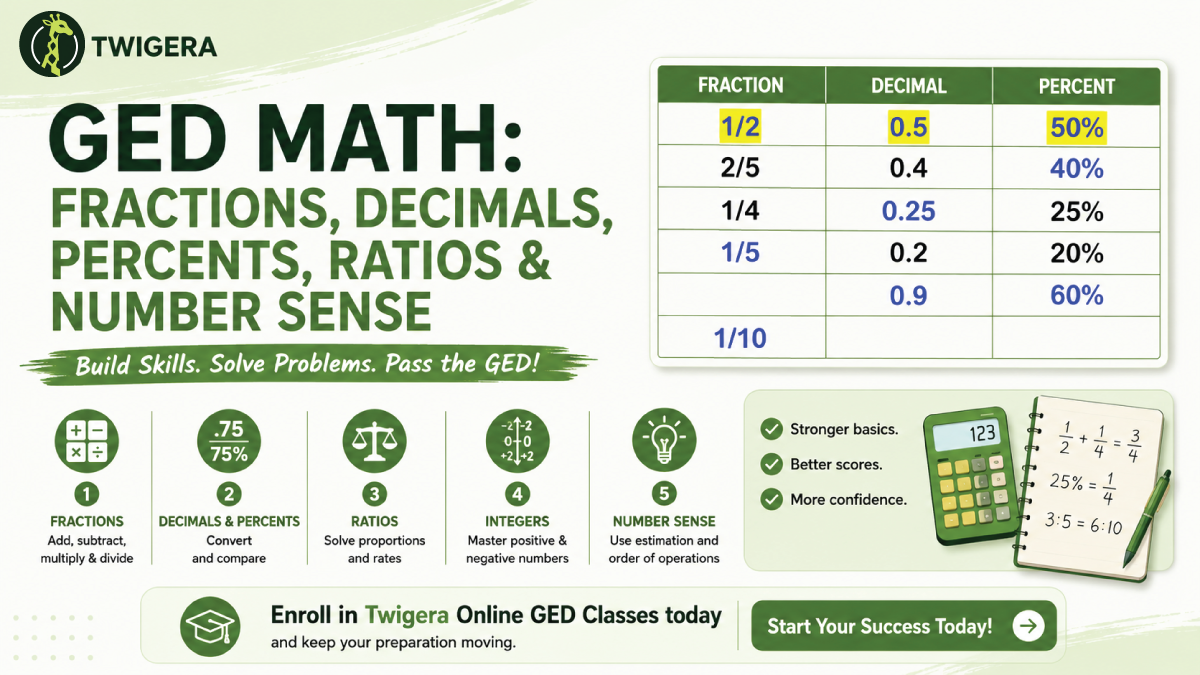
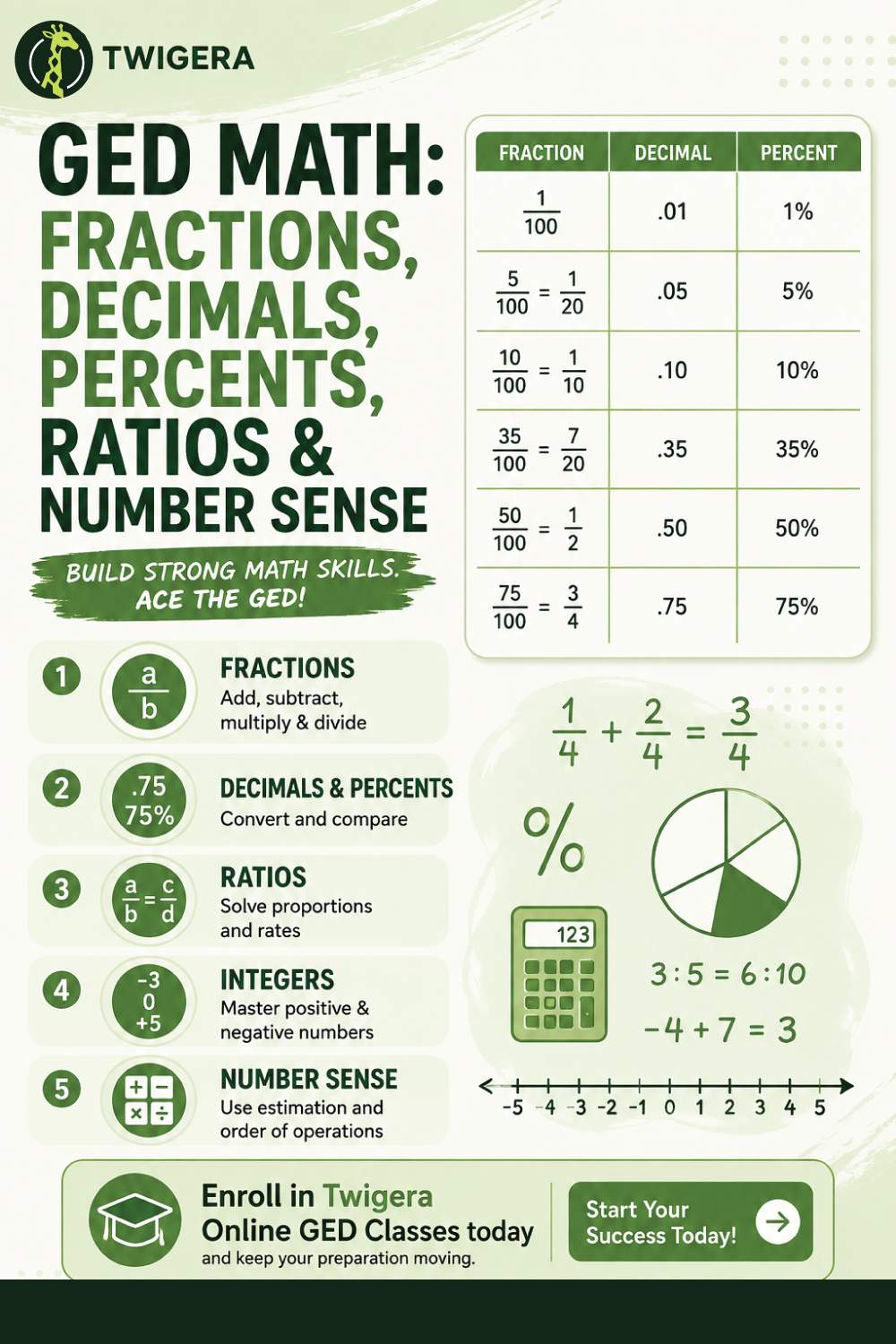
Three notations, one number. That is the whole idea, and the GED tests it constantly by handing you a mixed set and asking you to compare or order them.
Take 3/4. Divide to get a decimal: 3 ÷ 4 = 0.75. Multiply a decimal by 100 to get a percentage: 0.75 × 100 = 75%. Divide a percentage by 100 to get back to a decimal: 75 ÷ 100 = 0.75. So 3/4, 0.75 and 75% are the same quantity written three ways.
The rule that saves the most time: when a question mixes forms, convert everything to decimals first. Decimals are the only form you can compare by eye without a second calculation.
Arrange these from least to greatest: 0.42, 3/8, 45%, 7/16.
Now they line up: 0.375 < 0.42 < 0.4375 < 0.45, which means 3/8 < 0.42 < 7/16 < 45%.
Notice the trap. 0.42 has fewer digits than 0.4375 but is the smaller number, and 45% looks smaller than 7/16 until you convert it. Comparing digit counts instead of place value is the fastest way to get one of these wrong.
Different denominators have to be made the same before you can add or subtract. That is the only real rule, but mixed numbers add a second step that catches people out.
Calculate 7/12 − 5/18.
The least common denominator of 12 and 18 is 36. Convert both: 7/12 = 21/36 and 5/18 = 10/36. Subtract: 21/36 − 10/36 = 11/36.
A construction project needs 12 3/4 metres of cable. Workers have used 5 5/6 metres. How much remains?
Put the fractional parts over a common denominator of 12: 3/4 = 9/12 and 5/6 = 10/12. That gives 12 9/12 − 5 10/12.
You cannot take 10/12 from 9/12, so borrow one whole from the 12, which is 12/12: 11 21/12 − 5 10/12 = 6 11/12 metres.
The subtraction is not the hard part. Recognizing that the fractional parts need a common denominator, and then spotting that you have to borrow, is where the marks actually are.
Multiplication needs no common denominator, which makes it easier than addition — the opposite of what most people expect. Multiply straight across, but simplify first if you can, because it turns an ugly calculation into a short one.
Calculate 7/15 × 25/28.
Cancel across the fractions before multiplying. The 7 and 28 share a factor of 7, giving 1/4. The 25 and 15 share a factor of 5, giving 5/3. Now 1/4 × 5/3 = 5/12.
Multiplying first would give 175/420, which reduces to the same 5/12 — but only after you spot the common factor of 35. Cancelling early is less work and fewer places to slip.
Calculate 9/14 ÷ 27/35.
Division becomes multiplication by the flipped second fraction: 9/14 × 35/27. Now cancel — 9 and 27 give 1/3, and 35 and 14 give 5/2. So 1/3 × 5/2 = 5/6.
Flip the second fraction, never the first. Reversing that is the single most common division error, and it produces an answer that looks reasonable.
Percentage questions confuse people for one reason: they are unsure which number the percentage is measured against. That number is the base, and it is almost always the original or starting value.
A machine increases production from 1,250 units per day to 1,475. What is the percentage increase?
Find the change first: 1,475 − 1,250 = 225. Then divide by the original amount: 225 ÷ 1,250 = 0.18. Convert: 0.18 × 100 = 18%.
Dividing by 1,475 instead gives about 15.3% — wrong, but close enough to appear in the answer options. The base is the value you are measuring the change from, not the value you ended up with.
A computer costs $1,800. A retailer takes 15% off, then adds 7.5% sales tax to the discounted price. What is the final price?
Discount: 0.15 × 1,800 = 270
Price after discount: 1,800 − 270 = 1,530
Tax on the discounted price: 0.075 × 1,530 = 114.75
Final: 1,530 + 114.75 = $1,644.75
The order matters, and so does the base. Applying 7.5% to the original $1,800 gives $135 of tax instead of $114.75. Two percentage changes never combine into one — each is calculated on whatever the number is at that moment.
GED math ratios questions compare quantities. When the quantities have different units, the same comparison is called a rate.
A machine produces 2,340 components in 18 hours, so its rate is 2,340 ÷ 18 = 130 components per hour. Another produces 3,120 in 24 hours: 3,120 ÷ 24 = 130. Different totals, different times, identical rate — which is exactly the kind of comparison the GED likes to ask about.
A map uses a scale of 1.5 inches for every 12 miles. Two cities are 7.25 inches apart on the map. How far apart are they?
Set the ratios up in the same order on both sides: 1.5/12 = 7.25/x. Cross-multiply: 1.5x = 12 × 7.25 = 87. Divide: x = 58 miles.
Keeping the units in the same position on both sides is what makes this work. Inches over miles on the left means inches over miles on the right — flip one side and the answer is wrong by a factor you will not notice.
A school splits a budget between technology, supplies and activities in the ratio 5:3:2. The total is $48,000. How much goes to supplies?
Add the parts first: 5 + 3 + 2 = 10 shares. Each share is $48,000 ÷ 10 = $4,800. Supplies get 3 shares: 3 × $4,800 = $14,400.
Almost everyone who misses this divides by 3 or by 5 instead of by 10. A part-to-part ratio always needs the total number of parts before it can become an amount of money.
GED math integers questions arrive dressed as temperatures, elevations, account balances and inventory changes, as well as bare expressions. The content is easy; the sign errors are what cost points.
Adding a positive moves right on the number line; adding a negative moves left.
Subtracting a negative is the same as adding a positive.
Same signs multiply or divide to a positive result.
Different signs multiply or divide to a negative result.
Evaluate −18 + 27 − 14 + 9. Work strictly left to right: −18 + 27 = 9, then 9 − 14 = −5, then −5 + 9 = 4.
Evaluate (−6)(−4)(3). First (−6)(−4) = 24, because two negatives give a positive. Then 24 × 3 = 72.
A quick shortcut worth knowing: count the negative factors. An even count gives a positive result, an odd count gives a negative one. It lets you check a sign in a second without redoing the arithmetic.
Absolute value is the distance between a number and zero, so it is never negative. |−9| = 9 and |9| = 9. Distance does not care which direction you traveled.
The rule that matters on the GED: finish everything inside the bars before you remove them. Evaluate |−12 + 5| + |3 − 10|. Inside the first: −12 + 5 = −7. Inside the second: 3 − 10 = −7. Now apply the bars: |−7| + |−7| = 7 + 7 = 14.
Stripping the bars early turns this into −7 + −7 = −14, which is both wrong and the answer most likely to be offered. The bars are a grouping symbol first and a sign rule second. On the GED, absolute value usually appears in distance and difference questions — how far a temperature moved, how far an elevation is from sea level — where the direction genuinely does not matter.
An exponent is repeated multiplication: 4³ = 4 × 4 × 4 = 64. Two rules cover most of what the GED asks. When the bases match, multiplying means adding the exponents — 2⁴ × 2³ = 2⁷ = 128. Dividing means subtracting them — 5⁶ ÷ 5² = 5⁴.
Those rules only apply when the bases are the same. 2³ × 5² has no shortcut; you calculate each part and multiply.
Evaluate 36 ÷ [3(4 + 2)] + 5². Parentheses first: 4 + 2 = 6, then 3 × 6 = 18. The expression becomes 36 ÷ 18 + 25, so 2 + 25 = 27.
Evaluate 4[3² − 2(7 − 4)] + 6. Handle the exponent: 3² = 9. Innermost parentheses: 7 − 4 = 3, then 2 × 3 = 6. Inside the bracket: 9 − 6 = 3. Finally 4 × 3 + 6 = 18.
The sequence is the whole question. Starting with a multiplication or an addition before the brackets are resolved changes the answer, and every wrong option on a question like this is the result of one specific out-of-order step.
Number sense also means recognizing when an answer cannot be right. Before calculating 498 × 19.8, round: 500 × 20 = 10,000. The exact answer, 9,860.4, sits right where it should.
Now suppose your calculator showed 986.04. The estimate flags a misplaced decimal instantly, without you needing to know the exact answer. This habit is more valuable with a calculator than without one. A calculator confidently returns the result of whatever you typed, not what you meant. A five-second estimate before you trust the screen is one of the cheapest score improvements available, and it costs no extra knowledge at all. It also catches the two errors calculators cannot: a mistyped digit and an operation entered in the wrong order. The GED math cheat sheet collects the rest of these self-checking habits in one place.
Four questions mixing the skills above. Work each one before reading the solution — the point is deciding which method applies, which is exactly what the real test makes you do.
A store marks a $2,750 appliance down by 16%, then adds 6% tax to the discounted price. What is the final price?
Discount: 2,750 × 0.16 = 440
After discount: 2,750 − 440 = 2,310
Tax on 2,310: 2,310 × 0.06 = 138.60
Final: 2,310 + 138.60 = $2,448.60
Answer: $2,448.60 — and note the tax is calculated on $2,310, not on $2,750.
A recipe uses flour and sugar in a ratio of 7:3. The recipe needs 4.5 cups of sugar. How much flour?
Set up 7/3 = x/4.5, keeping flour on top on both sides. Cross-multiply: 3x = 7 × 4.5 = 31.5, so x = 10.5.
Answer: 10.5 cups of flour.
Evaluate −4[3 − 2(5 − 8)] + 7.
Innermost parentheses: 5 − 8 = −3. Then 2(−3) = −6. Inside the bracket: 3 − (−6) = 9, because subtracting a negative adds. Then −4(9) = −36, and −36 + 7 = −29.
Answer: −29. The step that decides this question is 3 − (−6) = 9. Reading it as 3 − 6 = −3 gives 19, which will be one of the options.
Arrange from least to greatest: 5/8, 0.59, 62%, 0.625.
Convert: 5/8 = 0.625 and 62% = 0.62. So the values are 0.625, 0.59, 0.62 and 0.625.
Answer: 0.59 < 62% < 5/8 = 0.625. Two of the four are the same number in different clothes, which is the point of the question — an ordering task will not always produce four distinct positions.
Do not spend a whole study session on one type of fraction problem. Blocked practice like that feels productive because your accuracy climbs, but the accuracy comes from knowing which method to use before you read the question. The real test never tells you.
Mix the skills so you have to choose. A useful rotation looks like this:
Compare fractions, decimals and percentages in mixed forms
Calculate a percentage increase or decrease
Solve a ratio or proportion
Work an expression with negative integers
Simplify a nested expression using order of operations
Solve a multi-step word problem involving percentages or proportions
Six problems drawn from six different skills is worth more than thirty of the same kind. When you miss one, write down the specific step that failed rather than the question number — "divided by the new value instead of the original" is something you can fix, while "got question 3 wrong" is not. Then apply the same skills under time pressure in the free GED math practice test.