

GED Math Algebra 2026: Equations & Word Problems
Algebraic problem solving is roughly 55 percent of the GED math test — the majority, not a section. This lesson gives you one reusable method for linear equations, word problems, and systems, with every step worked.

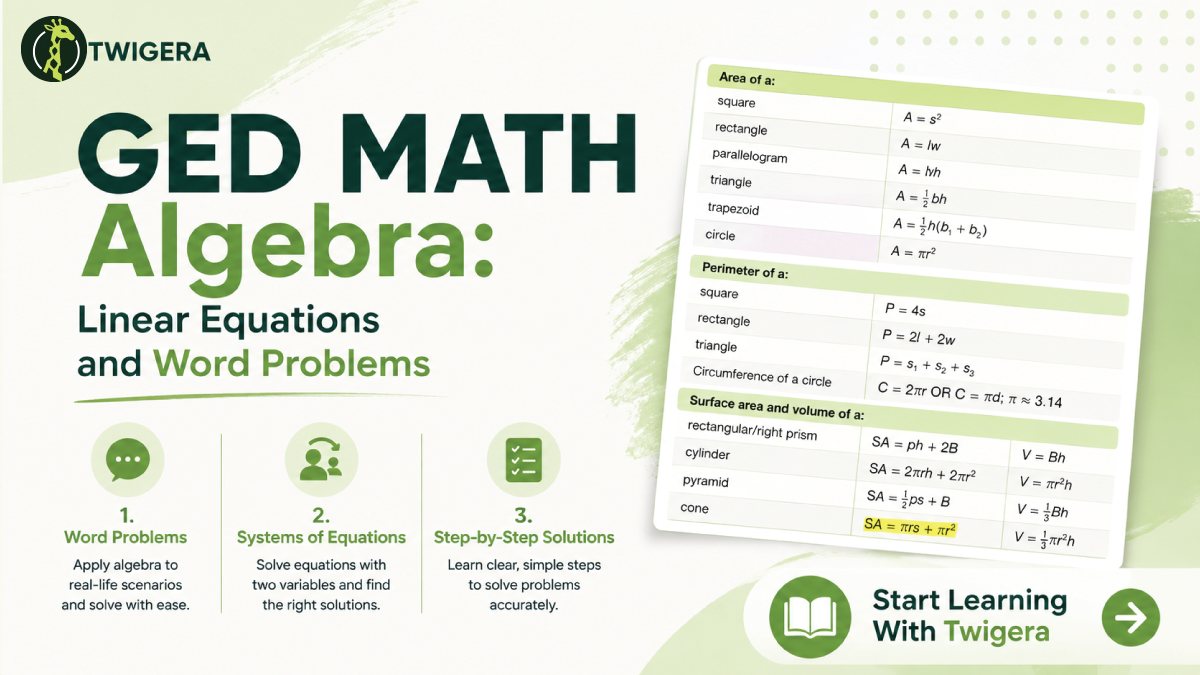
GED math algebra covers one-variable linear equations, inequalities, writing equations from real-world context, and systems of two simultaneous linear equations. Roughly 55 percent of the Mathematical Reasoning test is algebraic problem solving. The reliable method is three steps: translate the situation into an equation, solve by doing the same operation to both sides, then check that your answer addresses what was asked.
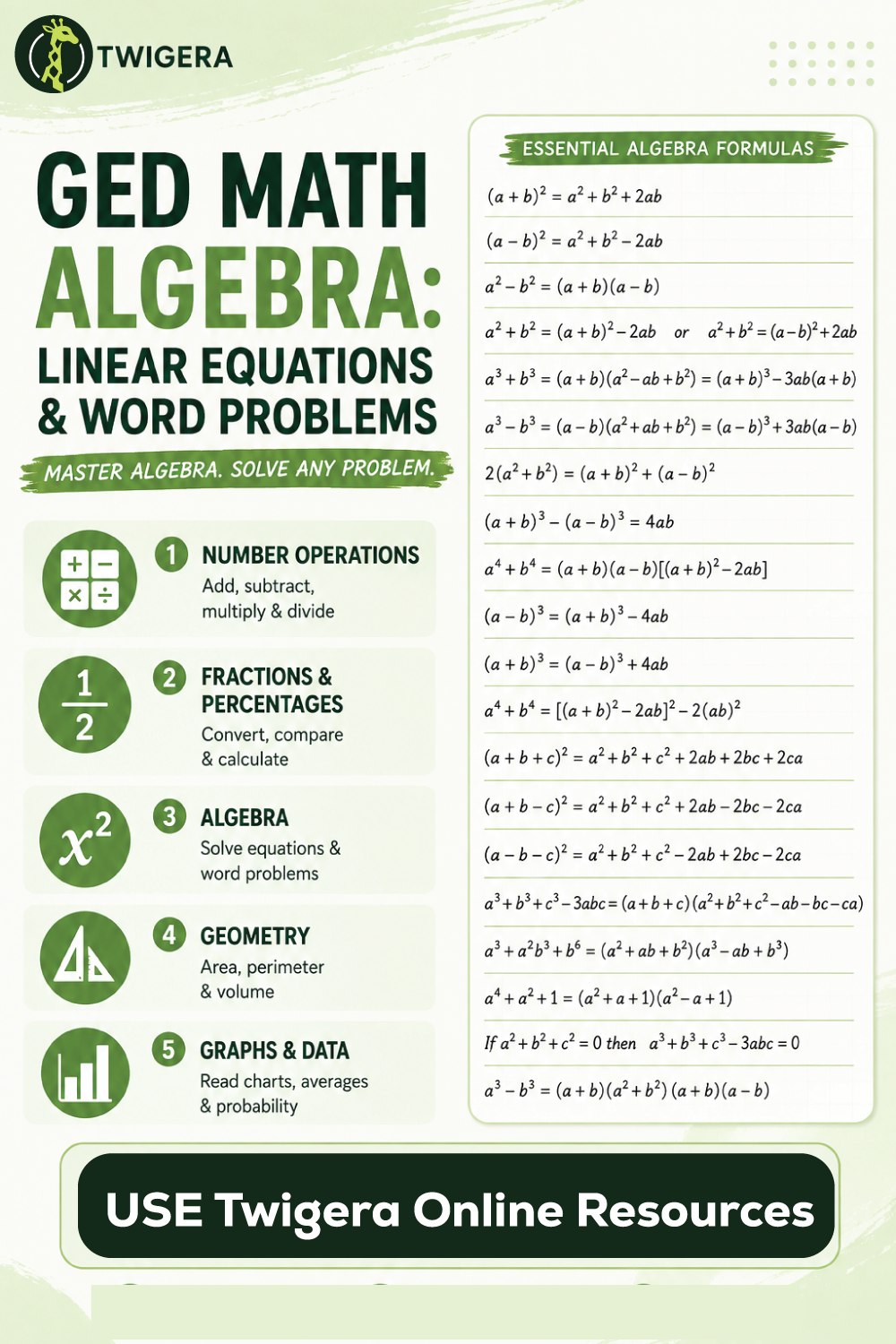
Pin this guide so you can find it again.
We refresh these every season. Save it to a Pinterest board and you’ll get the latest version next time you come back.
Save to PinterestQuestions people ask.
- What GED math algebra topics are tested?
The GED assessment targets cover solving one-variable linear equations with rational coefficients, solving real-world problems involving linear equations, writing one-variable and multi-variable equations to represent context, solving systems of two simultaneous linear equations, linear inequalities, and quadratic equations in one variable. Algebra sits inside the Mathematical Reasoning test alongside quantitative problem solving.
- How much of the GED math test is algebra?
Approximately 55 percent. GED Testing Service specifies that about 45 percent of the Mathematical Reasoning test focuses on quantitative problem solving and about 55 percent emphasizes algebraic problem solving. Algebra is the majority of the test, not a section of it, which is why it repays study time more than any other math topic.
- How do you solve GED math linear equations?
Isolate the variable using inverse operations, applying the same operation to both sides so the equation stays balanced. For 2x + 1 = 9, subtract 1 from both sides to get 2x = 8, then divide both sides by 2 to get x = 4. Substitute your answer back into the original equation to confirm it works.
- How do you set up GED math word problems?
Identify the unknown and give it a letter, separate the numbers that matter from the ones that do not, work out how the quantities relate, then write the equation that states that relationship. A gym charging a $20 fee plus $15 monthly with a $95 total becomes 20 + 15m = 95, which solves to m = 5 months.
- Are GED systems of equations on the test?
Yes. Assessment target A.2.d requires solving a system of two simultaneous linear equations by graphing, substitution, or linear combination, and solving real-world problems that lead to a system. These usually appear as two-quantity scenarios — two ticket types, two pricing plans — where you need both a count equation and a total equation.
- Do I need to memorize algebra formulas for the GED?
No. GED Testing Service provides a Mathematics Formula Sheet on screen throughout the Mathematical Reasoning test, covering slope, slope-intercept form, the quadratic formula, and more. Study time is better spent on translating situations into equations and on the inverse operations that isolate a variable, because the sheet does neither for you.
- What is the most common mistake on GED algebra questions?
Solving for the variable and stopping there. You find m = 6 miles, but the question asked for the fare at 6 miles, which is 4 + 2.50(6) = $19. The variable is often an intermediate step rather than the answer. Reread the final sentence before you select an option.
- Can I use a calculator on GED algebra questions?
On most of them. The Mathematical Reasoning test provides an on-screen TI-30XS MultiView scientific calculator for the calculator-permitted items, and you may bring your own handheld TI-30XS to a test center. A short first section allows no calculator, so the arithmetic in those items is kept simple by design.
Amara is the editor at Twigera. She came to publishing the long way — a decade teaching the GED in community colleges and adult-learning centers, where she watched students pass not on talent or time, but on the strength of a study plan they actually trusted. Now she shapes the guides students read here for the parent studying after a closing shift, the second-career welder, the grandmother finishing what she started forty years ago. Expect honest timelines, math made survivable, and study plans built around real life — not around a textbook's idea of one.
Take the next step — start today.
Our online GED course includes every subject, a free 30-minute diagnostic, and a 7-day refund on every plan.