Phlebotomy Without a GED 2026: What Schools Accept
A few programs will enroll you without a diploma. Not one certifying body will certify you without one — and 96 percent of employers require or encourage certification. Getting into a class and getting hired are different problems.

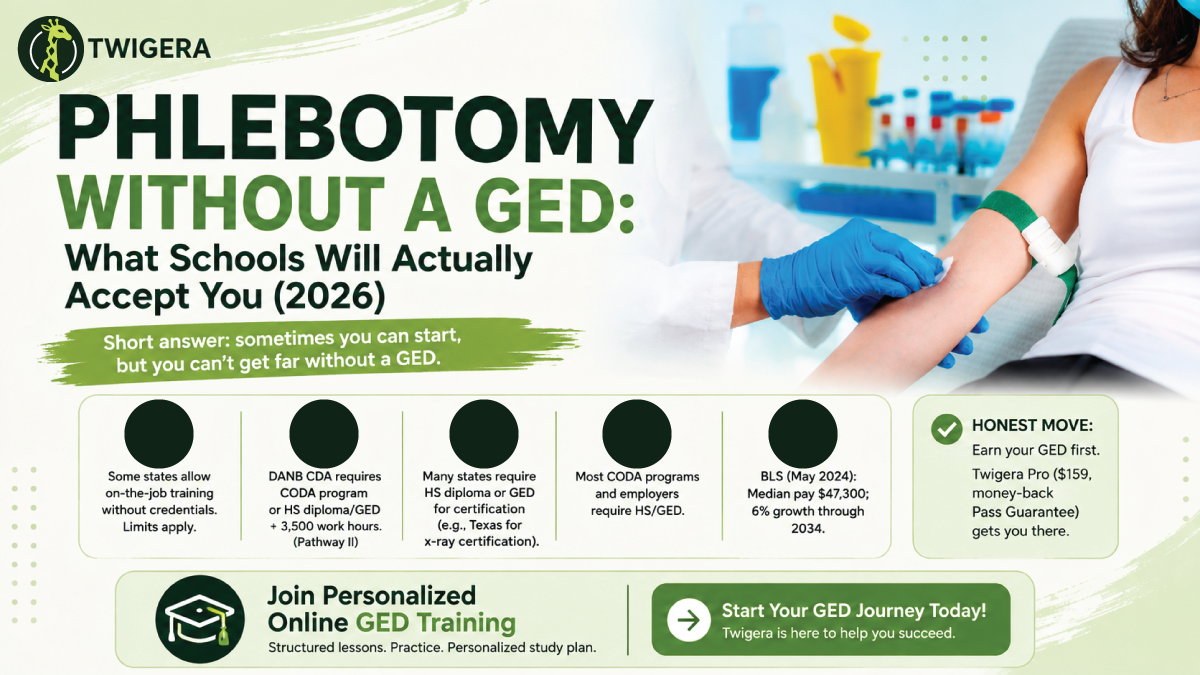
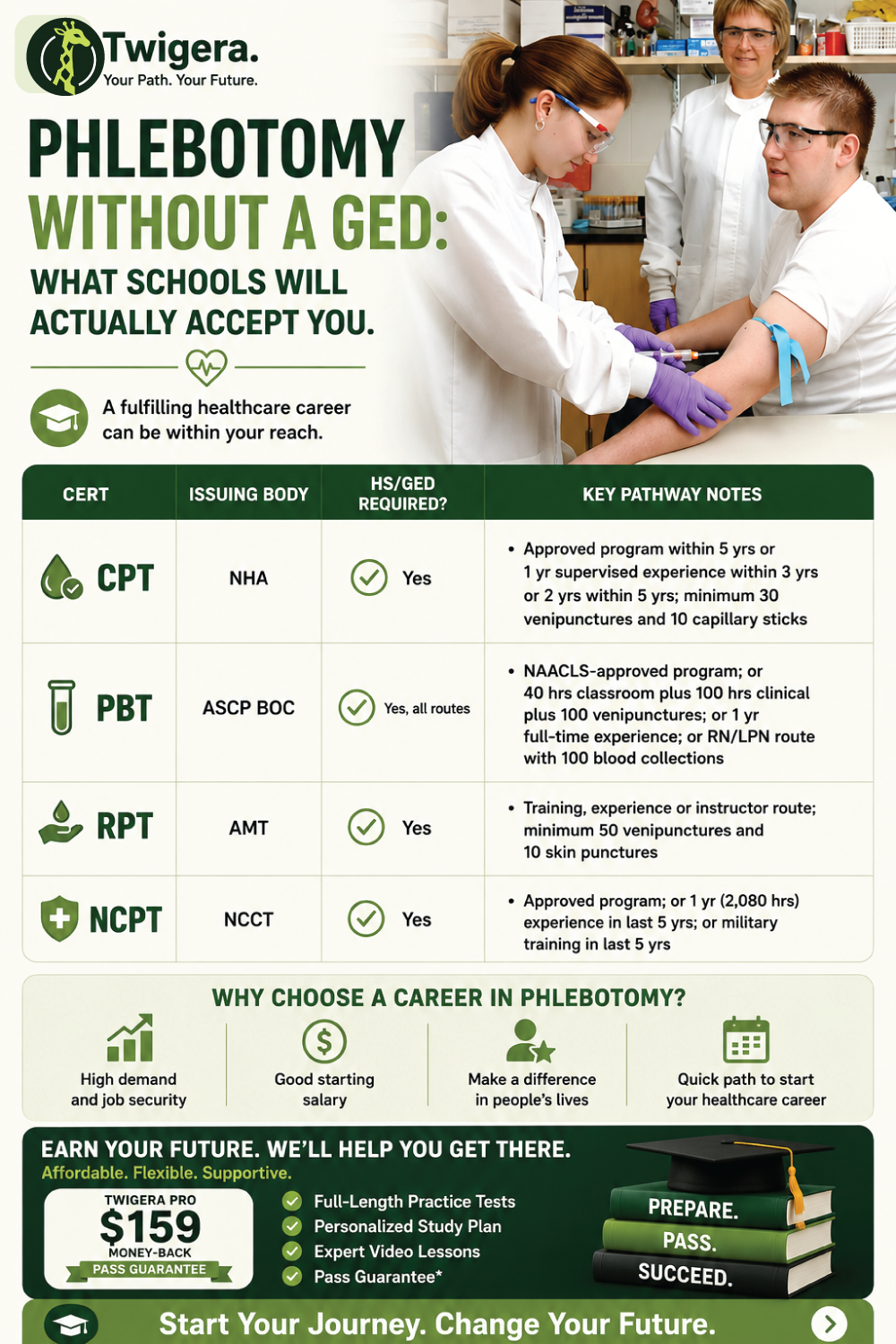
Sometimes you can enroll, but you cannot get certified. A few programs admit students without a diploma through a parent waiver or the federal Ability-to-Benefit pathway. Every national certifying body — NHA, ASCP, AMT and NCCT — requires a high school diploma or GED, and California writes the requirement into its CPT1 license. With 96 percent of employers requiring or encouraging certification, training you cannot certify from is a dead end.
Pin this guide so you can find it again.
We refresh these every season. Save it to a Pinterest board and you’ll get the latest version next time you come back.
Save to PinterestQuestions people ask.
- Can you take phlebotomy classes without a GED?
Sometimes. Most schools require a diploma or GED, but some private programs admit current high school students with a parent waiver, and the federal Ability-to-Benefit pathway lets adults enroll at Title IV-eligible colleges. Neither exception changes the certification rules, so enrollment is a head start rather than a route around the credential.
- Do you need a GED to be a phlebotomist?
For certification and employment, yes. NHA, ASCP BOC, AMT and NCCT all require a high school diploma or equivalent, and ASCP applies it to every one of its eligibility routes. California additionally requires it for the CPT1 state license. A GED is accepted as the equivalent everywhere a diploma is asked for.
- What are the phlebotomy certification requirements?
A diploma or GED, plus approved training or documented work experience, plus a minimum number of live blood draws. NHA requires 30 venipunctures and 10 capillary sticks; AMT requires 50 venipunctures and 10 capillary punctures; ASCP Route 2 requires 40 classroom hours, 100 clinical hours and 100 venipunctures.
- What makes California different for phlebotomy?
California licenses phlebotomists directly. The Certified Phlebotomy Technician I license from CDPH Laboratory Field Services requires a diploma or GED, 40 hours of approved classroom instruction, 40 hours of clinical practice including at least 50 venipunctures and 10 skin punctures, and a CDPH-approved national certification exam.
- What is the Ability-to-Benefit pathway?
A federal route that lets adults without a high school credential access Title IV aid, including Pell Grants, at qualifying institutions — by passing an approved ATB test or completing at least six college credit hours. It unlocks funding and enrollment. It does not satisfy any certifying body’s education requirement.
- How long does phlebotomy training take?
Typically 4 to 16 weeks depending on format. Online programs commonly run 4 to 6 weeks, private and vocational schools 4 to 8 weeks, and community college programs 12 to 16 weeks. These are market norms rather than a standardised requirement, so confirm the schedule with the specific program.
- How much does phlebotomy training cost?
Tuition commonly runs $500 to $2,500, the certification exam $110 to $200, and supplies $50 to $200 — roughly $660 to $2,900 all in. Get written figures from the specific program. Title IV-eligible schools accept FAFSA, and the maximum Pell Grant is $7,395 for the 2026–27 award year.
- How much do phlebotomists make?
The U.S. Bureau of Labor Statistics reports a median annual wage of $43,660 as of May 2024, about $20.99 an hour. Employment is projected to grow 6 percent from 2024 to 2034, faster than average, with roughly 18,400 openings each year over the decade.
- Is phlebotomy a good stepping stone to other healthcare jobs?
Yes. It is one of the shortest credentialed routes into a clinical setting, and the patient-contact and specimen-handling experience transfers directly into medical assisting, clinical laboratory technology, and nursing. Each of those pays more, and each also requires the same diploma or GED at its own entry point.
Check the rules where you test.
Fees, minimum age and online-testing availability are set by each state, not nationally. These hubs carry the current details for the state covered in this guide.
Amara is the editor at Twigera. She came to publishing the long way — a decade teaching the GED in community colleges and adult-learning centers, where she watched students pass not on talent or time, but on the strength of a study plan they actually trusted. Now she shapes the guides students read here for the parent studying after a closing shift, the second-career welder, the grandmother finishing what she started forty years ago. Expect honest timelines, math made survivable, and study plans built around real life — not around a textbook's idea of one.
Take the next step — start today.
Our online GED course includes every subject, a free 30-minute diagnostic, and a 7-day refund on every plan.