Can You Be a Medical Assistant Without a GED? Honest Answer
Most states don't license medical assistants — but accredited MA programs and the CMA, RMA, and CCMA certifications all require a high school diploma or GED. Here is the honest 2026 path, plus BLS pay and outlook data.
Usually no. Most states do not legally require a GED to work as a medical assistant, but the real barrier comes later: accredited MA programs and the CMA, RMA, and CCMA certifications all require a high school diploma or GED. Earn your GED first, then train and certify — the field pays a $44,200 median with 12% projected growth.
Last reviewed
There is a myth that you can become a medical assistant without a GED — skip the credential and get certified anyway. People hear it online, then assume a healthcare career can start without finishing high school first. The appeal makes sense — you want stable work, decent pay, and a faster route into healthcare. Then reality hits when schools, employers, and certification programs start asking about education requirements.
Medical assisting keeps growing. The U.S. Bureau of Labor Statistics projects medical assistant jobs will grow 12 percent between 2024 and 2034, with about 112,300 openings every year. So where does that leave someone trying to become a medical assistant without a GED standing in the way? This guide gives the honest 2026 answer.
Do Medical Assistants Even Need a License or Certification?
Technically sometimes; practically, no — but that is not the same as "no GED needed." First, no state law in 49 states requires a GED to work as an MA. Washington is the only state that requires medical assistants to hold a state credential for clinical duties. That is the good news. The bad news is that the state is not the wall. The wall is three other things:
Accredited MA programs require a high school diploma or GED to enroll.
All three major certifications — CMA, RMA, and CCMA — require a diploma or GED, either directly or through an accredited program that itself requires one.
Most employers require certification even where no state law does.
One narrow exception exists: a few private schools admit students without a diploma through an entrance exam. But that path costs you federal financial aid and still leaves the certification wall waiting on the other side. This is a different situation from CNA work — if you are weighing both, read our guide on becoming a CNA without a GED, where the state-level rules work differently.
The License Question Is Almost a Non-Issue
Washington is the only state that requires medical assistants to hold a license or formal credential to perform clinical duties, through its Department of Health. Everywhere else, there is no state law requiring an MA to be licensed at all. A couple of states carve out narrower rules — New Jersey and South Dakota require certification specifically before an MA can give injections, which is a task-level requirement rather than a blanket licensing law. Outside those situations, no state license stands between you and working as an MA.
Save for later
Pin this guide so you can find it again.
We refresh these every season. Save it to a Pinterest board and you’ll get the latest version next time you come back.
Certification is not legally mandated in most states, but most employers treat it as mandatory anyway, since it signals a verified skill level they do not have to take on faith. An uncertified MA is not barred by law in most places — they are just boxed out of most job postings. There is also a practical ceiling: certain clinical and documentation tasks are reserved for credentialed staff in many practice settings, which means an uncertified MA often ends up doing less, and earning less. No license required is not the same as no GED needed, and the certification you will practically need to get hired absolutely does require a high school diploma or GED.
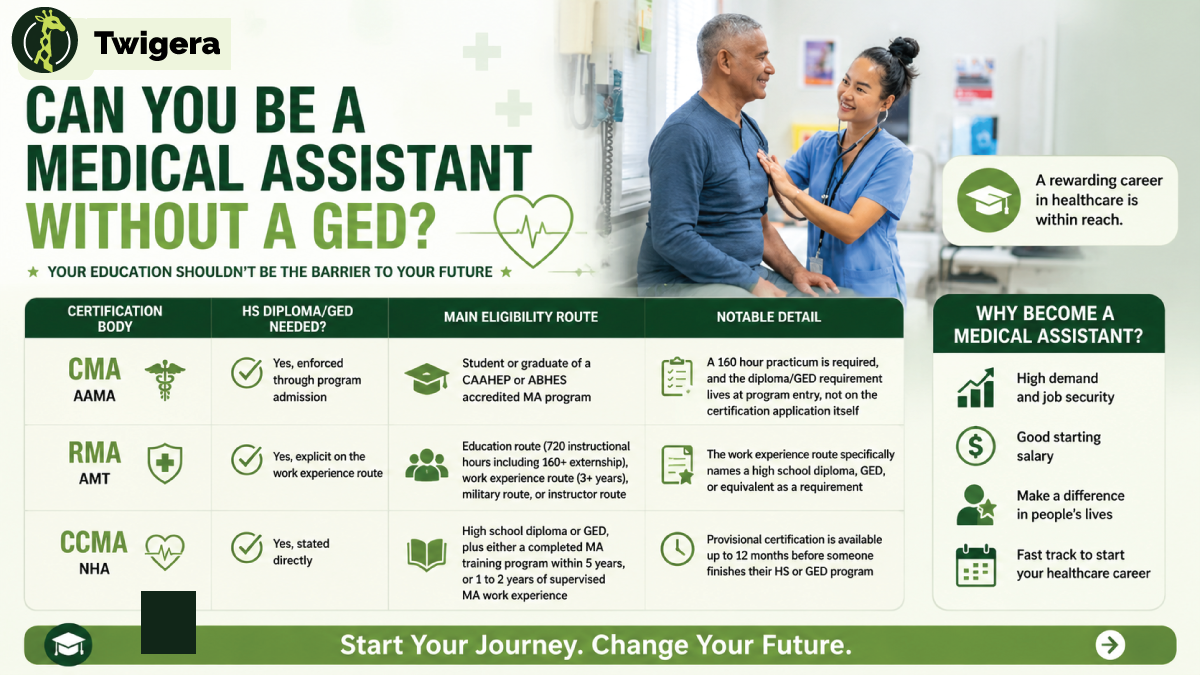
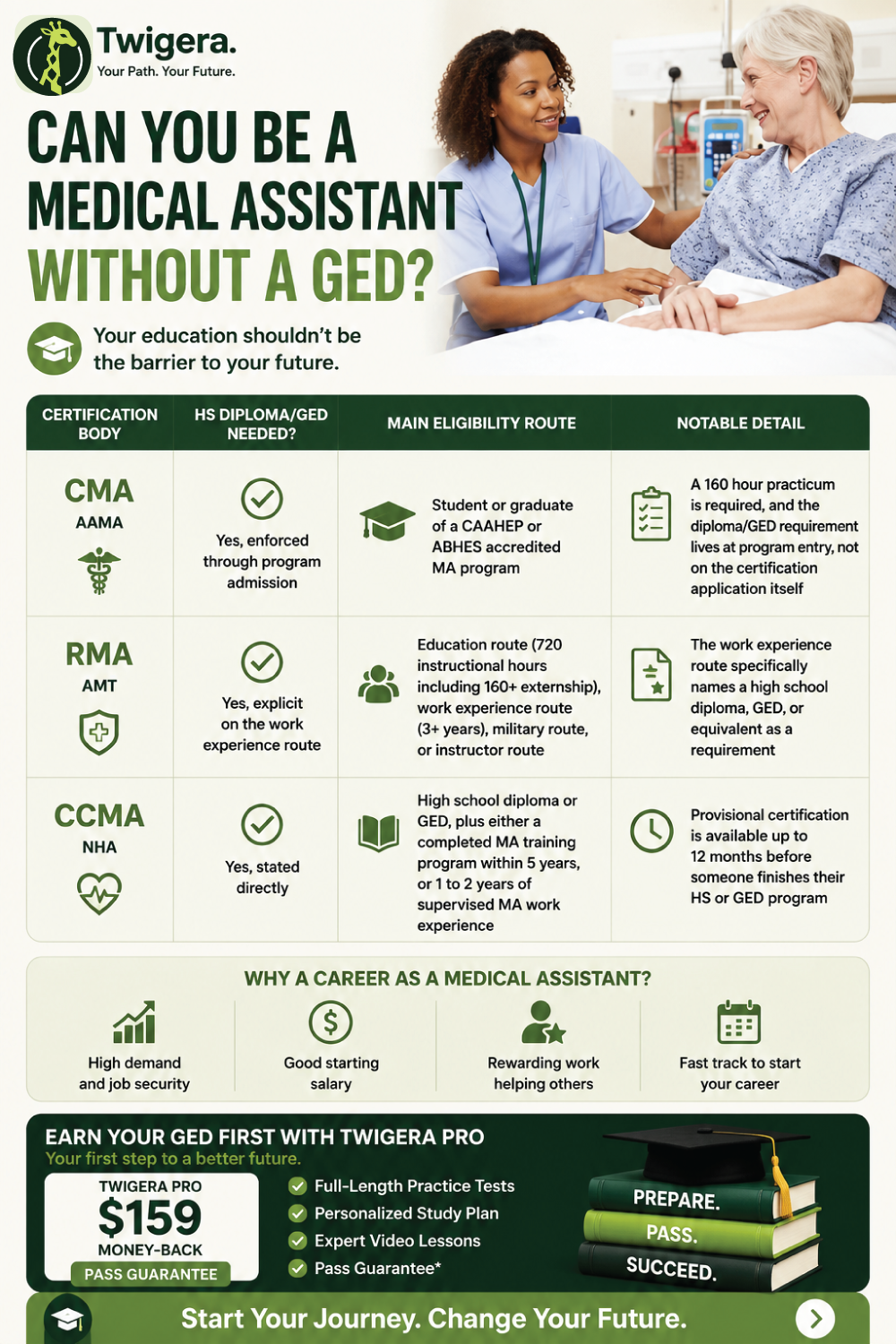
The Three Major MA Certifications and Their Diploma/GED Requirements
Certification
Body
Diploma/GED needed?
Main eligibility route
CMA
AAMA
Yes — enforced through program admission
Student or graduate of a CAAHEP- or ABHES-accredited MA program (160-hour practicum required)
RMA
AMT
Yes — explicit on the work-experience route
Education route (720 hours incl. 160+ externship), 3+ years work experience, military, or instructor route
CCMA
NHA
Yes — stated directly
Diploma or GED, plus a completed MA program within 5 years or 1-2 years supervised experience
The CMA route looks like it skips the diploma question, since AAMA talks about accredited programs, not a standalone diploma line. Do not be fooled — every CAAHEP- and ABHES-accredited program requires a diploma or GED to enroll, so the requirement just moves one step earlier.
— Twigera editorial
The "Without a Diploma" Loophole, and Its Two Dead Ends
Some private MA schools will admit a student without a high school diploma or GED, usually through an entrance exam such as an Ability to Benefit test instead of a transcript. That sounds like a real workaround. It is not, not cleanly — and here is why.
Dead end one: financial aid gets complicated. Federal aid generally requires a diploma, a GED, or a documented path around that requirement. Without one, a student must enroll in an Eligible Career Pathway Program and either pass an approved Ability to Benefit test or complete six college credit hours before federal aid becomes available, according to Federal Student Aid. Most students end up paying meaningfully more out of pocket while they work through that extra layer.
Dead end two: the certification wall is still waiting. Finishing a no-diploma training program does not make the CMA, RMA, or CCMA requirements disappear — every one of them still circles back to a diploma, a GED, or an accredited program that demanded one. The honest verdict: this loophole costs more, takes longer to sort out financially, and still ends at the same wall. Earning the GED first is the cheaper, faster, more direct route.
The Honest Path: Earn Your GED, Then Become an MA
Earn your GED. This credential unlocks everything else — financial aid, accredited program admission, and all three certifications. Most people complete focused GED prep in one to six months, and it is the cheapest step on the whole path.
Enroll in an accredited MA program. With a GED in hand, a CAAHEP- or ABHES-accredited program becomes available, along with federal aid through the standard Pell process. Programs run from about four months (accelerated certificate) to two years (associate degree).
Complete the practicum or externship. Hands-on clinical experience is built into every accredited path, typically 160 hours or more. Programs usually place students directly with a partner clinic or hospital.
Sit a certification exam. CMA, RMA, or CCMA — which one depends on the program you completed and the route you qualify under. Passing unlocks the credentialed hiring pool most employers screen for.
Get hired as a certified MA. The payoff stage, where the GED, the program, and the certification come together into a paycheck. Certified MAs tend to get first consideration for open roles.
Step one is the only one entirely in your control today. Math and reading are where most adults need the most work — a free GED diagnostic test shows exactly where you stand before you spend a dollar, and our how long it takes to get a GED guide sets realistic expectations for your timeline.
Medical Assistant Pay and Outlook: Why the GED Is Worth It
Median annual wage sits at $44,200, with the lowest 10% earning under $35,020 and the highest 10% over $57,830 (BLS).
Job growth is projected at 12% from 2024 to 2034, well ahead of the average for all occupations.
About 112,300 openings are projected each year over that decade.
The BLS Occupational Outlook Handbook itself lists a high school diploma or its equivalent as the typical entry-level education for this role. That is not a hurdle this guide invented — it is the literal baseline the federal government uses to describe the career. If you are budgeting the path, our how much the GED costs guide breaks down the fees.
Medical Assistant vs CNA: Which Has the Easier No-GED Path?
These two roles get confused constantly, and the confusion runs in a surprising direction. CNA work runs through state certification, with a federal training floor of at least 75 hours, and several states do not require a GED at the state level for CNA certification specifically. Medical assistant work runs the opposite way: there is barely any state licensing, but the accredited programs, the major certifications, and most employers all expect a diploma or GED regardless.
Either direction benefits from having the GED in hand, since it widens options across both roles rather than locking you into one.
How Twigera Helps You Clear the GED Gate
Every path into medical assisting starts with the same first step: the GED. It is the credential that gets you through the door before training even begins, so it is worth clearing efficiently rather than dragging it out. Twigera was built to move people through this step without wasted time on material they have already mastered. Four GED subjects sit inside one course at one price — no buying separate classes or piecing together resources from different places.
You study on your own schedule, whether that is 6 a.m. before a shift or midnight after the house goes quiet. The platform pairs structured video lessons with a large bank of adaptive practice questions modeled on the real GED, so each session builds on the last instead of leaving you guessing what to study next. If math or reading is your weak spot, the diagnostic flags it early — the Pro plan even adds a Pass Guarantee for learners who want extra certainty before exam day. The point is simple: clear the GED gate cleanly, and every accredited program and certification on the MA path opens up behind it.
Bottom Line
Medical assistant work is one of the rare healthcare roles that almost never requires a state license — but do not mistake that for an easy path without a diploma or GED. Every accredited training program, all three major certifications, and most employers still expect that credential, which means the real gate sits well beyond anything a state government controls. The faster, cheaper, more direct route starts with the GED itself, then moves through an accredited program straight into a $44,200-median, 12%-growth career.
Frequently asked
Questions people ask.
Can you be a medical assistant without a GED?
ShowHide
Technically yes, but rarely in practice. No state law blocks you, except licensing rules in Washington. The problem is that accredited programs and the major certifications require a high school diploma or GED. A few private schools accept entrance exams, but certification barriers remain.
Do you need a GED or high school diploma to be a medical assistant?
ShowHide
Yes, in almost every case. The U.S. Bureau of Labor Statistics lists a high school diploma or equivalent as the standard entry requirement, and training programs and certification bodies use the same baseline.
Do medical assistants need a license?
ShowHide
Usually no. Forty-nine states do not require licensing. Washington requires credentialing for clinical duties, while New Jersey and South Dakota require certification specifically for injections. Most employers still prefer certified candidates.
Can you get medical assistant certification without a diploma?
ShowHide
No. The major certifications from the American Association of Medical Assistants (CMA), American Medical Technologists (RMA), and the National Healthcareer Association (CCMA) all require a diploma, GED, or completion of an accredited program that itself required one.
Can you take medical assistant classes without a GED?
ShowHide
Sometimes. Some private schools admit students through Ability to Benefit exams such as ACCUPLACER. The catch is that you lose access to federal financial aid and still need a GED later for certification.
What is the difference between CMA, RMA, and CCMA?
ShowHide
CMA (AAMA) has stricter accredited-program requirements. RMA (AMT) offers more pathways, including work experience and military service. CCMA (NHA) requires a diploma or GED plus training or supervised work experience. All three are nationally recognized.
Is a medical assistant the same as a CNA?
ShowHide
No. A CNA follows state certification rules and a federal training floor, often with fewer education barriers. Medical assistant roles usually require a GED or diploma because accredited programs and certification bodies expect one.
How much do medical assistants make?
ShowHide
The median annual wage was $44,200 in 2024, according to the U.S. Bureau of Labor Statistics. Top earners make over $57,830, and certified medical assistants often earn more than non-certified workers.
How long does it take to become a medical assistant?
ShowHide
Training programs range from about four months to two years. If you need a GED first, add one to six months. Most people complete the full path in under eighteen months.
Can a 17-year-old be a medical assistant?
ShowHide
Usually no. Most schools, certification programs, and employers expect applicants to be 18 and hold a diploma or GED. Some programs accept 17-year-olds who are close to graduation.
Amara is the editor at Twigera. She came to publishing the long way — a decade teaching the GED in community colleges and adult-learning centers, where she watched students pass not on talent or time, but on the strength of a study plan they actually trusted. Now she shapes the guides students read here for the parent studying after a closing shift, the second-career welder, the grandmother finishing what she started forty years ago. Expect honest timelines, math made survivable, and study plans built around real life — not around a textbook's idea of one.
Enjoyed this?
Take the next step — start today.
Our online GED course includes every subject, a free 30-minute diagnostic, and a 7-day refund on every plan.