Starbucks College Achievement Plan: Get Your GED First
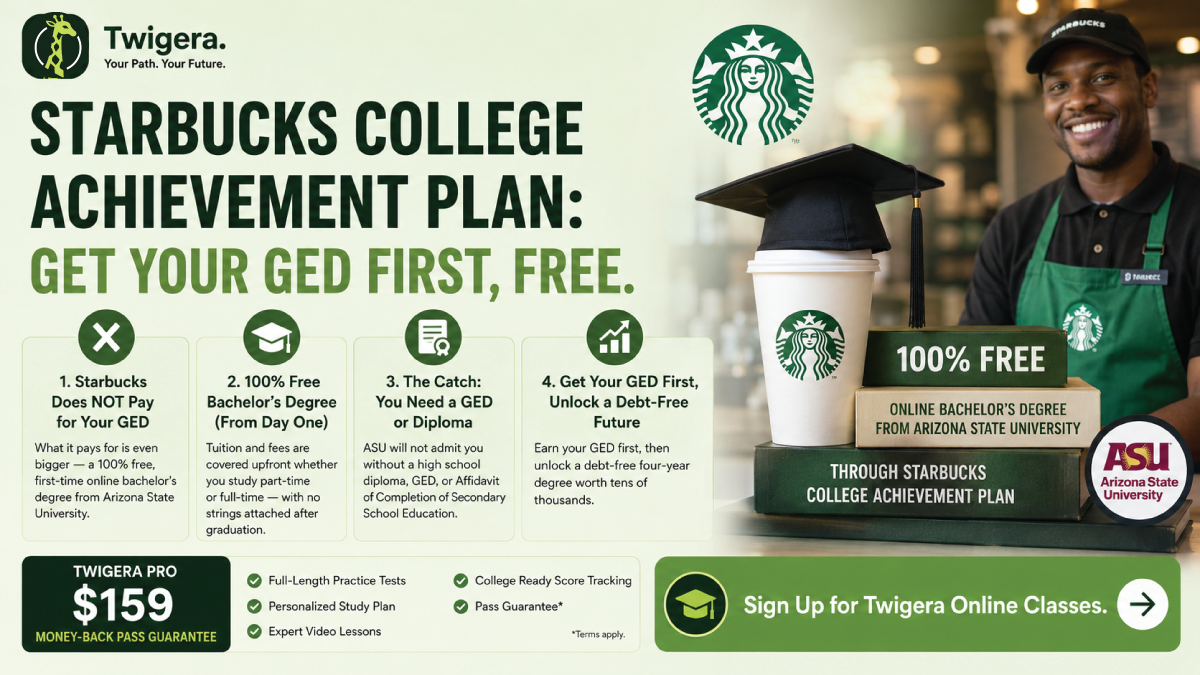
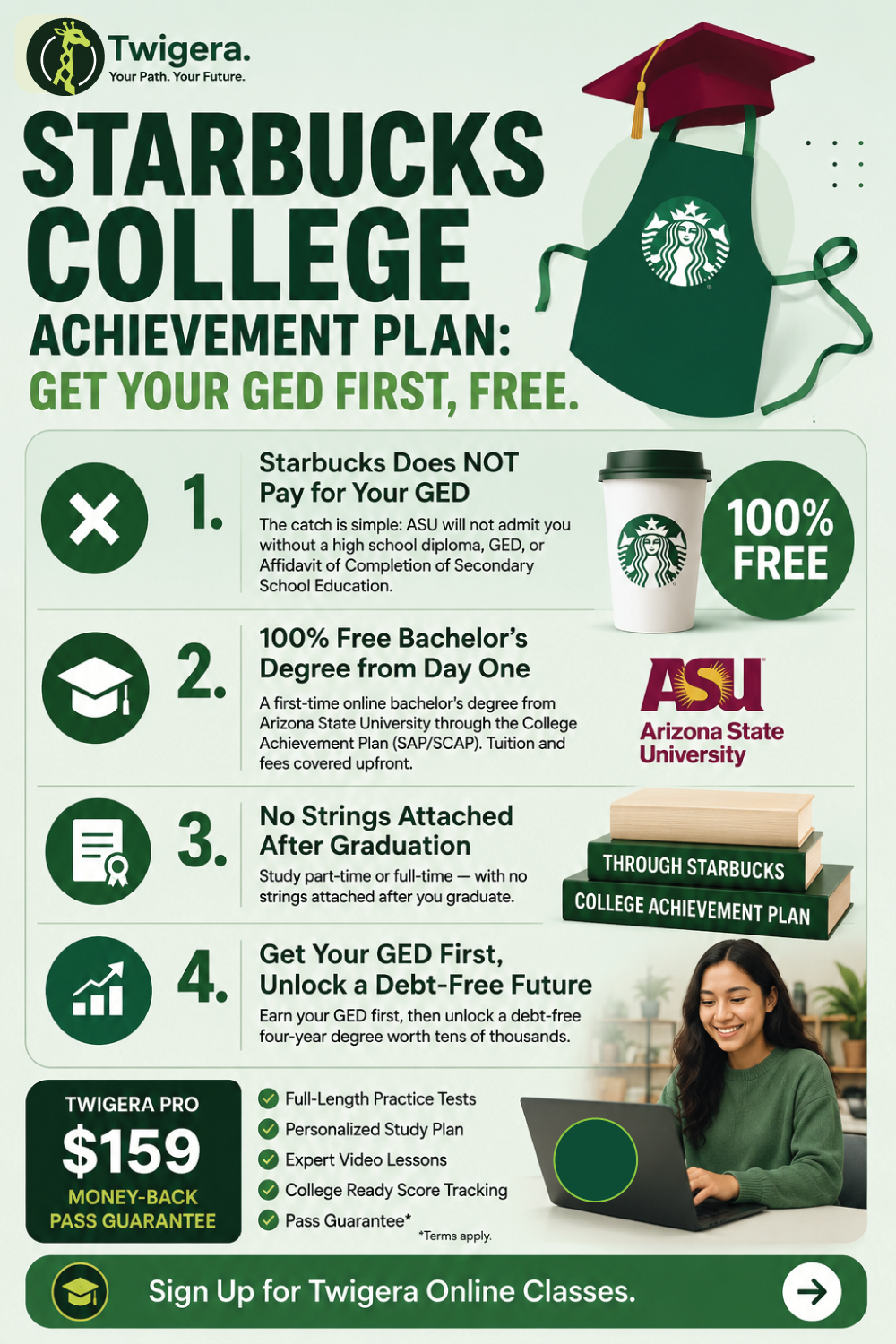
Starbucks does not pay for your GED — it pays for a 100% free ASU bachelor's degree. But ASU needs a high school diploma or GED to enroll, so the GED is step one. Here is how the benefit works and the order of operations to unlock it.
Starbucks does not pay for your GED — it pays for something bigger: a 100% free, first-time online bachelor's degree from Arizona State University through the College Achievement Plan, with tuition and fees covered upfront for part-time and full-time partners from day one. The catch: ASU will not admit you without a high school diploma or GED. So earn your GED first, then unlock a debt-free degree worth tens of thousands.
Last reviewed
There is a misconception that Starbucks pays for your GED, and it stops a lot of people before they even check the details. According to recent U.S. Census data, around 6% of employed adults do not hold a high school diploma or equivalent — and many work retail jobs just like this one. If you are in that group, the good news is bigger than a GED reimbursement: Starbucks offers a fully funded bachelor's degree through Arizona State University. The catch is simple — ASU requires a high school diploma or GED before you can enroll, no exceptions. So the GED is the real starting point, not the finish line.
Does Starbucks Pay for Your GED?
The short answer is no — Starbucks does not pay for your GED, and this is where many people get confused. A lot of articles lump every education benefit together, creating the false impression that Starbucks covers everything from high school completion to college. That is not how it works. Starbucks pays for college: specifically, a first-time bachelor's degree through its partnership with Arizona State University. This is the opposite of an employer like Amazon Career Choice, which funds the GED itself directly — Starbucks funds what comes after the GED.
What the Starbucks College Achievement Plan Actually Is
The Starbucks College Achievement Plan (SCAP, sometimes written SAP) is an employer benefit that pays for a first-time bachelor's degree, completed fully online through Arizona State University. Starbucks does not reimburse you after the fact — it pays ASU directly, so your tuition bill lands at zero before the semester starts. The coverage comes from three layers stacked together: a CAP scholarship that covers a large share of ASU Online tuition automatically; federal aid through FAFSA, including Pell Grants worth up to $7,395 for eligible students; and the Starbucks tuition benefit, which covers whatever is left. Outside scholarships do not shrink the benefit — if you win a $1,000 scholarship elsewhere, that money is yours on top, not instead.
Starbucks SCAP pays for
You bring or pay for
100% of tuition and required fees, upfront
A high school diploma or GED to enroll
First-time bachelor's degree, ASU Online
Books, laptop, and living costs
Up to 135 credit hours toward your degree
FAFSA completion every year enrolled
150+ undergraduate programs to choose from
Maintaining your weekly hours at Starbucks
That 135-credit cap matters more than it sounds: a standard ASU bachelor's runs 120 credits, so the extra 15 give you breathing room to switch majors, retake a course, or withdraw once without burning through your benefit early. And ASU Online is not a watered-down option — it is the same university, same faculty, and same accreditation as the Tempe campus, and your diploma will not say "online" anywhere on it. You earn a real ASU degree, funded entirely through SCAP.
The Catch Nobody Tells You: You Need a GED First
Most articles about this benefit skip the locked door standing in front of it. ASU has one non-negotiable admission requirement: a high school diploma, a GED, or an Affidavit of Completion of Secondary School Education. That is ASU's own admission policy, not a Starbucks rule. No diploma and no GED means no admission — and no admission means no SCAP. The free degree simply does not open for you yet.
The good news inside that bad news: a GED works exactly as well as a high school diploma here — ASU treats them as equal for admission. You do not need to go back to high school or spend years catching up. A GED, earned in a matter of months for most people, satisfies the same requirement. And Starbucks' Pathway to Admission program (up to 10 ASU courses for partners who do not meet standard admission criteria) is not a loophole around this: converting those credits into real degree progress still requires the diploma or GED. The gate does not move. If you do not have the credential, earning your GED is step one — the single requirement standing between you and a degree that would otherwise cost tens of thousands.
Save for later
Pin this guide so you can find it again.
We refresh these every season. Save it to a Pinterest board and you’ll get the latest version next time you come back.
Eligibility comes down to a few things that all have to line up: you work at a company-operated Starbucks store in the U.S. (licensed locations like airport kiosks do not qualify), you reach benefits eligibility by working about 240 hours over three consecutive months (roughly 20 hours a week), you do not already hold a bachelor's degree, you have a high school diploma or GED, you complete FAFSA every year, and you maintain satisfactory academic progress once you start. Coverage activates on the first day of the second month after you hit the 240-hour threshold, so plan your ASU enrollment date around that activation, not the day you cross the hours.
Part-time workers are genuinely included — around 20 hours a week is enough, and you do not need to stay at Starbucks after graduation. The benefit was built with shift workers in mind. One detail to watch: Starbucks checks enrolled partners' hours twice a year, in January and July, and if your average drops below 20 hours a week, coverage for the following term can be affected. If your schedule gets cut, talk to your store manager before the audit, not after.
How to Get In: The Honest Order of Operations
This section is written for one specific reader: someone without a high school diploma or GED who wants the free degree and needs the actual order of operations. Most guides gloss over the sequence, which is exactly where people lose months. Here it is, in the order that actually works.
Earn your GED first. This is the only truly non-negotiable step. The GED covers four subjects — math, science, social studies, and reasoning through language arts — and most test-takers finish within a few months of consistent prep.
Get or keep a benefits-eligible role. Hit the 240-hour threshold at a company-operated Starbucks store. Part-time hours count.
Apply to SCAP and ASU Online. You can apply to ASU on day one — the application is free — then complete your FAFSA right away, since coverage will not activate without a processed FAFSA on file.
Use Pathway to Admission if needed. If ASU's standard admission feels out of reach, this structured route helps — but remember, your GED from step one is what makes those credits convertible into real degree progress.
Enroll and study, tuition at zero. Pick from 150+ ASU Online bachelor's programs, maintain your hours and academic progress, and your tuition balance stays at zero through graduation.
What It Covers, What It Does Not, and the Tax Side
Tuition and fees are covered; books, laptop, and living costs are not. There is a tax piece worth understanding, and it is better news than most articles let on. Under IRS Section 127, the first $5,250 of employer-paid education benefits per calendar year is completely tax-free. If your covered tuition for a year goes above that line, the excess technically counts as taxable income — but Starbucks provides a tax gross-up, covering the tax cost on that excess for you, so your paycheck does not shrink because your tuition coverage crossed a threshold. Most employer programs simply report the taxable amount and leave you the bill; SCAP does not. One state note: a few states (Pennsylvania among them) tax the full tuition benefit regardless of the federal exclusion. For most partners taking one or two courses per session, you will likely stay under the $5,250 threshold anyway.
Why Your GED Is Worth More at Starbucks Than Almost Anywhere Else
Think about what a GED typically opens up: a job, a slightly better wage, eligibility for trade programs or entry-level healthcare roles like the nursing assistant positions that often require just a high school credential to start training. At Starbucks, a GED does all of that and then unlocks a fully funded four-year degree on top. A GED takes weeks to months to earn; a benefits-eligible Starbucks role is open to part-time workers; and SCAP then covers a bachelor's degree worth tens of thousands in tuition, with zero debt. Most employer education benefits cap out around $5,250 a year — SCAP blows past that ceiling through the gross-up structure. And a strong GED passing score (165+ earns college-ready status) only strengthens your start at ASU.
Bottom Line
Starbucks does not pay for your GED — it pays for something bigger: a 100% covered, first-time bachelor's degree through ASU Online, available to part-time and full-time partners, with no obligation to stay after graduation. The one thing standing between most no-diploma readers and that benefit is the GED itself, and ASU will not budge on the requirement. So the order matters: get your GED first, and the rest of the path — the application, the FAFSA, the 150+ programs — opens up. If you are weighing where a GED can take you, our guide on colleges that accept the GED shows the full picture, and the employer-sponsored GED programs guide maps which employers fund the GED directly versus which, like Starbucks, fund college after it.
Frequently asked
Questions people ask.
Does Starbucks pay for your GED?
ShowHide
No. Starbucks does not pay for your GED. The Starbucks College Achievement Plan pays for a first-time bachelor's degree through Arizona State University Online. You bring the GED or high school diploma; Starbucks funds the college degree after that. If you do not have a GED yet, you need to earn one first before using the benefit.
Can you do the Starbucks ASU program with a GED?
ShowHide
Yes. A GED is fully accepted for admission into Arizona State University — it opens the same door as a traditional high school diploma. Once you pass your GED, you meet one of the main academic requirements tied to the Starbucks College Achievement Plan.
Can you do Starbucks ASU without a high school diploma?
ShowHide
No. ASU requires a high school diploma or GED for admission, and this applies to every degree path under the Starbucks College Achievement Plan. Without one, the free degree stays out of reach — even Pathway to Admission requires the credential to convert credits into degree progress. The path is simple: get your GED first.
How does the Starbucks College Achievement Plan work?
ShowHide
Starbucks pays 100% of tuition and mandatory fees upfront for a first-time online bachelor's degree through ASU. The funding stacks three layers: an ASU scholarship (CAP), federal aid through FAFSA, and the Starbucks tuition benefit covering whatever is left — so your tuition balance lands at zero.
What are the requirements and how many hours do you need?
ShowHide
You need employment at a company-operated Starbucks store in the U.S., benefits eligibility (around 20 hours per week on average, about 240 hours over three months), no existing bachelor's degree, FAFSA completion every year, a high school diploma or GED, and good academic standing once enrolled.
Do part-time Starbucks employees qualify for free college?
ShowHide
Yes. Part-time partners qualify for the Starbucks College Achievement Plan once they meet benefits eligibility (roughly 20 hours a week on average). The program was built with shift workers in mind, which makes it accessible for adults balancing work, school, and family.
Is the Starbucks tuition benefit taxed?
ShowHide
In some cases. Under IRS Section 127, up to $5,250 per year in employer education assistance is tax-free. Above that, the excess can count as taxable income — but Starbucks provides a tax gross-up that covers the tax on the excess for you. A few states (such as Pennsylvania) tax the full benefit regardless of the federal exclusion.
Do you have to stay at Starbucks after you graduate?
ShowHide
No. Starbucks states there are no strings attached after graduation — you are not required to keep working there once you finish your degree. The credential is yours to use however you choose.
Amara is the editor at Twigera. She came to publishing the long way — a decade teaching the GED in community colleges and adult-learning centers, where she watched students pass not on talent or time, but on the strength of a study plan they actually trusted. Now she shapes the guides students read here for the parent studying after a closing shift, the second-career welder, the grandmother finishing what she started forty years ago. Expect honest timelines, math made survivable, and study plans built around real life — not around a textbook's idea of one.
Enjoyed this?
Take the next step — start today.
Our online GED course includes every subject, a free 30-minute diagnostic, and a 7-day refund on every plan.