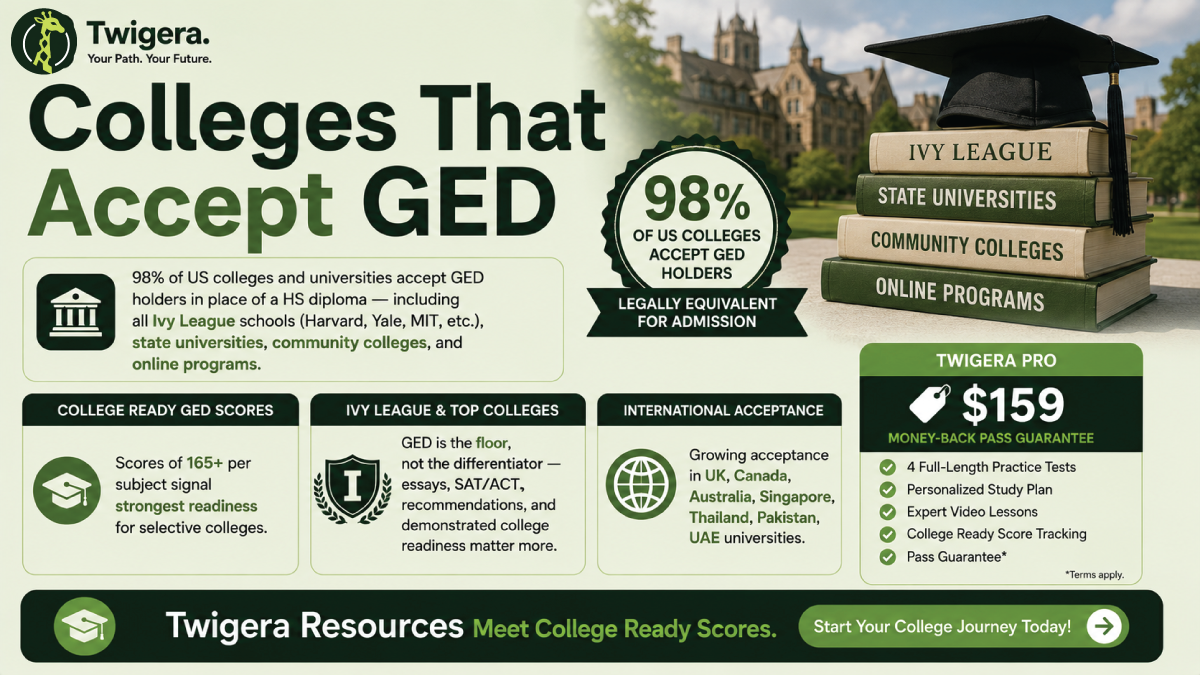
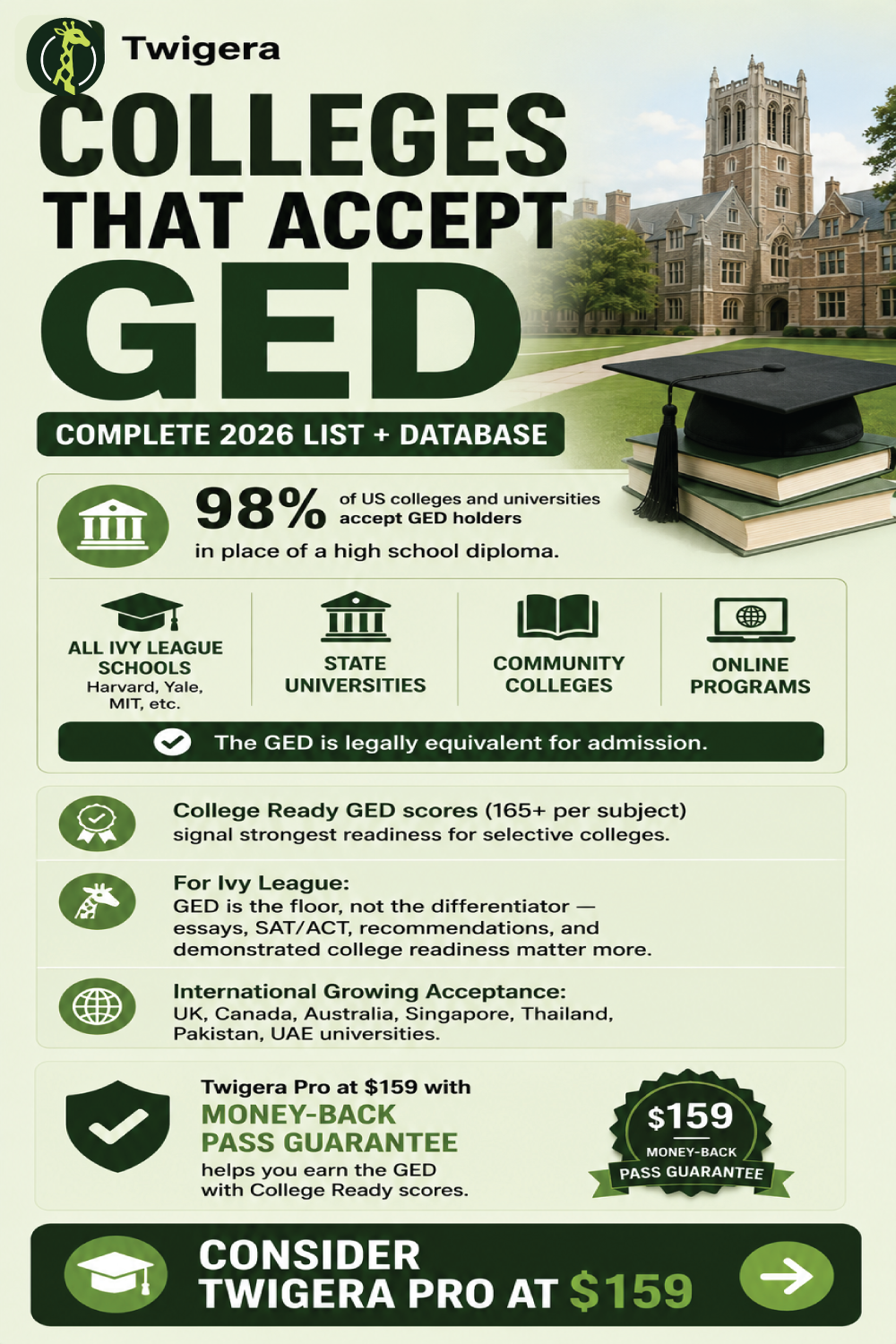
The short answer is yes. The GED Testing Service reports 98% of US colleges accept GED holders, including Ivy League schools, state universities, community colleges, HBCUs, most private liberal arts colleges, and most online colleges that accept GED. The small 2% that do not accept GED applicants are typically narrow religious-affiliated schools or a few selective vocational-track programs with specific entry rules.
For most students, the bigger question is not whether colleges accept the GED but which school fits your goals, budget, schedule, and degree path. Remember that "accepts GED" does not mean automatic admission. Selective colleges still review your scores, essays, recommendation letters, test results, activities, and overall readiness for college-level work.
If you are building a list of colleges that accept GED, Ivy League and elite schools belong on it — but admission is still highly selective.
School | GED Accepted? | What to Know |
|---|
Harvard | Yes | No special process for GED or homeschool applicants. Looks for strong essays, SAT/ACT, recommendations, intellectual curiosity, and academic readiness. |
Yale | Yes | Reviews GED applicants under the same standards as other applicants. Social maturity especially valued for non-traditional paths. |
MIT | Yes | Does not require a high school diploma and has no age requirement. Strong math/science/self-directed learning evidence matters most. |
Princeton | Yes | Accepts GED applicants; test-optional through 2026-27. A strong academic record beyond the GED helps. |
Columbia | Yes | Accepts GED applicants. Highly competitive with a reported 4.23% acceptance rate for the Class of 2030. |
Brown | Yes | Accepts GED applicants. Reported 5.35% acceptance rate for the Class of 2030. |
Cornell, Dartmouth, UPenn | Yes | All accept GED applicants. Strong scores, essays, recommendations, and achievements are still required. |
So which universities accept GED at the elite level? Harvard, Yale, MIT, Princeton, Columbia, Brown, Cornell, Dartmouth, and the University of Pennsylvania all belong on your list. Reality check: Ivy League acceptance rates fall between 3% and 10%, so the GED is the eligibility floor, not the advantage. For selective schools, community college coursework after the GED can demonstrate readiness, and strong essays plus recommendations explain your path and growth.
If you are asking which colleges that accept GED give the best practical odds, state universities are the strongest starting point. All 50 US state flagship universities accept GED holders, and many public colleges offer clear paths into 4-year degree programs with lower tuition, in-state financial aid, transfer pathways, and flexible admissions routes. College Ready GED scores of 165 or higher per subject help show stronger academic preparation.
State | Public College or University | Notes |
|---|
California | UC system | Holistic review. College Ready scores help support your application. |
Texas | UT Austin, Texas A&M | Strong scores, coursework, and application materials matter. |
Florida | University of Florida | GED holders may qualify for state and federal aid if eligible. |
New York | SUNY, CUNY | Many CUNY schools offer accessible admission paths. |
Illinois | UIUC | College Ready scores are strongly preferred. |
Michigan | University of Michigan | Selective; strong supporting materials needed. |
Ohio | Ohio State | College Ready or higher scores help show readiness. |
Pennsylvania | Penn State | Penn State World Campus is also a strong online option. |
Georgia | UGA | College Ready scores are preferred. |
North Carolina | UNC | Strong scores and full application materials matter. |
For students searching for colleges that accept GED in Texas, UT Austin and Texas A&M are two major public options, with many community colleges and regional public universities also open to GED holders. The best colleges that accept GED are not always the most selective — the best choice is the one that fits your budget, major, location, learning style, and transfer goals. State public universities are often the most accessible 4-year path, and if your GED scores are solid and your application shows readiness, public colleges give you a real path toward a degree.
Virtually all US community colleges accept GED holders, and many use open admission policies. That makes community college one of the most accessible starting points after earning a GED. Most do not require a long application essay; many use placement tests instead of SAT or ACT scores to decide which English or math classes fit your current skill level.
Community colleges are also more affordable than 4-year schools. Tuition often runs $3,000 to $7,000 per year, and Pell Grants may cover much of the cost for eligible GED holders — for the broader cost picture, see our how much does the GED cost guide. Common community college paths include an associate degree (2-year, transferable to a 4-year university), a career certificate (1 year or less, job-ready skills), workforce training (practical training for local job markets), or continuing education (short courses for career growth).
Community college is often the strongest first step because open admission removes the GED-versus-diploma concern. You begin with your GED, build a college transcript, and transfer later if your goal is a 4-year degree. It also lowers the stakes while you test the college path — explore classes, improve study habits, use financial aid, and prove college readiness before applying to a larger university.
Online colleges almost always accept GED holders, provided the school is accredited and the applicant meets program requirements. That makes online learning a strong option if you need flexibility, work full time, care for family, or prefer to study from home. Two accreditation signals matter most: regional accreditation (the older, traditional standard recognized by most colleges and employers) and the Distance Education Accrediting Commission (DEAC), which the US Department of Education recognizes for distance-learning institutions. Avoid any program that cannot name its accreditor on its own website. Public online programs at flagship state universities (Penn State World Campus, University of Florida Online, ASU Online, WGU) are the safest accreditation calls and typically offer the lowest tuition.
Public online colleges are often the most affordable options, especially with in-state tuition or federal financial aid. They carry the same regional accreditation as their on-campus programs. Penn State World Campus is fully online and issues the same Penn State diploma as on-campus students. University of Florida Online offers accredited degrees at affordable in-state rates. Arizona State University Online accepts GED holders and offers a large catalog of degree programs. Western Governors University (WGU) uses a competency-based model with monthly start dates — a strong fit if you want to move faster through subjects you already understand.
Private online colleges also accept GED holders and often serve adult learners, working students, and people returning to school. Before enrolling, check accreditation, tuition, transfer credit rules, and graduation requirements. Southern New Hampshire University (SNHU) offers a large online catalog and flexible scheduling. Liberty University Online may suit students looking for a faith-based option. Purdue Global offers many online degree paths for career-focused students. University of Phoenix is known for flexible scheduling built around adult learners. See our best online GED programs guide for related prep-program comparisons.
GED acceptance is not limited to the United States. A growing number of universities outside the US accept GED holders, though admission rules vary by country, school, and program. The pattern across most non-US universities is the same: the GED satisfies the basic high school equivalency requirement, but the school may also expect English language proficiency proof (IELTS or TOEFL for non-native English speakers), subject-specific prerequisites depending on the major, and sometimes a foundation year or pathway program for less-selective institutions. Always confirm with the specific university admissions office before submitting transcripts and fees, because cross-border credential recognition can change with national education-ministry rules. Three regions stand out as the most active in accepting GED holders: the UK (via UCAS), Canada, and Australia.
Many UK universities accept GED holders, but they often ask for extra academic proof — A-Level subjects, a foundation year, English language scores, or subject-specific requirements. Oxford and Cambridge usually expect strong A-Level results or equivalent qualifications in competitive subjects. Less-selective UK universities may accept a GED plus a foundation year, so always verify requirements through UCAS or the university admissions office.
Most Canadian universities accept GED holders, though some provinces and programs may ask for additional subjects. Ontario and Quebec schools, for example, may have specific course or credential requirements. Canada can also be a practical option for international students comparing tuition with US colleges — check each university admission page before applying.
GED is accepted at many Australian universities, especially when paired with the right academic preparation. Some schools may require pathway programs, foundation study, or English language proof (IELTS is the most commonly accepted test for non-native English speakers, with a minimum band score of 6.0 to 6.5 at most universities). Australia is also known for applied, vocational, and career-focused education paths through TAFE (Technical and Further Education) institutions — useful for GED holders who want practical degree options at lower tuition than the Group of Eight research universities. International student visas (the Subclass 500) require proof of full-time enrollment plus financial capacity and health cover, so the total cost of an Australian degree is meaningfully higher than tuition alone suggests.
Top Singapore universities such as the National University of Singapore (NUS), Nanyang Technological University (NTU), and Singapore Management University (SMU) may accept GED applicants, but admission is competitive — both rank consistently among the global top 30 in international university rankings, so they evaluate international applicants against extremely strong cohorts. These schools often require additional qualifications, strong test scores (SAT/ACT for some programs), and proof of academic readiness beyond the GED. A GED alone may not be enough for highly competitive programs — review each school international applicant requirements carefully and plan on either a foundation year or substantial College Ready + Credit (175+) GED scores plus strong supplemental credentials.
Multiple universities in Thailand accept GED holders, including institutions with growing international programs (Chulalongkorn, Mahidol, Thammasat are common examples). English language requirements can be competitive, so prepare for IELTS or TOEFL where required. In Pakistan, HEC-accredited universities increasingly accept GED holders, though requirements vary by institution and program (LUMS and Aga Khan University are common names). In the UAE, American University of Sharjah and NYU Abu Dhabi accept GED applicants — relevant for students interested in international degree programs and health sciences. Always confirm equivalency documents, subject prerequisites, and any additional testing requirements at the program level.
You can become a doctor with a GED, but the GED is only the first step. Medical schools care much more about your college performance, science coursework, MCAT score, clinical experience, and full application than the credential you used to enter college.
The standard path starts with earning your GED at College Ready or higher scores, then completing an undergraduate degree at an accredited 4-year college with a pre-med track (biology, chemistry, organic chemistry, physics, math). Next comes the MCAT, then application to an MD or DO medical school, then residency. Medical schools evaluate undergraduate record, not GED — a college GPA of 3.5 or higher and an MCAT score of 505 or higher make you competitive regardless of high school credential.
For international options, some Caribbean medical schools (St. George, AUC, Ross) generally consider applicants with a GED plus an undergraduate degree. European medical schools in countries such as the Czech Republic, Poland, and Bulgaria increasingly review US GED holders with verified undergraduate study. Schools in Pakistan, Bangladesh, and India may also accept GED holders who have completed and verified an undergraduate degree.
Colleges look at GED scores to gauge your academic readiness. Each GED subject is scored from 100 to 200, so your score level affects where you can apply and how strong your application reads.
Score Per Subject | Status | Typical Admissions Impact |
|---|
Below 145 | Not passed | Cannot be used for college admission. A retake is required. |
145 to 164 | High School Equivalency | Meets the basic GED passing level. Usually enough for open admission and community college eligibility. |
165 to 174 | College Ready | Shows stronger preparation for college-level work. Helps with many state universities and private colleges. |
175 to 200 | College Ready + Credit | Shows advanced readiness. Some selective colleges may view it more favorably, and some schools may grant college credit (up to 10 credits per subject). |
GED scores are measured by subject, not just by total. The four GED subjects together add up to a possible 800 points, but the College Ready threshold is 165 per subject — not a 165 average. For College Ready + Credit, you need 175 or higher in each qualifying subject. Credit rules vary by school, so confirm with the college before assuming your GED score will count toward credit.
Applying to college with a GED follows the same basic path as applying with a high school diploma. The key is to show colleges that you are ready for college-level work. Start by aiming for 165 or higher in each GED subject to land in the College Ready range. If you are applying to selective colleges or hoping to earn college credit, aim for 175 or higher. Some schools still require SAT or ACT scores, especially selective ones — for 2026 and 2027 admissions, several selective colleges are returning to test-required policies.
Strong supporting materials matter just as much as the GED score. Essays explain your story, goals, and preparation. Recommendation letters from teachers, mentors, employers, or supervisors round out the picture. A resume highlighting your GED, work experience, volunteer roles, skills, and achievements helps colleges see your progress. Submit FAFSA to qualify for federal financial aid — GED holders qualify for Pell Grants up to $7,395 for the 2025-2026 award year, per US Department of Education Federal Student Aid. Apply through the Common App, a college-specific application, or a state application system depending on each school. Community college is often a smart first move — build a strong transcript at lower cost, then transfer to a 4-year college later.