Target Tuition Reimbursement: Does It Cover the GED?
Target pays 100% to finish high school — debt-free, from day one, part-time or full-time — through its Dream to Be benefit. But the credential is a Penn Foster diploma, not a GED. Here is the honest difference and how to choose your path.
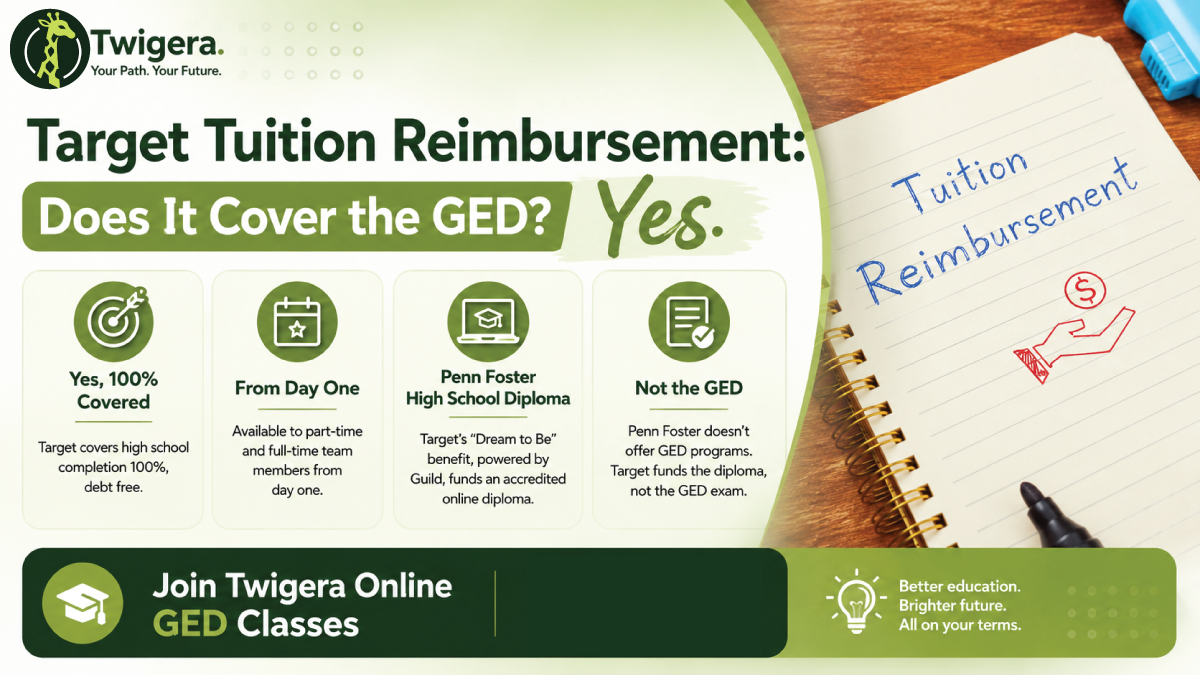
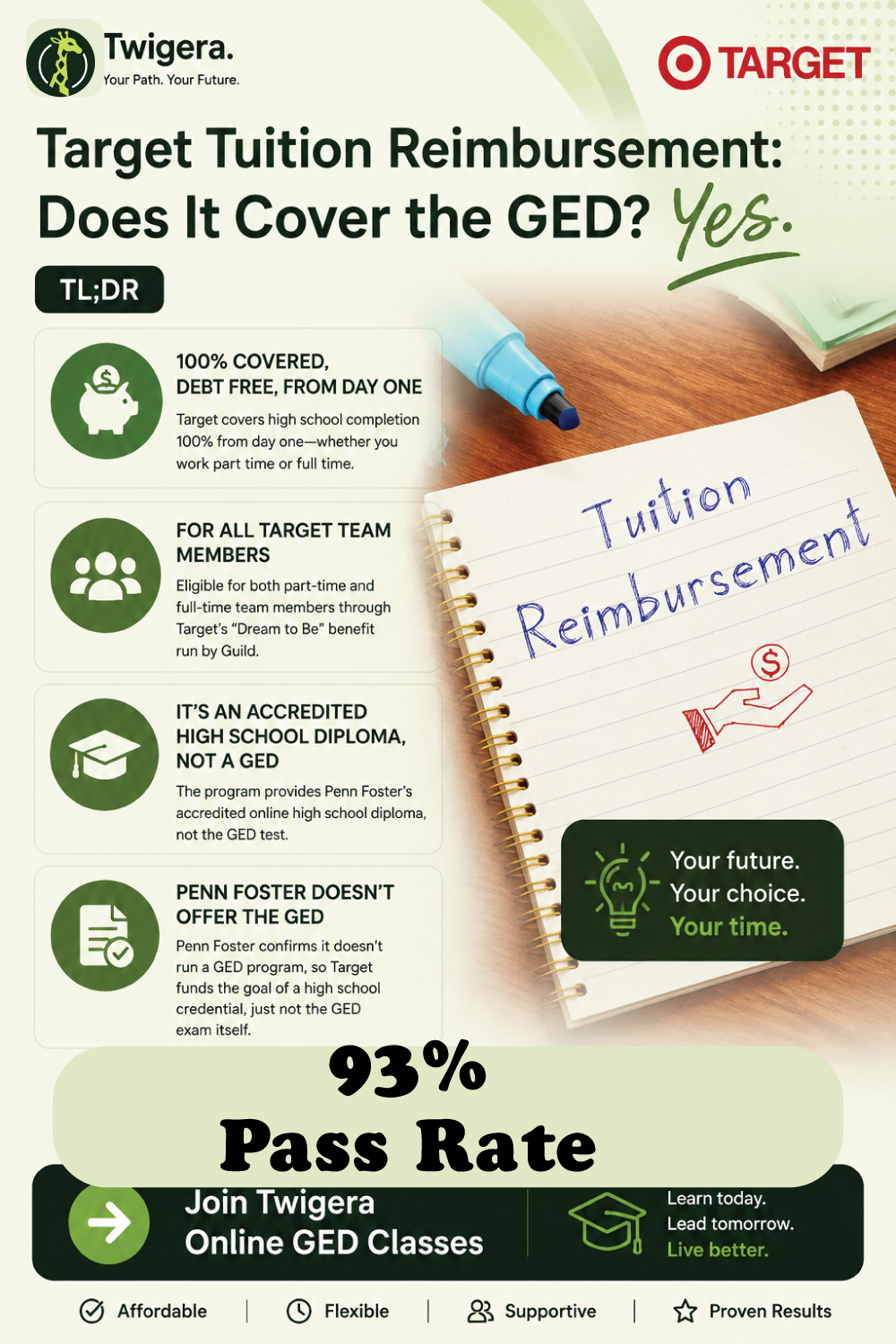
Yes — Target tuition reimbursement covers high school completion 100%, debt-free, from day one, part-time or full-time, through Target's Dream to Be benefit run by Guild. The catch: the high school path is Penn Foster's accredited online diploma, not a GED. Penn Foster does not run a GED program, so Target funds the goal of a high school credential — just not the GED exam itself.
Last reviewed
There is no better feeling than going back to school and earning the education you missed — but the cost of education keeps climbing, and that stops many capable adults before they begin. According to College Board, public four-year in-state tuition now averages roughly $12,000 a year before aid. And you are not alone: roughly 12 million U.S. adults aged 50 and over do not have a high school diploma or equivalent — real lives, real bills, and a goal that felt out of reach for too long. If you work at Target, your tuition benefit might change everything about what finishing high school costs you. Here is the honest truth about what Target pays for, what it does not, and how to use it.
Does Target Cover the GED? The Quick Answer
Yes — Target covers the cost of finishing high school, but the credential you walk away with is a diploma, not a GED. Target tuition reimbursement through its Dream to Be program does pay for high school completion, and that part is real and generous. But the program runs through Penn Foster, and Penn Foster does not run a GED program — it awards an accredited high school diploma instead. So Target covers high school completion at 100%, debt-free, from day one for both part-time and full-time team members; the credential earned is a Penn Foster diploma, not a GED certificate; and if your goal is specifically a GED, Target's benefit will not pay the exam fee.
What Is Target "Dream to Be"?
Dream to Be is Target's education benefit, built around the idea that workers should not go into debt to finish school or earn a degree. It runs through a partnership with Guild, a company that connects employers with schools and training providers. According to Target's own fact sheet, the program has driven hundreds of millions in investment in team members, with tens of thousands of enrollments and thousands of graduates. The catalog is wide: undergraduate and master's degrees, certificates, language learning, high school completion, and bootcamps in fields like tech and healthcare — "tuition-free or partially funded" access across roughly 40 partner schools, depending on the program and your eligibility. The scale is part of the point: Target reports that hourly team members enrolled in Dream to Be have a substantially lower turnover rate, which is exactly why the company keeps investing in it.
Reimbursement vs Debt-Free: How Target Actually Pays
Reimbursement usually means you pay first — you cover tuition out of pocket, finish the term, then submit paperwork and get paid back later, often with a cap. Debt-free (or prepaid) means Target pays the school directly: you never front the money, and there is nothing to submit because you never owed anything. For Target's top-tier programs, including high school completion, the debt-free model applies — Guild pays Penn Foster on your behalf, and you show up, do the coursework, and earn the diploma.
Tier
What it covers
You pay upfront
Annual cap
Tier 1 — debt-free
Select degrees, certificates, bootcamps, high school completion, college prep
$0
100% of tuition
Tier 2 — undergrad (capped)
Other non-master's undergraduate programs
Sometimes paid first, reimbursed later
$5,250 per year
Tier 2 — graduate (capped)
Master's degree programs
Sometimes paid first, reimbursed later
$10,000 per year
The $5,250 figure is not random — it lines up with the IRS Section 127 limit for tax-free employer-provided education assistance, a federal cap that applies broadly, not just to Target. Program tiers shift over time as Target and Guild update their partner-school list, so before you enroll, log into the Guild portal and confirm whether your specific program sits in Tier 1 or Tier 2. Do not assume based on what a blog post said last year.
Save for later
Pin this guide so you can find it again.
We refresh these every season. Save it to a Pinterest board and you’ll get the latest version next time you come back.
This is where Target's program stands out, especially for part-time workers: there is no waiting period. You do not need to put in 90 days or a full year before you can apply. The checklist is short — you must be a U.S.-based Target team member (part-time and full-time both qualify), eligibility starts on day one of employment, you stay in good standing (normal job performance and attendance), and you maintain academic progress in your chosen program. Seasonal or short-term roles may not qualify, so confirm directly with Guild.
The High School Path: A Penn Foster Diploma, Not a GED
Target's high school completion benefit runs through Penn Foster, an online school operating since 1890 that is regionally and nationally accredited, so the diploma holds weight with employers and colleges. The program is self-paced — no class times, no semester deadlines — which matters if you are also working full shifts. Here is the part many articles gloss over: Penn Foster does not offer a GED program. What Target funds is a high school diploma earned through coursework, not a GED, which is an exam-based equivalency credential. Both are legitimate and recognized by most employers and colleges; they are just different paths to the same destination, and the difference between a diploma and a GED is worth understanding before you commit. This is the same Guild-to-Penn-Foster route that Walmart's Live Better U uses — a useful comparison if you are weighing employers.
If you take the Target-funded route, here is what it looks like in practice:
You complete coursework across core subjects, similar to a traditional high school curriculum.
Target and Guild cover 100% of the tuition, with no cost to you.
At the end, you receive a diploma from an accredited high school.
That diploma is not the same document as a GED certificate, and it will not show up as "GED" on any transcript.
Factor
Penn Foster diploma via Target
GED
Credential type
Accredited diploma, coursework-based
Equivalency, exam-based
Who pays
Target, 100%, debt-free
You, out of pocket
Typical timeline
Self-paced coursework, often months
Test-ready in weeks with consistent prep
Best fit for
Target employees who want a no-cost diploma
Anyone wanting speed, lower cost, or non-Target
How to Enroll Through Guild, Step by Step
Confirm you are a U.S.-based Target team member. Your hours and tenure do not matter — only your employment status.
Log into the Guild portal for Target team members using your Target credentials.
Browse the available programs and look for the high school completion option through Penn Foster.
Connect with a Guild education advisor. They walk you through program selection and enrollment and answer questions specific to your situation.
Complete enrollment. For Tier 1 programs like high school completion, tuition is prepaid, so there is nothing to submit later.
Stay enrolled by keeping up with coursework and maintaining the academic-progress standards set by Penn Foster and Guild.
If You Want the GED Specifically, Here Is the Honest Path
Maybe the Penn Foster diploma is not what you are after — maybe you want the GED specifically, maybe you do not work at Target, or maybe you just want the fastest route to a recognized credential. The GED is built for exactly this: it covers four subjects (Mathematical Reasoning, Reasoning Through Language Arts, Science, and Social Studies) as a computer-based exam, and it is designed around the idea that adult test-takers already carry real-world knowledge into the exam room. A coursework-based diploma can take months; a GED, with focused prep, can take considerably less. This is especially relevant for adults returning to education later in life, who often want a credential that respects their time. Twigera focuses directly on the exact GED test subjects — no filler coursework, only material that appears on exam day — so start with a free GED diagnostic to see where you stand across each subject before choosing a plan.
What a GED or Diploma Actually Opens Up
A high school credential — diploma or GED — is often the line item that decides whether you are even considered for a role. Many entry points into the skilled trades require it to start an apprenticeship in fields like electrical work, plumbing, or HVAC. Healthcare is another example: the Bureau of Labor Statistics notes that nursing-assistant roles typically require a high school diploma or its equivalent plus a state-approved training program. A credential also unlocks federal financial aid — a diploma or GED is a baseline requirement for Pell Grants, which do not need to be repaid. And there is a less obvious benefit: the National Institute on Aging notes that staying mentally engaged through learning is linked to cognitive health in older adults. Going back to school later is an investment in how your mind stays active, whether you are 35 or 65.
Bottom Line
Target tuition reimbursement through Dream to Be pays 100% for high school completion, debt-free, available from day one, whether you work part-time or full-time. The catch is the credential: this benefit runs through Penn Foster, and what you earn is an accredited diploma, not a GED. Both credentials are valid and both open doors — the right one depends on whether you are a Target employee looking for a no-cost diploma or someone who wants the speed and structure of the GED exam specifically. If the GED is your goal, that is a path you fund yourself, and focused prep is where it starts.
Frequently asked
Questions people ask.
Does Target pay for your GED?
ShowHide
Not the GED exam itself. But Target does pay 100% for you to finish high school. Through Dream to Be, eligible team members earn an accredited online high school diploma via Penn Foster at zero cost, debt-free, from day one. Penn Foster confirms it does not run a GED program, so Target funds a high school credential — as a diploma rather than a GED.
Does Target pay for college?
ShowHide
Yes. Dream to Be covers select associate and bachelor's degrees, certificates, and bootcamps at 100%, debt-free, plus up to $5,250 a year for other undergraduate programs and $10,000 a year for master's degrees, across roughly 40 partner schools through Guild.
How much does Target tuition reimbursement cover?
ShowHide
Up to 100%. Select degrees, certificates, bootcamps, and high school completion are fully covered and prepaid, not out of pocket. Other programs are capped at $5,250 a year for non-master's programs or $10,000 a year for master's — figures that line up with the IRS Section 127 tax-free education assistance limit.
Is Target tuition assistance available to part-time employees?
ShowHide
Yes — part-time and full-time, from day one. Eligibility depends on being a U.S.-based team member in good standing, not on weekly hours. There is no tenure waiting period, though seasonal or short-term roles may not qualify, so confirm directly with Guild.
Who provides Target's high school completion program?
ShowHide
Penn Foster, through Guild. Penn Foster is a nationally and regionally accredited online high school that has operated since 1890. The program is self-paced and built for working adults, and it awards a diploma, not a GED.
Diploma or GED — which is better if I work at Target?
ShowHide
If zero out-of-pocket cost is your priority, take the Target-funded Penn Foster diploma. If you specifically want the GED — which is exam-based and typically faster — that is a separate path you fund yourself. Both are valid high school-level credentials accepted by most employers and colleges.
How does Target's debt-free benefit differ from normal tuition reimbursement?
ShowHide
For fully covered programs, Target pays tuition upfront through Guild, so you never front the money. Traditional reimbursement means you pay first and get paid back later — and that model only applies to Target's capped tier ($5,250/$10,000). The 100% tier, including high school completion, is prepaid.
Can I get a GED instead of the Penn Foster diploma?
ShowHide
Yes. If the GED specifically is your goal — for speed, lower cost, or because you are not a Target employee — that is a separate path you fund yourself. The GED is exam-based across four subjects and can be done on your own schedule, often faster than coursework-based diploma programs.
Amara is the editor at Twigera. She came to publishing the long way — a decade teaching the GED in community colleges and adult-learning centers, where she watched students pass not on talent or time, but on the strength of a study plan they actually trusted. Now she shapes the guides students read here for the parent studying after a closing shift, the second-career welder, the grandmother finishing what she started forty years ago. Expect honest timelines, math made survivable, and study plans built around real life — not around a textbook's idea of one.
Enjoyed this?
Take the next step — start today.
Our online GED course includes every subject, a free 30-minute diagnostic, and a 7-day refund on every plan.