Employer-Sponsored GED Programs: Who Pays in 2026?
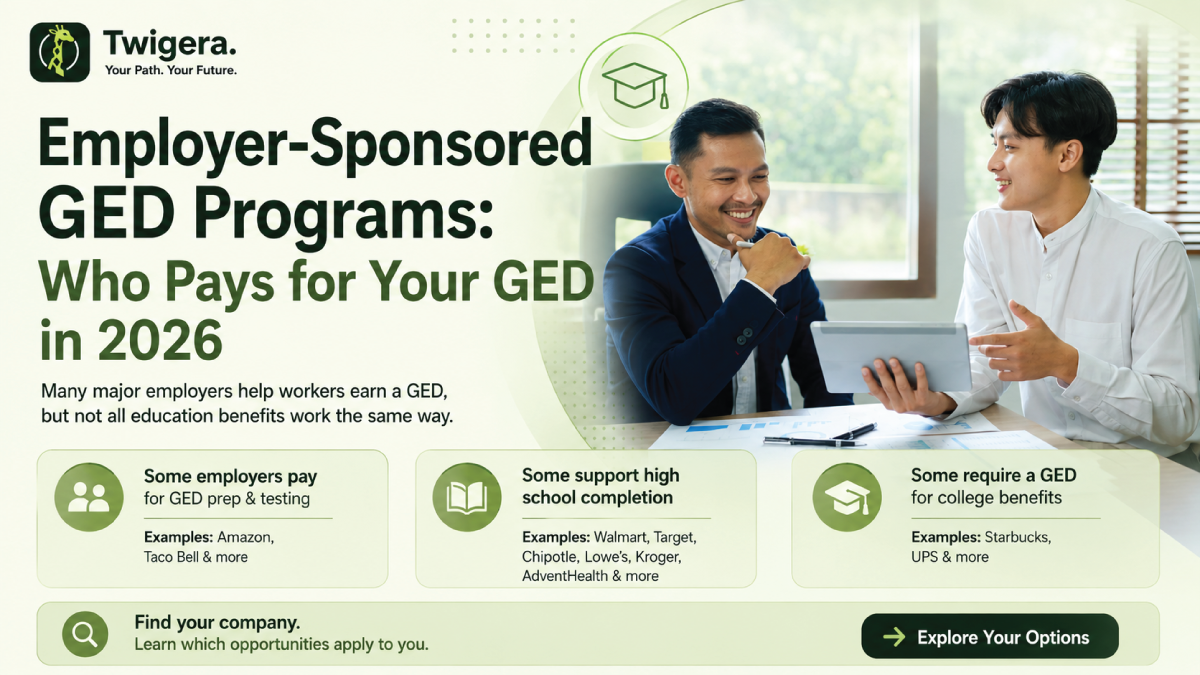
Many major employers help workers earn a GED — but the benefits are not all the same. Here is the verified breakdown of who funds GED prep and testing, who only pays for college, and how to find your own employer's coverage.
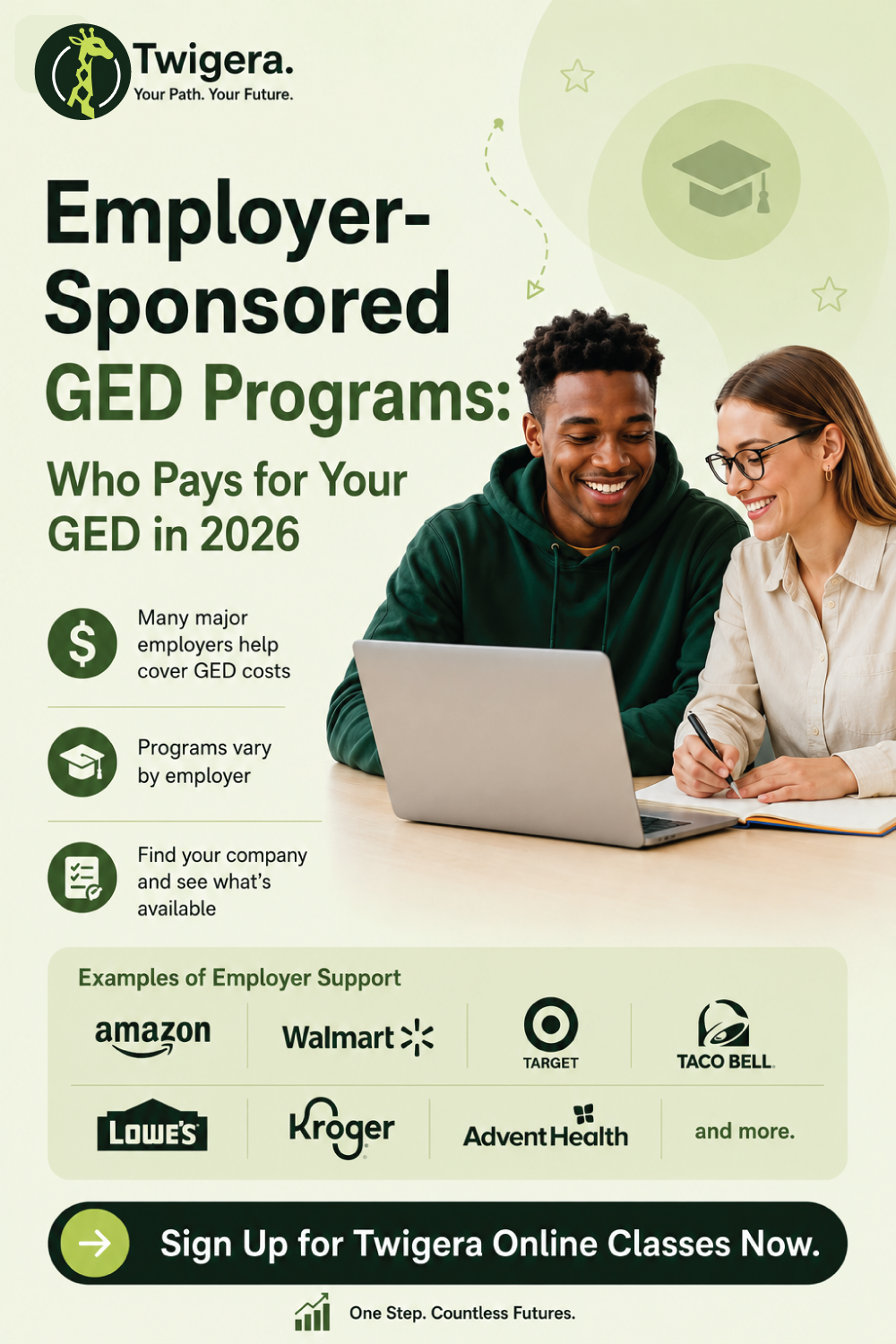
Yes — many major employers help workers earn a GED, but the benefits differ. Amazon and Taco Bell fund GED prep and testing through GEDWorks. Walmart, Target, Chipotle, Lowe's, Kroger, and AdventHealth support GED or high school completion through Guild Education or Penn Foster. Others, like Starbucks and UPS, fund college but require a GED first. Use the verified table below to find your employer and the benefit that applies to you.
Last reviewed
Sometimes the cost of testing is the one thing standing between you and a better job. You know you are capable of more, but without a GED, better pay, promotions, and employer-funded education programs stay closed off. More than 95% of employers require a GED or high school diploma — which is exactly why so many companies now help their workers earn one.
Through employer-sponsored GED programs, some companies cover GED preparation, high school completion, and even testing costs. But not every education benefit means the same thing. Some employers pay for GED prep directly; others offer college tuition assistance and expect you to already hold a GED. This guide sorts out which employers offer real GED support, how the benefits work, and how to confirm whether you qualify.
Quick Answer: Who Actually Pays for Your GED
Yes — if you are asking whether your job or your employer pays for your GED, many large employers do. The catch is that not all education benefits cover the same thing, and they fall into three distinct buckets. Getting this wrong can cost you months.
Bucket 1 — Employers that fund GED prep and testing. This is what most people want. Support may include study materials, tutoring, practice tests, high school completion courses, and the official GED test fees. Examples: Amazon Career Choice, Walmart Live Better U, Target Dream to Be, Chipotle Cultivate Education, Lowe's, Kroger Feed Your Future, AdventHealth, and Taco Bell through GEDWorks.
Bucket 2 — Employers that pay for college but require a GED first. Starbucks (College Achievement Plan, via Arizona State University) and UPS (Earn and Learn) fund college, but you need a GED or high school diploma before you qualify.
Bucket 3 — Scholarships that support future education. Taco Bell's Live Más Scholarship and Chick-fil-A's Remarkable Futures Scholarship help students continue their education but do not fund GED prep or testing.
Knowing which bucket your employer belongs to saves time and prevents disappointment. One example from Bucket 1 worth bookmarking: Amazon Career Choice fully funds the GED through GEDWorks. And one from Bucket 2: Disney Aspire funds an accredited high school diploma but not the GED test itself.
The Verified Employer Table
Most lists lump GED benefits, college tuition programs, and scholarships together as if they are the same thing. They are not. This table separates them so you can see exactly what support each major employer provides, confirmed for 2026.
Employer
GED prep funded
Platform
Cost to you
Eligibility
Amazon (Career Choice)
Yes
GEDWorks
Free
After an initial tenure window
Walmart (Live Better U)
Yes
Penn Foster
Free
Day one; must be 18+
Target (Dream to Be)
Yes
Guild
Free
Day one, PT/FT
Chipotle (Cultivate Education)
Yes
Guild
Free
After an initial tenure window
Lowe's
Yes
Guild
Free
PT/FT
Kroger (Feed Your Future)
Yes
Direct
Up to $3,500/yr
After an initial tenure window
AdventHealth
Yes
Guild
Free in-network
After an initial tenure window
Taco Bell (GEDWorks)
Yes
GEDWorks
Free
Varies
Starbucks (SCAP)
No
ASU / college
Not applicable
Requires GED first
Taco Bell (Live Más Scholarship)
No
Scholarship
Not applicable
Ages 16–26
Chick-fil-A (Remarkable Futures)
No
Scholarship
Not applicable
Team members
How to read this table: a "Yes" means the employer supports GED preparation, testing, or high school completion. A "No" does not mean the employer offers no education benefits — it means the benefit is aimed at college or career training and assumes you already hold a GED or high school diploma. Employer catalogs change, so always confirm your specific coverage directly with HR before building a plan around any benefit.
How Employer GED Funding Works: GEDWorks vs Guild
Most employees never see the systems powering their education benefits — they see a login portal, a list of programs, and a sign-up button. Behind the scenes, two pathways drive most employer-sponsored GED opportunities in the United States.
GEDWorks: when your employer pays for everything
GEDWorks is run by GED Testing Service, the same organization behind the official GED exam. When your employer partners with GEDWorks, they pre-pay the full package on your behalf: unlimited study materials in English and Spanish, full-length practice tests, one-to-one tutoring, a personal academic advisor, and the official GED test fees. Your out-of-pocket cost is zero. Confirmed GEDWorks partners include Amazon Career Choice, Taco Bell, KFC, and Sheetz. One fact worth repeating: Walmart is not a GEDWorks partner and never has been — Live Better U runs its own program through Penn Foster, fully separate from GEDWorks.
Guild Education: the platform behind most employer benefits
Guild Education is not a school — picture it as a middleman with a useful job. Guild connects employers with education providers and pays the school directly on the worker's behalf, so you never see the money and never pay upfront. For GED and high school completion specifically, Guild routes employees to Penn Foster, an accredited high school diploma program. What matters: coverage is determined by your individual employer's catalog within the Guild platform, not by Guild itself. A Target employee and a Chipotle employee both access benefits through Guild, but what each receives depends on what their employer chose to include.
Save for later
Pin this guide so you can find it again.
We refresh these every season. Save it to a Pinterest board and you’ll get the latest version next time you come back.
The Catch: Tuition Assistance Does Not Always Cover Your GED
Here is the conversation that plays out in HR offices across the country. A worker hears their employer offers tuition assistance and assumes it means GED support. They wait weeks or months to start, only to learn the benefit kicks in after they already hold a credential they do not have.
The Starbucks College Achievement Plan is genuinely one of the most generous employer education benefits in the country — full tuition coverage for a bachelor's degree at Arizona State University. But it requires a high school diploma or GED to enroll. Taco Bell deserves credit for running two different programs: its GEDWorks partnership funds GED prep directly (Bucket 1), while its Live Más Scholarship is a separate college scholarship for workers aged 16 to 26 that does not fund GED prep. And UPS Earn and Learn offers $5,250 per year in college tuition assistance with a $25,000 lifetime cap, but any GED references relate to college admission thresholds, not funded GED prep. The pattern is the same: a generous college benefit does not automatically include a path to earning a GED.
What If Your Employer Is Not on This List
Your employer does not have to be a Fortune 500 company for you to access GED funding. Smaller employers sometimes offer education benefits that go unnoticed because nobody asks the right questions. Work through these three steps.
Search your HR benefits portal for "education benefits," "tuition assistance," or "Guild." If Guild appears, ask HR specifically whether GED preparation or high school completion is in your employer's catalog.
Check the GEDWorks employer list at ged.com and search for your employer by name. The partner list is public and takes two minutes to check.
Ask HR the right question. Instead of "do we offer tuition assistance?", ask: "Does our education benefit cover GED preparation and the official test fee, or does it only apply to college programs?" A specific question forces a specific answer.
If the answer is no, free alternatives exist. According to the National Center for Education Statistics, millions of American adults do not hold a high school credential, and adult education programs exist across the country to serve exactly this population — many at no cost. Local adult education programs, public libraries, and state-funded programs are all worth checking, and our guide on whether the GED is really free breaks down every no-cost path.
Get GED-Ready No Matter Who Is Paying
Here is the part most people miss: even when your employer funds your GED through GEDWorks or Penn Foster, nobody studies for you. Your employer removes the financial barrier; passing is still your responsibility. A warehouse worker at Amazon has their test fees covered and a Chipotle crew member has their prep covered through Guild — but both still need to sit four subject exams and pass. The benefit is meaningless without the result, and the cost of resitting even one of the four GED subjects adds up fast.
That is where structured prep matters. Twigera is an online GED prep platform designed for working adults — flexible enough to fit around full-time shifts, structured enough to get you to a passing score. If your employer is funding your test, the financial barrier is gone and what remains is preparation. If your employer funds college but requires a GED first, the GED is the only step between you and a benefit already waiting for you. Before choosing any plan, take a free GED diagnostic so you study the subjects that need the most work — and check how much the GED costs in your state so you know what your employer benefit is really worth.
The Bottom Line
Many large employers genuinely help workers earn a GED, but not all education benefits serve the same purpose. Amazon, Walmart, Target, Chipotle, Lowe's, Kroger, AdventHealth, and Taco Bell offer support tied to GED preparation or high school completion. Others, including Starbucks and UPS, focus on college benefits and require a GED first. Before relying on any benefit, verify the details with your HR department — programs and eligibility change over time. No matter who is paying, success comes down to preparation.
Frequently asked
Questions people ask.
Does my employer pay for my GED?
ShowHide
Often, yes. Employers such as Amazon, Walmart, Target, Chipotle, Lowe's, Kroger, AdventHealth, and Taco Bell offer GED preparation or high school completion benefits. Check the employer table above and confirm eligibility with your HR department, because benefits change.
What is Guild Education and does it pay for my GED?
ShowHide
Guild Education helps employers manage education benefits and pays approved schools directly. Whether your GED is covered depends on your employer's catalog — high school completion is often delivered through Penn Foster. Some employers use Guild for GED-related programs; others use it only for college and career training.
What is GEDWorks?
ShowHide
GEDWorks is the official employer-sponsored GED program from GED Testing Service. Eligible employees receive study materials, tutoring, practice tests, academic support, and GED test-fee coverage at no cost. Employers such as Amazon and Taco Bell use GEDWorks to help workers earn their GED.
Which companies actually pay for GED prep and not just college?
ShowHide
Verified employers offering GED preparation or high school completion support include Amazon, Walmart, Target, Chipotle, Lowe's, Kroger, AdventHealth, and Taco Bell. These programs are designed for employees who still need a GED, rather than workers already enrolled in college. Always verify current eligibility with your employer.
Does Starbucks pay for your GED?
ShowHide
No. The Starbucks College Achievement Plan helps eligible employees earn a degree through Arizona State University, but participants must already have a GED or high school diploma. Earning your GED first lets you take advantage of that benefit and other college opportunities later.
Is an employer-paid GED really free?
ShowHide
In many cases, yes. Programs such as GEDWorks and employer-funded high school completion pathways often cover tuition, learning materials, and testing costs, leaving little or no out-of-pocket expense. Some employers require a waiting period before benefits begin; others offer access much sooner.
What if my employer does not pay for my GED?
ShowHide
You still have affordable options. Ask HR whether tuition assistance includes GED preparation, check whether your employer partners with GEDWorks, and explore local adult education programs — many cost nothing. A structured online prep platform such as Twigera is another route if you want flexible, subject-by-subject study.
How do I find out exactly what my employer covers?
ShowHide
Search your HR benefits portal for "education benefits," "tuition assistance," or "Guild," check the public GEDWorks employer list at ged.com, and then ask HR one specific question: does our education benefit cover GED preparation and the official test fee, or does it only apply to college programs? A specific question forces a specific answer.
Amara is the editor at Twigera. She came to publishing the long way — a decade teaching the GED in community colleges and adult-learning centers, where she watched students pass not on talent or time, but on the strength of a study plan they actually trusted. Now she shapes the guides students read here for the parent studying after a closing shift, the second-career welder, the grandmother finishing what she started forty years ago. Expect honest timelines, math made survivable, and study plans built around real life — not around a textbook's idea of one.
Enjoyed this?
Take the next step — start today.
Our online GED course includes every subject, a free 30-minute diagnostic, and a 7-day refund on every plan.