AdventHealth Tuition Reimbursement: GED Path Into Healthcare
AdventHealth's Guild education benefit funds high school completion and the path to your GED, plus certificates and degrees — up to $5,250 a year and $21,000 lifetime for benefits-eligible employees after six months. Here is how it works.
Yes. AdventHealth's education benefit through Guild covers high school completion — the pathway to your GED — plus certificates and degrees. Benefits-eligible part-time and full-time employees get up to $5,250 per year ($10,500 for master's) with a $21,000 lifetime cap, after six months of employment in good standing. Books and required fees are included.
Last reviewed
Starting healthcare training without a diploma often feels frustrating and expensive — tuition costs can stop progress before the journey even begins. AdventHealth tuition reimbursement offers a practical way forward: employees gain education support while building the qualifications they need for long-term growth.
Healthcare continues to offer steady demand across the country. The U.S. Bureau of Labor Statistics projects 1.9 million healthcare job openings each year through 2033. A GED often stands between where you are today and those opportunities, and education-support programs help remove part of that financial pressure. This guide explains how the benefit works, who qualifies, and the honest GED-first path into AdventHealth.
Does AdventHealth Pay for Your GED?
Yes. AdventHealth tuition reimbursement through Guild covers more than degrees. It funds high school completion — the modern pathway to a GED — along with certificates and college coursework. Does AdventHealth offer this to everyone who applies? Not quite. This is a team member benefit, not a public scholarship. You need to already be on staff, and you need to meet a few conditions before the funding kicks in.
Here is the two-part loop worth understanding upfront:
If you already work at AdventHealth and lack a high school credential, the AdventHealth Guild education benefit can fund your path to a GED.
If you are not yet hired, earn your GED first. AdventHealth regularly hires GED holders into entry healthcare roles, and the benefit becomes available once you are in.
What AdventHealth's Education Benefit Covers
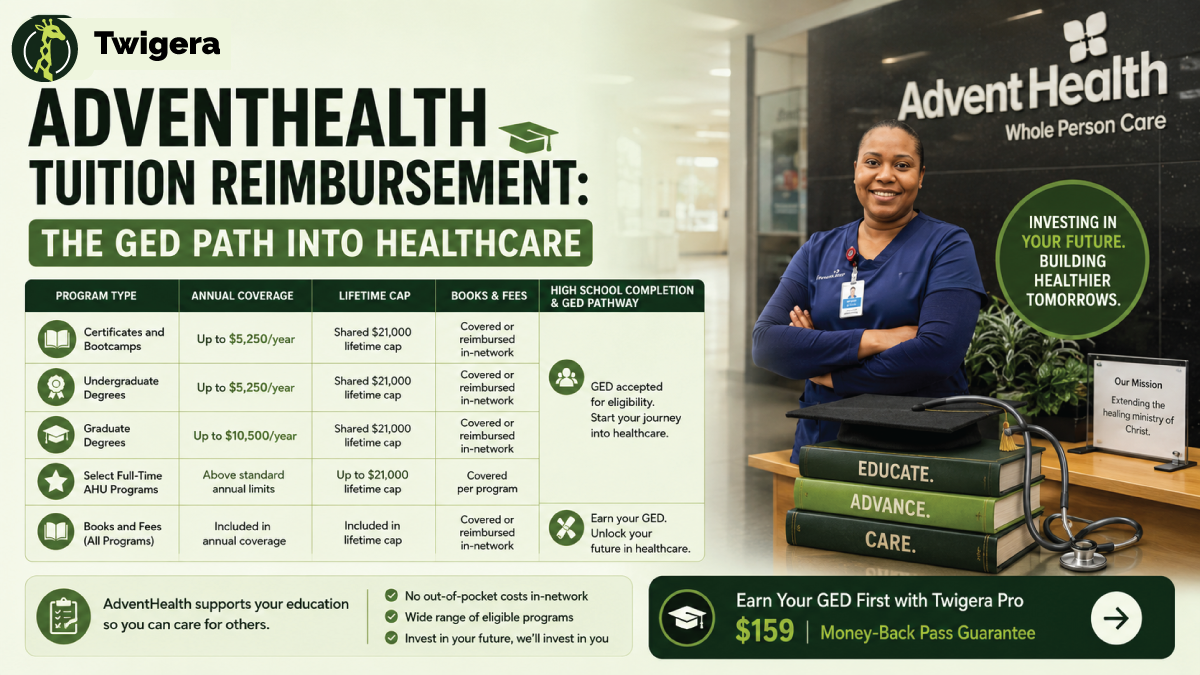
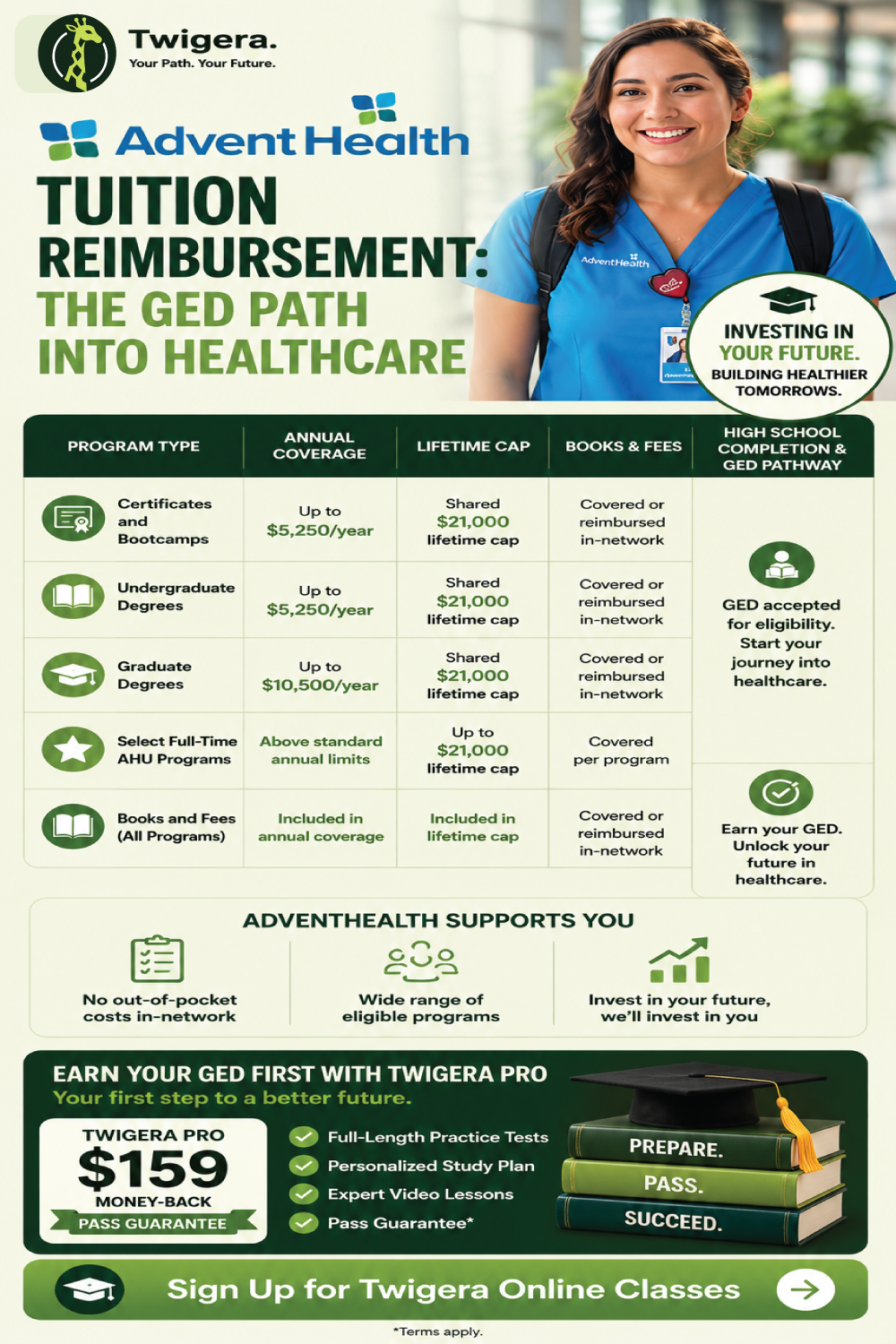
The AdventHealth tuition reimbursement program runs through Guild, and it covers a wide range of learning paths: certificates, bootcamps, undergraduate coursework, and graduate degrees all qualify. So does high school completion, college prep, and English language learning for team members who need it. Guild administers all of it through a single platform, so you are not juggling separate applications for separate programs.
Program type
Annual coverage
Lifetime cap
Books and fees
High school completion and GED pathway
Up to $5,250/year
Shared $21,000 lifetime cap
Covered or reimbursed in-network
Certificates and bootcamps
Up to $5,250/year
Shared $21,000 lifetime cap
Covered or reimbursed in-network
Undergraduate degrees
Up to $5,250/year
Shared $21,000 lifetime cap
Covered or reimbursed in-network
Graduate degrees
Up to $10,500/year
Shared $21,000 lifetime cap
Covered or reimbursed in-network
Select full-time AdventHealth University (AHU) programs
Above standard annual limits
Up to $21,000 lifetime cap
Covered per program
The lifetime cap is a ceiling, not a renewable yearly perk. Spend it on a sequence that builds — GED completion first, then a certificate, then a degree — instead of spreading it thin across unrelated courses.
— Twigera editorial
Before you map a multi-year plan around that cap, it helps to know exactly what the credential at the start of it involves — what the test covers, what it costs, and how the scoring works. The sections below break down each step.
Save for later
Pin this guide so you can find it again.
We refresh these every season. Save it to a Pinterest board and you’ll get the latest version next time you come back.
AdventHealth tuition reimbursement eligibility is straightforward once you see the checklist. Most of the requirements come down to tenure and standing, not credentials.
What gets you in:
Six months or more in your current position and facility
Active benefits-eligible status, part-time or full-time
Active employment at the time you apply
A satisfactory employment record
Passing grades once you are enrolled
What keeps you out, for now: being new to the company (under six months), not being on staff at all, or not holding benefits-eligible status. If you fall into that second group, do not wait around — earn your GED on your own timeline, land a role that accepts it, and let the clock start running toward eligibility.
A high school credential still shapes earning power decades later. Among adults aged 25 and older, those without a high school credential report consistently lower median earnings than those who completed one, according to Census educational attainment data. Roughly 88% of adults nationwide hold a high school credential or higher, per NCES. Closing that remaining distance early in your career changes your trajectory for decades, not just your next paycheck.
The Honest GED-First Pipeline Into AdventHealth
Here is where the strategy gets practical. AdventHealth jobs that require no degree actually exist, and they are not hidden behind fine print. The pipeline runs in four moves.
Step 1. Earn your GED
The test covers four subjects — math, science, social studies, and reasoning through language arts — according to GED's breakdown of test subjects. A passing score sits at 145 on each subject; the GED passing score guide explains the College Ready and College Ready Plus Credit ranges in detail. Roughly 13% of GED graduates score College Ready or higher nationally, based on GED's own data.
This is where Twigera earns its place in your plan. Twigera builds GED prep around your actual schedule rather than a fixed classroom calendar, and a free GED diagnostic test pinpoints exactly which subjects need work before you spend a dollar on the real exam. For someone working shifts and studying in stolen hours, that focus is the difference between finishing in months and stalling out for years.
Step 2. Get hired into a role that accepts a GED
Jobs at AdventHealth with a GED are not entry-level afterthoughts. They are real healthcare roles with real wage data behind them. Patient Care Technician postings typically list a high school diploma or GED and nothing more advanced; sterile processing and scheduling roles follow a similar pattern. For the wider picture, see our guide on what jobs you can get with a GED.
Entry role
Typical education requirement
National median wage
Patient Care Technician
HS diploma or GED
Tracked under nursing assistants (BLS)
Non-certified Medical Assistant
HS diploma or GED
$44,200/year (BLS)
Sterile Processing or Scheduler
HS diploma or GED, plus certs in some cases
Varies by market
National wage data from the Bureau of Labor Statistics describes the occupation broadly, not AdventHealth-specific pay. Treat it as a baseline, then confirm actual pay during the interview.
Step 3. Hit six months, unlock the benefit
Once you clear the tenure mark and hold benefits-eligible status, the Guild benefit opens up. There is no separate application for "unlocking" it — the moment you meet eligibility, you can log into Guild and start exploring programs. This is the point where your GED stops being just a credential and starts being a launchpad.
Step 4. Advance on AdventHealth's support
Use the benefit toward a healthcare certificate, an associate degree, or further nursing education. Books and required fees ride along with the funding for in-network programs, so your out-of-pocket cost stays low. If your next step is a degree, federal aid can stretch your AdventHealth funding even further — a Federal Pell Grant currently maxes out well above $7,000 a year for eligible students, and Pell dollars can stack with employer tuition benefits rather than compete with them.
How to Apply for the Benefit
How to apply for AdventHealth tuition reimbursement comes down to a short sequence, and Guild walks you through most of it. Most team members can complete the first three steps in under an hour.
Log into the team member portal. Start from AdventHealth's internal portal, not a general search. Find the Guild link inside your benefits hub — that is the official entry point, and it confirms on the backend that you are an active team member.
Connect with a Guild Specialist. Every team member gets free one-on-one coaching. Specialists help you compare in-network schools, check accreditation, and match a program to your goal — a GED pathway, a certificate, or a degree. Book this early, even before you pick a program.
Confirm your eligibility status. Verify inside Guild that you have hit the six-month tenure mark, hold active benefits-eligible status, and are in good standing. Guild usually displays this on your dashboard.
Check your specific program coverage. Confirm your annual funding limit, whether books and fees are included, and how much of your lifetime cap remains. Request a Sponsorship Letter if you are pursuing an AHU program — every term requires a new one.
Maintain passing grades. Funding is not a one-time approval. Most schools report grades directly to Guild, so your job is simply to show up, do the coursework, and pass — falling below the required level can pause or end funding mid-program.
Guild's coaching service exists specifically to stop you from picking an out-of-network program by accident. Use it before you commit, not after you have already paid a deposit.
— Twigera editorial
How Twigera Fits Into Your AdventHealth Plan
The benefit funds what comes after you are hired. Getting hired starts with the GED itself, and that is exactly where Twigera does its best work. Twigera was built for adults juggling a job, a family, or both while studying for a high school equivalency exam. Lessons are broken into short, focused sessions instead of long lectures — which matters when your study window is an hour between shifts.
The platform tracks your progress subject by subject, so you always know whether you are ready for math, science, social studies, or language arts before you book a test date. If math is your sticking point — and for working adults returning to study, it usually is — our guide on what math is on the GED shows exactly what the section tests. Twigera is not affiliated with AdventHealth or Guild, and it does not claim to be. What it offers is the credential that opens the door, while AdventHealth funds what happens once you walk through it.
Bottom Line
AdventHealth tuition reimbursement genuinely covers the path to a GED, along with the certificates and degrees that follow it. The catch is simple: you need to be a benefits-eligible team member with six months on the clock before the funding applies. The smartest sequence is not complicated — earn your GED, get hired into a role that accepts it, and let AdventHealth fund the climb from there. Confirm your specific terms inside your Guild dashboard before enrolling, since coverage details can shift over time.
Your GED is the first move, and it is the one entirely in your control today. If you are weighing the broader price of testing first, our how much the GED costs guide breaks down the fees — then start the clock on your AdventHealth career.
Frequently asked
Questions people ask.
Does AdventHealth pay for your GED?
ShowHide
Yes, indirectly. Through its Guild education benefit, AdventHealth covers high school completion or equivalency programs that lead to a GED, alongside certificates and degree programs. You must be a benefits-eligible employee with at least six months of employment.
How much is AdventHealth's tuition reimbursement?
ShowHide
Eligible employees can receive up to $5,250 per year for high school completion, certificates, and undergraduate programs, or $10,500 per year for master's degrees. The lifetime funding cap is $21,000, with books and required fees covered for approved Guild programs.
Who qualifies for AdventHealth tuition assistance?
ShowHide
You must be benefits-eligible, employed for at least six months in your current role, remain actively employed during the application process, maintain good standing, and earn passing grades. Coursework should align with your job or career growth.
Does AdventHealth cover part-time employees?
ShowHide
Yes. Benefits-eligible part-time employees can access tuition assistance, not just full-time workers, as long as they meet the tenure and employment requirements.
Can you work at AdventHealth with a GED?
ShowHide
Yes. AdventHealth hires for roles such as Patient Care Technician and non-certified Medical Assistant that accept a high school diploma or GED. After six months of employment, you may qualify for education benefits to keep advancing.
What is the lifetime cap for AdventHealth education benefits?
ShowHide
The maximum lifetime benefit is $21,000 through Guild. Once you reach that limit, additional education costs become your responsibility.
Can AdventHealth help pay for a BSN degree?
ShowHide
Yes. Nursing advancement programs, including BSN pathways, can qualify under the Guild benefit structure, subject to the annual funding limit and the lifetime cap.
How do you apply for AdventHealth tuition reimbursement?
ShowHide
Log into the AdventHealth employee benefits portal, access Guild, connect with a Guild specialist, confirm eligibility, choose an approved program, and complete your application. You must maintain passing grades to keep funding.
Amara is the editor at Twigera. She came to publishing the long way — a decade teaching the GED in community colleges and adult-learning centers, where she watched students pass not on talent or time, but on the strength of a study plan they actually trusted. Now she shapes the guides students read here for the parent studying after a closing shift, the second-career welder, the grandmother finishing what she started forty years ago. Expect honest timelines, math made survivable, and study plans built around real life — not around a textbook's idea of one.
Enjoyed this?
Take the next step — start today.
Our online GED course includes every subject, a free 30-minute diagnostic, and a 7-day refund on every plan.