Do You Need a GED to Join the Navy? Enlistment Rules
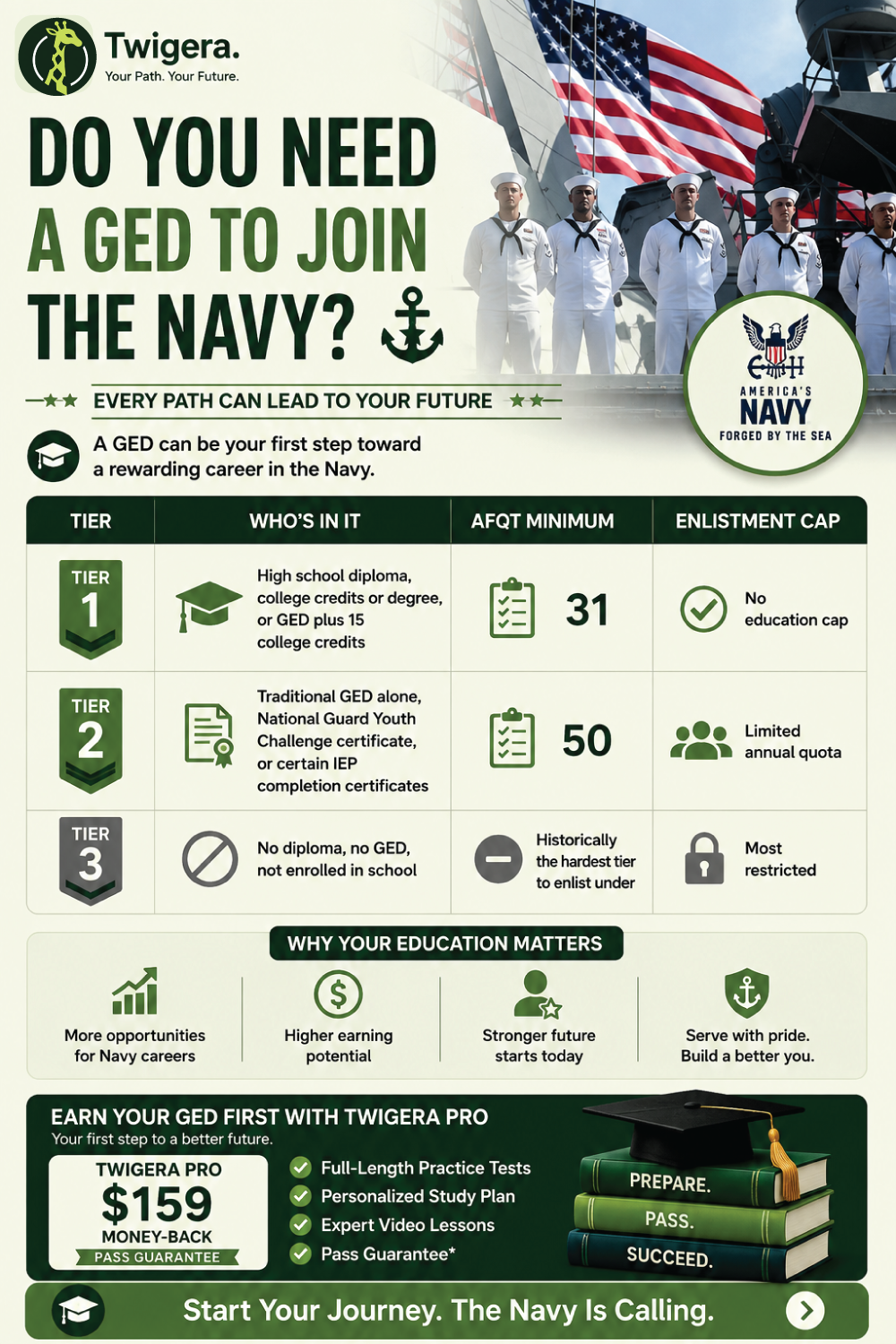
The Navy accepts a GED, but a GED alone makes you Tier 2 — a higher AFQT (about 50 vs 31) and a capped quota. A GED plus 15 college credits moves you to Tier 1, dropping the score floor to 31. Here are the 2026 Navy enlistment rules.
You do not need a diploma to join the Navy, but you must meet education and testing requirements. A GED is accepted, but a GED-only applicant is Tier 2 — usually an AFQT around 50, competing for a limited share of recruits. A GED plus 15 college credits moves you to Tier 1, where the floor drops to 31 and opportunities improve significantly.
Last reviewed
Is the question of joining the Navy making you pause because you never finished high school? A lot of confusion surrounds Navy enlistment rules — some sources say you need a diploma, others mention a GED, and few explain why two applicants with different credentials face completely different standards. If you have been asking whether you need a diploma to join the Navy, the answer starts with how the Navy classifies applicants before enlistment even begins.
Recent data shows the Navy missed its 2023 recruiting target by more than 7,464 sailors, which pushed major policy changes around who gets accepted and under what conditions. For GED holders, the process looks different from the traditional diploma route: score requirements are often higher, and openings are more competitive than most people expect. This guide breaks down the 2026 rules, how the tier system works, and the smartest path to improve your chances before speaking with a recruiter.
Quick Answer: Can You Join the Navy With a GED?
Yes, the Navy accepts a GED — but how it treats that GED depends entirely on your tier. A GED holder with nothing else is Tier 2, which means a higher entrance score and a smaller slice of available slots than someone with a diploma. Remember that "accepted" does not mean "easy" — and that distinction shapes everything else in this article.
A diploma, or a GED plus 15 college credits, makes you Tier 1: best odds, no education cap.
A GED alone makes you Tier 2: a higher AFQT bar, a capped number of yearly slots, and possibly extra time in the Delayed Entry Program.
No diploma and no GED used to be a closed door; since January 2024 the Navy opened a narrow path here too, with its own strict score requirement (covered below).
The DoD Education Tier System: Why a GED Is "Tier 2"
The tier system did not come from the Navy — it came from the Department of Defense. DoDI 1304.26 is the federal instruction governing enlistment standards across every branch, sorting each applicant into one of three education tiers before a recruiter even looks at scores. Why? Attrition data: sailors with a diploma have historically completed their first contract at higher rates than GED-only sailors, so the DoD treats education credential as a predictor of completion. It is a statistical hedge written into policy, not a verdict on intelligence.
Tier
Who's in it
AFQT minimum
Enlistment cap
Tier 1
Diploma, college credits or degree, or GED plus 15 college credits
31
No education cap
Tier 2
Traditional GED alone (and certain alternative certificates)
50
Limited annual quota
Tier 3
No diploma, no GED, not enrolled in school
Historically the hardest tier
Most restricted
Save for later
Pin this guide so you can find it again.
We refresh these every season. Save it to a Pinterest board and you’ll get the latest version next time you come back.
The ASVAB is the full test; the AFQT is a smaller composite pulled from four subtests — Arithmetic Reasoning, Mathematics Knowledge, Word Knowledge, and Paragraph Comprehension — and it is the number that decides whether you can enlist at all. For a Tier 1 diploma holder the AFQT floor is 31; for a Tier 2 GED-only applicant it jumps to 50. That is a real gap: a 50 places you above half of everyone who has ever taken the test. Hitting exactly 50 gets you through the door but does not make you competitive — higher scores open more Navy ratings (specific jobs) and carry weight when a recruiter decides who gets a limited Tier 2 slot. The reading and math on the GED math test overlap heavily with what the AFQT measures, which matters if you are studying for both at once.
The Smart Move: GED Plus 15 College Credits Equals Tier 1
Here is the single most useful fact in this guide. A GED holder who earns 15 semester hours of college credit (or the equivalent in quarter or clock hours) from an accredited institution gets reclassified as Tier 1 — community college, vocational school, and business college all qualify. That one move does two things: it drops the required AFQT from 50 back to 31, and it removes the Tier 2 quota entirely. In practice: earn the GED first, enroll in 15 credits at an accredited school (community college is usually fastest and cheapest), then return to a recruiter as a Tier 1 applicant. GED holders qualify for a Pell Grant the same as traditional graduates, which makes this path financially realistic — and many of the same colleges that accept a GED are where those credits come from.
The Navy's GED Quota: Why Slots Are Limited
Federal policy caps how much of annual recruiting can come from Tier 2 applicants. For years the Navy ran one of the tighter caps, around 5 percent. That changed with the 2024 recruiting overhaul: as part of the same push that opened enlistment to applicants without any diploma or GED, the Navy doubled its Tier 2 cap from 5 percent to 10 percent — meaningfully more room, though GED-only applicants still compete for a defined slice of seats. Tier 2 recruits may also spend time in the Delayed Entry Program before shipping, sometimes 90 days or longer. A strong AFQT score, a clean background, and flexibility on your ship date all make a real difference.
Can You Join the Navy Without a Diploma or GED in 2026?
In January 2024, the Navy reversed a policy that had stood since 2000 and began allowing applicants with no diploma and no GED to enlist, provided they score at least 50 on the AFQT — a move that came directly out of a recruiting shortfall, when the Navy brought in around 30,236 active-duty sailors against a goal of 37,700, according to Navy Times. This was not a one-year experiment: the Navy beat its FY2024 and FY2025 goals, and the no-diploma pathway remains an active part of recruiting strategy into 2026. Still, policy can shift, so confirm current eligibility directly with a Navy recruiter or navy.com. One honest note: walking in with a 50 and no credential is a harder position than a 31 with a diploma, or a GED backed by 15 college credits. The credential still buys you a lower bar — the no-diploma pathway is a real option, not the best one.
Navy Age, Citizenship, and Other Baseline Requirements
Beyond education, a handful of baseline requirements apply to every Navy applicant. Age: 17 with parental consent, or 18 to enlist independently, with the upper limit at 41 (raised from 39 in 2022). Citizenship: U.S. citizens, permanent residents, and U.S. non-citizen nationals are eligible, and a valid Social Security number is required regardless. Medical and moral standards: every applicant passes through MEPS for a medical exam plus standard moral and legal screening. A 17-year-old GED holder follows the same Tier 2 rules as an adult applicant — parental consent covers the age requirement, but it does not change the AFQT bar or the quota. Plan around the requirement that is hardest for your situation, not just the one that is easiest to check off.
How Twigera Helps You Qualify
Twigera is built around one job: getting you a GED you can trust, taught by people who know the test inside and out. Coverage goes deep, not wide — Math, Language Arts, Science, and Social Studies each get a dedicated track, a dedicated teacher, and full-length practice exams. The method is built for real schedules: self-paced does not mean self-taught, so you set the schedule, Twigera sequences the path, and credentialed teachers respond within hours when something does not click. Pricing is one payment for the months you actually need across Starter, Standard, and Pro plans, with a Pass Guarantee built into Pro.
The backing is real: Twigera is a GED Testing Service Approved Provider, with curriculum aligned to the four current GED test specifications from ACE and Pearson, so the score it predicts is the score the test gives you. The connection to Navy enlistment is direct, not incidental — the same math reasoning and reading comprehension Twigera builds for the GED carries straight into the four ASVAB subtests that make up your AFQT score, so strengthening one strengthens the other almost automatically. For context on how the Army and Marines handle GED holders, see our guides on joining the Army with a GED and the Marines with a GED.
Bottom Line
The Navy accepts a GED, but a GED alone puts you in Tier 2 — a 50 AFQT minimum instead of 31, and a defined annual quota instead of open enrollment. Adding 15 college credits erases that gap by moving you into Tier 1, and the 2024 policy change even opened a narrow path for applicants with no credential who clear a 50. The strongest move is still the most straightforward: earn your GED, build real strength in the math and reading the ASVAB tests, and consider the 15-credit path if Tier 1 matters to your timeline. Not sure where you stand? A free GED diagnostic test shows you in minutes — and the same skills carry straight into your ASVAB. Each step in this process builds on the one before it, and skipping the preparation step is the most common way GED holders end up retaking the ASVAB months later than planned. Handle the credential and the score first, lean on a recruiter for the current quota and Delayed Entry Program timing, and the rest of the path falls into a predictable order rather than a guessing game.
Frequently asked
Questions people ask.
Do you need a diploma to join the Navy?
ShowHide
Not always. The Navy accepts a GED instead of a diploma. A GED holder enters as Tier 2, while a diploma holder, or someone with a GED plus 15 college credits, qualifies as Tier 1 with lower score requirements.
Can you join the Navy with a GED?
ShowHide
Yes. The Navy accepts GED holders, but GED-only applicants fall under Tier 2 — a higher AFQT score requirement and competition for a limited number of yearly slots.
What ASVAB score do you need to join the Navy with a GED?
ShowHide
Most GED holders need about 50 on the AFQT, while Tier 1 applicants need 31. Because Tier 2 spots are limited, scoring well above 50 improves your chances.
How does the Navy treat a GED vs a high school diploma?
ShowHide
A diploma places you in Tier 1, which has fewer restrictions. A GED alone places you in Tier 2, which comes with higher test-score requirements and limited openings.
Can you join the Navy without a GED or diploma?
ShowHide
Possibly. In January 2024, the Navy opened enlistment for applicants without either credential who score at least 50 on the AFQT. Because policy changes happen often, confirm current rules with a recruiter before relying on this option.
Does a GED plus college credits help with Navy enlistment?
ShowHide
Yes. Adding 15 college credits to a GED moves you from Tier 2 to Tier 1, which lowers your AFQT requirement to 31 and removes the GED quota limitation.
How hard is it to join the Navy with a GED?
ShowHide
It is harder than joining with a diploma. GED holders face a higher AFQT requirement, fewer available slots, and extra competition during the enlistment process.
Can a 17-year-old join the Navy with a GED?
ShowHide
Yes, with parental consent. Without consent, you must wait until age 18. Tier 2 GED rules still apply unless you also have qualifying college credits.
What is Tier 2 in Navy enlistment?
ShowHide
Tier 2 is the category for applicants whose highest credential is a GED. The Navy places stricter score requirements on Tier 2 applicants and accepts a capped share of them each year.
What are the Navy's basic enlistment requirements in 2026?
ShowHide
You must meet age requirements (17 with parental consent, up to 41), hold an accepted education credential, pass the ASVAB, clear MEPS medical standards, and satisfy citizenship or residency requirements with a valid Social Security number.
Amara is the editor at Twigera. She came to publishing the long way — a decade teaching the GED in community colleges and adult-learning centers, where she watched students pass not on talent or time, but on the strength of a study plan they actually trusted. Now she shapes the guides students read here for the parent studying after a closing shift, the second-career welder, the grandmother finishing what she started forty years ago. Expect honest timelines, math made survivable, and study plans built around real life — not around a textbook's idea of one.
Enjoyed this?
Take the next step — start today.
Our online GED course includes every subject, a free 30-minute diagnostic, and a 7-day refund on every plan.