

Do You Need a GED to Join the Army? Tier 1 vs Tier 2
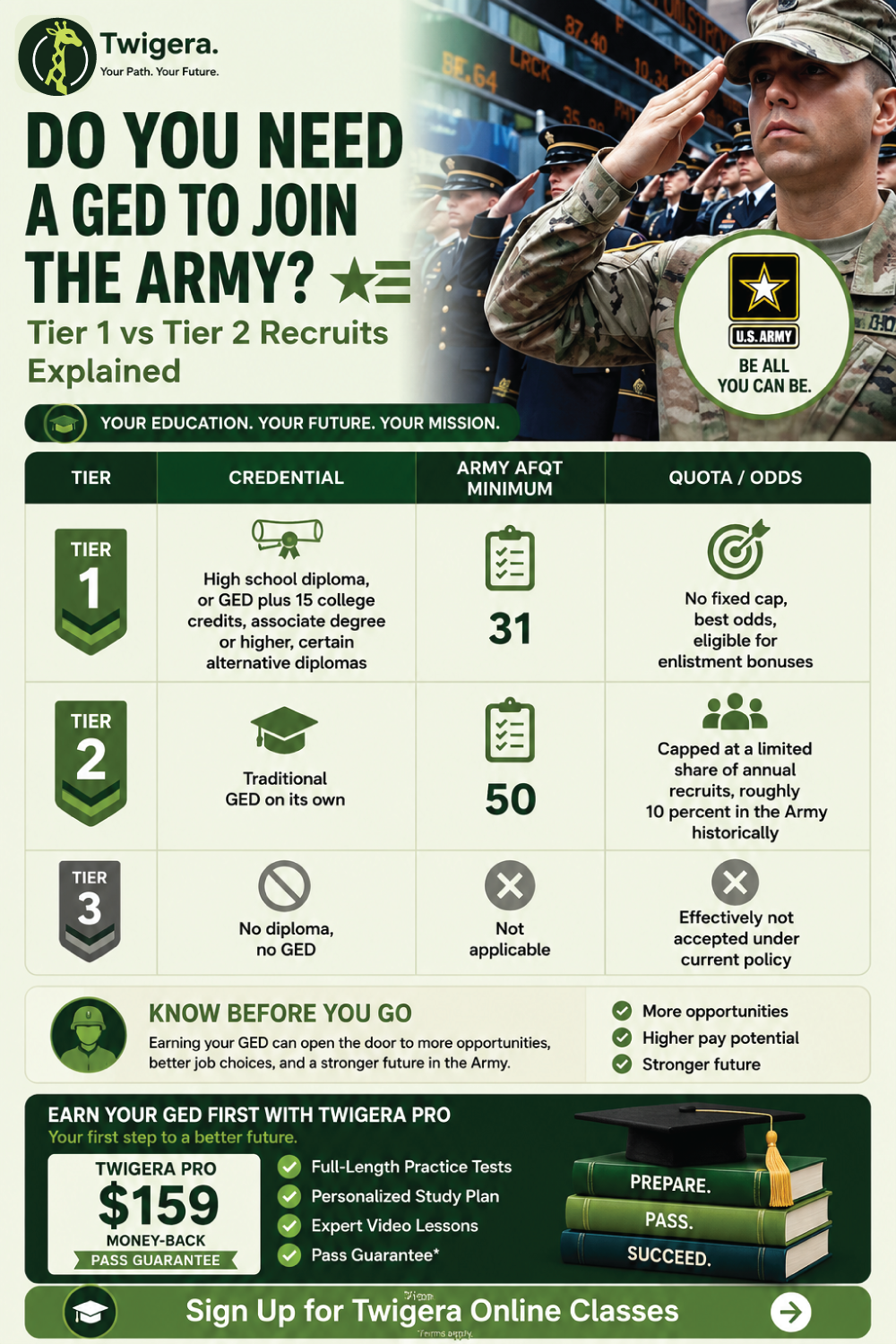
The Army accepts a high school diploma OR a GED — but not neither. A GED puts you in Tier 2 (AFQT 50, ~10% annual cap); a diploma, or a GED plus 15 college credits, puts you in Tier 1 (AFQT 31, no cap). Here is how to qualify and upgrade.


No, you cannot join the Army with no credential — you need a high school diploma or a GED. The difference is the tier system. Tier 1 (a diploma, or a GED plus 15 college credits) needs a 31 AFQT and faces no quota. Tier 2 (a GED alone) needs a 50 AFQT and competes for roughly 10% of recruits each year. A GED gets you in; Tier 1 gives you stronger odds.
Pin this guide so you can find it again.
We refresh these every season. Save it to a Pinterest board and you’ll get the latest version next time you come back.
Save to PinterestQuestions people ask.
- Do you need a GED to join the Army?
You need either a GED or a high school diploma to enlist. The Army accepts both, but a GED places you in Tier 2, which requires a higher AFQT score of 50 instead of 31 and falls under limited annual recruitment slots. A diploma, or a GED plus 15 college credits, places you in Tier 1.
- Can you join the Army with a GED?
Yes. The Army accepts GED holders every year and is often the most flexible branch for nontraditional students. You need at least a 50 AFQT score and must compete within the annual Tier 2 quota. Adding 15 college credits moves you into Tier 1.
- What is the difference between Tier 1 and Tier 2 recruits?
Tier 1 includes applicants with a high school diploma or a GED plus 15 college credits. Tier 2 includes GED holders without college credits. Tier 1 recruits need a 31 AFQT and face no quota, while Tier 2 recruits need 50 and compete for limited openings.
- What ASVAB score do you need to join the Army with a GED?
GED holders need at least a 50 AFQT score. Applicants with a diploma need only 31. The AFQT comes from the math, reading, and reasoning sections of the ASVAB, and scoring higher also improves your job options after enlistment.
- Can you join the Army without a high school diploma?
Yes, if you have a GED. What the Army does not accept is applying with no education credential at all. A GED places you in Tier 2, while a diploma or 15 college credits moves you into Tier 1.
- Does a GED count the same as a diploma in the Army?
No. A GED alone is classified as Tier 2; a high school diploma is Tier 1. GED holders move into Tier 1 only after earning at least 15 college semester credits from an accredited institution.
- What is the Army Future Soldier Preparatory Course?
It is an Army program that helps applicants improve academic or fitness standards before basic training; the academic track raises ASVAB scores. Entry rules change often (dual-track enrollment was scaled back in late 2025), so confirm current eligibility with a recruiter.
- How do you move from Tier 2 to Tier 1 with a GED?
Earn 15 college semester credits from an accredited college. Once completed, the Army reclassifies you as Tier 1, which lowers the AFQT requirement from 50 to 31 and removes the Tier 2 recruitment cap.
- Is joining the Army harder with a GED?
Somewhat, but many GED holders enlist every year. You need a higher AFQT score and compete for fewer slots than diploma holders. Scoring well on the ASVAB and earning 15 college credits improves your chances significantly.
Amara is the editor at Twigera. She came to publishing the long way — a decade teaching the GED in community colleges and adult-learning centers, where she watched students pass not on talent or time, but on the strength of a study plan they actually trusted. Now she shapes the guides students read here for the parent studying after a closing shift, the second-career welder, the grandmother finishing what she started forty years ago. Expect honest timelines, math made survivable, and study plans built around real life — not around a textbook's idea of one.
Take the next step — start today.
Our online GED course includes every subject, a free 30-minute diagnostic, and a 7-day refund on every plan.