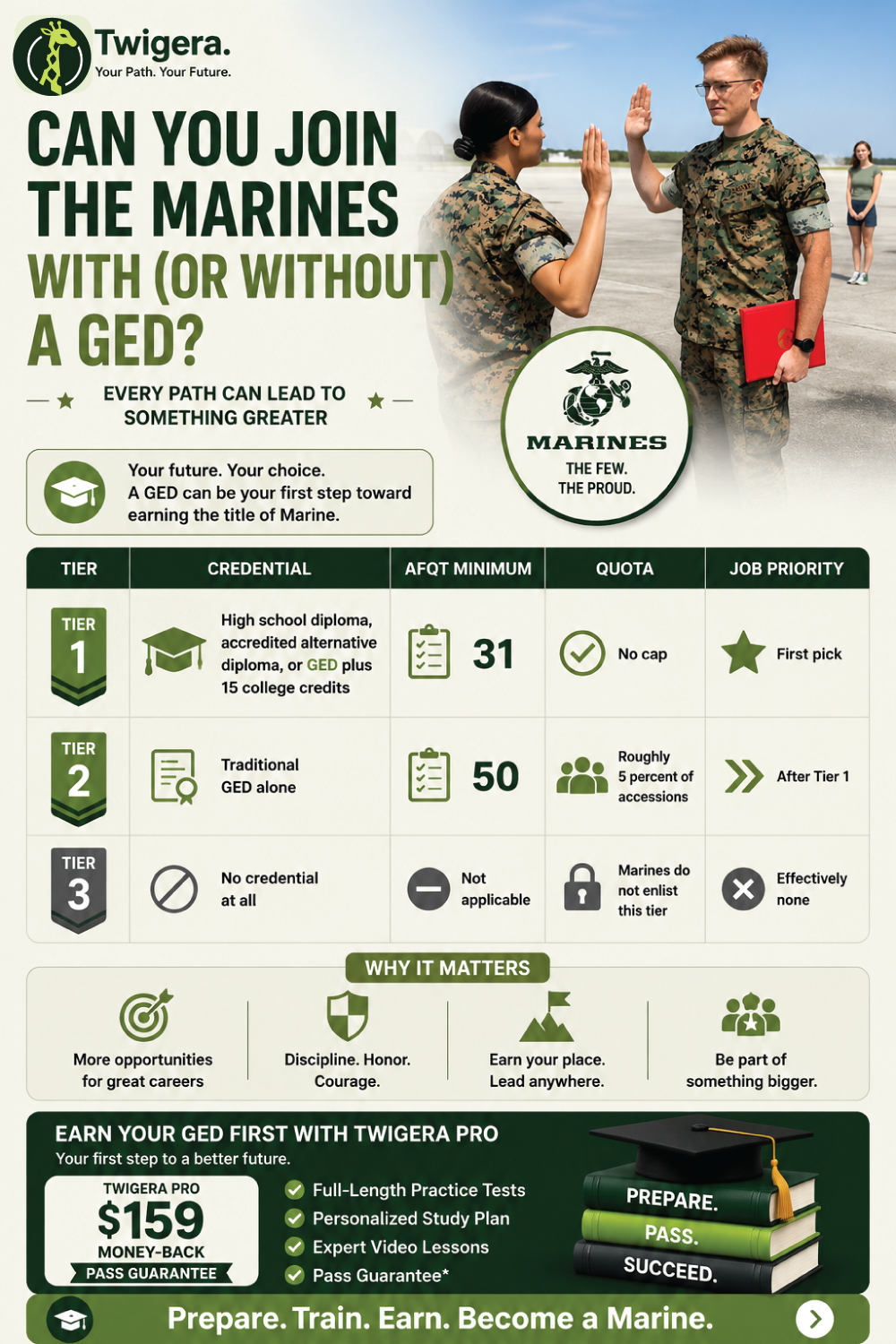
Can You Join the Marines With (or Without) a GED? 2026
The Marines accept a GED, but it puts you in Tier 2: a higher AFQT score (50 vs 31), a roughly 5% yearly quota, and last pick on jobs. The smartest fix is a GED plus 15 college credits to reach Tier 1.
Yes, the Marines accept a GED, but it places you in Tier 2: you need an AFQT score of 50 (versus 31 for a diploma), compete for a roughly 5% yearly quota, and choose jobs after diploma holders. Without any credential, you cannot realistically enlist. The smartest fix is a GED plus 15 college credits, which moves you to Tier 1.
Last reviewed
Trying to picture yourself in a Marine Corps uniform, but stuck on one nagging question — can you join the Marines with a GED, or without one at all? Most articles give you a flat no or vague hope. Neither is the truth. The Marine Corps takes its standards seriously: around 90 percent of new accessions across the military must come from applicants with a recognized education credential, according to DoDI 1304.26, the federal policy that governs who qualifies and how.
That single number explains everything that follows. Can you join with absolutely nothing — no diploma, no credential? Realistically, no. But a GED is a different story: the Marines do accept it. What changes is how the Corps treats you once you walk in with one instead of a diploma. The score bar moves, the odds shift, and the path looks different. This guide breaks down exactly what a GED gets you, what it does not, and the smartest way to stack the odds before you ever sit down with a recruiter.
Quick Answer: GED, No GED, and the Tier 2 Catch
With a GED: yes. Official marines.com requirements list education as a high school diploma or GED, with no exceptions carved out. Without a GED — meaning no diploma and no credential at all — realistically no. The Corps does not enlist applicants in that bottom category in practice, so the honest answer is to go earn a GED first. Here is the catch nobody likes to say out loud: a GED gets you in the conversation, but it does not put you on equal footing with a diploma holder.
GED holders face a higher entrance score than diploma holders.
GED holders compete for a small, capped number of slots each year.
GED holders pick jobs last, after diploma holders have already chosen theirs.
A GED opens the door a crack. A diploma — or a GED paired with college credit — opens it all the way. This guide is also a focused companion to our broader look at whether you can join the military with a GED across all branches.
How the Marines Classify You: The DoD Tier System
None of this is a Marine Corps invention — it comes from the Department of Defense through DoDI 1304.26, which sorts every applicant across every branch into one of three education tiers before a recruiter even glances at an ASVAB score. The reason is history: GED-only recruits have washed out of their first enlistment contract at noticeably higher rates than diploma holders, and the tier system manages that risk. It is not a judgment on intelligence. The Marines run one of the tightest Tier 2 caps of any branch.
Tier
Credential
AFQT minimum
Quota / job priority
Tier 1
Diploma, accredited alternative diploma, or GED plus 15 college credits
31
No cap; first pick of jobs
Tier 2
Traditional GED alone
50
Roughly 5% of accessions; picks after Tier 1
Tier 3
No credential at all
Not applicable
Marines do not enlist this tier
Save for later
Pin this guide so you can find it again.
We refresh these every season. Save it to a Pinterest board and you’ll get the latest version next time you come back.
Here is where the gap becomes a real number. A diploma holder needs an AFQT of 31 to enlist; a GED holder needs 50 — a 19-point jump confirmed on marines.com's enlistment requirements page. The AFQT comes from four ASVAB subtests — Arithmetic Reasoning, Mathematics Knowledge, Word Knowledge, and Paragraph Comprehension — and your score lands as a percentile from 1 to 99. A 50 means outperforming half of everyone who has taken the test nationally, not answering half the questions correctly.
Aiming for exactly 50 is a mistake. Tier 2 slots are capped, so a bare 50 puts you at the back of a competitive line. Scores of 50 to 64 are generally solid; 65 and above start opening specialized and technical job tracks and enlistment bonuses. The reading and math skills on the GED exam overlap directly with what those four ASVAB subtests measure — especially the math on the GED — so building a strong GED foundation does double duty. One last distinction: the AFQT decides whether you can enlist at all; separate "line scores" decide which specific jobs you qualify for once you are in.
The Smart Move: Use 15 College Credits to Reach Tier 1
This is the single most useful piece of information in this guide. A GED holder who earns 15 semester hours of accredited college credit gets reclassified from Tier 2 to Tier 1 — and that threshold also accepts the equivalent in quarter or clock hours from a community college, vocational school, or business school. A high ASVAB score alone does not do this; a traditional GED stays Tier 2 even at a 70 or 80 unless those credits are on a transcript. Here is what that one move buys you:
The AFQT floor drops from 50 back down to 31.
The roughly 5% quota cap disappears completely.
Job priority resets, putting you back in line with diploma holders instead of behind them.
This path is more realistic financially than it sounds. GED holders can apply for a Pell Grant — the same federal aid available to traditional high school graduates — and the 15-credit count is small compared to a full degree. Community college is usually the fastest, cheapest route, and the credits do not need to be in any particular subject. Many of the same colleges that accept a GED offer evening or online sections that fit around a job.
Can You Join the Marines Without a GED?
No — not realistically. The Marine Corps does not enlist Tier 3 applicants (anyone with no diploma and no GED) in practice. If you are hoping for a workaround, there is no secret form, no special program, and no path around this specific requirement. But there is a clear, achievable fix: a GED is itself the diploma equivalent the Marines are asking for, earning one typically takes months rather than years, and plenty of current Marines started in exactly this position. Everything else in this guide — the ASVAB prep, the college-credit upgrade — only becomes relevant once that first credential is in hand, and you can set realistic expectations with our guide on how long it takes to get a GED.
Other USMC Enlistment Requirements You Still Have to Meet
A GED clears one hurdle; it does not clear all of them. These stack on top of the education requirement, not instead of it:
Age: applicants must be between 17 and 28 (a 17-year-old needs parental consent).
Citizenship: a valid Green Card or U.S. citizenship is required, along with English proficiency.
Background and character: a criminal background check applies to everyone, and felony convictions disqualify most applicants outright.
Physical fitness: every applicant must pass the Initial Strength Test — pull-ups or push-ups, a timed 1.5-mile run, and a plank hold.
None of these get waived because someone holds a GED instead of a diploma, and education tier and age requirements run on separate tracks entirely. Because Tier 2 availability shifts with each fiscal year, an early conversation with a recruiter is worth more than guessing.
How Twigera Helps You Get Marine-Ready
Everything in this guide starts at the same place — the GED — and Twigera was built to make that first step solid rather than shaky. Coverage goes deep, not wide: Math, Language Arts, Science, and Social Studies each get a dedicated track, a dedicated teacher, and full-length practice exams, instead of a thin bundled overview pretending to cover four subjects at once. That depth matters here specifically, because the arithmetic reasoning and word knowledge you build for the GED are the exact skills the AFQT measures.
The method respects your schedule. Self-paced does not mean self-taught: you decide when to study, Twigera sequences exactly what comes next, and credentialed teachers respond within hours when something is not clicking. Pricing is built around honesty — one payment for the months you actually need across Starter, Standard, and Pro plans, with no subscription quietly renewing after you have already passed, and the Pro plan includes a Pass Guarantee. The backing means something too: Twigera is a GED Testing Service Approved Provider, with curriculum aligned to the four current test specifications from ACE and Pearson, so the score it predicts lines up with the score you actually walk away with. Clear the GED cleanly, carry that same academic foundation into the ASVAB, and you walk into the recruiting office a far stronger candidate than the applicant scraping the floor.
Bottom Line
The Marines will take a GED, but they run the strictest policy of any branch around it — a 50 AFQT floor, a roughly 5% quota, and last pick on jobs make GED-only enlistment a real path, not an easy one. Walking in with nothing at all is not a realistic option either, which means the GED is the starting line for this entire process. The strongest move from there is stacking 15 college credits to reach Tier 1, where the quota disappears and the score requirement drops back to 31. Not sure where your math and reading stand? A free GED diagnostic test shows you in minutes — and the same skills carry straight into your ASVAB. Treat the GED and the ASVAB as one connected project rather than two separate hurdles, handle the baseline requirements like age and fitness early, and the only variable left is how seriously you prepare. That part is entirely within your control, which is exactly why it is the smartest place to start.
Frequently asked
Questions people ask.
Can you join the Marines with a GED?
ShowHide
Yes. The United States Marine Corps accepts a GED, but this is one of the hardest branches for GED holders. A GED applicant falls under Tier 2, needs an AFQT score of 50, and competes for limited yearly openings.
Can I join the Marines without a GED?
ShowHide
In most cases, no. The Marines do not normally accept applicants without a diploma or GED. Earning your GED first is the strongest path before starting enlistment.
What ASVAB score do I need for the Marines with a GED?
ShowHide
You generally need an AFQT score of 50. Applicants with a diploma need only 31, so GED holders face a much higher entry requirement. Scoring well above 50 improves your chances when slots are limited.
What tier is a GED in the Marines?
ShowHide
A GED places you in Tier 2. You move to Tier 1 only after earning 15 semester hours of accredited college credit, or by holding a traditional high school diploma.
How do 15 college credits help a GED holder join the Marines?
ShowHide
They move you from Tier 2 to Tier 1. This removes the quota restriction, lowers your AFQT requirement from 50 to 31, and restores job-selection priority to the same level as diploma holders.
How strict is the Marines' GED quota?
ShowHide
Very strict. Department of Defense policy keeps most recruits in Tier 1, and the Marines accept only a small percentage (roughly 5%) of Tier 2 applicants each year. Competition is high even if you qualify.
Is there a GED waiver for the Marines?
ShowHide
Not exactly. There is no waiver that removes Tier 2 status. What people call a waiver is just the standard Tier 2 allocation plus hitting the 50 AFQT bar. The strongest real workaround is earning 15 college credits to upgrade to Tier 1.
What are the other requirements to join the Marines?
ShowHide
You must be 17 to 28, pass a background check, meet physical fitness standards (the Initial Strength Test), and satisfy citizenship or residency requirements. A GED applicant must meet all of these alongside the Tier 2 requirements.
Do the Marines take a GED or do I need a diploma?
ShowHide
A diploma is preferred because it places you in Tier 1. A GED is accepted, but Tier 2 applicants face higher score requirements and fewer available slots.
What is the fastest realistic path into the Marines if I have no diploma?
ShowHide
Start with a GED, prepare for a strong ASVAB score, earn 15 college credits, then apply as a Tier 1 applicant. The GED is the first step everything else depends on.
Amara is the editor at Twigera. She came to publishing the long way — a decade teaching the GED in community colleges and adult-learning centers, where she watched students pass not on talent or time, but on the strength of a study plan they actually trusted. Now she shapes the guides students read here for the parent studying after a closing shift, the second-career welder, the grandmother finishing what she started forty years ago. Expect honest timelines, math made survivable, and study plans built around real life — not around a textbook's idea of one.
Enjoyed this?
Take the next step — start today.
Our online GED course includes every subject, a free 30-minute diagnostic, and a 7-day refund on every plan.