Can You Be a Dental Assistant Without a GED? Honest Answer
You can sometimes start as a chairside dental assistant, but DANB certification and most state x-ray certifications require a high school diploma or GED. Here is the honest 2026 path, with BLS pay and outlook data.

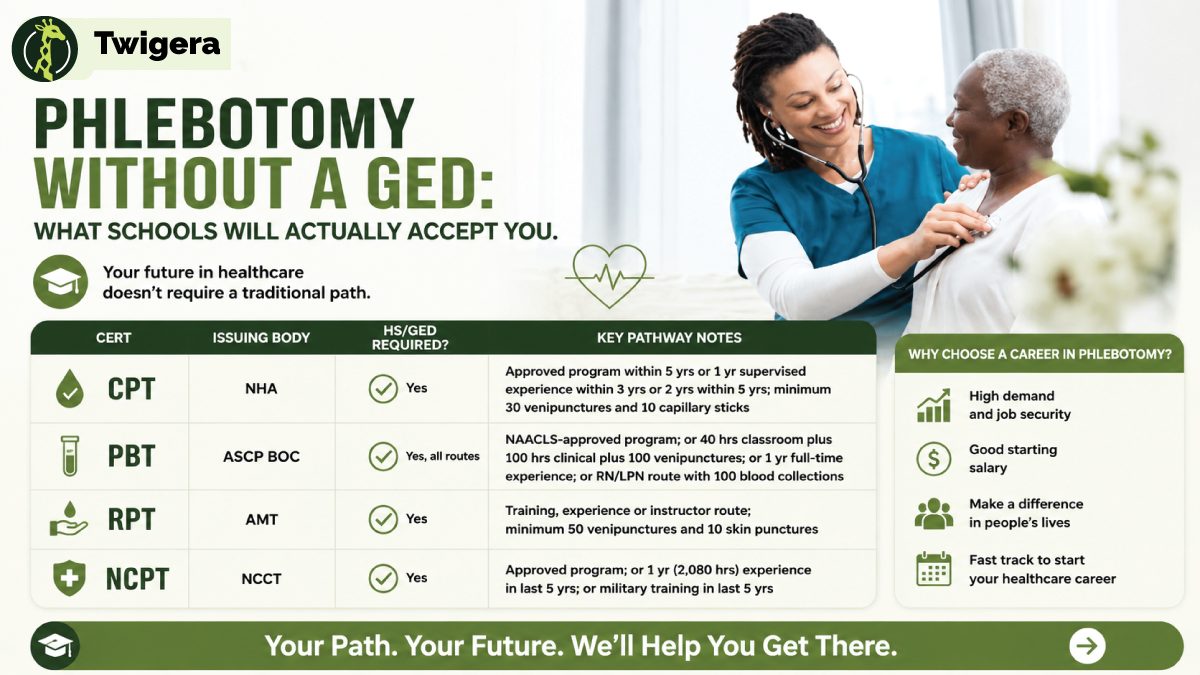
Sometimes you can start, but you cannot get far without a GED. A few states allow basic chairside dental assisting through on-the-job training, but the DANB Certified Dental Assistant credential needs a CODA-accredited program or a diploma/GED plus 3,500 work hours, and many states require a diploma or GED for x-ray certification. BLS: $47,300 median, 6% growth. Earn your GED first.
Pin this guide so you can find it again.
We refresh these every season. Save it to a Pinterest board and you’ll get the latest version next time you come back.
Save to PinterestIf a course or employer tells you "no diploma needed," ask the follow-up question nobody asks: will this let me sit the DANB exam later? If the answer is vague, that is your answer.
Questions people ask.
- Can you become a dental assistant without a high school diploma?
Sometimes you can start training, but certification becomes difficult. Some states allow basic chairside assisting without credentials, and a few non-CODA programs accept students without a diploma. Still, most employers and certification paths require a high school diploma or GED.
- Do you need a GED to be a dental assistant?
Not always for entry-level roles, but yes for career growth. Some states allow on-the-job training, though certifications like the DANB CDA and state x-ray credentials often require a GED or high school diploma.
- Can you take dental assistant classes without a GED?
It depends on the school. Some private, non-CODA programs accept students without a diploma, while others require a GED before admission. Even if you enroll, certification requirements usually still require a GED.
- What are the DANB CDA exam requirements?
The DANB CDA exam has three pathways: graduate from a CODA-accredited program (Pathway I), hold a high school diploma or GED plus 3,500 hours of work experience (Pathway II), or qualify through a degree-level route (Pathway III). Current CPR certification is required on all three.
- Can a 16-year-old be a dental assistant?
Sometimes. Some states and training programs allow teenagers to begin in trainee roles. Professional certification and state x-ray credentials usually require a GED or high school diploma later.
- Do you need certification to work as a dental assistant?
Not always for basic duties. Many states allow chairside assisting without certification, though x-rays and expanded functions usually require state approval and passing a certification exam.
- How long does dental assistant school take, and what does it cost?
Most certificate programs take 9 to 12 months. Costs usually range between $3,000 and $15,000, while online programs often cost less. Associate degree programs take longer.
- How much do dental assistants make?
According to the U.S. Bureau of Labor Statistics, median annual pay reached $47,300 in 2024. Employment is projected to grow 6 percent through 2034, with about 52,900 openings each year.
- Is a dental assistant the same as a dental hygienist?
No. Dental hygienists complete more advanced education and require state licensing. Dental assistants support dentists during procedures and often have a faster path into healthcare after earning a GED.
Amara is the editor at Twigera. She came to publishing the long way — a decade teaching the GED in community colleges and adult-learning centers, where she watched students pass not on talent or time, but on the strength of a study plan they actually trusted. Now she shapes the guides students read here for the parent studying after a closing shift, the second-career welder, the grandmother finishing what she started forty years ago. Expect honest timelines, math made survivable, and study plans built around real life — not around a textbook's idea of one.
Take the next step — start today.
Our online GED course includes every subject, a free 30-minute diagnostic, and a 7-day refund on every plan.